
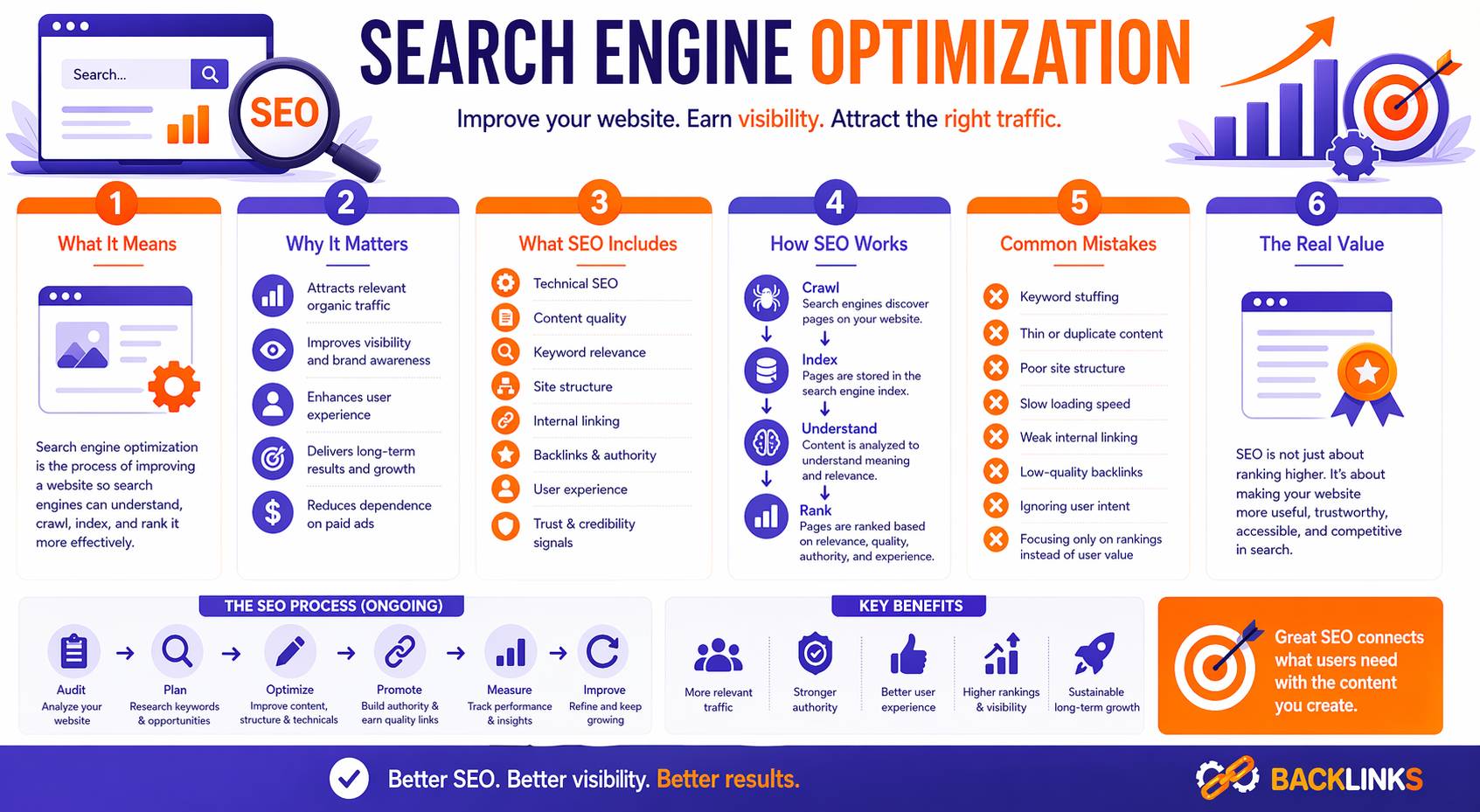
Search Engine Optimization: A Strategic Guide to Sustainable Organic Growth
Search engine optimization is one of the most important disciplines in digital marketing because it sits at the intersection of visibility, relevance, user experience, and business growth. When it is approached strategically, SEO helps a website attract qualified traffic, build authority in its market, and create a compounding source of leads and revenue over time.
Many businesses misunderstand SEO as a narrow technical task or a collection of ranking tricks. In practice, effective search engine optimization is much broader. It involves understanding what users are searching for, structuring content around clear intent, improving website performance, strengthening internal linking, and demonstrating credibility through high-quality information and strong site architecture.
This guide explains what search engine optimization is, why it matters, how it works, and how to apply it properly. It is designed for business owners, marketers, and SEO professionals who want a clearer and more practical understanding of how SEO creates long-term value.
What Is Search Engine Optimization
Search engine optimization is the process of improving a website so that search engines can better understand its pages and users can more easily find relevant content through organic search.
In practical terms, search engine optimization means increasing the likelihood that your pages appear prominently when someone searches for topics related to your business, products, services, or expertise. The goal is not simply to generate more traffic. The real goal is to attract the right traffic from people whose intent matches what your website offers.
SEO includes several interconnected areas:
- content strategy
- keyword targeting
- on-page optimization
- technical website health
- internal linking
- authority and trust signals
- user experience and performance
A useful way to think about SEO is this: search engines are trying to recommend the best result for a given query. Your job is to make your content the clearest, most helpful, and most trustworthy answer for the audience you want to reach.
Why Search Engine Optimization Matters
Search engine optimization matters because organic search remains one of the strongest channels for discovering information, comparing solutions, and evaluating providers. When your website ranks well for relevant searches, you gain consistent visibility at the exact moment users are looking for answers.
That matters for several reasons.
It attracts high-intent traffic
Unlike interruption-based channels, SEO reaches users when they are already searching. That means the traffic is often more qualified. A person searching for a specific problem, method, or service is typically further along in the decision process than someone passively seeing an ad.
It compounds over time
Paid campaigns usually stop producing results when the budget stops. SEO works differently. A well-optimized page can continue generating traffic, links, and brand exposure long after it is published. Results are not instant, but strong SEO assets often create cumulative returns.
It strengthens authority and trust
When a website consistently publishes useful, well-structured content on a subject, it becomes easier for both users and search engines to recognize topical depth. This is especially important in competitive markets where surface-level content is rarely enough.
It supports the full customer journey
Search engine optimization is not limited to one stage of the funnel. Informational content can attract early-stage visitors, comparison pages can support evaluation, and service or product pages can capture demand closer to conversion. A mature SEO strategy aligns pages to different search intents while maintaining a coherent site structure.
How Search Engine Optimization Works
Search engine optimization works by improving how search engines discover, interpret, evaluate, and rank your pages.
Although ranking systems are complex, the practical logic is straightforward. Search engines want to serve pages that are relevant to the query, useful to the user, technically accessible, and credible enough to deserve visibility.
Crawling and indexing
Before a page can rank, search engines need to find it and store it in their index. That requires a website structure that is accessible and logically connected.
If important pages are buried, orphaned, blocked, or poorly linked, search engines may not crawl or understand them efficiently. This is one reason internal linking and site architecture matter so much.
Relevance to search intent
A page must match what the searcher actually wants. This is where many SEO efforts fail. Businesses often target a keyword without considering whether the page type matches the dominant intent behind that query.
For example, an informational keyword usually requires an educational page that explains a topic clearly. Trying to rank a hard-sell service page for that type of query often produces weak results because the content format does not align with user expectations.
Content quality and depth
Search engines are better than they used to be at distinguishing between shallow content and genuinely useful content. Strong SEO content does more than define a term. It explains the topic with context, covers key subtopics, answers likely follow-up questions, and gives readers a reason to trust the page.
This does not mean every article needs to be long. It means it needs to be complete for its intended purpose.
Authority and trust signals
Not every page deserves to rank simply because it mentions the right keywords. Search engines also evaluate whether the source appears credible. This includes site-level signals, page quality, contextual relevance, reputation, and the overall strength of the website’s content ecosystem.
User experience and website performance
SEO is also influenced by usability. A page that loads slowly, performs poorly on mobile, or frustrates users with weak navigation creates friction. Even excellent content is harder to benefit from when the site experience is poor.
The Core Elements of Search Engine Optimization
SEO is most effective when it is treated as a system rather than a checklist. Each component supports the others.
Keyword Research and Topic Selection
Keyword research helps you understand how people search, what language they use, and which topics matter most to your audience.
Good keyword research is not just about search volume. It also involves evaluating intent, difficulty, business relevance, and how a topic fits into your website’s broader structure. In many cases, a lower-volume keyword with clearer intent is more valuable than a broader term that attracts the wrong audience.
Topic selection should also reflect site architecture. Rather than publishing disconnected articles, strong SEO programs organize content into related subject areas so that each page reinforces others contextually.
On-Page Optimization
On-page SEO refers to the elements on a page that help search engines and users understand its focus.
This includes:
- title tags
- headings
- URL structure
- body content
- image optimization
- internal links
- metadata where relevant
Effective on-page optimization is about clarity, not repetition. The primary keyword should appear naturally in strategic locations, but overuse weakens quality and readability. Good on-page SEO makes the topic obvious without sounding forced.
Content Strategy
Content strategy is the planning layer behind SEO content. It determines what to publish, why it deserves to exist, what intent it serves, and how it connects to related pages.
Without strategy, content often becomes repetitive, thin, or misaligned with business goals. With strategy, each article has a clear role. Some pages introduce major concepts, some go deeper into specific subtopics, and others support commercial intent.
A strong content strategy also prevents cannibalization, where multiple pages compete for the same keyword or intent.
Technical SEO
Technical SEO ensures that search engines can access, interpret, and process your website efficiently. It includes areas such as crawlability, indexability, structured data, canonicalization, page speed, mobile usability, and site architecture.
Technical SEO rarely creates value in isolation. Its role is to remove friction. It helps ensure that your content can actually perform as intended.
For most websites, the biggest technical issues are not obscure edge cases. They are practical problems such as poor internal linking, duplicate pages, broken indexation logic, slow templates, and inconsistent page structures.
Internal Linking
Internal linking is one of the most underused parts of search engine optimization. It helps search engines understand page relationships, distributes authority across the site, and guides users to relevant next steps.
Good internal links are contextual, useful, and deliberate. They connect related ideas naturally rather than forcing exact-match anchors into every paragraph. They also help define page hierarchy by showing which broader pages support more specific pages, and vice versa.
Strong internal linking improves both discoverability and topical coherence.
Authority and E-E-A-T
SEO increasingly rewards content that demonstrates real experience, expertise, authoritativeness, and trustworthiness. This does not come from adding empty claims about being an expert. It comes from how the content is written, structured, and supported.
Pages that demonstrate strong E-E-A-T usually share several characteristics:
- they explain topics with accuracy and nuance
- they avoid exaggerated promises
- they show practical understanding of implementation
- they reflect a coherent editorial standard
- they are published on websites with consistent subject relevance
In competitive spaces, trust is not optional. It is part of what makes content rank and convert.
How to Apply Search Engine Optimization Strategically
The most effective SEO strategy starts with business relevance, then builds outward into content, structure, and execution.
Start with audience and intent
Identify what your audience wants to know, what problems they are trying to solve, and how those needs map to search behavior. Then separate topics by intent. Informational queries need educational content. Commercial queries need evaluation-oriented pages. Transactional queries need pages that support action.
This simple distinction improves content relevance immediately.
Build a clear site structure
A website should not grow randomly. Related topics should live in a logical structure so that search engines can understand the relationship between broad subjects and more focused pages.
That structure supports crawl efficiency, internal linking, and topical depth. It also improves the user experience by making it easier to move from introductory content to more specific guidance.
Create content with distinct roles
Not every page should try to do everything. Some pages should define and frame a topic broadly. Others should answer focused subtopic questions in more depth. Others should support conversion. When each page has a distinct role, the whole website becomes more coherent.
Optimize after strategy, not before it
Many teams jump straight into title tags and keyword placement before deciding whether the page itself is worth publishing. Optimization matters, but it cannot fix weak positioning or unclear intent. The first question should always be whether the page serves a meaningful purpose within the site.
Measure performance with context
SEO performance should be evaluated beyond rankings alone. Rankings matter, but they are only one layer. Also assess qualified traffic, engagement, conversions, page-level visibility, internal link support, and whether the content attracts the right audience.
Common Search Engine Optimization Mistakes
Many SEO problems are caused less by technical complexity and more by poor strategic decisions.
Targeting keywords without understanding intent
A page can be optimized perfectly and still fail if it does not satisfy the underlying query intent. Keyword targeting without intent analysis leads to mismatched content and weak performance.
Publishing thin content at scale
Large volumes of low-value content rarely create sustainable SEO gains. Thin pages dilute site quality, consume resources, and often fail to earn visibility. Fewer, stronger pages usually outperform a weak content volume strategy.
Treating internal linking as an afterthought
When internal linking is neglected, important pages become isolated. This weakens discoverability, relevance signals, and user navigation. Internal linking should be part of content planning, not a last-minute add-on.
Over-optimizing content
Keyword stuffing, forced anchor text, and repetitive headings do not make a page stronger. They usually reduce readability and make the content feel artificial. SEO writing should still read like expert human communication.
Ignoring technical foundations
Even excellent content struggles when the website has persistent crawl, indexation, or performance issues. Technical SEO is not the whole strategy, but it is an essential foundation.
Practical Guidance for Improving SEO
If you want to improve search engine optimization in a meaningful way, focus on a sequence that supports both quality and execution.
First, identify the topics that genuinely matter to your audience and business. Then map those topics to search intent and define the right page format for each one.
Next, review your website structure. Make sure related pages are connected logically and that important pages are easy to reach through navigation and contextual internal links.
Then improve content quality. Expand pages that are too shallow, merge pages that overlap, and remove weak content that adds little value. Focus on usefulness, clarity, and completeness rather than raw word count.
Finally, audit technical barriers. Check crawlability, indexation, mobile usability, and performance issues that may limit visibility.
This order matters. SEO is strongest when strategy, content, and technical execution support each other.
Timing and Expectations
Search engine optimization is a long-term growth channel. Results usually take time because rankings depend on competition, website history, content quality, crawl frequency, and overall authority.
A well-executed SEO strategy can produce early improvements in areas such as indexation, page quality, and long-tail visibility. But meaningful gains in competitive topics often take months rather than weeks.
That is why realistic expectations matter. SEO is not a one-time project and it is not a shortcut. It is an ongoing process of improving relevance, authority, structure, and user experience.
The websites that benefit most from SEO are usually the ones that commit to consistency. They publish with purpose, maintain quality standards, improve weak areas over time, and think in terms of systems rather than isolated tactics.
Conclusion
Search engine optimization is not just about rankings. It is about building a website that deserves visibility because it is useful, well-structured, technically sound, and credible in the eyes of both users and search engines.
When SEO is done properly, it becomes a durable business asset. It helps the right audience discover your content, supports trust throughout the buying journey, and strengthens the long-term value of your website.
The most effective approach is strategic, not mechanical. Focus on search intent, content quality, internal linking, site architecture, and trustworthiness. Treat SEO as a connected system. That is how websites build sustainable organic growth instead of chasing short-lived gains.