
Content Structure SEO: How to Organize Content for Better Rankings and Readability
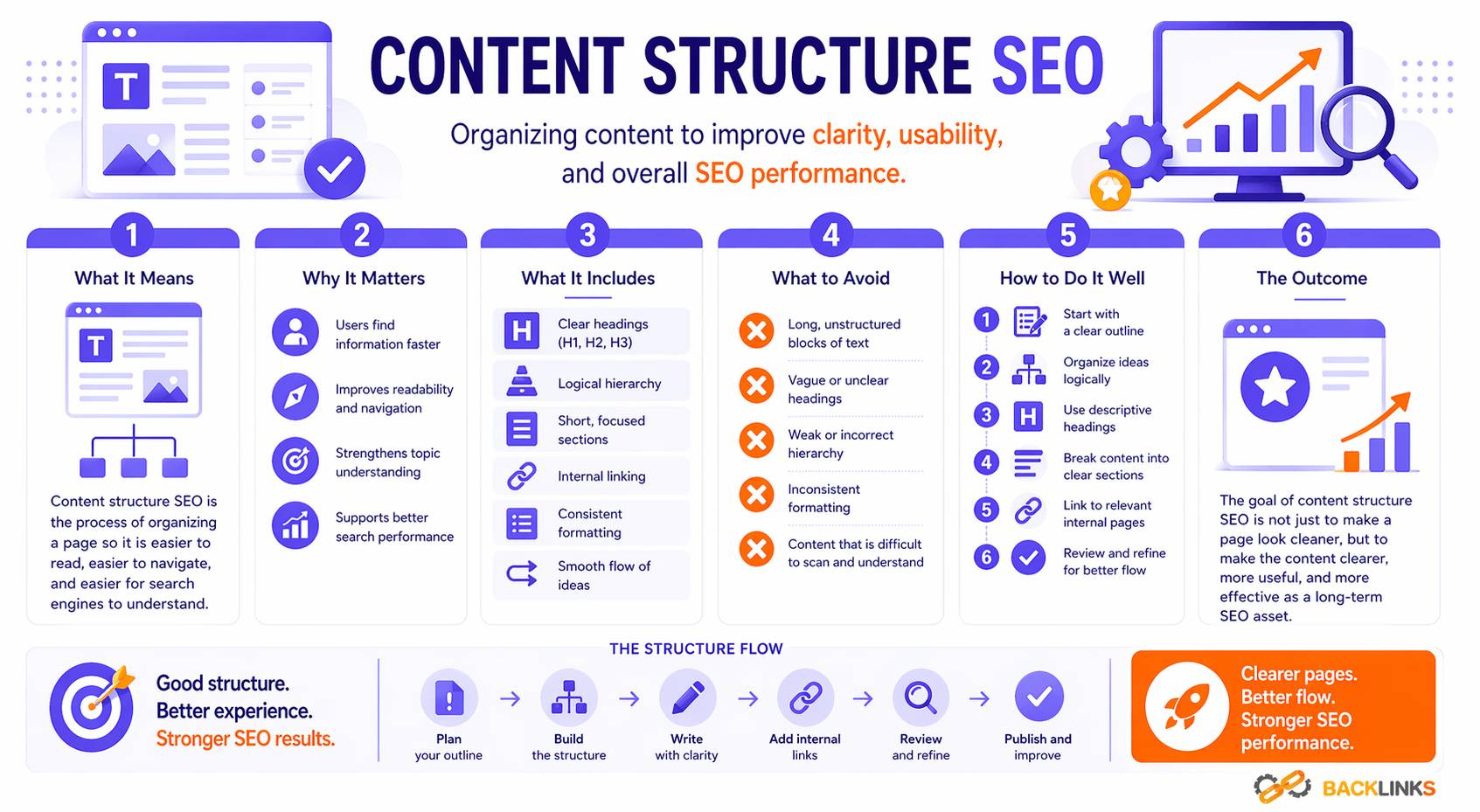
Content structure SEO is the practice of organizing content in a way that helps search engines understand the page and helps users navigate it easily. It covers how information is arranged on the page, how headings are used, how sections flow, and how the content supports clarity, relevance, and usability.
This matters because strong SEO content is not only about what you say. It is also about how you present it. A page may target the right keyword and still underperform if the structure is confusing, repetitive, or difficult to scan. Good structure improves comprehension, strengthens topical relevance, and makes the page more useful from the first paragraph to the last.
For businesses and SEO teams, content structure is one of the most practical ways to improve content quality without changing the topic itself. A well-structured page is easier to understand, easier to crawl, and more likely to satisfy search intent effectively.
What Is Content Structure SEO
Content structure SEO refers to the way content is organized so it communicates the topic clearly to both search engines and readers.
In practical terms, that includes the arrangement of the title, introduction, headings, subheadings, paragraphs, internal links, and supporting sections. The aim is to create a page where the topic is obvious, the logic is easy to follow, and each section contributes to the overall search intent.
A strong structure usually does several things well:
- introduces the topic clearly
- answers the main question early
- breaks the subject into logical sections
- uses headings that reflect real subtopics
- avoids unnecessary repetition
- helps readers move naturally through the page
- supports relevant internal linking
Content structure SEO is not about making a page look neat for its own sake. It is about improving how the page works as a search asset and as a reader experience.
Why Content Structure SEO Matters
Content structure matters because search engines and users both rely on organization to interpret content effectively.
It helps search engines understand the page
Search engines use headings, hierarchy, context, and section relationships to understand what a page covers. When the structure is weak, the content can appear less focused, even if the topic itself is relevant.
A strong structure reinforces topical clarity.
It improves readability
Most users do not read every page from top to bottom in a perfectly linear way. They scan. They look for relevant sections, clear subheadings, and quick answers. Good structure makes that possible.
If users cannot find what they need quickly, the page becomes less useful.
It supports search intent more effectively
A well-structured page helps deliver the right information in the right sequence. For an informational page, that usually means starting with a clear explanation, then expanding into supporting detail, practical guidance, and common mistakes.
This sequencing matters because it shapes how well the page meets user expectations.
It strengthens overall content quality
Strong structure is often one of the clearest differences between average content and high-performing content. Even when two pages cover similar ideas, the one with clearer organization is usually easier to trust and easier to use.
How Content Structure SEO Works
Content structure SEO works by improving the clarity and hierarchy of a page so its purpose, subtopics, and relevance are easier to interpret.
At a practical level, this usually involves deciding what the page should cover, what order the information should appear in, and how the sections should be labeled.
Start with the main topic
Every well-structured page begins with a clear primary focus. The page should target one main search intent and one core topic. Supporting ideas should reinforce that topic rather than pull the page in too many directions.
For a page about content structure SEO, the reader wants to understand what it is, why it matters, how to apply it, and what mistakes to avoid. That should define the structure from the start.
Use a logical heading hierarchy
Headings help divide the content into understandable sections. A clear H1 introduces the main topic. H2 headings break the page into major sections. H3 headings can be used when a section needs additional organization.
This hierarchy helps both usability and SEO. It shows how ideas relate to each other and prevents the content from feeling flat or disorganized.
Sequence information intentionally
A well-structured page does not place information randomly. It moves from the core explanation into deeper supporting points. That usually means introducing the concept first, then explaining why it matters, how it works, and how to apply it in practice.
When the sequence is weak, even accurate content can feel harder to follow.
Support scanning and comprehension
Content structure also depends on paragraph length, sentence clarity, spacing, and formatting. Short to medium paragraphs, descriptive headings, and focused sections help users find what they need faster.
This improves usability without reducing depth.
Key Elements of Content Structure SEO
A useful page structure is built from several connected parts.
Title and Introduction
The title should communicate the topic clearly and naturally. The introduction should confirm relevance quickly, explain why the topic matters, and set expectations for the rest of the page.
A weak introduction often delays the answer or frames the topic too vaguely. A strong one tells the reader they are in the right place.
H1, H2, and H3 Hierarchy
Heading hierarchy matters because it shapes the page’s logic. A good structure uses headings to organize real ideas, not just to break up text visually.
H2 headings should cover the major sections of the topic. H3 headings should only appear when a section benefits from being divided further. Overusing subheadings can make the page feel fragmented.
Section Flow
Each section should build naturally on the one before it. The reader should not feel like the page is jumping between disconnected ideas.
For informational SEO content, strong flow usually follows a sequence like this:
- definition
- importance
- process or application
- supporting subtopics
- mistakes
- practical guidance
- expectations
- conclusion
This creates a predictable and useful experience.
Paragraph Structure
Paragraphs should stay focused on one idea at a time. Overly long paragraphs make content harder to scan, while overly short paragraphs can make the writing feel abrupt or fragmented.
The goal is readability without oversimplification.
Internal Linking
Internal links are part of structure because they help position the page within the wider website. They guide readers toward related topics and help search engines understand content relationships.
A page about content structure SEO might naturally link to related pages on on-page SEO, content optimization, search intent, internal linking, and content audits.
Contextual Relevance
A well-structured page should stay tightly aligned with its topic. Supporting sections should deepen the reader’s understanding, not drift into adjacent subjects without purpose.
This helps keep the page focused and prevents dilution of intent.
How to Apply Content Structure SEO
Improving content structure begins with understanding what the page is trying to achieve.
Define the page’s main intent
Before organizing the page, confirm the search intent. For an informational keyword, the reader usually wants explanation and practical understanding. That means the structure should prioritize clarity, not sales language.
Build the outline before writing
A strong outline prevents structural problems later. Decide on the major sections in advance and make sure each one has a clear role. This reduces repetition and helps the article stay focused.
Put the most important information early
The page should answer the main question quickly. Users should not have to read several generic paragraphs before reaching the substance. That does not mean removing depth. It means earning depth through a clear opening.
Use headings that reflect real questions or subtopics
Headings should describe what the section actually covers. Vague headings reduce clarity. Useful headings help the user predict what comes next and make the page easier to scan.
Edit for structure, not just wording
A page can be well written at the sentence level and still poorly structured overall. During editing, review the order of sections, the logic between them, and whether the content feels coherent from beginning to end.
Common Content Structure SEO Mistakes
Many content issues are actually structure problems rather than keyword problems.
Using headings without a clear hierarchy
Some pages use headings inconsistently or treat every section as equally important. This makes the page harder to interpret and weakens the logic of the content.
Covering too many topics at once
A page with too many competing ideas often loses focus. Strong structure depends on a clear primary topic and selective supporting sections.
Hiding the main answer too late
If the introduction takes too long to become useful, the page creates friction immediately. Informational pages should establish relevance and answer the main question early.
Writing oversized blocks of text
Even strong insights become harder to use when they are buried inside long, dense paragraphs. Better paragraph structure improves access to the information.
Forcing structure around keywords
Headings and sections should be driven by usefulness, not by inserting exact-match phrases unnaturally. Forced structure often makes content feel mechanical.
Practical Guidance for Better Content Structure
If you want to improve content structure SEO, start by reviewing the page as a reader rather than as the author. Ask whether the page is easy to follow, whether the section order makes sense, and whether the headings help you find answers quickly.
Then look at the page from an SEO perspective. Check whether the structure reinforces the main topic, whether the heading hierarchy is clean, and whether the page stays aligned with one primary intent.
In many cases, the biggest structural improvements come from simple changes: rewriting a vague introduction, merging repetitive sections, clarifying headings, shortening dense paragraphs, or moving information into a more logical sequence.
Internal linking should also be reviewed. A strong page becomes more useful when it connects naturally to relevant supporting articles and service-related pages where appropriate.
The most effective structure usually feels almost invisible. It supports the content so well that the reader can move through the page without effort.
Timing and Expectations
Improving content structure can strengthen SEO performance, but the effect depends on the broader quality of the page and the competitiveness of the topic.
Structural improvements can make an immediate difference in readability and usability. From an SEO perspective, they may help search engines understand the page more clearly once it is recrawled. In some cases, this contributes to better rankings, stronger engagement, or improved keyword relevance over time.
Still, structure alone is not a complete SEO strategy. It works best when combined with strong content quality, intent alignment, internal linking, and sound technical foundations.
Conclusion
Content structure SEO is the practice of organizing content so it is easier for search engines to understand and easier for users to navigate.
It matters because even valuable content can underperform when the structure is unclear, unfocused, or difficult to scan. A strong structure improves clarity, reinforces relevance, supports search intent, and helps the page function more effectively as part of a broader SEO strategy.
For businesses and content teams, improving structure is one of the most reliable ways to make content more competitive. Good structure does not replace good ideas, but it is often what allows those ideas to perform.