
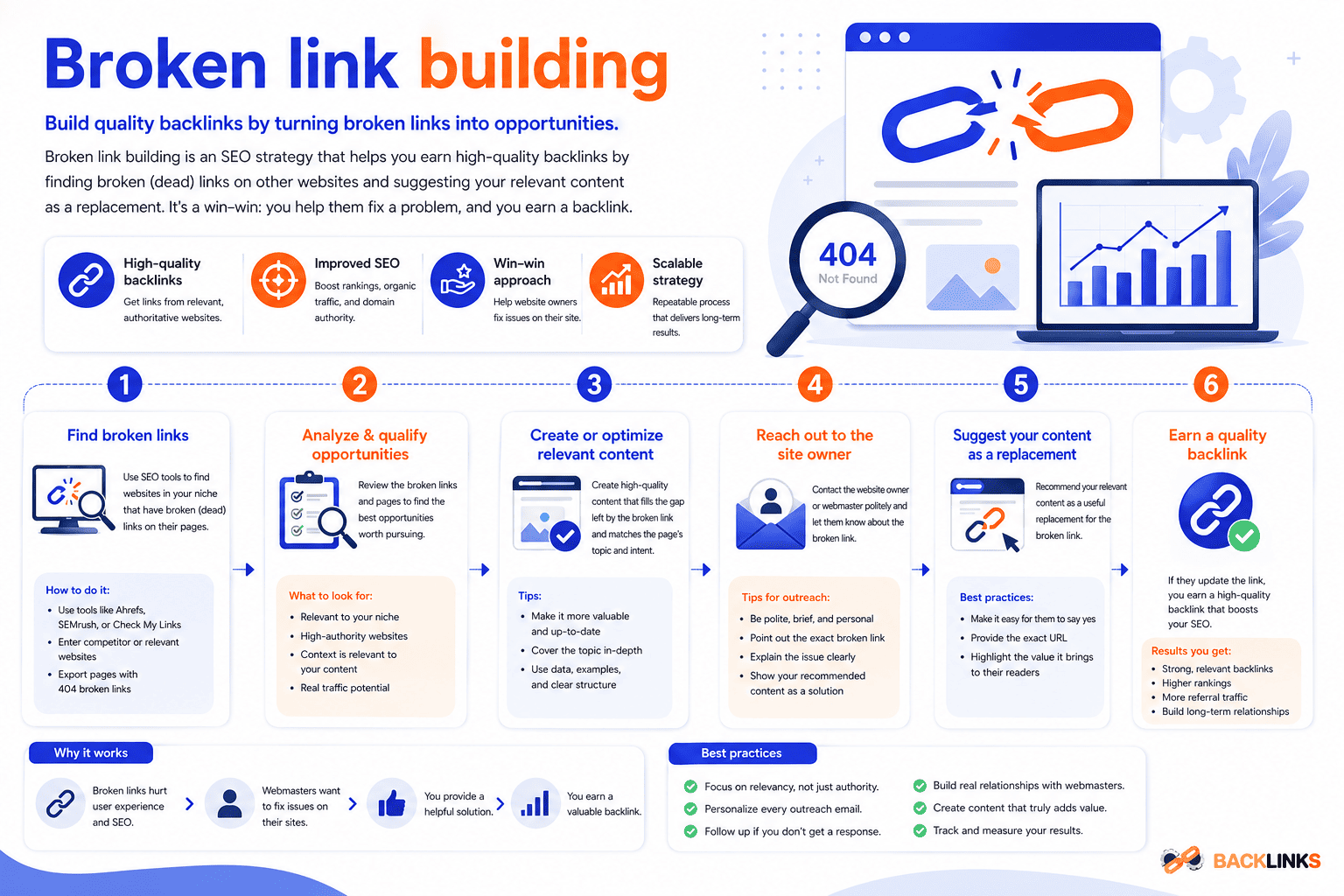
Broken Link Building: A Strategic Approach to Earning High-Quality Backlinks
Linkbuilding often comes down to one central challenge: how to earn relevant, high-quality backlinks without relying on manipulative tactics or unsustainable outreach methods. Many strategies require strong relationships, significant content investment, or long lead times.
Broken link building offers a different approach. Instead of competing for attention, it focuses on identifying existing problems—specifically broken links—and providing a solution.
When executed correctly, this method aligns value for all parties involved. Website owners fix dead links, users get a better experience, and you gain a relevant backlink. However, while the concept is straightforward, the execution requires precision and strategic thinking.
This article explains how broken link building works, why it remains effective, and how to apply it in a way that supports long-term SEO performance within a broader linkbuilding strategy.
What is Broken Link Building
Broken link building is a link acquisition strategy that involves finding broken (dead) links on other websites and suggesting your content as a replacement.
In practical terms, the process looks like this:
- Identify a page that links to a resource that no longer exists
- Create or match content that serves the same purpose
- Reach out to the website owner and suggest replacing the broken link with your page
The key difference from other linkbuilding methods is intent. Instead of asking for a link directly, you are helping solve an issue on the target website.
Because of this, broken link building tends to be more acceptable from a quality and editorial perspective—when done properly.
Why Broken Link Building Matters
Improves Link Quality and Relevance
Broken links are often found in older, well-established content. These pages may already have authority and topical relevance. Replacing a broken link in that context can result in a high-quality backlink.
Aligns with Natural Link Patterns
From a search engine perspective, broken link building produces links that appear natural. You are not creating artificial placements; you are restoring an existing reference.
This reduces the risk often associated with more aggressive link acquisition tactics.
Supports Content-Driven SEO
The strategy encourages the creation of useful, replacement-worthy content. This aligns well with a broader content strategy, particularly in a pillar-and-cluster model where supporting pages reinforce core topics.
For example, a detailed guide on linkbuilding fundamentals can act as a replacement resource for outdated or missing references across multiple sites.
How Broken Link Building Works
Broken link building requires a structured approach. The effectiveness depends less on the idea and more on how well each step is executed.
Step 1: Identify Relevant Opportunities
Start by finding pages within your niche that contain broken outbound links. These are typically:
- Resource pages
- Blog posts with external references
- Industry guides or curated lists
Tools such as SEO crawlers or browser extensions can help detect broken links, but the key is filtering for relevance. A broken link in an unrelated niche is unlikely to produce a meaningful result.
Step 2: Evaluate the Original Content
Before creating a replacement, understand what the original link was pointing to. This involves:
- Reviewing archived versions (if available)
- Identifying the intent of the original content
- Assessing why it was valuable enough to be linked
This step ensures that your replacement is not just similar, but genuinely useful.
Step 3: Create or Match a Replacement Resource
Your content should meet or exceed the quality of the original resource. This does not necessarily mean making it longer—it means making it relevant, clear, and valuable.
In many cases, this aligns with cluster content. For example, if you have a focused article on anchor text strategy, it can serve as a replacement for outdated resources on the same topic.
Step 4: Outreach with Context
Outreach is where many broken link building campaigns fail. The message should be:
- Direct and respectful
- Focused on the issue (the broken link)
- Positioned as helpful, not promotional
The goal is to make it easy for the website owner to fix the problem.
Important Subtopics in Broken Link Building
Content Fit vs Content Creation
Not every broken link requires new content. Often, existing pages can serve as replacements.
However, when no suitable content exists, creating a targeted resource may be worthwhile—especially if it supports your broader content cluster.
Relevance Over Volume
It is tempting to scale broken link building by targeting large numbers of pages. In practice, relevance matters more than volume.
A single well-placed link on a relevant, authoritative page is often more valuable than multiple low-quality placements.
Outreach Efficiency
Response rates in broken link building are typically low. This is not a flaw of the strategy, but a reflection of inbox volume and priorities.
Improving efficiency involves:
- Targeting the right pages
- Personalizing outreach where appropriate
- Keeping communication concise
Integration with Broader Linkbuilding Strategy
Broken link building should not be treated as a standalone tactic. It works best when integrated with other approaches such as guest posting or editorial link acquisition.
Within a structured linkbuilding framework, it fills a specific role: identifying and leveraging existing gaps.
Common Mistakes
Treating It as a Volume Game
Sending large numbers of generic outreach emails rarely produces meaningful results. Broken link building depends on precision, not scale.
Ignoring Content Quality
Suggesting weak or loosely related content reduces credibility. If your page does not clearly replace the broken resource, the outreach is unlikely to succeed.
Poor Outreach Messaging
Messages that feel templated or promotional are often ignored. The focus should remain on the broken link, not on selling your content.
Targeting Irrelevant Niches
Even if a page has authority, relevance still matters. Links that do not align with your topic provide limited SEO value.
Practical Guidance
Focus on High-Value Pages
Prioritize pages that:
- Have existing authority
- Are closely related to your niche
- Contain multiple outbound references
These pages are more likely to provide meaningful SEO impact.
Build Replacement Content Strategically
Instead of creating isolated pieces of content, align your replacements with your content structure. This ensures that each link contributes to a broader topical framework.
For example, supporting articles within your SEO cluster can act as linkable assets for broken link opportunities.
Refine Your Prospecting Process
Efficient prospecting is essential. Rather than searching randomly, use targeted queries and competitor analysis to identify relevant opportunities.
Track and Iterate
Broken link building improves over time. Track which types of pages, outreach approaches, and content formats produce results, then refine your process accordingly.
Timing and Expectations
Broken link building is not an instant-growth tactic. The process involves multiple steps, each with its own timeline:
- Prospecting and validation
- Content creation or adaptation
- Outreach and follow-up
Responses may take days or weeks, and many opportunities will not convert. This is expected.
Over time, consistent execution can produce a steady flow of high-quality backlinks, but results should be evaluated over months rather than weeks.
Conclusion
Broken link building is a practical, value-driven approach to earning backlinks. It shifts the focus from asking for links to solving problems, which makes it both effective and sustainable when applied correctly.
However, its success depends on execution. Relevance, content quality, and thoughtful outreach are critical at every stage.
Within a broader linkbuilding strategy, broken link building serves as a targeted method for acquiring contextual, high-quality links. When integrated into a well-structured content system, it contributes not only to rankings but to overall site authority.
The key is to approach it with discipline and realism. Done well, it becomes a reliable component of long-term SEO growth rather than a short-term tactic.