
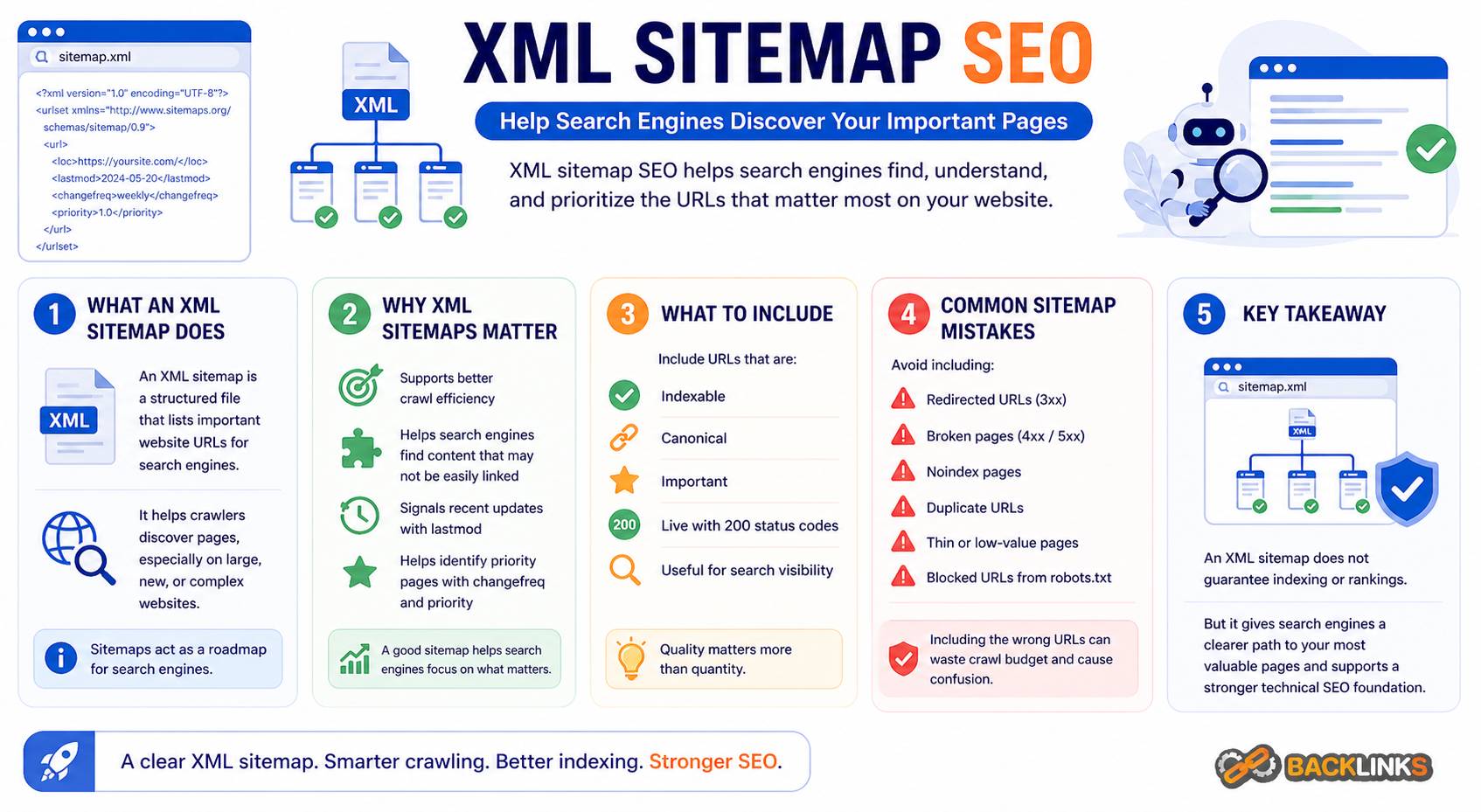
XML Sitemap SEO: How to Help Search Engines Discover Your Important Pages
XML sitemap SEO is the practice of using an XML sitemap strategically so search engines can discover, crawl, and understand the important URLs on your website more efficiently. An XML sitemap does not guarantee rankings, but it plays an important role in technical SEO because it tells search engines which pages you want them to find and consider.
For small websites, an XML sitemap may seem simple. For larger websites, it becomes much more important. Ecommerce stores, blogs, SaaS websites, service businesses, and multilingual websites can all create many URLs over time. Without a clean sitemap strategy, search engines may waste time processing redirected, duplicate, blocked, or low-value pages instead of the pages that matter most.
This guide explains what XML sitemap SEO is, why it matters, how XML sitemaps work, and how to use them correctly.
What Is an XML Sitemap?
An XML sitemap is a file that lists important URLs on a website in a format search engines can read. It helps search engine crawlers discover pages, especially pages that may not be easy to find through internal links alone.
In practical terms, an XML sitemap acts like a technical map of your website’s key pages. It does not replace good site architecture or internal linking, but it supports them.
A sitemap can include information such as:
- The page URL
- When the page was last modified
- Different sitemap sections for posts, pages, products, categories, images, or videos
The most important point is that a sitemap should include only URLs that deserve search engine attention. It should not become a dump of every URL your website can generate.
Why XML Sitemap SEO Matters
XML sitemap SEO matters because search engines need efficient ways to discover and revisit important pages. A clean sitemap helps point crawlers toward the pages you want indexed and ranked.
This is especially useful when:
- A website has many pages
- New content is published regularly
- Some pages are deep in the site structure
- Internal linking is not yet strong
- A website has recently migrated or changed URLs
- Product or category pages change often
- Important pages need faster discovery
A sitemap does not force search engines to index a page. If a page is low quality, duplicate, blocked, noindexed, or canonicalized elsewhere, it may still be excluded from search results. But a well-managed sitemap improves discovery and gives search engines clearer signals about which URLs are important.
How XML Sitemaps Work
Search engines can discover pages through links, but they can also use XML sitemaps as a direct URL source. When a crawler reads your sitemap, it finds a list of URLs that your website is presenting as important.
The crawler may then visit those URLs, evaluate their content, check technical signals, and decide whether they should be indexed.
This process depends on consistency. If your sitemap lists a page as important, but the page is noindexed, redirected, blocked by robots.txt, or canonicalized to another URL, the sitemap sends a confusing signal.
A strong XML sitemap should align with the rest of your technical SEO setup. The URLs in the sitemap should be crawlable, indexable, canonical, and useful.
What URLs Should Be Included in an XML Sitemap?
An XML sitemap should include the URLs you want search engines to discover, crawl, and consider for indexing.
For most websites, this includes:
- Main service pages
- Product pages
- Category pages with search value
- Important blog articles
- Resource pages
- Location pages
- Key informational guides
- Important evergreen content
Every URL in the sitemap should have a clear purpose. If a page does not support search visibility, user value, or business goals, it may not belong there.
For example, a strong product category page with unique content and internal links may deserve inclusion. A filtered URL that creates a near-duplicate version of the same category probably should not.
What URLs Should Be Excluded?
A common XML sitemap SEO mistake is including too many URLs. More is not always better. A sitemap filled with poor URLs can reduce clarity and make technical issues harder to diagnose.
You should usually exclude:
- Noindex pages
- Redirected URLs
- Broken URLs
- Duplicate pages
- Parameter URLs
- Internal search result pages
- Thin tag pages
- Staging or test URLs
- Login, cart, checkout, or account pages
- Canonicalized URLs pointing elsewhere
- Low-value filtered pages
The sitemap should reflect your preferred version of the website. If a URL should not appear in search results, it usually should not appear in the XML sitemap.
XML Sitemaps and Indexing
An XML sitemap supports indexing, but it does not guarantee it.
Search engines may crawl a URL from your sitemap and still decide not to index it. This can happen if the page is too similar to another page, lacks unique value, has weak internal links, returns the wrong status code, or sends conflicting technical signals.
This is why XML sitemap SEO must work with broader technical SEO. A sitemap can help search engines find a page, but the page still needs to be indexable and valuable.
If many sitemap URLs are discovered but not indexed, that is usually a signal to investigate. The problem may not be the sitemap itself. It may be page quality, duplication, canonicalization, internal linking, or crawl accessibility.
XML Sitemaps and Internal Linking
An XML sitemap should not be used as a replacement for internal links. Search engines use internal links to understand page relationships, site hierarchy, and importance.
A page that appears in the sitemap but has no internal links may be discovered, but it can still appear isolated. Search engines may have less context about where it fits within the website.
Strong websites use both:
- Internal links to connect pages naturally for users and crawlers
- XML sitemaps to support discovery and technical clarity
For example, a page about crawling and indexing should connect naturally to related pages about technical SEO, XML sitemaps, robots.txt, and canonical tags. The sitemap supports discovery, but internal links provide context.
XML Sitemap Best Practices
A good XML sitemap should be clean, accurate, and consistent with your SEO strategy.
Include Only Canonical URLs
Every sitemap URL should usually be the canonical version of the page. If the sitemap lists one URL but the canonical tag points to another, search engines receive mixed signals.
This often happens when websites include URLs with tracking parameters, alternate paths, or inconsistent trailing slash formats. The sitemap should contain the preferred URL only.
Keep the Sitemap Updated
Your XML sitemap should update when important pages are added, removed, redirected, or changed. Outdated sitemaps can include broken URLs or miss newly published pages.
Many CMS platforms and SEO plugins generate sitemaps automatically, but automatic generation still needs review. Automation can include URLs that should not be there if the rules are not configured properly.
Use Sitemap Index Files for Large Websites
Large websites may need multiple sitemaps organized under a sitemap index. This can help separate content types such as posts, products, categories, videos, or images.
Separating sitemaps makes troubleshooting easier. If product pages have indexation issues, you can review the product sitemap specifically instead of analyzing one large mixed file.
Avoid Including Non-Indexable URLs
If a URL is noindexed, blocked, redirected, or canonicalized elsewhere, it usually should not be in the sitemap. Including non-indexable URLs wastes crawl attention and creates poor reporting signals.
A clean sitemap should show search engines your important indexable pages, not every URL your website can produce.
Match the Sitemap With Robots.txt and Canonicals
Your sitemap should not conflict with robots.txt rules or canonical tags. If the sitemap includes a URL blocked by robots.txt, search engines may be unable to crawl it. If the sitemap includes a URL canonicalized to another page, search engines may ignore it.
Consistency across technical signals is essential.
Common XML Sitemap SEO Mistakes
Many XML sitemap issues come from automation, poor URL control, or a misunderstanding of what the sitemap is supposed to do.
One common mistake is assuming that submitting a sitemap will make pages rank. A sitemap helps discovery, but rankings depend on relevance, quality, authority, technical accessibility, and user value.
Another mistake is including every URL on the website. This often leads to sitemaps filled with duplicate pages, filters, archives, tags, and parameter URLs.
Other common mistakes include:
- Including redirected URLs
- Including 404 pages
- Including noindex pages
- Including URLs blocked by robots.txt
- Listing duplicate URL versions
- Forgetting to update the sitemap after a migration
- Including thin or low-value pages
- Using sitemap URLs that do not match canonical tags
- Relying on the sitemap instead of improving internal links
These mistakes make it harder for search engines to understand which pages matter most.
XML Sitemap SEO for Different Website Types
Different websites need different sitemap strategies.
For a small business website, the sitemap may include the homepage, service pages, location pages, core blog posts, and key resources. The main goal is clarity and accuracy.
For an ecommerce website, sitemap strategy is more complex. Product pages, category pages, and product images may need separate sitemap sections. Filtered URLs, sorting URLs, and low-value variations should be controlled carefully.
For a publisher or blog, XML sitemaps help search engines discover new articles and updated evergreen content. However, tag pages, author archives, and old thin content should be reviewed before inclusion.
For SaaS websites, sitemaps may include product pages, feature pages, use cases, comparison pages, documentation, and educational content. The sitemap should reflect the pages that support search visibility and business goals.
How to Audit an XML Sitemap
A practical XML sitemap audit should check both the sitemap file and the URLs inside it.
Start by reviewing whether the sitemap is accessible and properly formatted. Then check whether the listed URLs return a 200 status code, are indexable, and use the correct canonical tag.
Next, compare the sitemap against the website’s important pages. Make sure valuable pages are included and low-value pages are excluded.
A useful XML sitemap audit should answer these questions:
- Are all sitemap URLs indexable?
- Do sitemap URLs return 200 status codes?
- Are canonical tags consistent?
- Are redirected or broken URLs included?
- Are important pages missing?
- Are duplicate or parameter URLs listed?
- Are low-value pages included?
- Does the sitemap reflect the current site structure?
The goal is not simply to have a sitemap. The goal is to have a sitemap that supports search engine discovery and technical clarity.
How Long XML Sitemap Improvements Take
The timeline for XML sitemap improvements depends on how often search engines crawl your website and how significant the changes are.
If you remove bad URLs from a sitemap, search engines may gradually stop treating them as sitemap-discovered URLs. If you add important pages, they may be discovered faster than they would be through links alone, especially if the site is large or the pages are deep.
However, sitemap changes do not guarantee immediate indexing or ranking. Search engines still need to crawl the pages, evaluate their quality, and process other technical signals.
For best results, sitemap improvements should be combined with better internal linking, clearer site structure, correct canonical tags, and strong page content.
Practical Guidance for XML Sitemap SEO
Treat your XML sitemap as a curated technical signal, not a complete inventory of your website.
The best approach is to define which URLs deserve organic search visibility. Then make sure those URLs are crawlable, indexable, canonical, internally linked, and included in the sitemap.
At the same time, manage low-value URLs deliberately. Some should be noindexed. Some should be canonicalized. Some should be blocked from crawling if they create crawl waste. Some should be removed or redirected.
For growing websites, review XML sitemaps regularly. New templates, plugins, filters, tags, and CMS changes can quietly add unwanted URLs. Regular checks help prevent sitemap pollution and make technical SEO reporting more reliable.
Conclusion
XML sitemap SEO helps search engines discover the important pages on your website and understand which URLs deserve attention. A sitemap is not a ranking shortcut, but it is a valuable part of a strong technical SEO foundation.
The best XML sitemaps are clean, accurate, and aligned with the rest of the website’s technical signals. They include canonical, indexable, valuable URLs and exclude pages that are redirected, duplicated, blocked, noindexed, or low quality.
Used correctly, an XML sitemap supports crawl efficiency, indexation clarity, and long-term organic search performance. It works best when combined with strong internal linking, clear site architecture, useful content, and consistent technical SEO management.