
URL Structure SEO: How Clean URLs Support Better Search Performance
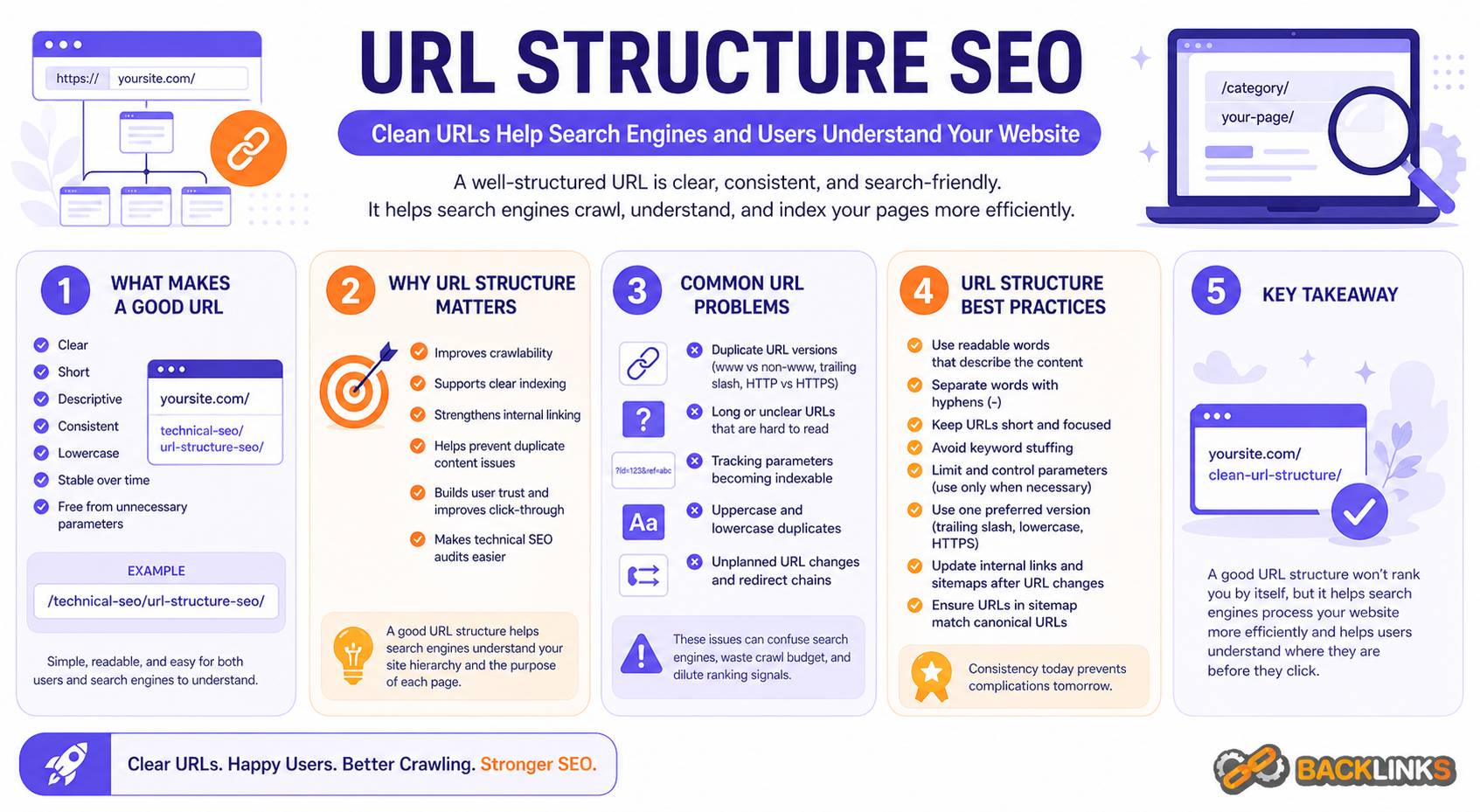
URL structure SEO is the practice of creating clear, consistent, and search-friendly URLs that help users and search engines understand what a page is about. A URL may seem like a small technical detail, but it plays an important role in website organization, crawlability, usability, and long-term SEO management.
A strong URL structure makes a website easier to navigate, easier to maintain, and easier for search engines to process. A weak structure can create duplicate pages, confusing crawl paths, unnecessary redirects, and poor user experience. This is especially important for websites that publish many pages, manage product categories, use filters, or update content regularly.
This guide explains what URL structure SEO means, why it matters, how URLs affect technical SEO, and how to build a clean URL system that supports long-term organic visibility.
What Is URL Structure SEO?
URL structure SEO refers to the way URLs are planned, written, organized, and managed to support search engine visibility and user experience.
A URL is the address of a web page. It tells browsers, users, and search engines where a page is located. But a good URL does more than identify a location. It also gives context.
For example, a URL like /technical-seo/url-structure-seo/ is easier to understand than /page?id=8392&type=blog. The first URL gives a clear signal about the page topic and its position within the website. The second URL may work technically, but it gives little useful information.
Good URL structure is usually:
- Clear
- Short enough to read
- Descriptive
- Consistent
- Stable over time
- Aligned with site architecture
- Free from unnecessary parameters
- Easy for users to understand
URL structure does not replace content quality, technical accessibility, or authority. However, it supports all of them by making the website cleaner and easier to process.
Why URL Structure SEO Matters
URL structure matters because URLs are part of how search engines and users interpret a website. They help communicate page meaning, hierarchy, and organization.
A clean URL can make a page easier to understand before someone clicks. It can also make internal linking, reporting, crawling, redirects, and content management more efficient.
From an SEO perspective, URL structure supports several important areas:
- Crawlability
- Indexation clarity
- Internal linking
- Duplicate content control
- Site architecture
- User trust
- Content organization
- Migration management
A messy URL structure can create avoidable problems. For example, if the same page is accessible through several URL versions, search engines may need to decide which one should be indexed. If categories and subfolders are inconsistent, the site may become harder to audit. If URLs change frequently, redirects can accumulate and weaken technical clarity.
Good URL structure helps prevent these issues before they become expensive to fix.
How URLs Affect Crawlability
Search engines discover pages by following links and processing URLs. A logical URL structure helps crawlers understand how sections of the website are organized.
For example, a website may organize content like this:
/technical-seo//technical-seo/crawling-and-indexing//technical-seo/xml-sitemap-seo//technical-seo/robots-txt-seo//technical-seo/url-structure-seo/
This structure shows a clear relationship between the main topic and supporting pages. It also makes the site easier for humans to understand.
Crawlability depends more on internal links than URL folders alone, but URL organization still matters. It helps SEO teams and developers manage pages in a structured way. It also makes technical audits easier because related URLs can be grouped and analyzed together.
URL Structure and Indexing
A good URL structure helps search engines identify the preferred version of a page. This is important because websites often create multiple URL variations without intending to.
Duplicate URL variations can come from:
- Tracking parameters
- Sorting options
- Filtered pages
- Session IDs
- Uppercase and lowercase versions
- Trailing slash inconsistencies
- HTTP and HTTPS versions
- WWW and non-WWW versions
- Product variants
- Category path duplication
If these variations are not controlled, search engines may crawl and index several versions of the same content. This can dilute ranking signals and make indexation less efficient.
URL structure SEO helps reduce this risk by setting clear rules for preferred URLs. Canonical tags, redirects, internal links, and XML sitemaps should all point to the same preferred URL version.
What Makes a Good SEO-Friendly URL?
A good SEO-friendly URL is easy to read, easy to share, and easy to manage. It should describe the page without becoming long or overloaded with keywords.
Use Clear, Descriptive Words
A URL should give a simple indication of the page topic. For example, /website-speed-seo/ is clearer than /post-517/.
Descriptive URLs help users understand where they are going. They also make reports and audits easier for SEO teams.
The goal is clarity, not keyword stuffing. Repeating keywords or adding unnecessary words can make URLs look unnatural.
Keep URLs Short and Focused
Shorter URLs are usually easier to read and remember. They also look cleaner when shared in emails, documents, social posts, or internal reports.
A URL should include enough information to describe the page, but not every possible keyword variation.
For example, /core-web-vitals/ is cleaner than /core-web-vitals-seo-page-speed-performance-user-experience-guide/.
Use Hyphens Between Words
Hyphens are the standard separator for readable URLs. They make words easier to distinguish.
For example, use /url-structure-seo/ rather than /urlstructureseo/ or /url_structure_seo/.
Consistency is important. Once a URL format is chosen, it should be applied across the website.
Use Lowercase URLs
Lowercase URLs are easier to standardize. Some servers treat uppercase and lowercase URLs differently, which can create duplicate versions.
For example, /Technical-SEO/ and /technical-seo/ may be treated as different URLs in some environments. Using lowercase URLs consistently reduces this risk.
Avoid Unnecessary Parameters
Parameters can be useful for tracking, filtering, sorting, and dynamic functionality, but they can also create duplicate URL problems.
For example, URLs with ?sort=, ?filter=, or ?utm= may create multiple versions of similar content. These should be managed carefully through canonical tags, parameter rules, redirects, or internal linking discipline.
Not every parameter is bad. The issue is whether it creates indexable URL variations that do not provide unique search value.
URL Structure and Site Architecture
URL structure should reflect the website’s organization, but it should not become unnecessarily deep.
A flat URL can be useful for simple websites. A folder-based structure can be useful when it reflects meaningful content groups.
For example:
/technical-seo/url-structure-seo/
This suggests the page belongs under the broader technical SEO topic.
However, overly deep URLs can become hard to manage:
/blog/seo/technical/website/optimization/url/best-practices/
This type of structure is usually unnecessary. It can make URLs longer and create complexity when sections change.
The best structure is logical, stable, and scalable. It should support the way users and search engines understand the website.
URL Structure for Different Website Types
Different websites need different URL strategies.
For a small business website, URLs should be simple and service-focused. Examples may include /services/, /seo-services/, /contact/, or /locations/bangkok/.
For an ecommerce website, URL structure becomes more complex. Category pages, product pages, filters, and variants need clear rules. Product URLs should be stable, and filtered URLs should be controlled carefully to avoid duplicate content.
For a blog or resource section, URLs should be organized around meaningful topics. Dates are usually unnecessary unless the content is strongly time-sensitive. Evergreen content often performs better with stable, topic-focused URLs.
For a SaaS website, URLs may include product pages, feature pages, use cases, integrations, comparisons, documentation, and learning resources. Each section should have a clear purpose and consistent structure.
Common URL Structure SEO Mistakes
One common mistake is changing URLs without a clear reason. If a page already has rankings, backlinks, internal links, and traffic, changing the URL can create risk. Even with redirects, unnecessary URL changes can cause temporary disruption.
Another mistake is using vague URLs that do not describe the page. URLs such as /page1/, /article-new/, or /services-main-final/ are not useful for users or SEO management.
A third mistake is allowing duplicate URL versions to exist. For example, both /technical-seo/ and /technical-seo may be accessible without redirecting to one preferred version. Over time, these inconsistencies can create duplicate content and reporting problems.
Other common mistakes include:
- Using overly long URLs
- Stuffing keywords into URLs
- Including dates in evergreen content URLs
- Using inconsistent folder structures
- Allowing uppercase and lowercase duplicates
- Leaving old URLs without redirects
- Letting tracking parameters become indexable
- Changing URLs during redesigns without planning
- Including irrelevant words or numbers
- Creating multiple URLs for the same page through category paths
These issues can usually be avoided with clear URL rules.
URL Changes and Redirects
Changing URLs should be handled carefully. A URL is not only a page address; it may also carry history, links, rankings, bookmarks, and internal references.
If a URL must change, it should be redirected to the most relevant new URL. A permanent redirect is usually used when a page has moved permanently.
Redirects should not simply send all old URLs to the homepage. That creates a poor user experience and weak relevance. Each old URL should point to the closest matching new page.
During a website redesign or migration, URL mapping is essential. Every important old URL should be reviewed and matched to its new destination. Internal links and XML sitemaps should also be updated to use the new preferred URLs.
Redirect chains should be avoided. A URL should ideally redirect directly to the final destination.
URL Structure and Internal Linking
Internal links should consistently point to the preferred version of each URL. If some internal links point to one version and others point to another, search engines receive mixed signals.
For example, if the preferred URL is /url-structure-seo/, internal links should not alternate between:
/url-structure-seo/URL-Structure-SEO//technical-seo/url-structure-seo/?ref=menu
Consistent internal linking supports canonical signals and helps search engines understand which URL should be prioritized.
Internal links also help show how URL structure fits into the broader website. A page about URL structure should connect naturally to related topics such as crawling and indexing, XML sitemaps, robots.txt, canonical tags, and website migrations.
How to Audit URL Structure SEO
A URL structure audit should identify whether URLs are clear, consistent, crawlable, indexable, and aligned with the site’s architecture.
Start by reviewing the most important pages. Check whether their URLs are readable, stable, and descriptive. Then look for duplicate versions, parameter URLs, redirect chains, and inconsistent formatting.
A practical URL audit should answer:
- Are URLs readable and descriptive?
- Are URLs too long or unnecessarily complex?
- Are lowercase rules applied consistently?
- Are trailing slash rules consistent?
- Are HTTP, HTTPS, WWW, and non-WWW versions controlled?
- Are parameter URLs creating duplicates?
- Do internal links point to preferred URLs?
- Do canonical tags match preferred URLs?
- Do sitemap URLs match canonical URLs?
- Are old URLs redirected correctly?
- Are important pages buried in confusing folders?
The goal is not to make every URL perfect. The goal is to remove confusion, reduce duplication, and support a cleaner technical structure.
How Long URL Structure SEO Changes Take
The timeline depends on the size of the change.
Small improvements, such as correcting internal links or consolidating duplicate URL versions, may be processed after search engines recrawl the affected pages.
Larger URL changes, such as a migration or full restructuring, can take longer. Search engines need to crawl old URLs, process redirects, discover new URLs, update canonical signals, and reassess page relationships.
Because URL changes carry risk, they should be planned carefully. In many cases, keeping an existing URL is better than changing it for minor cosmetic reasons.
URL structure SEO is most effective when it is planned before a website grows too large. Fixing messy URLs later is possible, but it often requires more redirects, more testing, and more monitoring.
Practical Guidance for URL Structure SEO
A strong URL strategy should be simple, consistent, and future-proof.
Before creating new pages, define clear URL rules. Decide how categories, services, products, blog posts, locations, and resources should be structured. Use a format that can scale as the website grows.
Avoid changing URLs unless there is a meaningful SEO, UX, or business reason. When changes are necessary, use proper redirects and update internal links.
For large websites, document URL rules so developers, content teams, and SEO teams follow the same standards. This prevents inconsistent page creation and reduces future cleanup work.
The best URL structure is not the most complicated one. It is the one that helps users, search engines, and website teams understand the site clearly.
Conclusion
URL structure SEO helps create a cleaner, more understandable website for users and search engines. Clear URLs support crawlability, indexation, internal linking, duplicate content control, site architecture, and long-term technical SEO management.
A good URL should be descriptive, concise, consistent, and stable. It should reflect the page’s purpose without keyword stuffing or unnecessary complexity.
For businesses building long-term organic visibility, URL structure should not be treated as a minor formatting detail. It is part of the technical foundation that helps search engines process the website efficiently and helps users understand where they are before they even click.