
What is Linkbuilding? A Clear and Practical Explanation
What is linkbuilding is one of the most common questions in SEO, yet it is often misunderstood or oversimplified. Many website owners associate it with tactics or shortcuts, without fully understanding its role in building long-term search visibility.
At its core, linkbuilding is about earning trust. Search engines rely on external signals to evaluate which pages deserve to rank, and backlinks remain one of the strongest of those signals.
This article explains what linkbuilding is, how it works in practice, and why it plays a critical role in SEO. It also provides the foundation for more advanced topics such as outreach, backlink analysis, and anchor text optimization.
What is Linkbuilding?
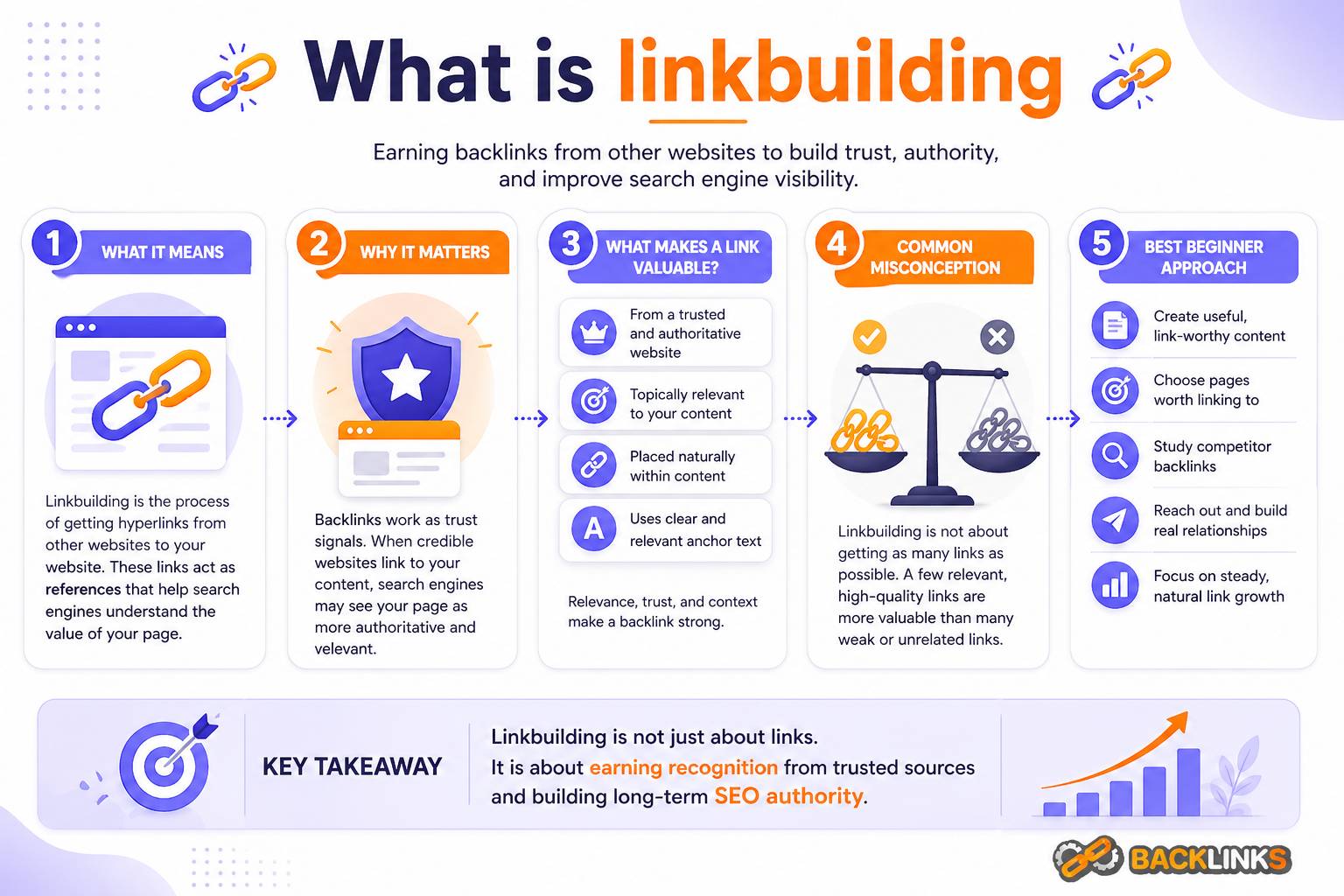
Linkbuilding is the process of acquiring hyperlinks from other websites to your own.
A hyperlink—commonly called a backlink—is a clickable connection from one page to another. When another website links to your content, it signals to search engines that your page may be valuable, relevant, or trustworthy.
In simple terms, linkbuilding is not just about getting links. It is about earning references from other websites.
These references matter because search engines interpret them as endorsements. If multiple credible websites link to a page, it suggests that the content has value beyond its own domain.
However, not all backlinks are equal. The value of a link depends on several factors, including the authority of the linking site, the relevance of the content, and the context in which the link appears.
Why Linkbuilding Matters in SEO
Backlinks as Trust Signals
Search engines cannot rely solely on on-page content to determine quality. Backlinks provide an external validation layer.
When a reputable website links to your page, it effectively vouches for your content. The more high-quality endorsements your page receives, the stronger its perceived authority.
This is why linkbuilding remains a core part of ranking algorithms.
Impact on Rankings
Pages with strong backlink profiles tend to rank higher, especially for competitive keywords.
Even well-optimized content can struggle to rank without backlinks. In contrast, content with strong link signals can outperform competitors, even if the content itself is similar in quality.
This is one of the reasons why linkbuilding is often considered a key differentiator in SEO performance.
Role in Content Discovery
Backlinks also help search engines discover new content. When your page is linked from other websites, it becomes easier for search engine crawlers to find and index it.
This is particularly important for new websites or newly published pages that do not yet have strong internal linking.
Contribution to Topical Authority
Linkbuilding supports the development of topical authority. When multiple pages within a subject area receive backlinks, search engines begin to associate your site with that topic.
For example, if your site includes detailed articles on related SEO topics—such as technical SEO audit or structured data SEO—and these pages earn links, it strengthens your authority across the entire topic.
How Linkbuilding Works
Understanding how linkbuilding works requires looking beyond the idea of “more links equals better rankings.” Search engines evaluate links based on quality, relevance, and context.
Authority of the Linking Website
A backlink from a well-established, trusted website carries more weight than one from a low-quality or unknown site.
Authority is influenced by the linking site’s own backlink profile, its content quality, and its reputation within its niche.
Relevance of the Content
Relevance plays a significant role. A link from a page that covers a related topic is more valuable than one from an unrelated source.
Search engines analyze both the domain and the specific page to determine how closely it aligns with your content.
Anchor Text Context
Anchor text is the clickable text used in a link. It provides context about the destination page.
For example, if a page links using descriptive text related to SEO, it reinforces the relevance of the linked page for that topic.
However, anchor text must be used naturally. Overuse of exact-match keywords can appear manipulative and reduce trust.
Placement Within the Page
Links placed within the main body of content are generally more valuable than those in less prominent areas such as footers or sidebars.
Editorial links—those placed naturally within content—carry the most weight because they are more likely to reflect genuine recommendations.
Link Patterns Over Time
Search engines also evaluate how links are acquired over time. A steady, natural growth pattern suggests credibility, while sudden spikes may raise concerns.
This is why sustainable linkbuilding focuses on consistency rather than rapid accumulation.
Types of Links in Linkbuilding
Not all links serve the same purpose. Understanding different types of links helps clarify how linkbuilding works in practice.
Editorial Links
These are links given naturally because your content is useful or relevant. They are considered the most valuable because they are not influenced by incentives or manipulation.
Outreach-Based Links
These links are acquired through direct communication with website owners, editors, or content creators.
Outreach is effective when it focuses on relevance and value rather than generic requests.
Guest Content Links
Contributing content to other websites can lead to backlinks. When done properly, this approach combines authority building with audience exposure.
Resource Links
Some websites maintain curated lists of useful resources. If your content fits, it can be included as a reference.
Internal Links
While not part of external linkbuilding, internal links play a supporting role by distributing authority within your site.
For example, linking from a broader guide like a content optimization strategy article to more specific topics helps reinforce relationships between pages.
How Linkbuilding Fits Into a Broader SEO Strategy
Linkbuilding is not a standalone activity. It works best when integrated into a structured SEO approach.
Connection to Content Quality
Without strong content, linkbuilding becomes difficult. Websites are unlikely to link to content that does not provide clear value.
This is why content optimization is closely tied to linkbuilding success.
Role in Site Architecture
Linkbuilding is more effective when your site has a clear structure. A well-organized system of pages—supported by internal linking—ensures that the value of backlinks is distributed effectively.
For example, a main guide on linkbuilding can support related pages such as:
- outreach strategies
- anchor text optimization
- backlink analysis
This structure strengthens the overall authority of your site.
Alignment With Search Intent
Linkbuilding should focus on pages that align with user intent. Informational content often attracts links more naturally than purely commercial pages.
However, informational pages can support commercial pages through internal linking, creating a balanced strategy.
Common Misconceptions About Linkbuilding
“More Links Are Always Better”
Quantity alone does not determine success. A small number of high-quality, relevant links is often more valuable than a large number of low-quality ones.
“Any Link Helps SEO”
Links from unrelated or low-quality sites may provide little benefit and can sometimes create risk.
Relevance and trust are more important than sheer volume.
“Linkbuilding Is Only About Outreach”
Outreach is just one part of the process. Content quality, promotion, and strategic positioning all contribute to link acquisition.
“Results Should Be Immediate”
Linkbuilding takes time. The impact on rankings and authority develops gradually as links accumulate.
Practical Guidance for Beginners
For those starting with linkbuilding, the focus should be on building a solid foundation rather than pursuing advanced tactics too early.
Start by identifying pages that deserve links. These are typically:
- in-depth guides
- high-quality informational content
- resources that solve specific problems
Next, analyze where competitors are getting their links. This provides realistic insights into what is achievable within your niche.
Focus on relevance when seeking links. A single link from a well-matched source can be more valuable than multiple unrelated ones.
Finally, think long term. Linkbuilding is not about quick wins—it is about building authority over time.
Timing and Expectations
Linkbuilding does not produce immediate results. The timeline depends on several factors, including competition, content quality, and consistency.
In general:
- Initial changes may take a few weeks to appear
- Noticeable ranking improvements often take several months
- Strong authority growth requires ongoing effort
Patience and consistency are essential. The goal is to build a stable, trustworthy link profile.
Conclusion
Linkbuilding is a fundamental part of SEO because it connects your content to the wider web.
It is not simply about acquiring links, but about earning recognition from relevant and authoritative sources. When done correctly, it strengthens your site’s credibility, improves rankings, and supports long-term growth.
Understanding what linkbuilding is—and how it works—provides the foundation for more advanced strategies. As you move deeper into SEO, linkbuilding becomes less about tactics and more about building a reputation that others are willing to reference.
That shift in perspective is what ultimately leads to sustainable success.