
Optimizing Content: How to Improve Pages for SEO and User Value
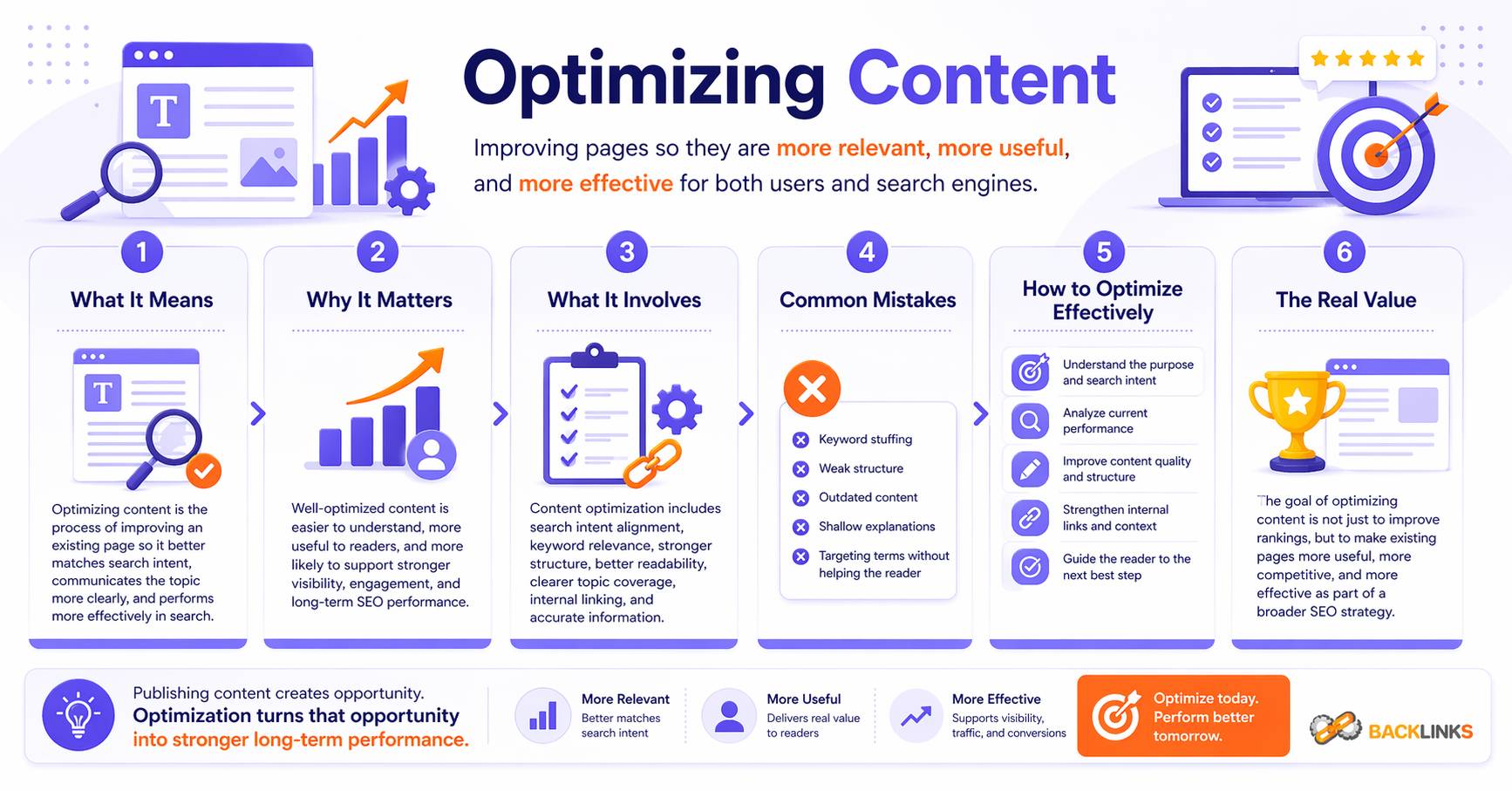
Optimizing content means improving a page so it performs better in search results and serves readers more effectively. In practice, that involves more than adding keywords or rewriting a few headings. It means making content clearer, more relevant, better structured, and more aligned with what users actually want when they search.
This matters because content rarely performs at its full potential the moment it is published. A page may target the right topic but still underperform because it is too shallow, poorly organized, misaligned with search intent, or disconnected from the rest of the website. Optimizing content is the process of fixing those weaknesses so the page becomes more competitive and more useful.
For businesses, marketers, and SEO professionals, content optimization is one of the most practical ways to improve organic visibility without relying only on constant content production. Stronger pages tend to rank more consistently, support topical authority more effectively, and create better paths from traffic to conversion.
What Is Optimizing Content
Optimizing content is the process of refining written content so it is easier for search engines to understand and more valuable for users to consume.
That usually includes improving areas such as keyword relevance, structure, readability, topical depth, internal linking, and alignment with search intent. It may also involve updating outdated information, removing unnecessary sections, or strengthening the page’s connection to commercial goals.
A useful way to think about optimizing content is this: you are not just editing words. You are improving how the page functions as an SEO asset and as a user resource.
A well-optimized page should do three things clearly:
- match the reason behind the search
- explain the topic in a useful and credible way
- help the user take the next logical step
If any of those elements are weak, the page is less likely to perform well.
Why Optimizing Content Matters
Optimizing content matters because search engines rank pages based on relevance, usefulness, and overall quality, not simply because the topic appears on the page.
It improves search visibility
When content is better aligned with the target query, more clearly structured, and more comprehensive, it becomes easier for search engines to interpret and rank appropriately. Optimization strengthens the signals that show what the page is about and why it deserves visibility.
It increases the value of existing content
Many websites already have pages with untapped potential. They may be ranking on page two, attracting impressions without clicks, or getting traffic without conversions. Optimizing content often improves those pages more efficiently than starting from scratch.
It supports better user engagement
A page that is easier to read, easier to navigate, and more directly useful tends to keep readers engaged. Better engagement alone is not the goal, but it usually reflects a stronger user experience, which supports overall performance.
It contributes to broader SEO strategy
Content does not exist in isolation. Well-optimized pages strengthen the topic ecosystem of a website. They help reinforce subject relevance, improve internal linking opportunities, and support authority across related topics.
How Optimizing Content Works
Optimizing content works by improving the page across several layers at once. The process is not only editorial and not only technical. It sits between content strategy, on-page SEO, and user experience.
Aligning with search intent
This is the starting point. Before changing wording or structure, you need to confirm what the searcher expects. If the query is informational, the page should educate clearly. If the query reflects comparison or evaluation, the content should help the user assess options.
For a topic like optimizing content, the intent is informational. Readers usually want to understand what content optimization involves, why it matters, and how to do it properly. The page should therefore focus on explanation and practical guidance rather than promotional messaging.
Improving relevance
Relevance comes from more than repeating a phrase. A page becomes more relevant when it clearly addresses the main topic, includes supporting subtopics naturally, and uses language that reflects how the subject is actually discussed.
That includes the primary keyword, related terms, and contextual phrases that help search engines understand the page without making the writing feel forced.
Strengthening structure
A content page should be easy to scan. Strong headings, short to medium paragraphs, logical section flow, and clear progression all improve readability. These improvements also help search engines interpret the hierarchy of the content.
Expanding or tightening where needed
Some pages underperform because they do not go deep enough. Others underperform because they are bloated with filler. Optimizing content means identifying which problem exists and correcting it. The goal is completeness for the topic, not length for its own sake.
Connecting the page to related content
Internal links are part of optimization because they help place the page in context. A page about optimizing content should naturally connect to related topics such as search intent, on-page SEO, content audits, internal linking, and SEO content strategy.
Key Elements of Optimizing Content
A strong optimization process looks at the whole page, not just a few isolated details.
Keyword Targeting
Keyword targeting still matters, but it should be handled naturally. The primary keyword should appear where it makes sense, such as the title, introduction, and selected headings, while related terms help broaden the topical coverage.
The purpose is to make the page unmistakably relevant without making it repetitive.
Search Intent Fit
A page should satisfy the underlying reason for the search. This is often the difference between content that ranks and content that struggles. Even a well-written article can fail if it addresses the wrong intent.
For informational topics, clarity and usefulness matter more than aggressive selling. The content should lead with answers, then introduce related services or solutions only where appropriate.
Topic Coverage
Optimized content should cover the key aspects of the topic well enough to meet user expectations. That means including the necessary supporting ideas, not just defining the term.
For this subject, relevant subtopics include content quality, headings, internal linking, keyword usage, search intent, content refreshes, and performance improvement.
Readability and UX
Good optimization makes content easier to consume. Readers should be able to move through the page without confusion or friction. That includes sentence clarity, paragraph length, heading hierarchy, and formatting.
When content is hard to scan, its value drops even if the information itself is good.
Internal Linking
Internal links help search engines understand content relationships and help users continue their journey. This strengthens both discoverability and topical coherence.
A page about optimizing content should not sit alone. It should point readers toward relevant supporting articles and receive links back from them where appropriate.
Accuracy and Trust
Content should reflect real understanding. Claims should be realistic, explanations should be precise, and advice should reflect practical conditions. Pages that sound exaggerated or shallow are less likely to build trust with users or support long-term SEO value.
How to Optimize Content Effectively
A practical content optimization process should begin with strategy, not surface edits.
Start with page purpose
Define what the page is meant to accomplish. Is it targeting a specific informational keyword, improving visibility for a topic area, or supporting a page that introduces a related service? A clear purpose shapes every optimization decision.
Review current performance
Look at how the page is currently performing. Is it getting impressions but few clicks? Is it ranking but failing to hold attention? Is it attracting traffic for the wrong terms? These signals help identify what kind of optimization is needed.
Evaluate intent and structure
Compare the page to the search intent behind the keyword. Then review the structure. Are the headings useful? Is the introduction clear? Does the page answer the main question quickly enough? Does the content flow logically?
Improve weak sections
Optimization is rarely about rewriting everything. Focus on the sections that limit performance most. That may mean rewriting an unclear introduction, expanding a thin section, improving internal links, tightening repetitive passages, or adding missing context.
Strengthen contextual relevance
Add related concepts naturally where they improve clarity. This helps the page feel complete and reinforces its relevance. The emphasis should always stay on usefulness, not artificial density.
Support the next step
Even informational content should guide the reader somewhere meaningful. That may be another relevant article, a more advanced guide, or a service page where there is a natural connection. The transition should feel helpful, not forced.
Common Mistakes When Optimizing Content
Many content optimization efforts fail because they focus on visible edits rather than strategic improvement.
Overusing the target keyword
This is one of the most common mistakes. Repetition does not create better SEO content. It usually weakens the writing and makes the page sound mechanical.
Optimizing without checking intent
If the page format is wrong for the query, surface-level edits will not solve the problem. Intent mismatch is often a bigger issue than on-page phrasing.
Adding volume instead of value
Some teams respond to weak performance by making the article longer. That only helps when the added content improves the page. Extra text without purpose usually reduces clarity.
Ignoring internal linking
A page that is never connected to related content loses contextual support. Internal linking should be part of the optimization process, not an afterthought.
Leaving outdated content untouched
Even a strong page can decline if it is not refreshed when needed. Optimization often includes updating examples, refining language, and making sure the content still reflects current expectations.
Practical Guidance for Better Results
To optimize content well, focus on usefulness first and SEO precision second. That does not mean ignoring SEO. It means using SEO to support clarity rather than distort it.
Review the page with a simple framework. Ask whether it matches search intent, covers the topic properly, reads clearly, links naturally to related pages, and supports a clear next step. That process will usually reveal the main weaknesses quickly.
Prioritize the improvements that change performance most. In some cases, the biggest win is a stronger heading structure. In others, it is a better explanation of the core topic. In others, it is reducing fluff that hides the real value of the page.
The strongest optimization work tends to be selective and strategic. It improves what matters instead of changing everything at once.
Timing and Expectations
Optimizing content can improve results faster than publishing a brand-new page, especially if the existing page already has some indexation and visibility. Even so, results are not immediate.
Search engines need time to recrawl and reassess the page. Performance improvements also depend on competition, site authority, and how meaningful the changes were. Some pages improve quickly with better alignment and structure. Others require deeper rewrites or stronger support from related pages across the site.
This is why content optimization should be viewed as an ongoing process. Important pages should be reviewed periodically, especially if rankings decline, search intent shifts, or the content becomes outdated.
Conclusion
Optimizing content is the process of making pages more relevant, more useful, and more effective for both search engines and users.
It involves much more than adding keywords. Strong content optimization improves intent alignment, structure, topic coverage, internal linking, readability, and trust. When handled properly, it helps pages perform better in search while also creating a better experience for the people reading them.
For any website investing in organic growth, optimizing content is one of the most practical and high-value SEO activities available. Publishing content creates opportunity. Optimization is what turns that opportunity into stronger long-term performance.