
Structured Data SEO: How to Help Search Engines Understand Your Content
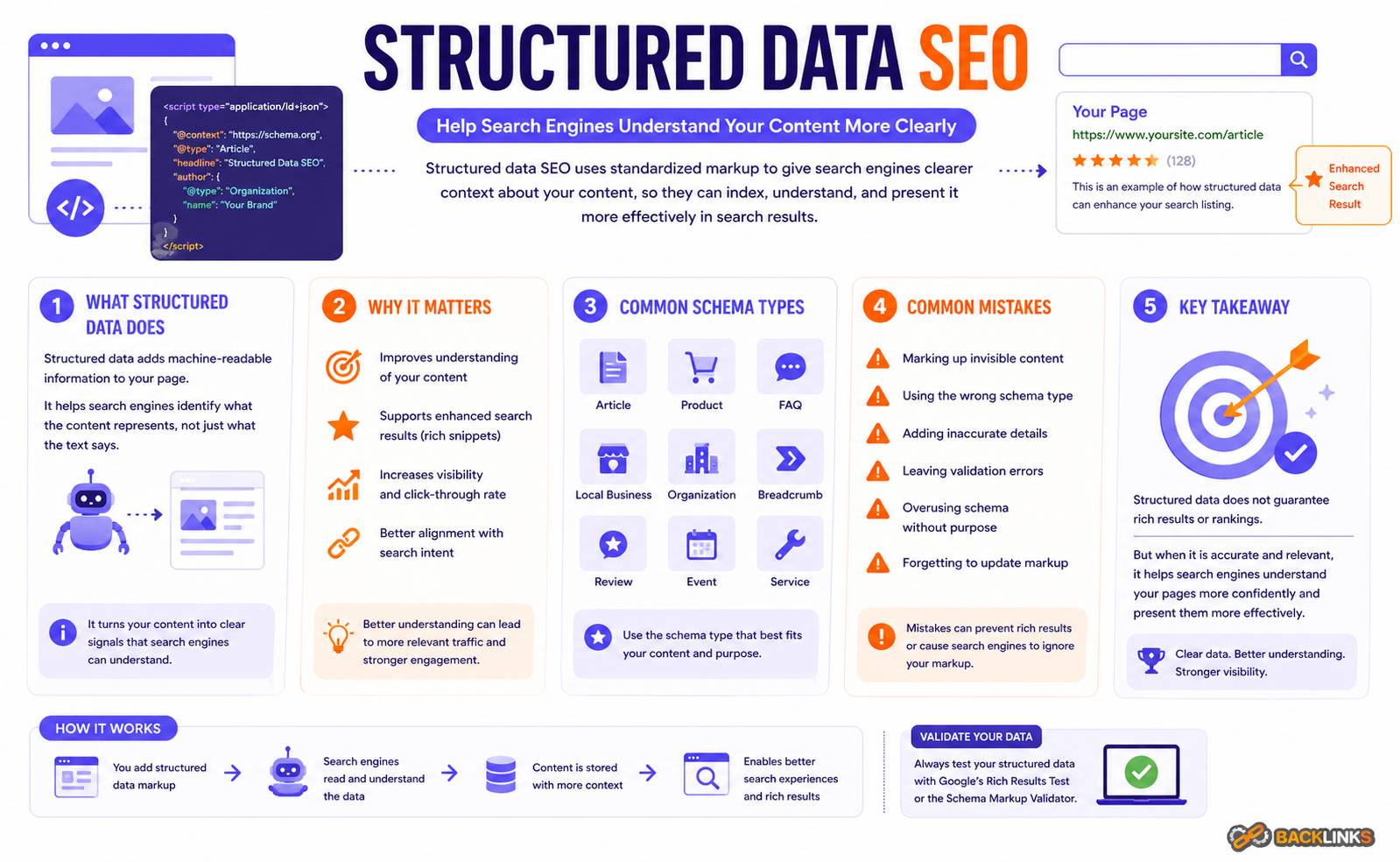
Structured data SEO is the practice of adding standardized code to your website to help search engines better understand your content. It does not directly improve rankings on its own, but it can enhance how your pages appear in search results and improve how clearly your content is interpreted.
Structured data is part of technical SEO because it provides additional context about a page. It helps search engines identify what the content represents, not just what it says. This can support better indexing, more relevant search visibility, and enhanced search result features.
This guide explains what structured data is, why it matters, how it works, and how to use it effectively.
What Is Structured Data?
Structured data is a format of code, usually written in JSON-LD, that provides specific information about a page’s content. It uses a shared vocabulary to describe elements such as articles, products, reviews, organizations, events, and more.
In practical terms, structured data answers questions like:
- What type of content is this?
- Who created it?
- What is the page about?
- What key details should be understood?
For example, a product page can include structured data describing the product name, price, availability, and reviews. A blog post can include structured data describing the article title, author, and publish date.
This helps search engines interpret content more accurately beyond just reading the visible text.
Why Structured Data SEO Matters
Structured data SEO matters because search engines aim to deliver results that are not only relevant but also clearly presented. Structured data helps support that goal.
One of the main benefits is the potential for enhanced search results, often called rich results. These can include:
- Star ratings for reviews
- Product pricing and availability
- FAQ dropdowns
- Breadcrumb navigation
- Article details
- Event information
These features can make a listing more informative and visually distinct, which may improve user engagement.
Structured data also supports better content understanding. It helps search engines connect entities, identify relationships, and interpret page purpose more clearly. This is especially useful for complex websites with many page types.
However, structured data should not be treated as a shortcut to rankings. It works best as part of a broader SEO strategy that includes content quality, internal linking, crawlability, and technical clarity.
How Structured Data Works
Structured data works by adding machine-readable information to a page. This information follows a defined structure that search engines can parse and interpret.
The most common format is JSON-LD, which is typically added in the <head> or body of a page. It does not affect how the page looks to users, but it provides additional signals to search engines.
For example, an article page might include structured data that identifies:
- The article title
- The author
- The publication date
- The main topic
- The organization publishing it
Search engines can use this information to display more accurate and enriched search results.
The key principle is consistency. The structured data should match the visible content on the page. If the code says one thing but the page shows another, the signal may be ignored.
Types of Structured Data for SEO
Different types of structured data are used depending on the page type and purpose.
Article and Blog Content
Article structured data is used for blog posts, guides, and news content. It helps search engines understand authorship, publication details, and content type.
This is useful for content-driven websites building topical authority.
Product Pages
Product structured data is used on ecommerce pages. It can include price, availability, brand, and reviews.
This type of markup supports rich results that show product information directly in search.
Organization and Website
Organization structured data provides information about the business, such as name, logo, and contact details. Website structured data can help define the site structure and search functionality.
This is useful for brand recognition and consistency.
Breadcrumbs
Breadcrumb structured data shows the page’s position within the site hierarchy. This can improve how URLs appear in search results and help users understand navigation.
FAQ and How-To
FAQ structured data can display expandable questions and answers in search results. How-to structured data can break down step-by-step instructions.
These should only be used when the content genuinely matches the format.
Structured Data and Search Results
Structured data can enhance how your pages appear in search results, but it does not guarantee that enhancements will be shown.
Search engines decide whether to display rich results based on:
- Content quality
- Relevance
- Structured data accuracy
- Page trustworthiness
- Search query context
Even if structured data is implemented correctly, enhancements may not appear for every query.
However, when used properly, structured data can improve how your listing stands out and how users interpret it before clicking.
Common Structured Data SEO Mistakes
Structured data is often implemented incorrectly or used in ways that do not support SEO goals.
One common mistake is adding structured data that does not match the page content. For example, marking a page as a product when it is actually a blog post.
Another mistake is overusing structured data types without purpose. Not every page needs every type of markup.
Other common mistakes include:
- Using incorrect or outdated schema types
- Adding structured data with missing required fields
- Marking up hidden or irrelevant content
- Applying the same markup across unrelated pages
- Forgetting to update structured data when content changes
- Using plugins that generate incorrect markup
- Ignoring errors or warnings in validation tools
These mistakes can reduce the effectiveness of structured data or cause it to be ignored.
How to Audit Structured Data
A structured data audit should check whether the markup is accurate, complete, and aligned with the page content.
Start by reviewing key page types, such as articles, product pages, service pages, and category pages. Confirm that the structured data matches what users see on the page.
Then check whether the markup includes required and recommended properties for each schema type.
A practical audit should answer:
- Is structured data implemented on important pages?
- Does it match the visible content?
- Are required fields included?
- Are there validation errors or warnings?
- Are the correct schema types being used?
- Is markup applied consistently across templates?
- Are outdated or irrelevant schema types present?
- Does the markup support search result enhancements?
The goal is to make structured data clear, accurate, and useful.
Structured Data SEO for Different Website Types
Different websites benefit from different structured data strategies.
For ecommerce websites, product markup is critical. It helps display pricing, availability, and reviews in search results.
For blogs and publishers, article markup supports content discovery and clarity.
For service-based websites, organization, local business, and breadcrumb markup can help define the business and site structure.
For SaaS websites, structured data can be used for product pages, feature pages, and content resources, depending on how the site is structured.
The key is to match the markup to the purpose of each page.
How Long Structured Data Changes Take
Structured data changes can be processed relatively quickly after search engines recrawl the page. However, the appearance of enhanced search results may take longer or may not occur for every page.
Search engines need to validate the markup, assess content quality, and determine whether to show rich results.
Because structured data is only one signal, its impact depends on how well the rest of the SEO foundation is implemented.
Monitoring changes over time is important. Improvements in search appearance and engagement may become clearer gradually.
Practical Guidance for Structured Data SEO
Structured data should be implemented with intention. Start by identifying which page types would benefit most from enhanced search results or clearer interpretation.
Focus on high-value pages such as product pages, key articles, and important content resources. Make sure the markup is accurate and consistent with the visible content.
Work with developers to implement structured data at the template level where possible. This ensures consistency across similar pages.
Avoid adding markup just to “check a box.” Each implementation should serve a clear purpose.
As the website grows, review structured data regularly. New templates, content updates, and CMS changes can affect how markup is generated.
Conclusion
Structured data SEO helps search engines better understand your content and may enhance how your pages appear in search results. It adds clarity, supports richer search features, and improves how content is interpreted.
While it does not directly improve rankings on its own, it strengthens the technical foundation of a website and supports better search visibility.
The most effective approach is to use structured data accurately, consistently, and strategically. When combined with strong content, clean technical SEO, and clear site structure, structured data becomes a valuable part of long-term SEO success.