
Technical SEO vs On-Page SEO: Key Differences and How They Work Together
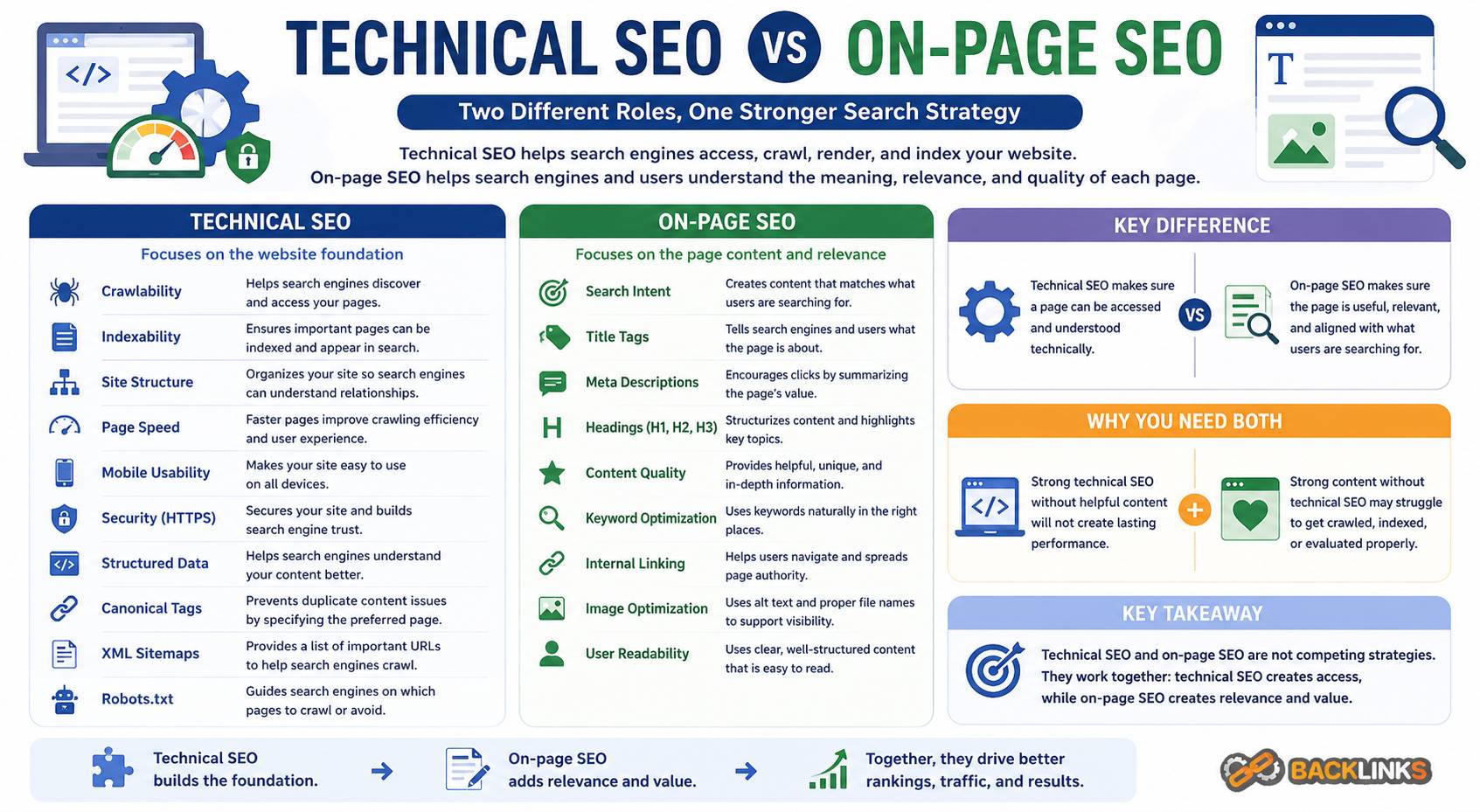
Technical SEO vs on-page SEO is an important distinction because both influence organic search performance, but they solve different problems. Technical SEO focuses on whether search engines can access, crawl, index, and understand a website properly. On-page SEO focuses on whether individual pages are clearly optimized for the topics, keywords, and search intent they target.
A website needs both. Strong on-page SEO cannot perform well if technical problems prevent pages from being indexed. Strong technical SEO cannot compensate for thin content, unclear headings, weak keyword targeting, or pages that fail to satisfy search intent.
For business owners, marketers, and SEO teams, understanding the difference helps with planning, prioritization, and collaboration. It also prevents a common mistake: treating every SEO issue as either a content problem or a development problem. In reality, technical SEO and on-page SEO overlap in some areas, but each has a distinct role in building sustainable search visibility.
What Is Technical SEO?
Technical SEO is the process of improving the technical foundation of a website so search engines can crawl, render, index, and evaluate its pages effectively. It deals with the systems that support search visibility behind the page content.
Technical SEO includes elements such as crawlability, indexability, site architecture, page speed, mobile usability, canonical tags, redirects, XML sitemaps, robots.txt files, structured data, HTTP status codes, JavaScript rendering, and duplicate URL control.
In practical terms, technical SEO answers questions such as:
- Can search engines discover this page?
- Can they access and render the content?
- Is the correct version of the page indexable?
- Are duplicate URLs being handled properly?
- Is the site structure easy to crawl?
- Does the page load reliably on mobile devices?
Technical SEO is often more closely connected to website infrastructure, development, CMS setup, templates, and server behavior. However, it is not only a developer responsibility. SEO teams need to define what search engines should be able to access, which pages should be indexed, and how the website structure should support organic growth.
What Is On-Page SEO?
On-page SEO is the process of optimizing the visible and page-level elements of content so search engines and users can clearly understand what the page is about. It focuses on the quality, relevance, structure, and optimization of individual pages.
On-page SEO includes title tags, meta descriptions, headings, body content, keyword usage, search intent alignment, internal links, image optimization, content depth, readability, and topical relevance.
In practical terms, on-page SEO answers questions such as:
- Does this page clearly match the target search intent?
- Is the primary keyword used naturally in important places?
- Are the headings clear and useful?
- Does the content answer the user’s question well?
- Is the page structured for readability?
- Are internal links contextually relevant?
- Does the page provide enough depth to be useful?
On-page SEO is closely connected to content strategy, copywriting, editing, keyword research, UX, and conversion planning. It ensures that a page is not only accessible, but also relevant and helpful.
Technical SEO vs On-Page SEO: The Core Difference
The simplest way to understand the difference is this:
Technical SEO helps search engines access and process your website. On-page SEO helps search engines and users understand the value and relevance of each page.
Technical SEO is about the foundation. On-page SEO is about the content and page-level signals built on top of that foundation.
For example, if a page is blocked by a noindex tag, that is a technical SEO issue. If the page is indexable but the title tag is vague and the content does not answer the search query, that is an on-page SEO issue.
If a website has slow mobile performance, broken redirects, duplicate URL variations, or poor crawlability, those are technical problems. If a page has weak headings, poor keyword alignment, thin content, or unclear internal links, those are on-page problems.
Both areas influence rankings, but they operate at different stages of the search process.
Why the Difference Matters
Understanding the difference between technical SEO and on-page SEO helps teams diagnose problems more accurately.
If a page is not appearing in search results, the first question should be whether it is crawlable and indexable. If it is not, improving the content will not solve the problem. The issue is technical.
If a page is indexed but ranking poorly, the issue may be on-page relevance, content quality, search intent alignment, internal links, competition, authority, or a combination of factors.
This distinction also helps teams assign responsibility. Developers may need to fix crawl errors, template problems, redirect logic, or page speed issues. Content and SEO teams may need to improve headings, page structure, keyword targeting, and content usefulness.
Without this clarity, teams can waste time optimizing the wrong layer of the website.
How Technical SEO Works
Technical SEO works by reducing friction between your website and search engines. It helps search engines move through the site efficiently, identify important pages, avoid duplicate or low-value URLs, and interpret technical signals correctly.
Crawlability
Crawlability refers to whether search engines can discover and access your pages. Internal links, navigation, XML sitemaps, and clean site architecture all help search engines find important content.
Technical crawlability problems include broken links, blocked URLs, redirect loops, orphan pages, and pages that are only accessible through forms or scripts.
If search engines cannot crawl an important page, the page has little chance of ranking.
Indexability
Indexability refers to whether a page can be included in search results. A page may be crawlable but not indexable if it has a noindex tag, points to another URL with a canonical tag, returns an incorrect status code, or is considered too low value.
Technical SEO helps ensure that important pages are indexable while low-value or duplicate pages are managed appropriately.
Site Architecture
Site architecture affects how search engines understand the relationship between pages. A clear structure helps important pages receive internal links and makes topical relationships easier to interpret.
Poor architecture can bury valuable content too deeply, isolate supporting pages, or create confusing crawl paths.
Page Speed and Mobile Performance
Technical SEO also includes performance and mobile usability. Slow, unstable, or difficult-to-use pages create a weaker user experience. They can also make crawling and rendering less efficient.
Performance work often involves image optimization, JavaScript management, caching, server response improvements, and template refinement.
Canonicals, Redirects, and Duplicate URLs
Canonical tags, redirects, and URL rules help search engines understand which page version should be treated as the main one.
This matters when the same content can be accessed through multiple URLs, such as filter pages, tracking parameters, product variants, or inconsistent trailing slash versions.
How On-Page SEO Works
On-page SEO works by making each page more relevant, useful, and understandable for its target search intent. It improves the signals that help search engines connect a page to the right queries.
Search Intent Alignment
Search intent is the reason behind a search query. A page targeting an informational query should explain, guide, or educate. A page targeting a commercial query should help users compare options or make a decision.
On-page SEO ensures the page matches what the searcher expects. If the content format, depth, or angle is wrong, the page may struggle even if the technical setup is strong.
Title Tags and Meta Descriptions
Title tags help define the topic of a page and often influence how the page appears in search results. A good title tag is clear, relevant, and aligned with the primary keyword.
Meta descriptions do not guarantee rankings, but they can influence how users understand the result before clicking. A strong meta description should accurately summarize the page and set expectations.
Headings and Content Structure
Headings help organize content for readers and search engines. A strong H1 introduces the page clearly. H2 and H3 headings break the topic into logical sections.
Good heading structure improves readability and helps search engines understand the main themes of the page.
Keyword Usage
On-page SEO uses keywords naturally in important areas such as the title, introduction, headings, body copy, image alt text where relevant, and internal link anchors.
The goal is not keyword stuffing. The goal is clarity. A well-optimized page should make the topic obvious without sounding repetitive or forced.
Content Quality and Depth
On-page SEO depends heavily on content quality. The page should answer the query thoroughly enough to satisfy the reader, but without adding irrelevant filler.
Good content explains the topic clearly, includes practical context, avoids unsupported claims, and provides a useful next step for the reader.
Where Technical SEO and On-Page SEO Overlap
Technical SEO and on-page SEO are separate disciplines, but they are not completely isolated. Some elements affect both technical processing and page-level relevance.
Internal Linking
Internal linking supports both areas. Technically, internal links help search engines discover pages and understand crawl paths. On-page, they provide context and guide users to related content.
A link from a page about technical SEO to a deeper article about crawlability can help search engines understand topical relationships while also helping readers continue learning.
Structured Data
Structured data is usually considered technical SEO because it involves code. However, it must accurately reflect the visible content on the page. That creates an overlap with on-page SEO.
If structured data describes content that is not actually visible or relevant, it can create inconsistency. Strong implementation requires both technical accuracy and content alignment.
Image Optimization
Image optimization can involve technical elements such as compression, sizing, lazy loading, and file formats. It can also involve on-page elements such as descriptive filenames, relevant alt text, and image placement.
Both sides matter. A well-described image that loads slowly can hurt performance. A fast-loading image with poor context may add little value.
Page Experience
Page experience connects technical performance with content usability. A page can have useful information but still perform poorly if it is slow, unstable, or difficult to navigate. Likewise, a fast page with shallow content may not satisfy the searcher.
Common Technical SEO Issues
Technical SEO issues often affect access, crawl efficiency, indexation, and site performance.
Common examples include:
- Important pages blocked by robots.txt
- Accidental noindex tags
- Incorrect canonical tags
- Broken redirects
- Redirect chains and loops
- Slow page load times
- Mobile usability problems
- Duplicate URL variations
- Non-indexable URLs in XML sitemaps
- Broken internal links
- Orphan pages
- JavaScript rendering issues
- Incorrect HTTP status codes
These problems can prevent search engines from processing the website correctly. Some are urgent because they can remove important pages from search results or weaken visibility across entire sections of a site.
Common On-Page SEO Issues
On-page SEO issues usually affect relevance, clarity, and content usefulness.
Common examples include:
- Missing or weak title tags
- Unclear H1 headings
- Poor keyword alignment
- Thin or shallow content
- Content that does not match search intent
- Repetitive or over-optimized keyword usage
- Poor heading structure
- Missing internal links
- Weak image alt text
- Duplicate page copy
- Vague meta descriptions
- Content that lacks practical value
These issues may not prevent a page from being indexed, but they can make it less competitive. A page may appear in search results yet struggle to rank well because it does not provide enough relevance or usefulness.
Which Should You Prioritize First?
The right priority depends on the current condition of the website.
If search engines cannot crawl or index important pages, technical SEO should come first. There is little value in rewriting content that search engines cannot access or include in results.
If the website is technically healthy but pages are not ranking well, on-page SEO may deserve more attention. In that case, the issue may be search intent, keyword targeting, content quality, topical depth, or internal linking.
For many websites, the best approach is to evaluate both together. Start with the pages that matter most to the business, such as service pages, product categories, location pages, high-value articles, and lead generation pages. Then ask two sets of questions.
From a technical perspective:
- Can the page be crawled?
- Can it be indexed?
- Does it return the correct status code?
- Is it internally linked?
- Is it fast and usable on mobile?
- Is the canonical tag correct?
From an on-page perspective:
- Does the page target a clear search intent?
- Is the primary keyword used naturally?
- Are the headings clear?
- Is the content useful and complete?
- Are related topics covered appropriately?
- Does the page guide users to a logical next step?
This combined approach avoids wasted effort and gives each page a stronger chance to perform.
Technical SEO vs On-Page SEO in a Website Audit
A good SEO audit should separate technical issues from on-page issues while also showing how they affect each other.
For example, an audit may find that a key service page has a weak title tag and poor content depth. That is an on-page concern. But if the same page also has an incorrect canonical tag pointing elsewhere, the technical issue should be addressed first.
Similarly, a blog article may have strong content but receive little organic traffic. The audit should check whether it is buried too deeply in the site, lacks internal links, or is excluded from the sitemap. If those technical elements are healthy, then the content and keyword targeting should be reviewed.
The best audits prioritize based on impact, not just issue count. A single technical error on a high-value page may matter more than dozens of minor on-page suggestions on low-priority pages.
Technical SEO vs On-Page SEO for Different Website Types
Different websites require different balances of technical and on-page SEO.
For a small service business website, on-page SEO may involve improving service pages, local landing pages, headings, content clarity, and calls to action. Technical SEO may focus on indexability, mobile performance, internal links, and clean URL structure.
For an ecommerce website, technical SEO often becomes more complex because product variants, filters, categories, pagination, and parameters can create many URL variations. On-page SEO still matters, especially for product and category content, but technical control is essential.
For a publisher or blog, on-page SEO may focus on content quality, topical depth, and article structure. Technical SEO helps manage archives, tags, pagination, internal links, crawl depth, and site speed.
For SaaS websites, both are critical. Product pages, feature pages, comparison pages, documentation, and educational content need strong on-page optimization and a clean technical structure that supports discovery and authority flow.
How Technical SEO and On-Page SEO Work Together
Technical SEO and on-page SEO perform best when they are planned together.
A strong content plan should consider whether the website structure can support the new pages. A technical SEO plan should consider which pages and topics are most important to the business. Internal linking should connect related pages in a way that supports both crawling and user understanding.
For example, a website building topical authority around SEO may have a broad technical SEO guide supported by focused articles about crawlability, indexability, page speed, structured data, XML sitemaps, robots.txt, canonical tags, and site architecture. Technical SEO ensures those pages are accessible and connected. On-page SEO ensures each page answers its specific query clearly.
When both work together, the website becomes easier to crawl, easier to understand, and more useful to readers.
Practical Guidance for Managing Both
The best way to manage technical SEO and on-page SEO is to build them into the website workflow.
Before publishing a page, check that it has a clear keyword target, search intent, title tag, H1, heading structure, internal links, and useful content. Also check that it is indexable, canonicalized correctly, included in the right sitemap if appropriate, and accessible through internal links.
Before making technical changes, consider how they affect content visibility. A change to templates, navigation, URL structure, or JavaScript can affect many pages at once.
SEO teams, developers, designers, and content teams should work from a shared understanding of what each page is supposed to achieve. This prevents technical decisions from weakening content performance and prevents content decisions from creating technical problems.
How Long It Takes to See Results
Results from technical SEO and on-page SEO can appear at different speeds.
Technical fixes may show results after search engines recrawl and reprocess the affected pages. Some issues, such as removing an accidental noindex tag or fixing a broken redirect, may be reflected sooner than broader changes.
On-page improvements may take longer, especially if the page needs to earn stronger engagement, topical relevance, or authority. Search engines may need time to reassess the page against competing results.
The most reliable approach is to monitor both technical and content performance over time. Track indexation, crawl errors, rankings, impressions, clicks, engagement, and conversions. This gives a more accurate view than judging success from rankings alone.
Conclusion
Technical SEO vs on-page SEO is not a choice between two competing strategies. They are complementary parts of effective search optimization.
Technical SEO makes sure search engines can access, crawl, index, and understand your website. On-page SEO makes sure each page is relevant, useful, well structured, and aligned with search intent.
If technical SEO is weak, strong content may never reach its full potential. If on-page SEO is weak, a technically healthy website may still fail to rank for meaningful queries.
The best SEO strategies treat both as connected priorities. Technical SEO creates the foundation. On-page SEO builds relevance and usefulness on top of it. Together, they help a website become easier for search engines to process and more valuable for users to visit.