
Search Intent SEO: How to Match Content with What Users Really Want
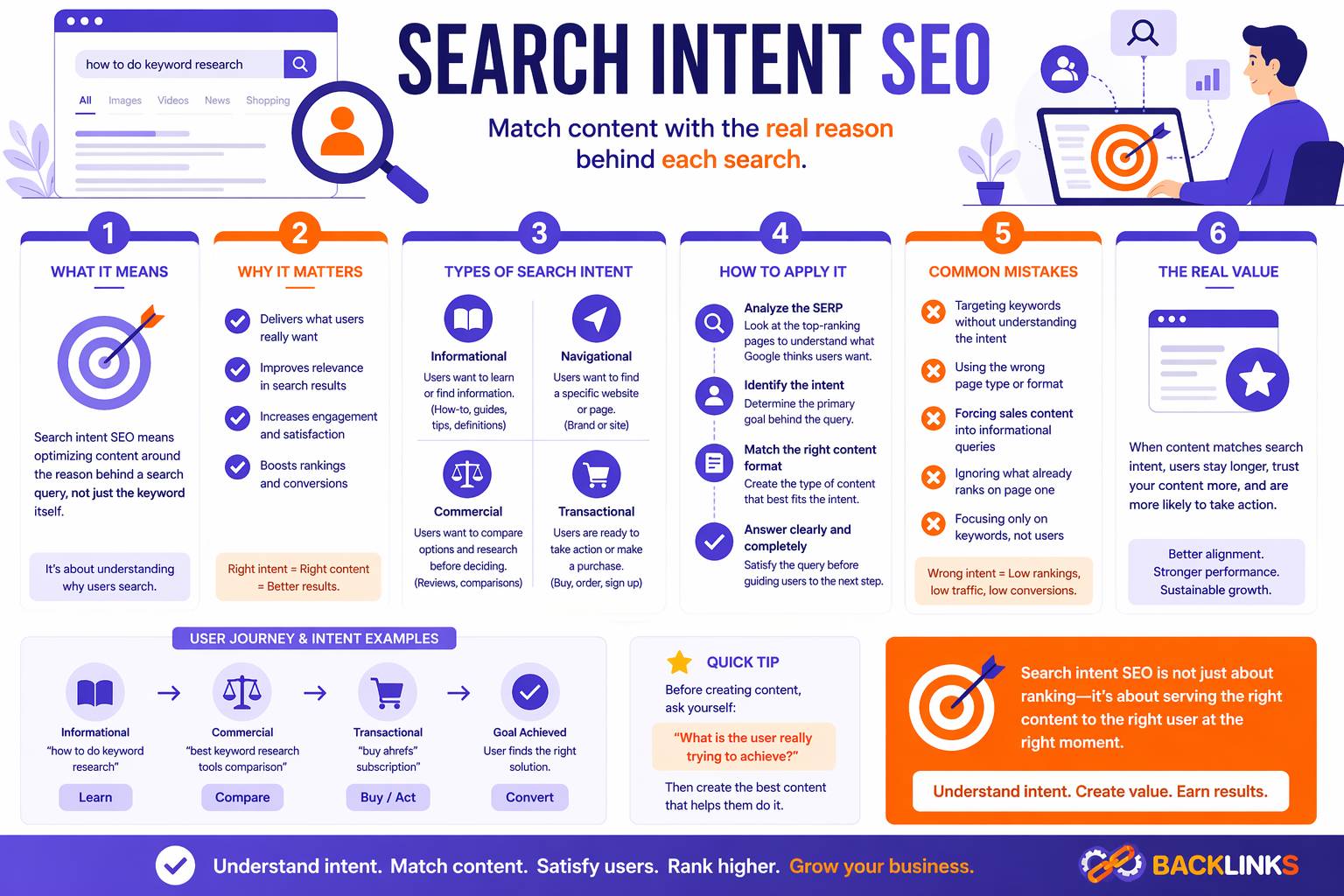
Search intent SEO is the practice of creating and optimizing content based on the reason behind a user’s search query. It focuses on understanding what the searcher wants to accomplish, then shaping the page so it satisfies that need clearly and completely.
Many SEO problems happen because a page targets the right keyword but the wrong intent. A website may publish a well-written article, use the keyword naturally, and include helpful information, but still struggle to rank because the content does not match what users expect to find.
For example, someone searching “what is keyword research” wants an explanation. Someone searching “keyword research tools” likely wants software options. Someone searching “keyword research service” may be looking for a provider. These searches are related, but they require different types of pages.
This article explains what search intent means, why it matters for SEO, how to identify it, and how to create content that better matches user expectations.
What Is Search Intent SEO?
Search intent SEO means optimizing content around the purpose behind a search, not just the words in the query.
Search intent is the “why” behind a keyword. It explains whether the user wants to learn, compare, buy, navigate to a specific website, or solve a particular problem.
In practical terms, search intent SEO helps answer questions such as:
- What does the user expect from this search?
- What type of page should rank for this keyword?
- How detailed should the content be?
- Should the page educate, compare, guide, or convert?
- What questions need to be answered for the page to be useful?
This approach is important because search engines aim to show results that satisfy users. If your content does not match the dominant intent behind a keyword, it may underperform even if it is technically optimized.
Why Search Intent Matters for SEO
Search intent matters because relevance is not only about keyword matching. A page must also match the user’s goal.
A page can include the target keyword, related terms, internal links, and strong formatting, but if it gives users the wrong type of answer, it will not be competitive.
It Helps You Create the Right Type of Content
Different keywords require different content formats.
For example:
- “What is search intent” needs a clear explanation
- “How to identify search intent” needs a step-by-step guide
- “Best SEO tools for keyword research” needs a comparison or list
- “SEO agency near me” needs a local service page
If you create an educational blog post for a keyword where users expect a product page, the content is unlikely to satisfy the query. Likewise, if you create a sales page for a keyword where users want to learn, the page may feel too promotional.
Search intent SEO helps you choose the right format before writing.
It Improves Content Relevance
Search engines evaluate whether a page is relevant to a query. Relevance includes the topic, but also the depth, angle, and usefulness of the content.
A page about “search intent SEO” should explain what search intent is, how it affects rankings, how to identify intent, and how to apply intent analysis to content strategy. If the page only defines the term briefly, it may not fully satisfy informational intent.
Matching intent makes content more useful and more likely to meet user expectations.
It Reduces Wasted SEO Effort
Targeting keywords without understanding intent can waste time and resources.
A business may spend hours creating a detailed article for a keyword that actually requires a service page. Another website may create a landing page for a keyword where searchers want a beginner guide.
In both cases, the issue is not effort. The issue is mismatch.
Search intent analysis helps you avoid creating the wrong page for the right keyword.
It Supports Better User Experience
When users land on a page that matches their intent, they can find what they need faster.
This improves the experience because the content feels relevant from the beginning. Clear intent alignment can also support better engagement, more internal clicks, and stronger trust.
A user searching for “how to use SEO keywords” expects practical guidance. If the page immediately explains the process clearly, the experience is better than if the user has to scroll through unrelated background information.
It Helps Build Stronger Topic Coverage
Search intent SEO also supports better content planning.
A broad topic may contain several different intents. For example, keyword research can include:
- What is keyword research?
- Why is keyword research important?
- How to do keyword research
- Keyword research tools
- Keyword research services
Each query serves a different purpose. By separating and organizing content based on intent, your website can cover the topic more clearly and avoid overlapping pages.
Main Types of Search Intent
Search intent is commonly grouped into four main categories: informational, navigational, commercial, and transactional.
These categories are useful, but they should be applied with judgment. Some searches have mixed intent, and the search results may show more than one type of page.
Informational Intent
Informational intent means the user wants to learn something.
Examples include:
- What is search intent?
- Search intent SEO
- How does keyword research work?
- Why are backlinks important?
- Types of keywords in SEO
Users with informational intent usually expect explanations, guides, examples, definitions, or tutorials.
Content for informational intent should be clear, helpful, and educational. It should avoid pushing too hard toward conversion before answering the user’s question.
For this article, the search intent is informational. That means the page should explain search intent SEO in detail and provide practical guidance.
Navigational Intent
Navigational intent means the user wants to reach a specific website, brand, tool, or page.
Examples include:
- Google Search Console
- Ahrefs login
- Semrush keyword tool
- Moz blog
- Backlinks.in.th SEO
These users already have a destination in mind. They are not usually looking for a general explanation.
For your own brand, navigational searches are important because users expect to find your official pages easily. Clear branding, page titles, and site structure help support this.
Commercial Intent
Commercial intent means the user is researching options before making a decision.
Examples include:
- Best keyword research tools
- Ahrefs vs Semrush
- Top SEO agencies
- Best backlink checker tools
- SEO software comparison
These users are not always ready to buy immediately, but they are evaluating solutions. They may want comparisons, reviews, pros and cons, pricing details, or recommendations.
Content for commercial intent should help users make informed decisions. It should be specific, balanced, and useful rather than purely promotional.
Transactional Intent
Transactional intent means the user is ready or close to ready to take action.
Examples include:
- Hire SEO consultant
- Buy keyword research report
- SEO audit service
- Book SEO consultation
- Content optimization service
These keywords often have stronger business value because the user may be closer to converting.
Transactional pages should be clear, credible, and action-oriented. They should explain the offer, build trust, answer objections, and make the next step easy.
Mixed Search Intent
Some keywords have mixed intent. This means users searching the same keyword may want different things.
For example, “keyword research tools” could mean the user wants:
- A list of tools
- A comparison article
- A free tool
- A software product page
- A tutorial on how tools work
In these cases, the search results are especially useful. They show what search engines currently believe best satisfies the query.
If the top results include mostly comparison articles, a comparison format is likely needed. If product pages dominate, a product-focused page may be more appropriate.
How to Identify Search Intent
Identifying search intent requires more than guessing. You need to analyze the keyword, the search results, and the user’s likely stage of awareness.
Look at the Keyword Wording
The words in a query often reveal intent.
Informational modifiers include:
- what is
- how to
- why
- guide
- examples
- meaning
- tips
Commercial modifiers include:
- best
- top
- comparison
- review
- vs
- alternatives
Transactional modifiers include:
- buy
- hire
- service
- pricing
- book
- quote
- near me
Navigational searches often include brand names, product names, or specific website names.
For example, “search intent SEO” is broad but informational. The user likely wants to understand how search intent works in SEO and how to apply it.
Review the Search Results
The search results are one of the best indicators of intent.
Look at the pages currently ranking and ask:
- Are they guides, product pages, service pages, videos, or comparison articles?
- How detailed are they?
- What questions do they answer?
- What format appears most often?
- Are the results beginner-focused or advanced?
- Do they include tools, templates, examples, or step-by-step instructions?
If most top-ranking pages are educational guides, the intent is likely informational. If most are service pages, the keyword may have transactional intent.
Analyze SERP Features
Search result features can also reveal intent.
For example:
- Featured snippets often appear for informational queries
- Local packs appear for location-based or service searches
- Shopping results suggest transactional intent
- Video results may indicate tutorial or visual learning intent
- People Also Ask boxes reveal related informational questions
These features help you understand what users may expect beyond traditional blue links.
Consider the User Journey
A keyword can also be understood by where it fits in the user journey.
Early-stage users usually search broad educational terms. Middle-stage users compare options. Late-stage users search for pricing, services, providers, or specific products.
For example:
- “What is search intent?” is early-stage
- “How to analyze search intent” is practical and educational
- “Best SEO content tools” is comparison-stage
- “SEO content optimization service” is closer to action
Matching content to the journey helps create a better experience.
Check Whether the Query Is Broad or Specific
Broad queries often have mixed intent. Specific queries usually reveal clearer intent.
For example, “keywords” is broad. It could mean many things. “How to choose SEO keywords for blog posts” is specific and easier to satisfy.
The more specific the query, the easier it is to identify the right angle and content format.
How to Apply Search Intent SEO to Content
Once you understand intent, apply it to the page strategy, structure, and writing.
Choose the Right Page Type
The first step is choosing the correct page type.
For informational intent, create guides, explanations, tutorials, or educational articles.
For commercial intent, create comparison pages, product roundups, reviews, or buying guides.
For transactional intent, create service pages, product pages, landing pages, or booking pages.
For navigational intent, make sure the relevant brand or product page is easy to find and clearly optimized.
Choosing the wrong page type is one of the most common reasons keyword-targeted content fails.
Match the Depth of the Content
Search intent also determines how deep the content should be.
A simple definition query may need a concise answer followed by supporting explanation. A broad strategic topic may require a more comprehensive guide. A comparison query may need detailed criteria and examples.
For “search intent SEO,” users likely expect a useful explanation with practical application. The content should go beyond a definition and explain how intent affects rankings, content planning, keyword research, and page structure.
Align the Introduction with the Intent
The introduction should quickly confirm that the page matches the user’s search.
If the query is informational, answer the concept early. If the query is practical, make it clear that the page will provide steps or guidance.
Avoid long, vague introductions. Users should quickly understand that they are in the right place.
Structure Headings Around User Questions
Headings should reflect what users want to know.
For a page about search intent SEO, useful sections include:
- What is search intent SEO?
- Why search intent matters
- Types of search intent
- How to identify search intent
- How to apply search intent to content
- Common mistakes
This structure helps users scan the page and helps search engines understand the content.
Cover Related Questions Naturally
Search intent analysis often reveals related questions that should be answered on the page.
For this topic, related questions may include:
- What are the four types of search intent?
- How does search intent affect SEO?
- How do you determine search intent?
- Why does intent matter in keyword research?
- Can one keyword have multiple intents?
Answering these naturally improves usefulness and topical relevance.
Use Internal Links Based on Intent
Internal links should guide users to the next logical topic.
A page about search intent SEO may naturally link to articles about keyword research, SEO keywords, types of keywords, long tail keywords, content structure SEO, and using keywords in content.
The anchor text should be descriptive and natural. Avoid forcing exact-match phrases repeatedly.
Common Search Intent SEO Mistakes
Targeting a Keyword Without Checking the Results
One of the biggest mistakes is assuming intent based only on the keyword.
A keyword may look informational, but the search results may show commercial pages. Another keyword may look transactional, but users may actually want comparison content.
Always review the results before deciding the page format.
Creating the Wrong Content Type
If users want a guide, a sales page will usually underperform. If users want a service provider, a long educational article may not be enough.
The content type must match the dominant intent.
Ignoring Mixed Intent
Some keywords serve multiple audiences. In these cases, you may need to choose the dominant intent or create content that addresses the main intent while supporting secondary needs.
For example, a commercial investigation keyword may still need educational context before comparison details.
Over-Optimizing for the Keyword Instead of the Need
Search intent SEO is not about repeating the keyword more often. It is about satisfying the searcher’s goal.
A page can use the primary keyword naturally and still fail if it does not answer the right question.
Making Informational Content Too Promotional
For informational searches, users want answers first. A page that becomes too sales-focused too quickly can lose trust.
It is acceptable to guide users toward related services or deeper resources, but the main purpose of the page should match the intent.
Treating Intent as Fixed Forever
Search intent can shift over time. Search results change as user behavior, competition, and search engine interpretation evolve.
Important pages should be reviewed periodically to make sure they still match the current search landscape.
Practical Guidance for Better Search Intent SEO
Start every SEO page by identifying the primary keyword and reviewing the search results. Do not rely only on the keyword phrase itself.
Look at what type of content currently ranks. Notice whether users seem to expect a guide, list, comparison, product page, service page, video, or local result.
Then create content that matches the dominant intent while offering better clarity, structure, and usefulness than competing pages.
Use the introduction to confirm relevance quickly. Use headings to answer the user’s main questions. Cover related subtopics where they support the primary intent.
Avoid turning every page into a general SEO guide. A focused page usually performs better because it answers the query more directly.
Finally, monitor performance. If a page ranks but does not gain clicks or engagement, the issue may be title alignment, content depth, or intent mismatch. Search intent analysis should continue after publication.
Timing and Expectations
Improving search intent alignment can make content stronger immediately, but SEO results take time.
After publishing or updating a page, search engines need time to crawl, index, and evaluate it. Rankings depend on content quality, competition, website authority, internal links, backlinks, and technical performance.
If a page was previously targeting the wrong intent, correcting the format and structure may improve its relevance. However, results are not instant. Search engines need to reassess the page in relation to competing results.
For new pages, strong intent alignment gives the content a better foundation from the beginning. For existing pages, intent analysis can help identify why a page is underperforming and what needs to change.
Conclusion
Search intent SEO is essential because successful SEO is not only about targeting keywords. It is about understanding what users want and creating content that satisfies that need.
When you match content to intent, your pages become more relevant, useful, and competitive. You can choose better page types, write clearer introductions, structure content around real questions, and avoid wasting effort on mismatched content.
Search intent should guide keyword research, content planning, on-page optimization, and internal linking. It turns SEO from keyword placement into a more strategic process focused on user needs.
The strongest SEO content does not simply include the right terms. It answers the right search in the right way.