
Dofollow vs Nofollow: What They Mean for SEO and Linkbuilding
Backlinks are often discussed as if every link has the same SEO value. In practice, search engines treat links differently depending on how they are marked, where they appear, and the context around them.
One of the most important distinctions is dofollow vs nofollow. Understanding this difference helps website owners, marketers, and SEO professionals evaluate backlink quality more accurately and build a healthier link profile.
This article explains what dofollow and nofollow links are, how they work, why they matter for SEO, and how to use them strategically within a broader linkbuilding approach.
What Is Dofollow vs Nofollow?
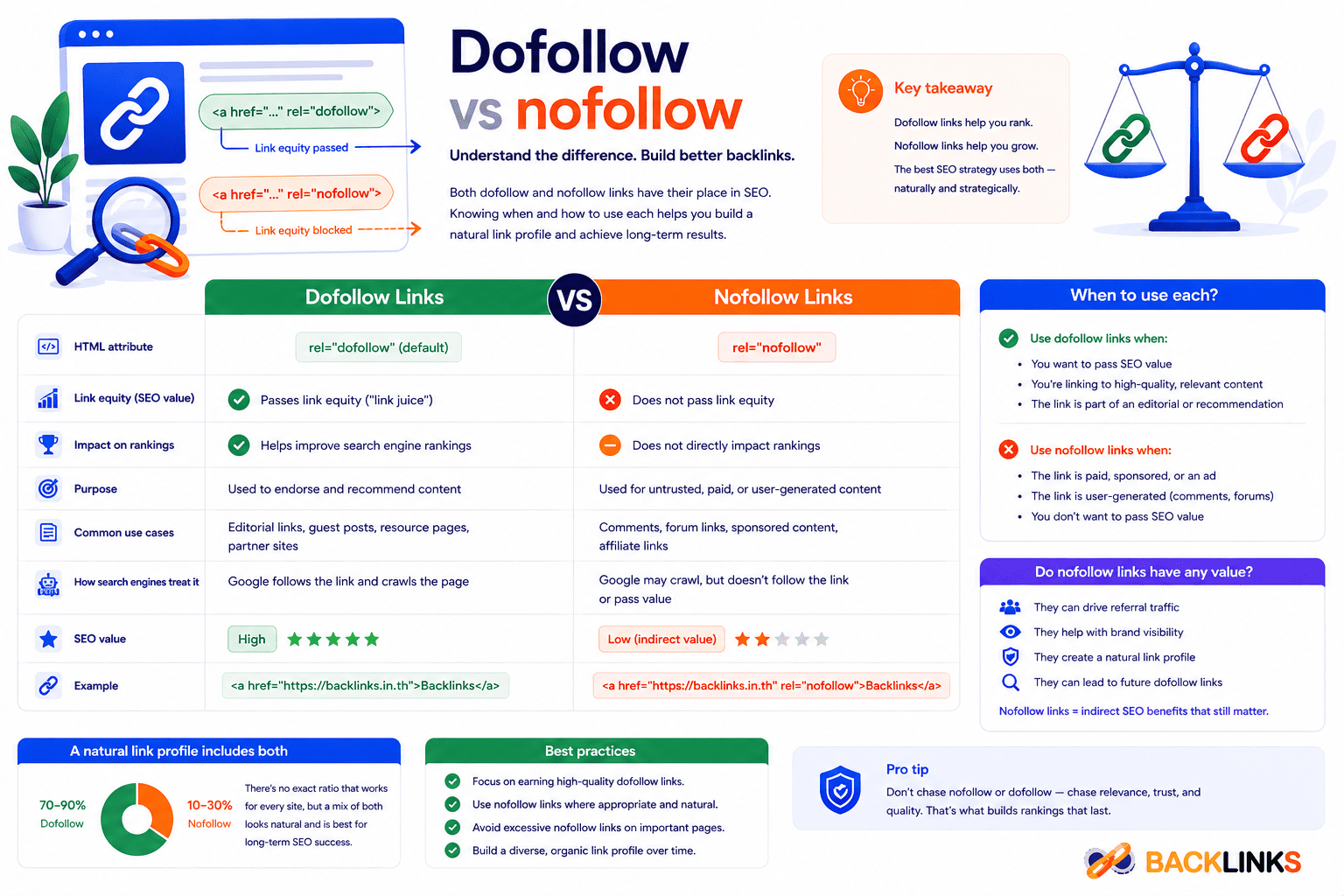
The terms dofollow and nofollow describe how search engines are instructed to treat a hyperlink.
A dofollow link is a standard hyperlink that can pass ranking signals from one page to another. There is no special “dofollow” tag required; by default, most regular links are treated as followable unless another attribute is added.
A nofollow link includes a rel="nofollow" attribute. This tells search engines that the linking site does not want to fully endorse the destination page or pass traditional link equity in the same way.
In simple terms:
- Dofollow links can contribute more directly to rankings
- Nofollow links may still provide visibility, referral traffic, and natural profile diversity
The key mistake is assuming nofollow links have no value at all. Their role is different, but they can still support a broader SEO strategy.
Why Dofollow vs Nofollow Matters
It Affects Link Equity
Dofollow links are generally more valuable for passing authority. If a relevant, trusted website links to your page with a standard link, that link can help strengthen your page’s ranking potential.
Nofollow links are less direct. They are not usually relied on as primary authority signals, but they may still contribute indirectly through discovery, traffic, and brand exposure.
It Helps Create a Natural Link Profile
A natural link profile rarely contains only dofollow links. Real websites earn links from social platforms, directories, forums, comments, press mentions, and user-generated content, many of which are nofollow.
A backlink profile with a mix of dofollow and nofollow links often looks more realistic than one made entirely of optimized dofollow placements.
It Reduces Risk in Linkbuilding
Understanding link attributes is especially important when dealing with paid backlinks, sponsored content, or user-generated links.
Using the correct attributes helps reduce risk and keeps linkbuilding activity aligned with search engine expectations.
How Dofollow and Nofollow Links Work
Standard Dofollow Links
A dofollow link is simply a normal HTML link without a restrictive rel attribute. Search engines can crawl it, interpret the anchor text, and may pass authority through it.
For example, if a relevant SEO blog links to your guide using a natural anchor, that link can help reinforce topical relevance and authority.
Nofollow Links
A nofollow link uses the rel="nofollow" attribute. This signals that the link should not be treated as a full editorial endorsement.
Nofollow links are common in:
- Blog comments
- Forums
- Some directories
- Social media profiles
- Certain sponsored or contributed content
While nofollow links are not the main target in most linkbuilding campaigns, they can still play a useful supporting role.
Related Attributes: Sponsored and UGC
Modern link attributes also include:
rel="sponsored"for paid or sponsored linksrel="ugc"for user-generated content
These attributes give search engines more context about why a link exists. For ethical and risk-aware SEO, using the correct attribute matters.
Important Subtopics in Dofollow vs Nofollow
SEO Value Beyond Link Equity
A link’s value is not limited to whether it is dofollow. A nofollow link from a highly relevant site can still send qualified referral traffic, increase brand visibility, and lead to future editorial links.
For example, a nofollow mention in a trusted industry publication may attract readers who later reference your content elsewhere.
Anchor Text and Context
Anchor text still matters, but its impact depends on link type and context. A dofollow link with a natural anchor in relevant content is stronger than a keyword-heavy link placed in a weak or unrelated page.
This connects directly with anchor text SEO, where balance and context are more important than forcing exact-match keywords.
Link Profile Balance
A healthy backlink profile includes variation. If every link is dofollow, keyword-rich, and acquired from similar sources, the pattern may appear unnatural.
A balanced profile may include dofollow editorial links, nofollow mentions, branded links, URL anchors, and links from different content types.
Internal Links Are Different
The dofollow vs nofollow distinction is mainly discussed in the context of external links. For internal links, most websites should generally allow links to be followed so authority can flow naturally through the site.
In a pillar-and-cluster structure, internal links help distribute authority from core pages to related cluster articles.
Common Mistakes
Ignoring Nofollow Links Completely
Many marketers dismiss nofollow links too quickly. While they may not pass authority in the same way, they can still support traffic, discovery, and brand credibility.
Chasing Only Dofollow Links
A link profile made only of dofollow placements may look unnatural, especially if those links are acquired through repetitive tactics.
Misusing Nofollow on Internal Links
Adding nofollow to internal links without a clear reason can restrict how authority moves through your own site. This can weaken site architecture and reduce the effectiveness of internal linking.
Treating All Dofollow Links as Valuable
A dofollow link from an irrelevant, low-quality, or spammy site may provide little benefit and can contribute to risk.
Forgetting Sponsored Link Rules
Paid placements should be handled carefully. If a link exists because of compensation, the correct attribute may be needed to reduce compliance risk.
Practical Guidance
Prioritize Relevant Dofollow Links
For ranking impact, relevant dofollow links from trusted sites are usually the most valuable. Focus on placements where the link fits naturally within the content.
Accept Useful Nofollow Links
Do not reject nofollow links automatically. If a link can send relevant traffic or strengthen brand visibility, it may still be worthwhile.
Build a Balanced Backlink Profile
Use a mix of linkbuilding methods, such as guest blogging, linkbuilding outreach, niche edits, and content-driven link acquisition. This creates more natural diversity in link type and source.
Monitor Link Attributes
During backlink audits, review whether links are dofollow, nofollow, sponsored, or UGC. This helps you understand the true strength and risk profile of your backlinks.
Align With Long-Term SEO Strategy
Dofollow links may drive stronger ranking signals, but sustainable SEO depends on the overall quality of your profile. Relevance, content quality, anchor diversity, and internal linking all matter.
Timing and Expectations
Dofollow links may influence rankings after search engines crawl and evaluate the linking page, but the timeline varies. Some effects may appear within weeks, while stronger improvements often take longer.
Nofollow links are usually more indirect. Their value may come through referral traffic, brand exposure, or future link opportunities rather than immediate ranking movement.
Both types should be evaluated as part of a larger SEO system rather than isolated link events.
Conclusion
The difference between dofollow vs nofollow is important, but it should not be reduced to “good links” and “bad links.”
Dofollow links generally carry more direct SEO value because they can pass authority and reinforce relevance. Nofollow links, while less direct, can still contribute to visibility, traffic, and a natural backlink profile.
A strong linkbuilding strategy does not rely on one link type alone. It focuses on quality, relevance, context, and balance.
When dofollow and nofollow links are understood correctly, they become part of a healthier, more sustainable approach to building authority and improving search performance.