
How to Remove Toxic Backlinks: A Practical Guide to Protecting Your SEO Performance
Backlinks are a core part of SEO, but not all links contribute positively. Over time, many websites accumulate links that offer no value—or worse, introduce risk. These are often referred to as toxic backlinks.
The challenge is not just identifying them, but deciding when and how to act. Removing the wrong links can reduce your site’s authority, while ignoring harmful patterns can lead to ranking loss or long-term trust issues.
This article explains how to remove toxic backlinks in a structured, strategic way. It focuses on practical decision-making rather than reactive cleanup, helping you maintain a healthy link profile that supports sustainable SEO growth.
What Does It Mean to Remove Toxic Backlinks
To remove toxic backlinks means identifying and addressing links that negatively impact your site’s credibility or appear manipulative in the eyes of search engines.
In practice, this does not always mean physically deleting the link. The process typically involves:
- Evaluating link quality and relevance
- Attempting removal through outreach
- Using tools such as disavow when necessary
A toxic backlink is not simply a low-quality link. It is a link that contributes to problematic patterns, such as unnatural anchor usage or associations with spam networks.
Understanding this distinction is critical before taking action.
Why Removing Toxic Backlinks Matters
Protecting Rankings and Visibility
Search engines evaluate backlink profiles holistically. A pattern of suspicious links can lead to reduced trust signals, even if individual links seem insignificant.
Removing or neutralizing toxic backlinks helps prevent these patterns from affecting rankings.
Supporting Long-Term Authority
A clean backlink profile allows high-quality links to carry more weight. When toxic signals are reduced, the overall authority of the domain becomes clearer and more stable.
Avoiding Manual Actions
In severe cases, unnatural links can trigger manual penalties. Addressing toxic backlinks proactively reduces the likelihood of needing reactive recovery efforts.
Improving Linkbuilding Efficiency
If a backlink profile contains large numbers of low-value or harmful links, it becomes harder to measure the impact of new, high-quality links. Cleanup improves clarity and performance tracking.
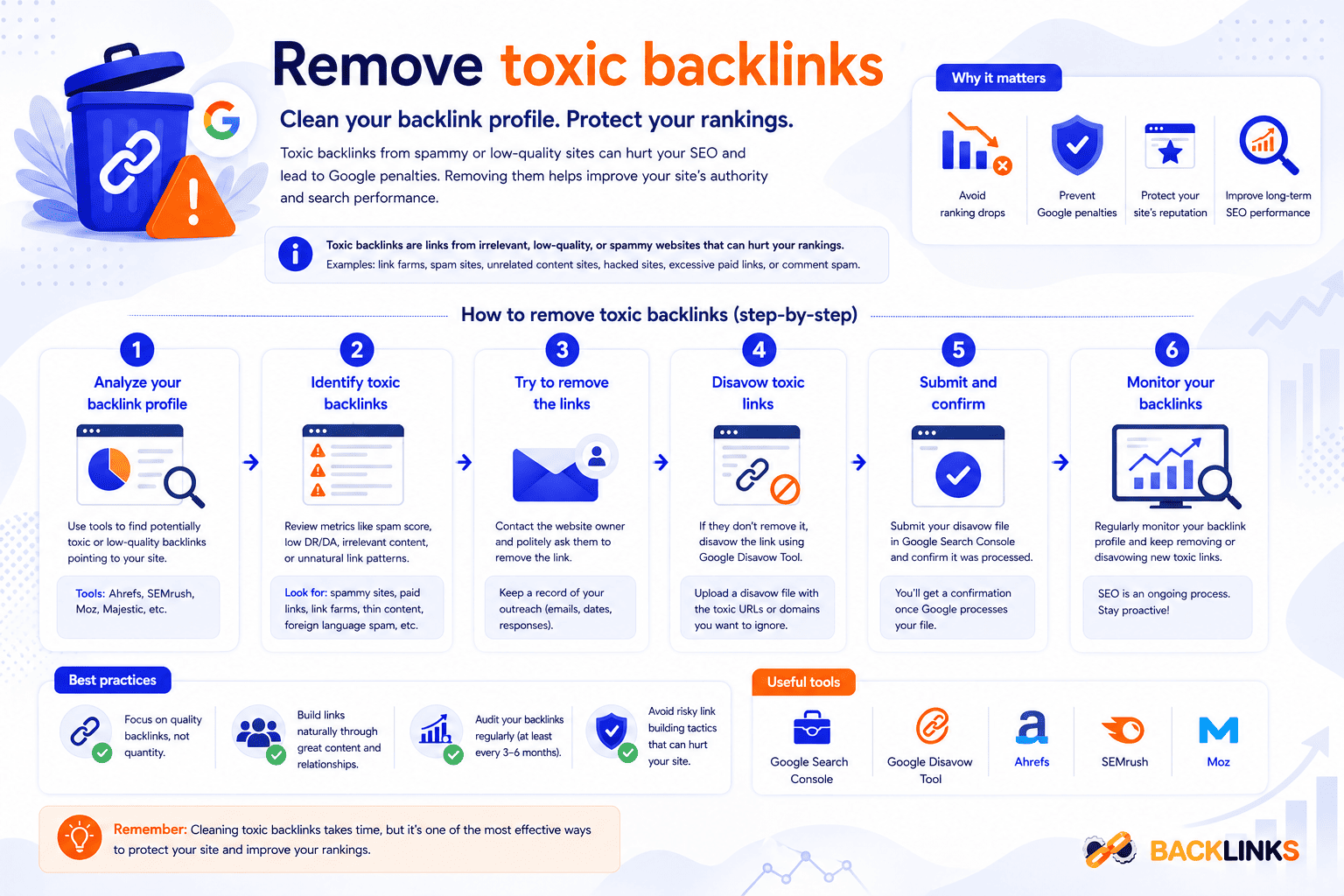
How to Remove Toxic Backlinks
Removing toxic backlinks requires a structured process. Acting without proper evaluation can create more harm than benefit.
Step 1: Audit Your Backlink Profile
Start by reviewing all incoming links using reliable SEO tools. Focus on identifying patterns rather than isolated links.
Key indicators include:
- Links from irrelevant or unrelated niches
- Domains with low-quality or thin content
- Repetitive anchor text targeting commercial keywords
- Clusters of links from similar or interconnected sites
The goal is to understand whether there is a systemic issue, not just individual anomalies.
Step 2: Evaluate Link Intent and Risk
Not every suspicious link requires removal. It is important to distinguish between:
- Low-value links (which can often be ignored)
- Potentially harmful links (which may require action)
Context matters. A single questionable link rarely causes issues, but repeated patterns may signal manipulation.
Step 3: Attempt Manual Removal
Where appropriate, reach out to the website owner and request link removal. This is most relevant for:
- Links placed through previous outreach or partnerships
- Clearly spammy placements on identifiable sites
Responses may be limited, but this step demonstrates due diligence, especially in cases involving manual actions.
Step 4: Use the Disavow Tool Carefully
If removal is not possible, the disavow tool can be used to signal to search engines that certain links should be ignored.
This step should be taken cautiously:
- Only disavow links that present clear risk
- Avoid including entire domains unless necessary
- Review the list carefully before submission
Overuse of disavow can remove legitimate signals and reduce overall authority.
Important Subtopics in Removing Toxic Backlinks
Toxic vs Low-Quality Links
A common misunderstanding is treating all weak links as toxic.
- Low-quality links are often ignored by search engines and do not require action
- Toxic links contribute to patterns that may trigger penalties or devaluation
The focus should be on identifying patterns of risk, not eliminating every imperfect link.
Algorithmic Devaluation vs Manual Penalties
In many cases, search engines simply ignore problematic links rather than penalizing the site.
However, when patterns suggest intentional manipulation, manual actions may occur. This distinction affects how aggressively you need to respond.
Role of Anchor Text Patterns
Anchor text is often a stronger signal than link source alone. A high concentration of exact-match keywords can increase risk, even if the links come from moderately relevant sites.
Balancing anchor diversity is part of both prevention and cleanup.
Integration with Linkbuilding Strategy
Removing toxic backlinks should not be treated as a standalone task. It must align with ongoing linkbuilding efforts.
For example, strengthening your profile through high-quality, relevant links—such as those earned through content-driven strategies or broken link building—helps offset past issues.
Common Mistakes
Removing Too Many Links
Over-cleaning is a frequent issue. Eliminating large numbers of links without clear justification can weaken your backlink profile.
Relying Only on Automated Scores
Many tools assign toxicity scores, but these should not be taken at face value. Manual review is essential for accurate evaluation.
Ignoring Patterns
Focusing on individual links rather than overall patterns can lead to ineffective cleanup. Search engines assess link profiles holistically.
Delaying Action
When there is clear evidence of harmful patterns, delaying action can prolong negative impact and complicate recovery.
Practical Guidance
Focus on Patterns, Not Individual Links
Look for clusters of similar links, repeated anchor text usage, and networks of low-quality domains. These patterns are more important than isolated cases.
Maintain Documentation
Keep records of:
- Links identified as problematic
- Outreach attempts for removal
- Disavow submissions
This is particularly useful if manual review becomes necessary.
Combine Cleanup with Positive Signals
Removing toxic backlinks alone does not improve rankings. It stabilizes your profile. Growth comes from acquiring high-quality, relevant links.
This is where content-driven approaches—such as creating linkbait content or strengthening your topical authority—play a role.
Review Regularly, Not Reactively
Backlink audits should be part of ongoing SEO maintenance. Regular reviews help identify issues early and prevent escalation.
Timing and Expectations
The impact of removing toxic backlinks depends on several factors:
- Whether a manual action is involved
- The extent of the problematic link patterns
- The overall strength of the domain
In general:
- Disavow effects may take weeks to be processed
- Ranking stabilization can take several months
- Full recovery depends on rebuilding trust signals over time
It is important to view cleanup as a stabilization step, not an immediate performance boost.
Conclusion
Removing toxic backlinks is not about eliminating every imperfect link. It is about identifying and addressing patterns that undermine trust and stability in your backlink profile.
A measured approach is essential. Overreaction can weaken your site, while inaction can allow risks to grow.
The most effective strategy combines careful cleanup with ongoing improvement. By focusing on relevance, diversity, and high-quality link acquisition, you create a backlink profile that supports long-term SEO performance.
Ultimately, the goal is not just to remove risk, but to build a foundation that can sustain growth as search engine evaluation continues to evolve.