
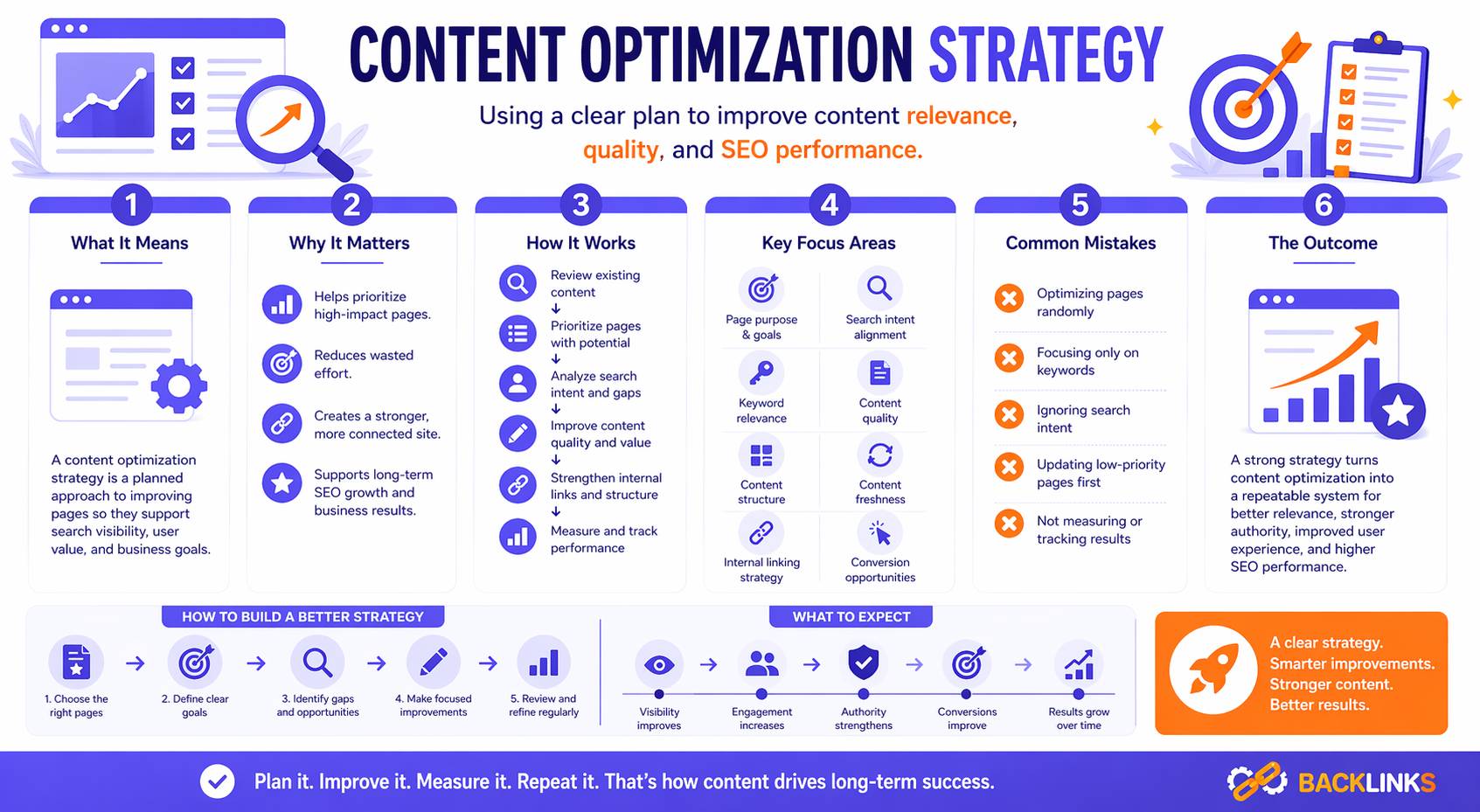
Content Optimization Strategy: How to Improve Content Systematically for Better SEO Results
A content optimization strategy is a structured approach to improving website content so it performs better in search, supports business goals more effectively, and fits clearly within the broader site architecture.
This matters because content rarely performs at its best just because it has been published. Pages may target useful topics but still underperform because they are misaligned with search intent, too thin, poorly structured, outdated, weakly linked, or disconnected from the wider content strategy. A content optimization strategy helps solve those problems systematically instead of treating content improvement as a series of random edits.
For businesses, marketers, and SEO teams, this is one of the most practical ways to build stronger organic performance over time. Rather than relying only on net-new content production, a strong strategy improves the value of content you already have while strengthening topical authority, internal linking, and conversion pathways across the site.
What Is a Content Optimization Strategy
A content optimization strategy is a plan for improving content quality, relevance, structure, and performance across a website.
In practical terms, it defines how you will evaluate pages, prioritize opportunities, make improvements, and measure results. It turns content optimization from an occasional task into a repeatable SEO process.
A strong content optimization strategy usually answers questions such as:
- which pages should be optimized first
- what criteria should be used to evaluate content
- how search intent should guide updates
- how internal linking should support important pages
- when a page should be refreshed, rewritten, merged, or removed
- how optimized content should support the wider topic structure of the site
Without a strategy, content optimization often becomes inconsistent. Teams make surface-level changes, improve pages in isolation, or spend time on low-impact updates. With a strategy, content improvement becomes more deliberate and more likely to produce meaningful results.
Why a Content Optimization Strategy Matters
Content optimization matters because websites often have more untapped value in existing pages than they realize. The issue is not always a lack of content. It is often a lack of refinement, prioritization, and structural clarity.
It improves the performance of existing assets
Many pages already have indexation, impressions, ranking history, or business relevance. A good content optimization strategy helps identify which of those pages deserve improvement and what type of improvement will create the most value.
It creates a more efficient SEO process
Without a strategy, optimization work is often reactive. Teams update pages because rankings dipped slightly or because a page feels old. A strategic framework makes the process more efficient by defining what to review, how to review it, and how to prioritize action.
It strengthens topical authority
A website builds stronger subject relevance when its pages are maintained as part of a coherent content system. Optimization helps ensure that important pages are updated, supporting pages stay aligned with them, and topic relationships remain clear.
It improves user experience and business value
Content optimization is not just about rankings. Better content also creates clearer journeys for users, stronger internal navigation, and more relevant paths toward enquiry, lead generation, or purchase.
How a Content Optimization Strategy Works
A content optimization strategy works by combining content review, SEO analysis, editorial judgment, and structured prioritization.
At a high level, the strategy should help you decide what to optimize, why it matters, and how each page should be improved.
Start with business and topic priorities
The strongest strategy begins with business relevance. Not every page deserves the same level of attention. Pages tied to important services, high-value topics, strong search demand, or key stages of the customer journey should usually be prioritized first.
This helps ensure optimization supports business goals rather than becoming a purely academic SEO exercise.
Evaluate pages by intent and usefulness
A page should be assessed not only by traffic but also by whether it serves the right intent and provides enough value. A content optimization strategy should include clear criteria for reviewing whether a page is still relevant, still competitive, and still useful to the audience.
Separate content actions clearly
Not every page needs the same treatment. Some need light updates. Some need a full rewrite. Some need better internal links. Some need consolidation. Some should be removed or redirected.
A useful strategy makes those distinctions clear instead of applying the same type of update to every weak page.
Support site structure, not just individual pages
Content optimization should strengthen the wider architecture of the site. That means improving relationships between broad and specific pages, reinforcing topic clusters, and making internal linking more purposeful.
Core Elements of a Content Optimization Strategy
A strong strategy depends on several connected elements working together.
Content Audit Framework
A content audit is often the foundation of a content optimization strategy. It helps you understand what exists, how pages are performing, where overlap exists, and which content assets have the most potential.
The audit should not only capture performance metrics. It should also evaluate page purpose, intent match, content quality, freshness, internal linking, and business relevance.
Search Intent Alignment
Search intent should guide optimization decisions at every stage. A page that targets the wrong intent will usually struggle no matter how well it is edited.
For an informational page, the strategy should focus on clarity, completeness, and usefulness. For pages with commercial relevance, optimization may also need to improve conversion pathways without weakening the informational value.
Prioritization Model
One of the most important parts of a content optimization strategy is deciding what to optimize first.
Useful prioritization factors often include:
- business importance
- existing impressions or rankings
- traffic potential
- conversion relevance
- content quality issues
- overlap or cannibalization
- strategic role in the site structure
Without prioritization, teams often spend time improving low-impact pages while stronger opportunities remain untouched.
On-Page Improvement Standards
A strategy should define what good optimization looks like at the page level. This may include standards for headings, topic coverage, keyword targeting, content depth, readability, metadata, and internal links.
These standards help make optimization more consistent across the site.
Internal Linking Strategy
Content optimization should improve how pages support one another. Important pages should receive stronger contextual links, supporting content should connect naturally to broader topic pages, and orphaned pages should be addressed.
This helps search engines understand topic relationships and helps users move through the site more naturally.
Content Governance
A good strategy also includes ongoing review. Important pages should not be optimized once and forgotten. Content changes, search expectations shift, and competitors improve. Governance helps ensure that strong pages stay strong.
How to Build a Content Optimization Strategy
A practical strategy should be structured enough to guide decisions but flexible enough to adapt to different types of pages.
Identify your key topic areas
Start by defining the main subject areas your website wants to build authority around. This helps frame optimization work within a broader content system rather than treating pages as isolated assets.
Pages that support those key topic areas usually deserve greater attention.
Audit existing content
Review the current content inventory and assess which pages are performing, declining, overlapping, outdated, or underdeveloped. This gives you the baseline needed to make informed decisions.
A useful audit should include both quantitative signals and qualitative review.
Group pages by role
Not every page exists for the same reason. Some pages are broad topic pages. Some are focused educational articles. Some are closer to commercial intent. Grouping pages by role makes it easier to optimize them appropriately.
Define action types
Create a clear set of actions for pages under review. For example:
- refresh
- expand
- rewrite
- merge
- redirect
- remove
- improve internal links only
This makes execution more consistent and prevents vague decisions.
Set optimization criteria
Decide how pages will be judged. For example, you may evaluate whether the page matches intent, covers the topic well, has a strong structure, includes natural internal links, and supports the next useful step for the reader.
Create an update workflow
The strategy should also define how optimization work happens in practice. That includes who reviews pages, who approves changes, how updates are documented, and how performance is checked afterwards.
Common Mistakes in Content Optimization Strategy
Many teams try to optimize content regularly but still fail to build an effective strategy.
Optimizing without prioritization
This leads to scattered effort. Teams spend time on whichever page feels easiest to edit rather than the pages most likely to create meaningful SEO or business impact.
Treating every page the same
A broad topic page should not be optimized in the same way as a narrow supporting article or a commercially relevant service page. Different page roles require different standards.
Focusing only on keywords
Keyword relevance matters, but it is only one part of optimization. A strong strategy also addresses intent, structure, usefulness, internal linking, and page purpose.
Ignoring overlap and cannibalization
Some optimization efforts improve individual pages while leaving deeper structural issues unresolved. If multiple pages compete for similar queries, performance often remains limited until that overlap is addressed.
Updating content without measuring impact
Optimization should be tied to outcomes. If no one tracks whether updates improved visibility, engagement, or conversion quality, it becomes difficult to refine the strategy over time.
Practical Guidance for a Stronger Content Optimization Strategy
If you want a better content optimization strategy, begin by shifting from page-level thinking to system-level thinking. Look at how content functions across the site, not just how one article performs on its own.
Focus first on the pages with the clearest combination of business importance and organic potential. Improve those pages so they are more aligned with search intent, more complete, better structured, and better supported by internal links.
Then look outward. Review the supporting pages around those important assets. Make sure they are distinct, useful, and connected properly. In many cases, the strongest gains come not just from improving one page, but from improving the topic ecosystem around it.
Keep the process disciplined. Use a consistent review framework, document decisions clearly, and avoid making content longer or more complex unless that change improves actual value.
Most importantly, treat optimization as an ongoing strategic function. The goal is not to make content look updated. The goal is to make it more competitive, more useful, and more valuable to the business.
Timing and Expectations
A content optimization strategy can begin producing value faster than a net-new content strategy because it often focuses on pages that already exist, already rank to some degree, or already contribute to the business.
Still, results are rarely immediate. Search engines need time to recrawl and reassess updated pages, and larger gains often depend on how substantial the improvements are. A stronger strategy usually produces cumulative returns over time as the website becomes more focused, more coherent, and more useful.
It is also important to be realistic about scope. Once you begin auditing and prioritizing content properly, you may uncover more structural work than expected. That is normal. A better strategy often reveals how much hidden inefficiency has built up over time.
Conclusion
A content optimization strategy is the framework that turns content improvement into a meaningful SEO discipline instead of a series of disconnected edits.
It helps you identify which pages matter most, decide how they should be improved, align content with search intent, strengthen internal relationships across the site, and maintain higher quality standards over time. More importantly, it helps ensure that content supports broader business goals instead of simply existing for traffic alone.
For any website serious about organic growth, content optimization should be planned strategically. Publishing content creates opportunity, but optimization is what helps that opportunity mature into stronger rankings, better user journeys, and more durable long-term results.