
How Linkbuilding Works: A Practical SEO Guide
How linkbuilding works is an important question for anyone trying to improve organic rankings, build website authority, and understand why some pages perform better than others in search results. Linkbuilding is not simply the act of getting backlinks; it is the process of earning trust signals from other websites that help search engines evaluate the credibility and relevance of your content.
In SEO, backlinks act as external references. When another website links to your page, it creates a connection between its content and yours. Search engines use these connections to understand how pages relate to each other, which sites are trusted, and which resources deserve stronger visibility.
This article explains how linkbuilding works in practical terms, what makes a backlink valuable, how search engines interpret links, and how to approach linkbuilding in a way that supports sustainable SEO performance.
What is Linkbuilding?
Linkbuilding is the process of acquiring links from other websites to your own website. These links are commonly called backlinks or inbound links.
A backlink is a clickable hyperlink that points from one web page to another. For example, if a marketing blog references your SEO guide and links to it, that link becomes a backlink to your website.
From an SEO perspective, backlinks matter because they act as signals of credibility. If reputable websites link to your content, search engines may interpret that as evidence that your page is useful, trustworthy, or authoritative.
However, linkbuilding is not about collecting as many links as possible. Modern SEO focuses on link quality, relevance, context, and natural link acquisition.
Why Linkbuilding Matters for SEO
Linkbuilding matters because search engines use links to evaluate authority and relevance. While algorithms consider many ranking factors, backlinks remain one of the strongest external signals.
A page with high-quality backlinks can often rank more competitively because those links help demonstrate that other websites consider the page valuable.
Links Help Search Engines Discover Pages
Search engines crawl the web by following links. When a page is linked from another website, it becomes easier for crawlers to discover and revisit that page.
This is especially useful for newer websites, newly published content, or pages that are not yet strongly connected through internal links.
Links Help Build Page Authority
Backlinks can pass authority from one page to another. This concept is often described as link equity.
When an authoritative page links to your content, some of that authority may help strengthen your page’s ability to rank. The value passed depends on the quality, relevance, and structure of the link.
Links Support Topical Authority
When multiple relevant websites link to your content around a specific subject, it can reinforce your site’s authority within that topic.
For example, if a website publishes several strong resources about SEO and earns backlinks to pages about keyword research, technical SEO, content optimization, and linkbuilding, search engines may begin to associate the site with broader SEO expertise.
This is why linkbuilding works best when it supports a clear content structure rather than isolated pages.
How Linkbuilding Works
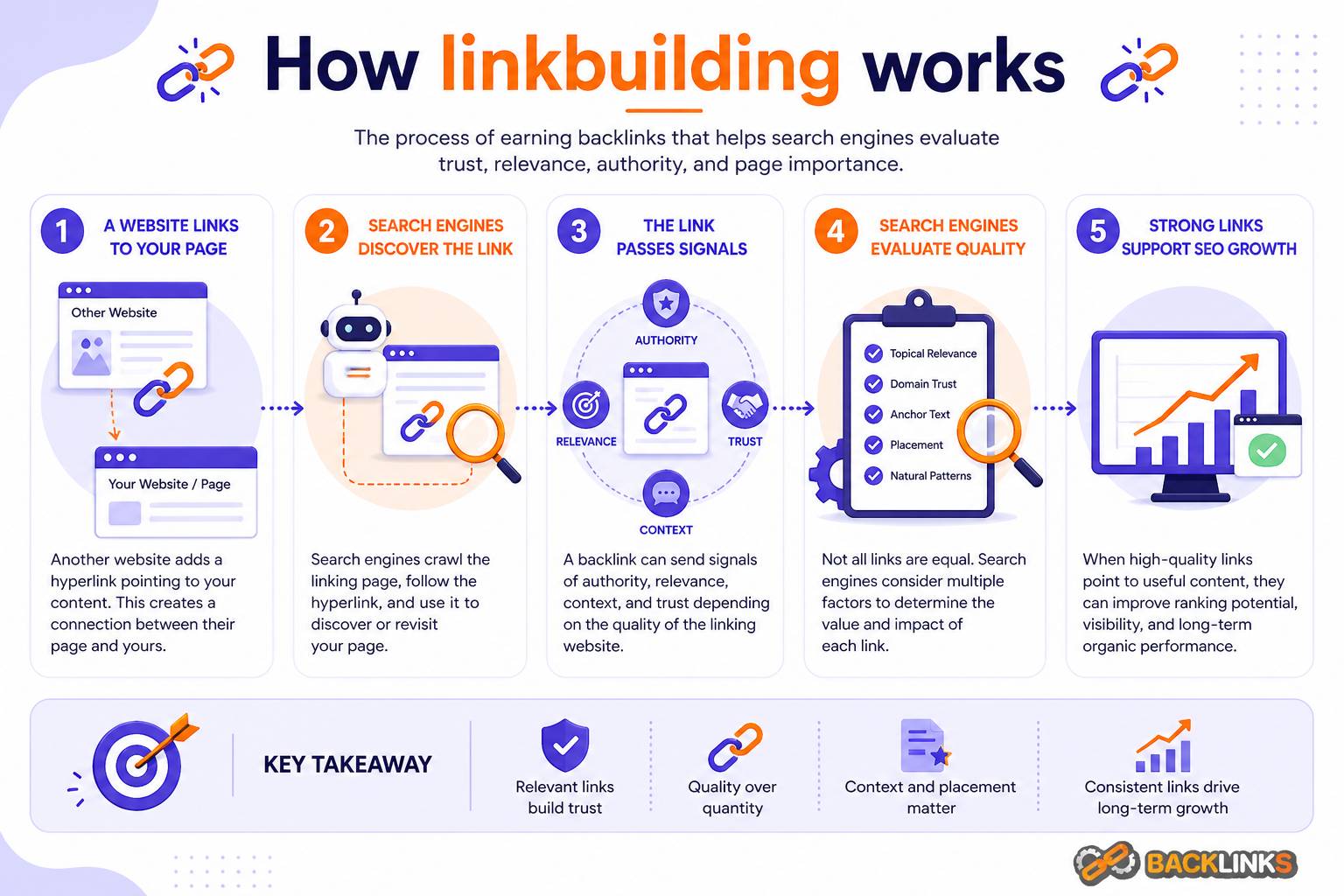
Linkbuilding works by creating external signals that help search engines assess the value of a page. These signals are not judged equally. Search engines evaluate backlinks using several layers of context.
1. A Website Links to Your Page
The process begins when another website adds a hyperlink pointing to your content. This link may appear in a blog post, guide, resource page, news article, directory, or other type of web content.
The reason for the link matters. A link placed naturally because your content is useful is generally more valuable than a link placed only for SEO purposes.
2. Search Engines Crawl the Link
Once the linking page is crawled, search engines may discover the backlink. They analyze the source page, the destination page, the anchor text, and the surrounding content.
This helps determine whether the link is relevant and trustworthy.
3. The Link Sends Contextual Signals
A backlink gives search engines information about your page. The linking website, the topic of the page, and the words used in the link all provide context.
For example, if a reputable SEO publication links to your article about linkbuilding using natural anchor text, that link reinforces the relevance of your page to SEO and backlink-related topics.
4. Authority May Be Passed
If the link is crawlable and not blocked by certain attributes, it may pass authority. This authority can contribute to the ranking potential of the linked page.
However, the amount of value passed depends on many factors, including the credibility of the linking site, the number of other links on the page, and the relevance of the content.
5. Rankings May Improve Over Time
Linkbuilding rarely produces immediate results. Search engines need time to crawl links, evaluate patterns, and reflect those signals in rankings.
A single backlink may help, but the broader impact usually comes from a consistent pattern of high-quality, relevant links over time.
What Makes a Backlink Valuable?
Not every backlink improves SEO performance. Some links are highly valuable, while others provide little benefit or may even create risk.
Relevance
Relevance is one of the most important factors in linkbuilding. A backlink from a website in the same or closely related industry is usually more meaningful than a random link from an unrelated site.
Search engines assess relevance at multiple levels:
- The linking domain
- The specific linking page
- The surrounding paragraph
- The anchor text used in the link
A relevant link helps search engines understand why your page deserves attention for a particular topic.
Authority
A link from a trusted, established website generally carries more weight than a link from a low-quality or unknown site.
Authority is influenced by the linking website’s own backlink profile, content quality, editorial standards, and reputation.
This does not mean only large websites matter. A smaller niche website can still provide strong value if it is trusted and highly relevant.
Editorial Context
Links placed naturally within the main content of a page tend to be more valuable than links placed in footers, sidebars, or unrelated lists.
Editorial links are powerful because they usually exist as part of a genuine recommendation or citation.
Anchor Text
Anchor text is the clickable text of a hyperlink. It helps search engines understand the topic of the linked page.
For example, anchor text such as “guide to linkbuilding” gives clearer context than generic text such as “click here.”
However, anchor text must remain natural. Repeating exact-match keywords too often can look manipulative. A healthy backlink profile includes varied anchors, such as branded anchors, partial-match phrases, URLs, and natural descriptive text.
Link Attributes
Some links include attributes that tell search engines how to treat them. Common examples include:
- Dofollow links: Standard links that may pass authority.
- Nofollow links: Links that suggest search engines should not pass ranking value in the same way.
- Sponsored links: Used for paid or sponsored placements.
- UGC links: Used for user-generated content, such as comments or forum posts.
A natural backlink profile may include different types of links. The goal is not to force every link to be dofollow, but to build a credible overall profile.
Linkbuilding Methods That Work
There are several practical ways to build links. The best method depends on your niche, content quality, resources, and level of competition.
Content-Led Linkbuilding
This approach focuses on creating content that deserves to be referenced. Examples include detailed guides, original research, useful tools, templates, case studies, and expert explanations.
Content-led linkbuilding works because it gives other websites a reason to link to you.
Outreach-Based Linkbuilding
Outreach involves contacting website owners, editors, journalists, or bloggers to introduce your content.
Good outreach is not generic. It explains why the content is relevant, how it helps their audience, and where it fits naturally.
Poor outreach focuses only on asking for a link. Effective outreach focuses on mutual relevance.
Broken Link Building
Broken link building involves finding dead links on relevant websites and suggesting your content as a replacement.
This works because it helps the website owner fix a problem while giving your content a chance to earn a useful backlink.
Resource Page Linkbuilding
Some websites maintain curated resource pages. If your content is genuinely useful and relevant, you can suggest it for inclusion.
This method works best when your content is practical, comprehensive, and clearly aligned with the page’s purpose.
Digital PR
Digital PR focuses on earning links through newsworthy content, expert commentary, industry insights, or unique perspectives.
This can produce high-quality links, but it usually requires strong positioning and a clear reason for publishers to mention your brand.
Common Mistakes in Linkbuilding
One common mistake is focusing only on the number of backlinks. A large number of weak links is usually less valuable than a smaller number of relevant, authoritative links.
Another mistake is ignoring relevance. Links from unrelated websites rarely support long-term authority.
Over-optimized anchor text is also risky. If too many backlinks use the exact same keyword phrase, the profile may look unnatural.
Some websites also build links to the wrong pages. Informational content often attracts links more naturally than commercial pages, but those informational pages should then support important business pages through internal links.
Finally, many businesses expect results too quickly. Linkbuilding takes time because search engines evaluate link patterns gradually.
Practical Guidance for Building Links Safely
Start by improving the quality of your content before pursuing links. A page that is shallow, poorly structured, or too promotional will be difficult to promote successfully.
Next, identify pages that are worth building links to. These may include pillar guides, educational resources, comparison pages, tools, or original insights.
Then research where similar content has earned backlinks. Competitor backlink analysis can reveal realistic opportunities and show what types of content attract links in your niche.
When reaching out, prioritize relevance over scale. A small number of carefully targeted outreach messages often performs better than mass email campaigns.
You should also monitor your backlink profile regularly. Look for new links, lost links, unusual patterns, and anchor text distribution. This helps you understand what is working and where risk may exist.
Timing and Expectations
Linkbuilding is a long-term SEO activity. Results are usually gradual rather than immediate.
Search engines need time to discover new links, evaluate their quality, and adjust rankings accordingly. Competitive keywords may require sustained linkbuilding over several months or longer.
The most reliable approach is consistent effort. Building a few strong links each month from relevant sources is usually more sustainable than chasing sudden spikes in backlink volume.
Conclusion
Understanding how linkbuilding works is essential for building a strong SEO strategy. Links help search engines discover pages, evaluate authority, understand relevance, and compare competing content.
The quality of backlinks matters more than the quantity. Relevance, authority, editorial context, anchor text, and natural growth patterns all influence how much value a link can provide.
Effective linkbuilding is not about shortcuts. It is about creating content worth referencing, earning links from relevant sources, and building authority over time.
When done strategically, linkbuilding becomes more than a ranking tactic. It becomes a long-term trust-building process that strengthens your website’s visibility, credibility, and competitive position in search.