
Keyword Research: The Foundation of Smarter SEO Strategy
Keyword Research is one of the most important foundations of search engine optimization. Before a website can earn meaningful organic traffic, it needs to understand what people search for, why they search for it, and what kind of content is most likely to satisfy that demand.
Many SEO problems begin with weak keyword research. A business may publish articles regularly, optimize page titles, add internal links, and improve technical performance, but still fail to grow organic traffic because the content is not aligned with real search behavior. In other cases, a website may target keywords that are too broad, too competitive, too vague, or disconnected from the audience’s actual needs.
Effective keyword research brings structure to SEO. It helps you identify opportunities, prioritize content, understand search intent, and build a website that answers the right questions at the right depth. It also prevents content teams from relying on assumptions. Instead of creating pages based only on internal opinions, you can use search data to understand how your market thinks, compares, evaluates, and makes decisions.
This guide explains what keyword research is, why it matters, how the process works, and how to use it as a strategic framework for long-term SEO growth.
What is Keyword Research?
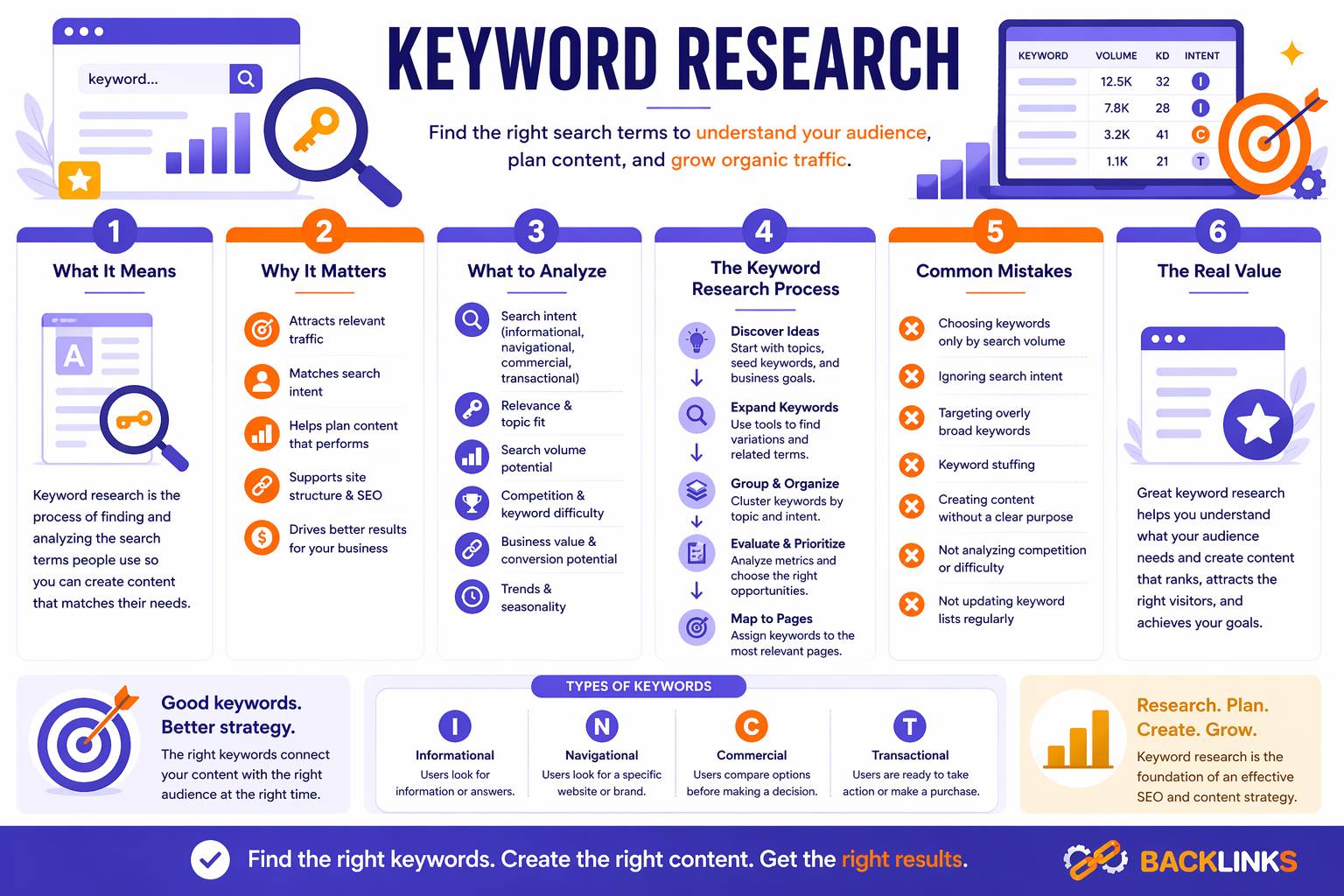
Keyword Research is the process of finding, analyzing, and prioritizing the words and phrases people use when searching online.
In SEO, a keyword is not just a single word. It can be a short phrase, a question, a comparison, a brand-related search, or a highly specific query. For example, “SEO” is a broad keyword, while “how to do keyword research for a new website” is a more specific search query with clearer intent.
Keyword research helps answer several important questions:
- What topics does your audience care about?
- How do people describe their problems?
- Which searches show learning intent, comparison intent, or buying intent?
- How competitive is each keyword?
- What type of content should be created for each search?
At a practical level, keyword research connects audience demand with website content. It helps you decide which pages to create, how to structure them, what questions to answer, and how to organize related topics across your site.
Good keyword research does not mean choosing the keyword with the highest search volume. It means choosing the right keywords for your audience, your business goals, your current authority level, and your ability to create genuinely useful content.
Why Keyword Research Matters for SEO
Keyword research matters because SEO is built around relevance. Search engines need to understand what your page is about, and users need to feel that your content matches what they were looking for.
Without keyword research, SEO becomes guesswork. You may publish content that sounds useful internally but does not reflect how people actually search. You may also miss important opportunities because you are using industry language while your audience uses simpler or more specific terms.
It Helps You Understand Real Search Demand
Keyword research gives you insight into real user behavior. Instead of assuming what people want, you can see the language they use and the topics they repeatedly search for.
This matters because businesses often describe their products, services, or expertise differently from their customers. A company may use technical terms, while customers search using everyday language. Keyword research closes that gap.
For example, an SEO professional may talk about “information architecture,” while many users search for “website structure for SEO” or “how to organize website content.” Both may relate to the same topic, but the wording reveals different levels of understanding.
It Aligns Content with Search Intent
Search intent is the reason behind a search. A person searching for “what is keyword research” expects a different page from someone searching for “best keyword research tools” or “keyword research agency.”
If the content does not match the intent, rankings are difficult to sustain. Even if the page is well written, users may leave quickly because it does not answer the type of question they had in mind.
Keyword research helps you identify whether a search is mainly informational, commercial, transactional, or navigational. For this topic, the intent is informational. That means the page should educate the reader, explain the concept clearly, and provide practical guidance rather than push a product or service too aggressively.
It Supports Better Content Planning
A strong SEO strategy needs more than individual articles. It needs a structured content plan that covers broad topics, supporting questions, related concepts, and deeper subtopics.
Keyword research helps you build that plan. It shows which topics deserve comprehensive pages, which topics should become focused supporting articles, and which keywords may be better addressed within existing content.
For example, a broad topic such as Keyword Research may naturally connect to more specific articles about keyword difficulty, search intent, long-tail keywords, competitor keyword analysis, using keywords in content, and content optimization tools.
This structure helps your website become more useful and easier for search engines to understand.
It Improves Traffic Quality
Not all organic traffic has the same value. A keyword with high search volume may attract visitors who are not relevant to your business. A lower-volume keyword may bring fewer visitors but better engagement because the searcher’s need is more specific.
Keyword research helps you balance traffic potential with relevance. The goal is not simply to attract more visitors. The goal is to attract the right visitors: people who are likely to read, engage, compare, subscribe, inquire, or eventually become customers.
It Reduces Wasted SEO Effort
SEO takes time. Creating content, optimizing pages, building links, and improving site structure all require effort. Targeting the wrong keywords wastes that effort.
Keyword research helps prevent common strategic mistakes such as:
- Creating content no one searches for
- Targeting keywords that are too competitive too early
- Publishing multiple pages that compete with each other
- Ignoring valuable long-tail opportunities
- Misjudging the type of content needed to rank
A clear keyword strategy improves decision-making before content production begins.
How Keyword Research Works
Keyword research is not a single action. It is a process that moves from broad discovery to focused prioritization.
The exact workflow may vary depending on the website, industry, and available tools, but the core principles remain the same.
Start with Business and Audience Understanding
Before using keyword tools, start with the business context.
A keyword may have search volume, but that does not automatically make it valuable. The keyword must connect to the audience you want to reach and the expertise your website can credibly provide.
Start by clarifying:
- Who is the target audience?
- What problems are they trying to solve?
- What topics are directly relevant to the business?
- Which services, products, or expertise areas need organic visibility?
- What stage of awareness is the audience in?
This step matters because keyword tools show search data, but they do not fully understand your business model. Human judgment is needed to decide whether a keyword is strategically useful.
For example, a website offering SEO services may find high-volume keywords about social media marketing. Those searches might be related to digital marketing, but they may not be the best priority if the site’s core authority and service offering are focused on SEO.
Build a List of Seed Topics
Seed topics are broad starting points for keyword research. They represent the main areas your audience cares about.
For an SEO website, seed topics might include:
- Keyword research
- Technical SEO
- Content optimization
- Link building
- Internal linking
- SEO strategy
- On-page SEO
These broad topics are not always the final keywords you target. Instead, they help you generate related search terms, questions, and subtopics.
A seed topic like “keyword research” can expand into related searches such as:
- how to do keyword research
- keyword research tools
- keyword difficulty
- long-tail keywords
- search intent
- competitor keyword analysis
- keyword mapping
- keyword strategy
This expansion is where the research begins to become useful.
Identify Keyword Variations
Once you have seed topics, the next step is to find keyword variations. These variations reveal how people search for the same or related ideas.
Keyword variations can include short phrases, long-tail searches, questions, comparisons, and problem-based queries.
For example, around the topic Keyword Research, users may search for:
- what is keyword research
- why is keyword research important
- how to do keyword research for SEO
- keyword research for beginners
- keyword research process
- keyword research strategy
- best keyword research methods
- how to find keywords for website content
These variations help you understand the breadth of the topic. They also help determine which ideas belong on the main page and which may deserve separate supporting articles.
Analyze Search Intent
Search intent is one of the most important parts of keyword research.
A keyword’s wording often reveals what the user expects, but you should also review the search results to confirm. Search engines already show what they believe satisfies the query. If most results are beginner guides, the intent is likely educational. If most results are software comparisons, the intent may be commercial.
Common intent types include:
Informational intent: The user wants to learn something. Example: “what is keyword research.”
Commercial intent: The user is comparing options before making a decision. Example: “best keyword research tools.”
Transactional intent: The user is ready to take an action. Example: “buy SEO keyword research report.”
Navigational intent: The user wants a specific website, brand, or tool. Example: “Google Keyword Planner.”
For an informational page, the content should explain concepts clearly, answer common questions, and guide the reader through the topic. It should not be written like a product landing page.
Evaluate Keyword Difficulty and Competition
Keyword difficulty helps estimate how hard it may be to rank for a keyword. Most SEO tools provide a difficulty score, but that score should be treated as a guide, not a final decision.
A keyword may look difficult because strong websites rank for it. However, if the current ranking pages are outdated, shallow, poorly structured, or missing important subtopics, there may still be an opportunity.
When evaluating competition, look at:
- The authority of ranking domains
- The quality and depth of ranking pages
- The freshness of the content
- The format of the results
- The number of strong pages targeting the exact topic
- Whether your site can provide a better or more specific answer
Competition analysis should be realistic. A new website should not build its entire strategy around extremely competitive broad keywords. It is usually better to target a mix of achievable long-tail keywords, mid-competition topics, and a few larger strategic pages designed for long-term growth.
Balance Search Volume with Relevance
Search volume shows how often people search for a keyword, but it does not show whether the keyword is right for your business.
A high-volume keyword may be too broad. A low-volume keyword may be highly relevant and easier to rank for. This is why experienced SEO professionals do not choose keywords based on volume alone.
A strong keyword opportunity usually balances four factors:
- Relevance to the business
- Clear search intent
- Realistic ranking potential
- Enough demand to justify the content
For example, “SEO” has very high search volume, but it is broad and highly competitive. “keyword research for service business websites” may have lower volume, but it may attract a more specific and valuable audience.
Group Keywords by Topic
Modern SEO is not about creating a separate page for every keyword variation. That approach often leads to thin, repetitive content and pages that compete with each other.
Instead, group related keywords into topic sets.
For example, these keywords could belong on one comprehensive page:
- keyword research
- what is keyword research
- keyword research process
- keyword research for SEO
- why keyword research matters
But these may deserve separate focused pages:
- keyword research tools
- long-tail keywords
- keyword difficulty
- search intent
- competitor keyword analysis
The goal is to decide which keywords should be covered together and which need their own dedicated page.
This improves content quality, reduces duplication, and helps search engines understand the depth of your website’s coverage.
Map Keywords to Pages
Keyword mapping is the process of assigning keywords to specific pages.
This step prevents confusion in your SEO strategy. Each important topic should have a clear destination page. If multiple pages target the same keyword too closely, they may compete with each other instead of strengthening the site.
A keyword map should identify:
- The primary keyword for each page
- Supporting keywords
- Search intent
- Recommended page format
- Existing or new URL
- Related internal links
For a topic like Keyword Research, the main page can cover the broad concept, while more specific pages can explore subtopics in greater depth.
This is where keyword research becomes a practical content roadmap.
Important Keyword Research Concepts
Primary Keywords
A primary keyword is the main search phrase a page is targeting. It should represent the central topic of the page.
For this page, the primary keyword is Keyword Research.
The primary keyword helps guide the title, headings, introduction, body content, metadata, and internal linking. However, it should be used naturally. Repeating the exact phrase too often can make the content feel forced and reduce readability.
A page should be written for the topic, not just the exact keyword.
Secondary Keywords
Secondary keywords are closely related terms that support the main topic. They help expand topical relevance and allow the page to rank for a wider range of searches.
For a Keyword Research page, secondary keyword ideas may include:
- keyword research process
- SEO keyword research
- keyword strategy
- keyword analysis
- search intent
- long-tail keywords
- keyword difficulty
- keyword mapping
These terms should appear naturally where they fit. They should not be added mechanically.
Long-Tail Keywords
Long-tail keywords are longer, more specific search phrases. They often have lower search volume but clearer intent.
Examples include:
- how to do keyword research for a new website
- keyword research for local SEO
- how to choose keywords for blog content
- keyword research mistakes to avoid
Long-tail keywords are valuable because they often reflect specific problems. They can also be easier to rank for, especially for newer websites or websites building authority in a competitive space.
Over time, many long-tail rankings can contribute significant traffic.
Search Intent
Search intent determines what kind of content is needed.
For example, a person searching “what is keyword research” likely wants a clear explanation. A person searching “keyword research tools” likely wants software options, features, or comparisons. A person searching “keyword research services” may be closer to hiring help.
If you target these keywords with the wrong page type, the content will struggle. Intent should shape the structure, depth, tone, and call to action of every page.
Keyword Difficulty
Keyword difficulty helps estimate ranking competition. It is useful, but it should not be followed blindly.
A difficulty score does not always account for content quality, brand strength, user experience, or internal linking. It also cannot fully judge whether your page offers a better answer than the current results.
Use keyword difficulty as one signal among several. A keyword with moderate difficulty and strong business relevance may be more valuable than an easy keyword with little strategic value.
SERP Analysis
SERP analysis means reviewing the search engine results page for a keyword.
This shows what Google is currently rewarding. You can identify the dominant content type, common headings, content depth, featured snippets, related questions, and competing domains.
SERP analysis helps answer practical questions:
- Are the ranking pages guides, product pages, category pages, or tool pages?
- How comprehensive are they?
- What questions do they answer?
- What gaps can your content fill?
- What format does the user likely expect?
This step is essential because keyword data alone does not show the full search landscape.
Competitor Keyword Analysis
Competitor keyword analysis helps you understand which keywords drive traffic to similar websites.
This does not mean copying competitors. It means learning from the market.
You can identify:
- Topics competitors cover well
- Gaps they have missed
- Keywords where they rank but have weak content
- Content formats that perform well
- Opportunities to create more useful resources
The best use of competitor analysis is strategic differentiation. You want to understand what already exists, then build something clearer, deeper, or more useful.
Keyword Research Tools
Keyword research tools help collect and analyze search data. Common tool categories include search volume tools, SEO platforms, browser extensions, search trend tools, and analytics platforms.
Tools can help with:
- Discovering keyword ideas
- Estimating search volume
- Reviewing keyword difficulty
- Finding competitor keywords
- Identifying related questions
- Tracking rankings
However, tools should not replace strategy. They provide data, but they do not decide what matters most for your business. The strongest keyword research combines tool-based insights with human judgment.
For deeper execution, this topic naturally connects with content optimization tools, because keyword research data becomes more valuable when it is applied during content planning, writing, and updating.
Common Keyword Research Mistakes
Choosing Keywords Based Only on Volume
High search volume can be attractive, but it often comes with high competition and broad intent.
A keyword may bring traffic without bringing qualified visitors. This is especially common when websites target broad educational keywords without considering whether the audience matches their goals.
A better approach is to evaluate volume alongside relevance, intent, and ranking potential.
Ignoring Search Intent
This is one of the most damaging keyword research mistakes.
If someone searches for a comparison and you give them a general definition, the page is unlikely to perform well. If someone searches for a beginner guide and you give them a sales page, the same problem occurs.
Intent mismatch creates poor user experience and weak SEO performance.
Creating Too Many Similar Pages
Some websites create separate pages for small keyword variations. This can lead to duplicate content, thin pages, and internal competition.
For example, separate pages for “what is keyword research,” “keyword research meaning,” and “keyword research definition” would likely overlap too much.
A stronger approach is to combine closely related keywords into one useful, comprehensive page.
Ignoring Low-Volume Keywords
Low-volume keywords are often overlooked, but they can be highly valuable.
Some tools underreport niche searches. Also, specific queries may indicate strong intent even if the monthly volume appears small.
For specialized businesses, low-volume keywords can attract highly relevant visitors who are closer to taking action.
Not Reviewing the Search Results
Keyword tools are useful, but they do not show everything. Reviewing the actual search results helps you understand what type of page is likely needed.
If all ranking pages are detailed guides, a short article may not be enough. If all ranking pages are tool lists, a general educational post may not match the intent.
SERP review keeps your strategy grounded in reality.
Treating Keyword Research as a One-Time Task
Search behavior changes. Competitors publish new content. Search engines update how they interpret topics. Your own website also grows over time.
Keyword research should be revisited regularly. Existing content may need to be expanded, consolidated, redirected, or repositioned based on performance data.
How to Apply Keyword Research to Content Strategy
Keyword research becomes valuable when it influences real content decisions.
A keyword list alone does not improve rankings. The value comes from turning that research into a structured plan.
Decide Which Pages Need to Exist
Start by identifying which topics deserve their own pages. Broad, important topics may need comprehensive resources. Specific subtopics may need focused supporting articles.
For example, a website covering SEO may create a main page on Keyword Research, then connect it to deeper resources about:
- Search intent
- Long-tail keywords
- Keyword difficulty
- Keyword mapping
- Using keywords in content
- Content structure SEO
- Optimizing internal links
This gives readers a clear path to learn more and helps search engines understand relationships between topics.
Match Content Depth to the Keyword
Not every keyword requires a 3,000-word article. Some searches need a concise answer. Others require a detailed guide.
The depth should match the intent and competition.
For a broad informational keyword like Keyword Research, a detailed guide is appropriate because the topic includes definitions, process, strategy, tools, mistakes, and application.
For a narrow question, a shorter article may be enough if it answers the query clearly.
Use Keywords Naturally in Key Areas
Once the keyword target is clear, use it in important on-page areas where natural:
- Page title
- H1 heading
- Introduction
- Relevant H2 headings
- Body content
- Meta title and description
- Image alt text where appropriate
- Internal link anchor text
The goal is clarity, not repetition. Search engines are good at understanding related terms, synonyms, and context. A page does not need to repeat the exact keyword unnaturally to be relevant.
For implementation, this connects closely to using keywords in content, where keyword placement, readability, and natural language need to work together.
Plan Internal Links Early
Internal linking should not be an afterthought. Keyword research can help identify which pages should connect to each other.
A page about Keyword Research may link naturally to articles about content optimization strategy, content structure SEO, and optimize internal links. These connections help users continue learning and help distribute authority across related pages.
Anchor text should be descriptive but natural. Avoid forcing exact-match anchors every time. Variation usually reads better and looks more organic.
Update Existing Content
Keyword research is not only for new pages. It is also useful for improving existing content.
You may find that an older article ranks for unexpected keywords, but does not fully answer those searches. You may also discover that several pages overlap and should be combined.
Updating existing content can include:
- Expanding missing sections
- Improving headings
- Adding related questions
- Strengthening internal links
- Refining keyword targeting
- Removing outdated information
- Consolidating overlapping pages
This is often one of the most efficient ways to improve SEO performance.
Timing and Expectations
Keyword research can be completed relatively quickly, but SEO results take time.
The research phase may produce immediate clarity: which topics to target, which pages to create, and which opportunities are realistic. However, rankings and traffic depend on content quality, website authority, technical health, competition, and ongoing optimization.
For new content, early indexing may happen within days or weeks, but stable rankings usually take longer. Meaningful traffic growth often requires several months of consistent publishing, internal linking, and refinement.
For established websites, results may appear faster when new content is supported by existing authority and strong internal links. For newer websites, keyword research should prioritize achievable opportunities and build momentum gradually.
The most realistic expectation is that keyword research improves decision-making immediately, while performance gains build over time.
Practical Keyword Research Workflow
A strong keyword research process can be summarized in a practical sequence.
First, define the business goals and target audience. This keeps the strategy focused on relevant traffic, not just search volume.
Next, identify broad topic areas that connect to your expertise. These topics become the foundation for keyword discovery.
Then, collect keyword ideas from tools, search suggestions, competitor analysis, analytics data, customer questions, and sales conversations. The best keyword insights often come from combining search data with real customer language.
After that, analyze intent. Decide whether each keyword requires an educational guide, comparison page, service page, product page, or supporting article.
Then, evaluate competition and prioritize opportunities. Look for keywords where your site can realistically provide a better result.
Finally, map keywords to pages and connect related pages through internal links. This turns research into an actionable SEO roadmap.
Measuring Keyword Research Success
Keyword research should eventually lead to measurable outcomes.
Useful metrics include:
- Organic impressions
- Organic clicks
- Ranking improvements
- Number of ranking keywords per page
- Engagement metrics
- Assisted conversions
- Leads or inquiries from organic traffic
- Growth in visibility across related topics
Rankings matter, but they are not the only measure of success. A page that ranks for many relevant long-tail queries and brings qualified visitors can be more valuable than a page that ranks for one broad keyword with weak engagement.
The best keyword strategies are measured by both visibility and business relevance.
Conclusion
Keyword Research is more than finding popular search terms. It is a strategic process that connects audience demand, content planning, search intent, and long-term SEO growth.
When done well, it helps you choose the right topics, create better content, avoid wasted effort, and build stronger visibility across your market. It also gives your website a clearer structure, making it easier for users and search engines to understand what your content covers.
The strongest SEO strategies do not rely on guessing. They use keyword research to understand real search behavior, then turn that insight into useful, well-structured content.
For any website serious about organic growth, keyword research should not be treated as a one-time task. It should be an ongoing discipline that guides content creation, optimization, internal linking, and future expansion.