
Types of Keywords: A Practical Guide for SEO Content Planning
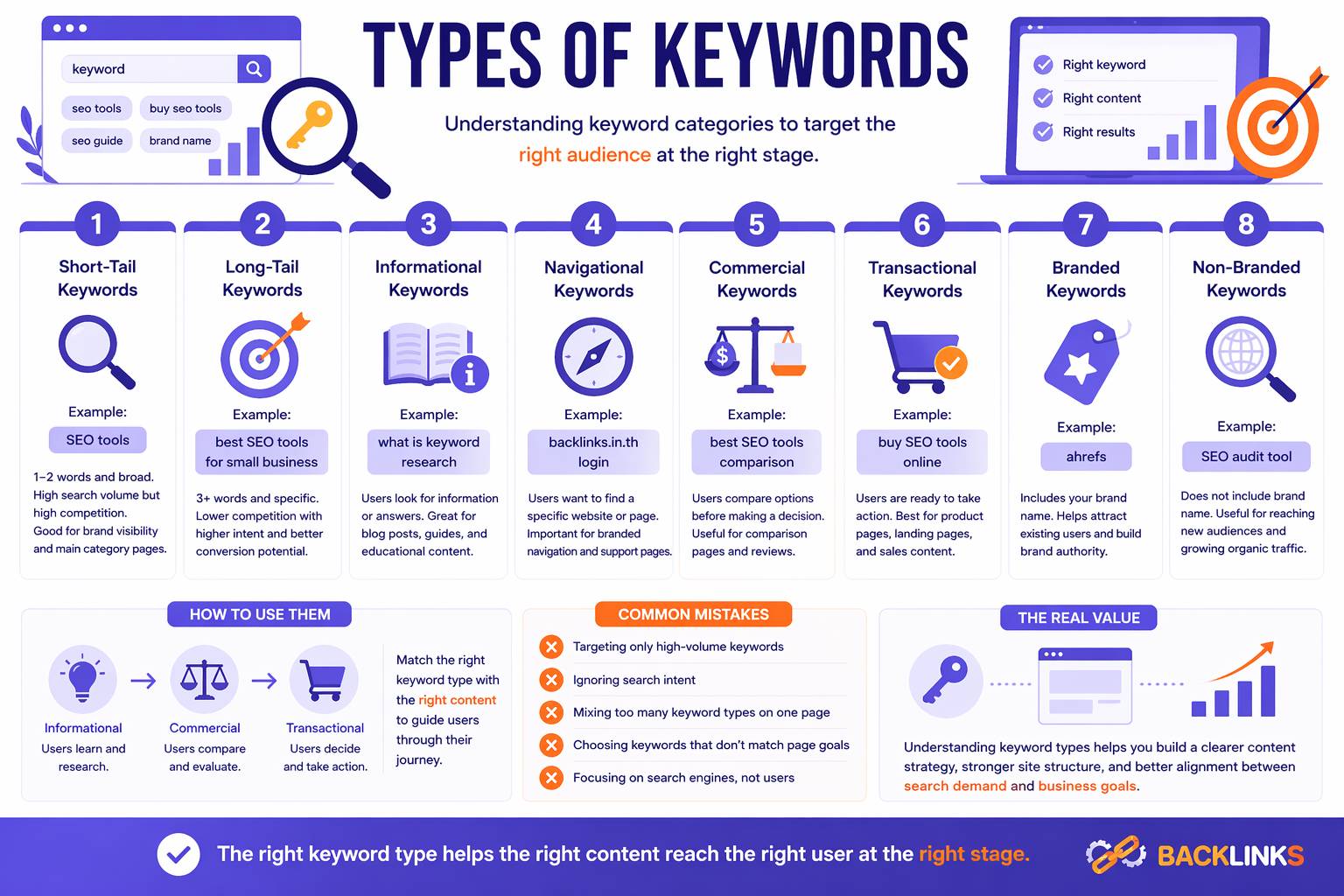
Types of keywords matter because not every search term serves the same purpose. Some keywords show that a user wants to learn. Others show comparison, purchase intent, brand awareness, local needs, or a very specific problem.
In SEO, understanding keyword types helps you choose the right topics, create the right content format, and match what users expect to find in search results. Without this understanding, a website may target keywords that look valuable but fail to attract the right audience or satisfy search intent.
For example, a person searching “what are SEO keywords” needs a definition. A person searching “best keyword research tools” is likely comparing options. A person searching “SEO agency near me” may be ready to contact a provider. These searches are related to SEO, but each one requires a different type of page.
This guide explains the main types of keywords used in SEO, how they work, and how to use them strategically in content planning.
What Are Types of Keywords?
Types of keywords refer to the different categories of search terms people use in search engines.
A keyword can be grouped based on several factors, including:
- Search intent
- Keyword length
- Brand association
- Competition level
- Search volume
- User journey stage
- Location
- Content purpose
These categories help SEO professionals understand what a keyword means beyond the words themselves.
For example, “keyword research” is a broad informational keyword. “How to do keyword research for a new website” is a long-tail informational keyword. “Best keyword research tools” is a commercial keyword. “Ahrefs keyword explorer” is a branded keyword.
Each keyword type gives clues about what the user wants and what kind of content should be created.
Why Understanding Keyword Types Matters
Understanding types of keywords helps you make better SEO decisions. It prevents you from treating all search terms the same way.
It Helps Match Search Intent
Search intent is one of the most important factors in SEO content planning. If a keyword shows informational intent, the page should educate. If it shows commercial intent, the page should help the user compare options. If it shows transactional intent, the page should support action.
When you understand keyword types, you can align content with intent more accurately.
It Improves Content Planning
Different keyword types belong in different parts of a website.
Broad informational keywords may work well for educational guides. Commercial keywords may work better for comparison pages. Transactional keywords may belong on service or product pages. Local keywords may require location-specific content.
This helps create a more organized content strategy instead of publishing disconnected articles.
It Helps Prioritize SEO Opportunities
Some keyword types are harder to rank for than others. Broad short-tail keywords usually have more competition, while specific long-tail keywords may be more realistic for newer websites.
Understanding keyword types helps you decide which opportunities to target first and which ones require a longer-term strategy.
It Supports Better User Experience
When users land on a page that matches their search intent, they are more likely to stay, read, click, and take the next step.
Keyword types help you understand what users need before they arrive on your website. This leads to clearer, more useful content.
Types of Keywords by Search Intent
One of the most useful ways to classify keywords is by search intent. This focuses on why the person is searching.
Informational Keywords
Informational keywords are used when people want to learn something.
Examples include:
- what are keywords
- types of keywords
- how keyword research works
- why keyword research is important
- what is search intent
These keywords are common at the early stage of the user journey. The searcher may not be ready to buy, compare, or contact a business yet. They are trying to understand a topic.
Content for informational keywords should be clear, educational, and useful. It may include definitions, explanations, examples, step-by-step guidance, and practical advice.
For the keyword “types of keywords,” the intent is informational. Users want to understand the different keyword categories and how they are used in SEO.
Navigational Keywords
Navigational keywords are used when people are looking for a specific website, brand, product, or page.
Examples include:
- Google Keyword Planner
- Semrush login
- Ahrefs blog
- Moz keyword explorer
- Backlinks.in.th SEO
These searches usually show that the user already knows where they want to go. For most websites, navigational keywords are most relevant when they include your own brand name.
If users are searching for your brand, your website should clearly rank for those terms. This requires strong brand signals, clear page titles, and well-structured branded pages.
Commercial Keywords
Commercial keywords are used when people are researching options before making a decision.
Examples include:
- best keyword research tools
- Ahrefs vs Semrush
- top SEO tools for small business
- best SEO keyword software
- keyword research tool comparison
These users are not always ready to buy immediately, but they are evaluating solutions. They may want comparisons, reviews, pros and cons, pricing information, or expert recommendations.
Content for commercial keywords should be balanced, specific, and useful. It should help users compare options without sounding overly promotional.
Transactional Keywords
Transactional keywords show that the user is closer to taking action.
Examples include:
- hire SEO consultant
- buy keyword research report
- SEO audit service
- keyword research service
- book SEO consultation
These keywords are often valuable because they indicate stronger business intent. The user may be ready to purchase, subscribe, inquire, download, register, or contact a provider.
Content for transactional keywords usually works best on service pages, product pages, landing pages, or conversion-focused pages. The content should still be helpful, but it should also make the next step clear.
Types of Keywords by Length
Another common way to classify keywords is by length and specificity.
Short-Tail Keywords
Short-tail keywords are broad search terms, usually one to three words long.
Examples include:
- SEO
- keywords
- keyword research
- backlinks
- content marketing
Short-tail keywords often have high search volume, but they are usually competitive and less specific.
For example, someone searching “SEO” could want a definition, a course, a tool, an agency, a checklist, or a strategy guide. Because the intent is broad, it can be harder to create a page that satisfies everyone.
Short-tail keywords can be useful for long-term visibility, but they often require strong authority, comprehensive content, and a well-developed website.
Long-Tail Keywords
Long-tail keywords are longer, more specific search phrases.
Examples include:
- how to find keywords for a blog post
- types of keywords in SEO with examples
- best keywords for local SEO strategy
- how to choose keywords for website content
- why long-tail keywords are easier to rank for
Long-tail keywords often have lower search volume, but they usually show clearer intent. They can be especially useful for newer websites or highly specific topics.
A person searching a long-tail keyword often knows what they need. This makes it easier to create content that directly answers the query.
Long-tail keywords are valuable because they can attract relevant traffic, support broader topic coverage, and help websites build authority gradually.
Medium-Tail Keywords
Medium-tail keywords sit between short-tail and long-tail keywords.
Examples include:
- SEO keywords
- keyword types
- keyword strategy
- keyword difficulty
- content optimization
These keywords are more specific than broad one-word searches but less specific than detailed long-tail queries.
Medium-tail keywords can be useful because they often balance search volume and intent. They may still be competitive, but they are usually easier to target than very broad keywords.
Types of Keywords by Brand Association
Keywords can also be grouped by whether they include a brand name.
Branded Keywords
Branded keywords include a company, product, tool, or brand name.
Examples include:
- Google Search Console
- Ahrefs keyword tool
- Semrush SEO platform
- Yoast SEO plugin
- Backlinks.in.th
Branded keywords are often used by people who already know the brand. They may be looking for the official website, pricing, reviews, support, comparisons, or specific features.
For your own brand, branded keywords are important because they reflect reputation and demand. Your website should control as much relevant branded search visibility as possible.
Non-Branded Keywords
Non-branded keywords do not include a specific brand name.
Examples include:
- types of keywords
- keyword research tools
- SEO content strategy
- how to improve rankings
- internal linking best practices
Non-branded keywords are important for reaching new audiences. These users may not know your brand yet, but they are searching for topics, problems, or solutions related to your expertise.
Most SEO growth strategies rely heavily on non-branded keywords because they expand visibility beyond existing brand awareness.
Types of Keywords by User Journey Stage
Keywords can also reflect where a user is in the decision-making process.
Awareness Keywords
Awareness keywords are used when users are just beginning to understand a problem or topic.
Examples include:
- what is keyword research
- types of keywords
- why SEO matters
- what is search intent
- how Google ranking works
These keywords usually require educational content. The goal is to explain the topic clearly and build trust.
Awareness keywords are useful for attracting early-stage visitors and strengthening topical authority.
Consideration Keywords
Consideration keywords are used when users are comparing methods, tools, providers, or solutions.
Examples include:
- keyword research tools
- best SEO tools
- keyword research methods
- Ahrefs vs Semrush
- SEO software comparison
These keywords require more detailed and evaluative content. Users may need comparisons, use cases, pros and cons, or decision criteria.
Decision Keywords
Decision keywords show that the user is closer to taking action.
Examples include:
- SEO keyword research service
- hire SEO specialist
- SEO audit pricing
- keyword research consultant
- content optimization service
These keywords usually belong on pages designed to support inquiries, purchases, bookings, or other conversions.
The content should be clear, credible, and specific. It should answer practical concerns and make the next step easy.
Types of Keywords by Competition
Keyword competition matters because not every keyword is equally realistic to rank for.
High-Competition Keywords
High-competition keywords are searched often and targeted by many strong websites.
Examples may include:
- SEO
- keyword research
- digital marketing
- content marketing
These keywords can be valuable, but they are difficult to rank for without strong authority, excellent content, quality backlinks, and a well-organized website.
High-competition keywords are usually better treated as long-term goals rather than quick wins.
Low-Competition Keywords
Low-competition keywords have fewer strong pages competing for them.
Examples might include more specific questions or niche topics, such as:
- types of keywords for local SEO
- how to group SEO keywords by intent
- keyword examples for service pages
- how many SEO keywords per page
These terms may have lower volume, but they can be easier to rank for and more closely aligned with specific user needs.
Low-competition keywords are useful for building momentum, especially on newer websites.
Types of Keywords by Search Volume
Search volume is another way to classify keywords, but it should be used carefully.
High-Volume Keywords
High-volume keywords receive many searches. They can offer large traffic potential, but they are often broad and competitive.
Examples include:
- SEO
- keywords
- marketing
- backlinks
These keywords may attract a wide audience, but not all visitors will be relevant. High volume does not always mean high value.
Low-Volume Keywords
Low-volume keywords receive fewer searches, but they can still be valuable.
Examples include:
- types of keywords in SEO with examples
- how to choose primary and secondary keywords
- keyword intent examples for blog content
- SEO keywords for service pages
Low-volume keywords often reflect specific needs. They may attract fewer visitors, but those visitors can be more engaged because the content closely matches their search.
In many cases, SEO tools underreport niche search demand. A keyword that appears small may still support useful traffic when combined with related terms.
Types of Keywords by Location
Location-based keywords are especially important for businesses serving specific areas.
Local Keywords
Local keywords include a city, region, neighborhood, or “near me” phrase.
Examples include:
- SEO agency Bangkok
- keyword research service Thailand
- digital marketing consultant near me
- local SEO services Chiang Mai
These keywords show geographic intent. Users are looking for information, services, or businesses in a specific location.
Local keywords are important for local SEO, service-area businesses, physical locations, and region-specific landing pages.
Geo-Modified Keywords
Geo-modified keywords include a specific place name.
Examples include:
- SEO consultant Bangkok
- content marketing agency Thailand
- keyword research service Singapore
These keywords can be used in location pages, service pages, and locally focused content.
The key is to make the content genuinely relevant to that location. Simply adding a city name without useful local context can create weak content.
Types of Keywords by Content Role
Keywords can also be grouped based on how they support a website’s content strategy.
Primary Keywords
A primary keyword is the main keyword a page targets.
For this article, the primary keyword is “Types of keywords.” It defines the main topic and should guide the title, introduction, headings, and overall structure.
Each important page should usually have one clear primary keyword. This keeps the content focused.
Secondary Keywords
Secondary keywords are related terms that support the primary keyword.
For this topic, secondary keyword ideas may include:
- SEO keyword types
- keyword categories
- long-tail keywords
- short-tail keywords
- branded keywords
- informational keywords
- transactional keywords
- keyword intent
Secondary keywords help cover the topic more completely. They also allow the page to rank for related searches without creating separate pages for every variation.
Semantic Keywords
Semantic keywords are words and phrases closely related to the main topic.
For “types of keywords,” semantic terms may include search intent, keyword research, ranking opportunities, user queries, content planning, search volume, and keyword difficulty.
These terms help search engines understand context. They also make the content more natural and complete.
Semantic keyword use should not be forced. It should come from writing thoroughly about the topic.
How to Choose the Right Types of Keywords
Choosing the right keyword type depends on your goal, audience, and website stage.
Match Keywords to Search Intent
Start by identifying what the user wants.
If the keyword is informational, create an educational guide. If it is commercial, provide comparison-focused content. If it is transactional, create a page that supports action.
Matching intent is more important than simply including the keyword.
Balance Broad and Specific Keywords
A strong SEO strategy usually includes both broad and specific keywords.
Broad keywords help define major topics. Specific keywords help capture clear user needs and more realistic ranking opportunities.
For example, “keyword research” may be a broad strategic topic, while “types of keywords in SEO with examples” is a more specific opportunity.
Prioritize Relevance Over Volume
Search volume is useful, but relevance matters more.
A keyword with thousands of searches may not be valuable if it attracts the wrong audience. A keyword with fewer searches may be more useful if it matches your business, expertise, and content goals.
Consider Ranking Difficulty
Before targeting a keyword, review the competition. If the top results are dominated by highly authoritative websites, ranking may be difficult.
That does not mean you should avoid competitive keywords completely. It means you may need supporting content, strong internal links, and a long-term approach.
Group Related Keywords Together
Avoid creating separate pages for every keyword variation.
If several keywords share the same intent, they can often be covered on one strong page. For example, “types of keywords,” “keyword types,” and “SEO keyword types” can likely belong together.
If the intent is different, a separate page may be better.
Common Mistakes When Using Keyword Types
Treating All Keywords the Same
A common mistake is using the same content format for every keyword. Informational, commercial, and transactional keywords require different approaches.
A definition article will not satisfy every query. A service page will not work for every educational search.
Choosing Only High-Volume Keywords
High-volume keywords can be tempting, but they are often broad and competitive. They may also attract users who are not relevant to your goals.
A balanced strategy includes specific, intent-driven keywords as well.
Ignoring Long-Tail Keywords
Long-tail keywords may look small in keyword tools, but they often bring highly relevant traffic.
Ignoring them can cause a website to miss realistic opportunities, especially in competitive industries.
Creating Duplicate Content
Some websites create too many similar pages for small keyword variations. This can cause content overlap and weaken SEO performance.
It is usually better to group similar terms into one useful page unless the search intent is clearly different.
Forcing Keywords into Content
Understanding keyword types should improve content quality, not make writing unnatural.
Keywords should guide structure and relevance. They should not be repeated mechanically.
Practical Guidance for Using Keyword Types in SEO
Start with the main topic you want to cover. Then identify related keywords and classify them by intent, length, competition, and content role.
For each keyword, ask what the user expects. Do they want a definition, a guide, a comparison, a product page, a local provider, or a specific answer?
Next, decide whether the keyword should be covered on an existing page or deserves a separate page. Closely related keywords can often be combined. Distinct intents usually need separate content.
Then, use the primary keyword naturally in the title, introduction, headings, and body content. Add secondary and semantic keywords where they improve clarity.
Finally, connect related pages through internal links. A page about types of keywords may naturally connect to articles about keyword research, SEO keywords, long-tail keywords, search intent, and using keywords in content.
Timing and Expectations
Choosing the right types of keywords can improve content planning immediately, but SEO results take time.
After publishing or updating a page, search engines need time to crawl, index, and evaluate the content. Rankings depend on competition, content quality, website authority, internal links, backlinks, and technical SEO.
For newer websites, specific long-tail and low-competition keywords are often more realistic starting points. For more established websites, broader and more competitive keywords may become achievable over time.
The best results usually come from consistent keyword targeting, content improvement, and internal linking across related topics.
Conclusion
Understanding the types of keywords is essential for creating a practical SEO strategy. Different keywords reveal different user needs, levels of awareness, and stages of decision-making.
Informational keywords help educate. Commercial keywords support comparison. Transactional keywords help drive action. Long-tail keywords capture specific needs. Branded and non-branded keywords serve different visibility goals.
The key is not to target keywords randomly. Each keyword should have a clear purpose, match search intent, and fit into a wider content plan.
When you understand keyword types, you can create more relevant content, prioritize better SEO opportunities, and build a website that serves both users and search engines more effectively.