
What Is a Backlink? A Practical SEO Explanation
What is a backlink is one of the most important questions to understand in SEO because backlinks play a major role in how search engines evaluate trust, authority, and relevance. A backlink is more than a simple clickable link from one website to another; it is a signal that helps search engines understand how content across the web is connected.
For website owners, marketers, and SEO professionals, backlinks matter because they can influence rankings, discovery, referral traffic, and overall website credibility. However, not every backlink has the same value. A link from a trusted, relevant website can support SEO performance, while a low-quality or unrelated link may provide little benefit.
This article explains what a backlink is, how backlinks work, why they matter for SEO, and how to evaluate backlink quality in a practical and realistic way.
What Is a Backlink?
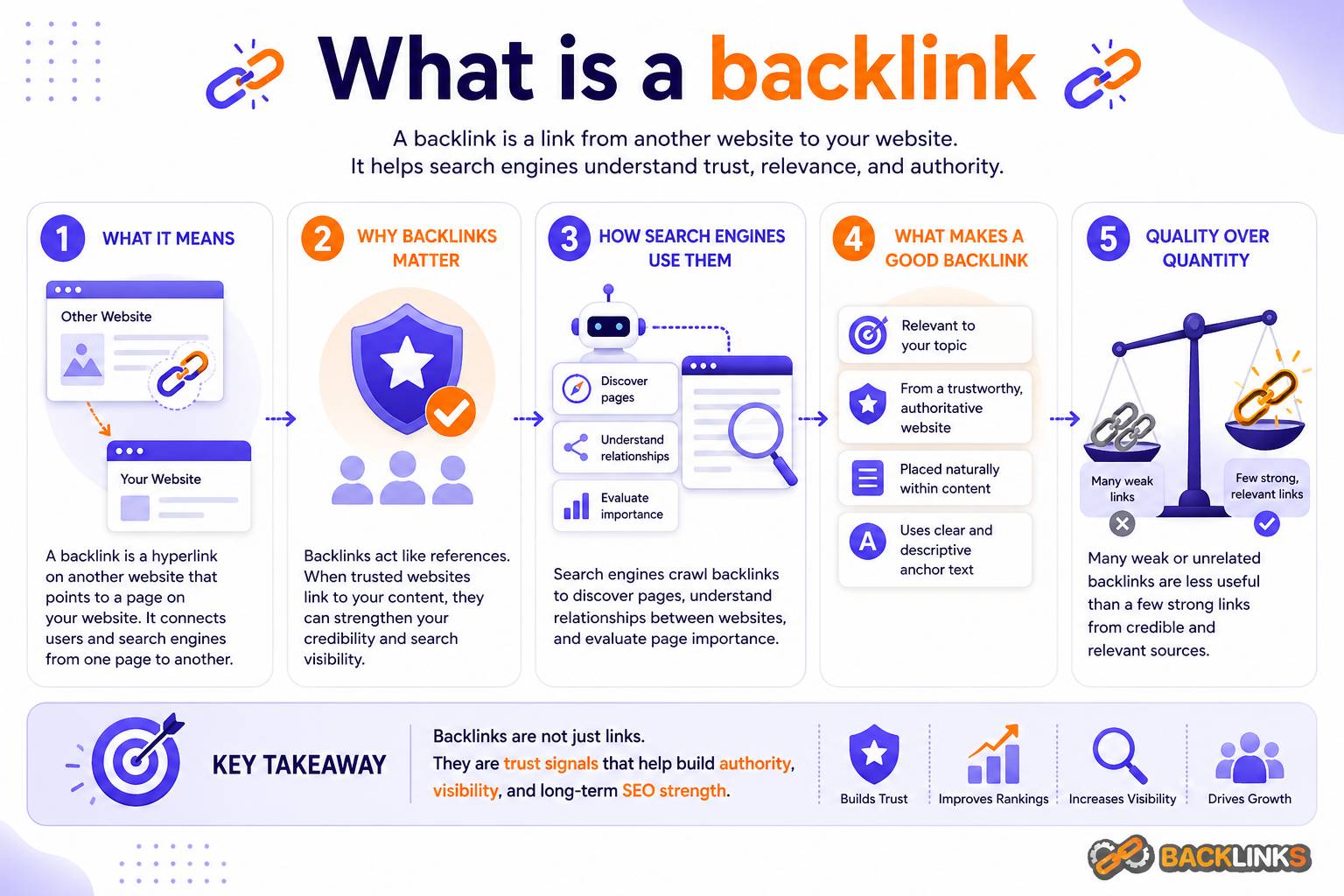
A backlink is a hyperlink from one website that points to another website. It is also commonly called an inbound link or external link.
For example, if a marketing blog links to your article about SEO strategy, that hyperlink is a backlink for your website. From the linking website’s perspective, it is an external link. From your website’s perspective, it is a backlink.
Backlinks are important because they act as references. When another site links to your content, it may indicate that your page is useful, relevant, or trustworthy enough to be cited.
In SEO, backlinks are often compared to votes of confidence. This comparison is useful, but it should not be taken too literally. Search engines do not treat every backlink equally. A backlink from a respected industry website is usually much more valuable than a link from an unrelated or low-quality site.
Why Backlinks Matter for SEO
Backlinks matter because search engines use them as external signals. Your own content tells search engines what your page is about. Backlinks help show whether other websites recognize your content as valuable.
This distinction is important. Any website can claim expertise on a topic. Backlinks provide evidence that other websites are willing to reference that content.
Backlinks Help Build Authority
Authority is one of the main reasons backlinks matter.
When trusted websites link to your content, they can help strengthen your page’s perceived credibility. Search engines may interpret those links as signs that your content deserves attention.
This authority can work at both page level and domain level. A specific page can become stronger when it earns relevant backlinks, while a website can build broader authority when multiple pages earn links over time.
A strong backlink profile can make it easier for your site to compete in search results, especially for topics where many websites publish similar content.
Backlinks Can Improve Rankings
Backlinks are not the only ranking factor, but they remain highly influential in competitive SEO.
When two pages are similar in content quality, relevance, and search intent alignment, backlinks can help search engines decide which page deserves to rank higher.
This is why pages with strong backlink profiles often perform better than pages with little external support. The links help confirm that the page has value beyond the website that published it.
However, rankings do not improve simply because a page has many backlinks. Quality, relevance, and context are more important than raw link count.
Backlinks Help Search Engines Discover Pages
Search engines discover new content by crawling links. When another website links to your page, it creates another path for search engines to find and evaluate your content.
This can be especially useful for:
- New websites
- Newly published articles
- Pages with limited internal links
- Important resources that need stronger visibility
A backlink does not guarantee that a page will rank, but it can help search engines discover and revisit the page more efficiently.
Backlinks Can Drive Referral Traffic
Backlinks are not only useful for search engines. They can also send real visitors to your website.
If a relevant website links to your content, users who trust that website may click through to learn more. This referral traffic can be valuable because it often comes from an audience already interested in the topic.
For example, a backlink from an industry article, resource page, or trusted blog can bring visitors who are actively researching your field. These visitors may be more engaged than users who arrive through unrelated channels.
How Backlinks Work
A backlink works by connecting one web page to another through a hyperlink. When search engines crawl the linking page, they can discover the link and analyze several signals around it.
Search engines may evaluate:
- The authority of the linking website
- The relevance of the linking page
- The anchor text used in the link
- The placement of the link on the page
- The overall quality of the linking content
- Whether the link uses attributes such as nofollow or sponsored
These signals help search engines decide how much value, if any, the backlink should pass.
What Makes a Good Backlink?
Not all backlinks are equally useful. A good backlink is usually relevant, trustworthy, and placed in a meaningful context.
Relevance
Relevance is one of the strongest indicators of backlink quality.
A backlink from a website related to your industry or topic is usually more valuable than a link from a completely unrelated website. For example, a link from an SEO publication to an article about backlinks has clearer relevance than a link from a random lifestyle blog.
Search engines consider not only the overall website, but also the specific page and surrounding content where the link appears.
Authority
A backlink from a trusted website generally carries more value than one from a weak or low-quality website.
Authority is influenced by the linking website’s reputation, content standards, backlink profile, and overall trustworthiness. This does not mean that only major publications matter. A smaller niche website can still provide strong value if it is respected within its field.
Editorial Context
A backlink placed naturally within the main body of content is usually more valuable than a link placed in a footer, sidebar, or unrelated list.
Editorial links are important because they often exist as genuine references. If a writer links to your content because it supports their point or helps their audience, that link carries meaningful context.
Anchor Text
Anchor text is the clickable text used in a hyperlink. It helps users and search engines understand what the linked page is about.
For example, anchor text such as “guide to backlinks” gives more context than generic text such as “click here.”
However, anchor text should remain natural. If too many backlinks use the exact same keyword phrase, the link profile may appear manipulated. A healthy backlink profile usually includes a mix of branded anchors, partial-match phrases, URLs, and natural descriptive text.
Link Placement
Links placed higher in the main content and surrounded by relevant text are generally more useful than links hidden in less visible areas.
Placement matters because it affects both user experience and contextual value. A link that readers are likely to notice and use is often more meaningful than a link placed only for SEO purposes.
Types of Backlinks
Understanding different types of backlinks helps you evaluate their purpose and value.
Dofollow Backlinks
A standard backlink can pass ranking signals from one page to another. These are often called dofollow links, although “dofollow” is not usually written in the code. It simply means the link has not been marked with an attribute that limits how search engines treat it.
Dofollow backlinks are typically the most sought-after for SEO because they may pass authority.
Nofollow Backlinks
A nofollow backlink includes an attribute that tells search engines not to treat the link in the same way as a standard link.
Nofollow links may not pass authority in the same direct way, but they can still have value. They can drive referral traffic, build brand awareness, and contribute to a natural backlink profile.
Sponsored Backlinks
Sponsored links are used when a link is part of paid placement, advertising, or sponsorship. These links should be clearly marked with the appropriate attribute so search engines understand the relationship.
User-Generated Content Links
User-generated content links are commonly found in comments, forums, and community platforms. These links are often marked to show that they were created by users rather than editorially placed by the website owner.
Backlinks vs Internal Links
Backlinks and internal links are both important, but they are different.
A backlink comes from another website and points to your website. An internal link connects one page of your own website to another page on the same site.
Backlinks help bring authority and trust signals from external sources. Internal links help distribute that authority across your website and guide users to related content.
For example, a backlink may point to an educational article on your site. That article can then internally link to related pages, helping users and search engines understand the broader topic structure.
Common Misconceptions About Backlinks
One common misconception is that more backlinks always mean better SEO performance. In reality, quality matters more than quantity. A few strong, relevant links can be more valuable than many weak links.
Another misconception is that any backlink is helpful. Links from spammy, unrelated, or low-quality websites may provide little benefit and can create risk if they appear manipulative.
Some people also believe backlinks work immediately. In practice, search engines need time to discover, evaluate, and reflect backlink signals in rankings.
Another mistake is focusing only on domain authority metrics. Third-party metrics can be useful for evaluation, but they are estimates. Relevance, context, traffic quality, and editorial standards should also be considered.
How to Evaluate a Backlink
When reviewing a backlink, ask practical questions:
- Is the linking website relevant to your topic or industry?
- Does the linking page have useful content?
- Is the link placed naturally within the content?
- Does the anchor text look natural?
- Would real users benefit from clicking the link?
- Does the website appear trustworthy and well maintained?
A backlink that passes these checks is more likely to support SEO performance. A link that exists only for manipulation is less likely to provide lasting value.
How Backlinks Fit Into Linkbuilding
Backlinks are the outcome of linkbuilding. Linkbuilding is the process of earning or acquiring those backlinks through strategies such as content creation, outreach, digital PR, guest contributions, and resource promotion.
The best linkbuilding strategies focus on earning links that make sense. Instead of chasing random placements, they prioritize relevance, usefulness, and long-term authority.
This is why strong content is essential. Websites are more likely to link to pages that offer clear value, such as detailed guides, original insights, tools, templates, or practical resources.
Timing and Expectations
Backlinks do not usually create instant results. Search engines need time to crawl the linking page, process the link, and evaluate its quality.
A strong backlink may help improve visibility over time, but the effect depends on competition, page quality, search intent alignment, and the broader backlink profile.
Sustainable SEO growth usually comes from earning relevant backlinks consistently, not from sudden spikes or shortcuts.
Conclusion
Understanding what a backlink is helps clarify why links remain such an important part of SEO. A backlink is a hyperlink from another website to your own, but its value depends on much more than its existence.
The best backlinks come from relevant, trustworthy websites and appear naturally within useful content. They help search engines discover pages, evaluate authority, understand relevance, and compare competing resources.
For long-term SEO success, backlinks should be treated as credibility signals, not just ranking tools. When earned through valuable content and thoughtful promotion, they can strengthen website authority, improve organic visibility, and support sustainable growth.