
Types of Backlinks: A Practical SEO Guide
Types of backlinks matter because not every link pointing to your website carries the same SEO value. Some backlinks can strengthen authority, improve rankings, and drive relevant referral traffic, while others may provide little benefit or create unnecessary risk if they come from weak or unrelated sources.
For anyone working on SEO, understanding backlink types is essential before starting linkbuilding. A backlink is not valuable simply because it exists. Its value depends on where it comes from, how it is placed, what context surrounds it, and whether it reflects a real connection between two relevant pages.
This article explains the main types of backlinks, how they work, which ones are most valuable, and how to evaluate them as part of a sustainable SEO strategy.
What Are Backlinks?
Backlinks are hyperlinks from one website to another. They are also called inbound links because they point into your website from an external source.
For example, if a marketing blog links to your article about SEO, that link is a backlink for your website. From the other website’s perspective, it is an outbound link.
Backlinks matter because search engines use them as signals of trust, authority, and relevance. When a reputable website links to your content, it can suggest that your page is useful enough to reference.
However, search engines do not treat all backlinks equally. A link from a relevant industry publication is very different from a random link on a low-quality directory. This is why understanding the different types of backlinks is important.
Why Different Types of Backlinks Matter
Different types of backlinks serve different purposes. Some help pass authority. Some drive referral traffic. Some build brand visibility. Others may exist for attribution, sponsorship, or user-generated content.
The type of backlink affects how search engines interpret the link. It also affects how much value the link may provide.
A strong backlink profile usually includes a natural mix of links. If every backlink looks identical, uses the same anchor text, or comes from the same type of website, the profile may appear artificial.
Healthy backlink profiles tend to look diverse because real websites earn links in different ways over time.
Types of backlinks
Dofollow Backlinks
Dofollow backlinks are standard links that search engines can follow and may use as ranking signals.
Technically, there is no “dofollow” tag required in the HTML. A link is considered dofollow when it does not include attributes such as rel="nofollow", rel="sponsored", or rel="ugc".
Dofollow backlinks are often the most sought-after because they may pass authority from the linking page to the linked page.
For example, if a trusted SEO website links to your guide within the main content of an article, and the link is not marked with a limiting attribute, that backlink may support your page’s ranking potential.
That said, a dofollow link is not automatically valuable. It still needs relevance, context, and quality. A dofollow backlink from an unrelated or low-quality page may provide little benefit.
Nofollow Backlinks
Nofollow backlinks include the rel="nofollow" attribute. This attribute tells search engines not to treat the link in the same way as a standard followed link.
Nofollow links are common in comments, forums, press release platforms, social media profiles, and some editorial websites.
Many people assume nofollow backlinks are useless, but that is too simplistic. While they may not pass authority in the same direct way as dofollow links, they can still provide value.
Nofollow links can:
- Drive referral traffic
- Increase brand visibility
- Create a natural backlink profile
- Lead to future followed links
- Support discovery and awareness
A natural backlink profile usually includes both followed and nofollow links. The goal is not to eliminate nofollow links, but to understand their role.
Sponsored Backlinks
Sponsored backlinks are links that exist because of payment, sponsorship, advertising, or another commercial arrangement. These links should use the rel="sponsored" attribute.
This helps search engines understand that the link was not purely editorial.
Sponsored links can still be useful for brand awareness, partnerships, and referral traffic. However, they should not be treated as a shortcut for manipulating rankings.
If a link is paid or part of a sponsorship, it should be clearly marked. This keeps the backlink profile cleaner and reduces the risk of violating search engine guidelines.
UGC Backlinks
UGC stands for user-generated content. UGC backlinks are links created by users rather than by the website’s editorial team.
These links often appear in:
- Blog comments
- Forum posts
- Community discussions
- User profiles
- Review sections
UGC links usually use the rel="ugc" attribute to show that they were added by users.
These backlinks are generally less powerful than editorial backlinks because they are not placed by a site owner as a trusted recommendation. However, they can still bring referral traffic and visibility when they appear in relevant communities.
The main risk with UGC backlinks is spam. If a link exists only because someone dropped it into a comment or forum thread without context, it is unlikely to provide meaningful SEO value.
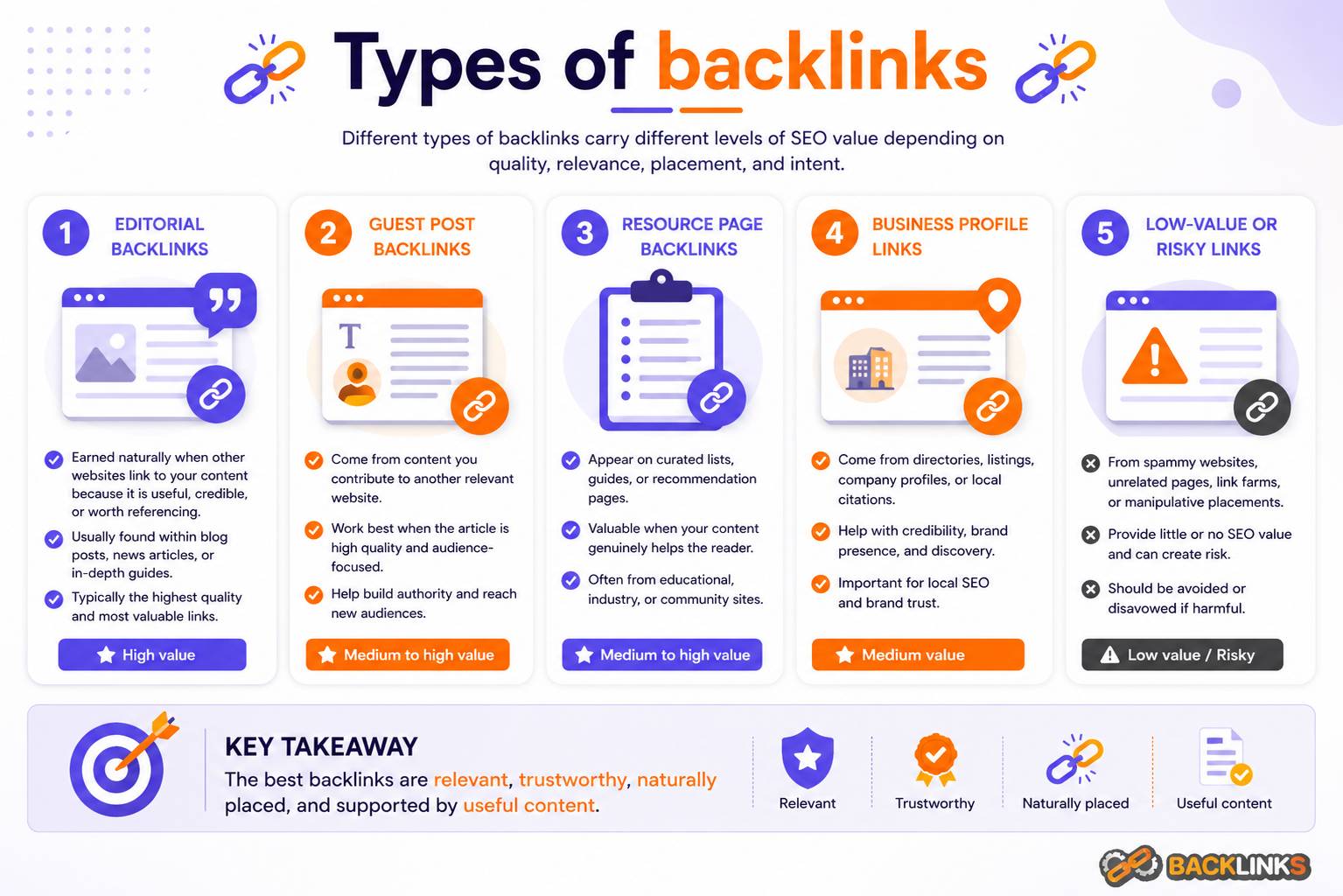
Editorial Backlinks
Editorial backlinks are among the most valuable types of backlinks.
An editorial backlink is a link given naturally by a website because the content is useful, credible, or relevant. The website owner, writer, or editor chooses to reference your page because it supports their content or helps their audience.
For example, if an industry blog writes an article about SEO strategy and links to your research or guide as a helpful reference, that is an editorial backlink.
Editorial backlinks are powerful because they usually come with strong context. They are placed within content, surrounded by relevant text, and often reflect genuine trust.
These links are difficult to earn at scale, but they are usually worth more than easier, lower-quality links.
Guest Post Backlinks
Guest post backlinks come from articles you contribute to other websites.
Guest posting can be useful when it is done for the right reasons: sharing expertise, reaching a relevant audience, and building relationships within your industry.
A strong guest post backlink should come from a website that is relevant, well-maintained, and editorially selective. The content should provide real value rather than exist only as a link placement.
Poor-quality guest posting is a common problem. If the same article format is used repeatedly across low-quality sites, or if the content is thin and written only to include a backlink, the value is limited.
Guest post backlinks can be useful, but quality control is essential.
Resource Page Backlinks
Resource page backlinks come from pages that list useful tools, guides, articles, or references on a specific topic.
For example, a marketing website may have a page listing recommended SEO resources. If your backlink guide is included there, that is a resource page backlink.
These links can be valuable because they are often placed on pages designed to help users find useful information.
To earn resource page backlinks, your content needs to clearly deserve inclusion. It should be practical, well-structured, and relevant to the resource page’s purpose.
Directory Backlinks
Directory backlinks come from online directories that list businesses, websites, tools, or services.
Some directory backlinks can be useful, especially if the directory is relevant, trusted, and used by real people. Examples include professional associations, local business directories, industry-specific directories, or partner listings.
However, low-quality directories are a common source of weak backlinks. If a directory accepts any website without review, has little traffic, and exists mainly for link placement, it is unlikely to provide strong SEO value.
Directory backlinks should be evaluated carefully. Relevance and legitimacy matter more than the link itself.
Social Media Backlinks
Links from social media platforms are usually nofollow or treated differently from editorial website links.
Social media backlinks may not directly pass authority in the same way as traditional backlinks, but they can still support SEO indirectly.
They can help:
- Increase content visibility
- Drive referral traffic
- Encourage sharing
- Put content in front of people who may later link to it
Social links should not be viewed as a replacement for linkbuilding. They are better understood as part of content promotion and brand visibility.
Image Backlinks
Image backlinks occur when another website uses your image, graphic, chart, or infographic and links back to your site as the source.
These links can be valuable when the image is original and relevant. Infographics, diagrams, charts, and visual explanations often attract image backlinks because other websites may reference them in their own content.
To benefit from image backlinks, make sure your visuals are clearly branded, useful, and easy to credit. You can also monitor where your images appear and request proper attribution when necessary.
Broken Link Replacement Backlinks
Broken link replacement backlinks are earned by finding broken links on other websites and suggesting your relevant content as a replacement.
This method works because it helps the website owner fix a problem while giving your page an opportunity to earn a backlink.
For this approach to work, your content must closely match the missing resource. If the replacement is not relevant, the outreach will feel forced and is unlikely to succeed.
Broken link building is most effective when it is targeted, helpful, and based on genuine relevance.
Backlinks From Partnerships
Partnership backlinks come from businesses, suppliers, clients, associations, or organizations that have a legitimate relationship with your company.
These links may appear on partner pages, case studies, testimonials, event pages, or member directories.
Partnership backlinks can be valuable because they are based on real-world relationships. They often look natural and relevant when the connection between the websites is clear.
However, these links should still be used responsibly. Excessive reciprocal linking or large-scale partner link exchanges can look unnatural.
Common Mistakes When Evaluating Backlink Types
One common mistake is assuming that only dofollow backlinks matter. While followed links are important, a natural profile includes different types of backlinks.
Another mistake is chasing links from high-authority websites without considering relevance. A link from a smaller niche website may be more useful than a link from a large but unrelated site.
Some websites also rely too heavily on one backlink type. For example, if most links come from directories or guest posts, the profile may lack diversity.
Over-optimized anchor text is another issue. Even strong backlinks can become risky if too many use the exact same keyword phrase.
The best backlink profiles look natural, relevant, and earned over time.
How to Build a Healthy Backlink Profile
A healthy backlink profile should include quality, relevance, and diversity.
Start by creating content that deserves links. Detailed guides, original insights, tools, templates, and useful resources are more likely to attract editorial and resource page backlinks.
Then identify realistic link opportunities. Competitor backlink analysis can help reveal which types of websites already link to similar content in your industry.
Prioritize links that make sense for users. A good backlink should be useful to someone who clicks it, not just valuable for search engines.
Finally, monitor your backlink profile regularly. Look at the types of backlinks you are earning, where they come from, what anchor text they use, and whether they support your broader SEO goals.
Timing and Expectations
Building a strong backlink profile takes time. Different types of backlinks are earned at different speeds.
Directory and partnership links may be easier to acquire early. Editorial backlinks, digital PR links, and high-quality resource links usually require stronger content and more outreach.
The goal is not to build every type of backlink at once. The goal is to earn relevant links consistently and avoid shortcuts that could create risk later.
Conclusion
Understanding the main types of backlinks helps you make better SEO decisions. Dofollow, nofollow, sponsored, UGC, editorial, guest post, directory, resource, image, and partnership backlinks all play different roles.
The most valuable backlinks are usually relevant, trustworthy, editorially placed, and useful for real users. The least valuable links are typically unrelated, low-quality, spammy, or created only for manipulation.
A strong linkbuilding strategy does not focus on one type of backlink alone. It builds a natural, diverse, and relevant backlink profile over time.
When you understand how different backlinks work, you can focus less on chasing link volume and more on building authority that supports sustainable organic growth.