
SEO Competitor Analysis: How to Learn from Competing Websites and Improve Your Strategy
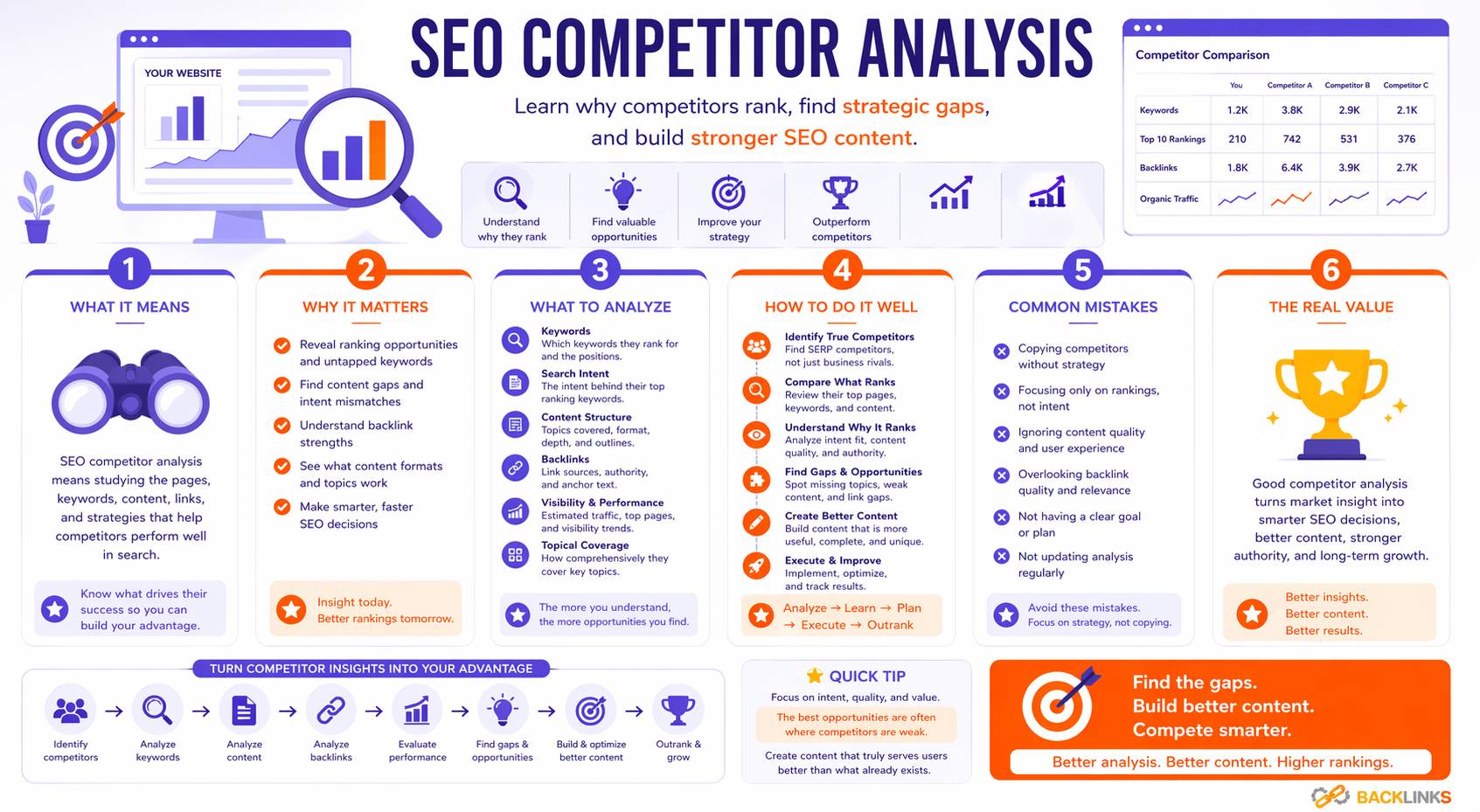
SEO competitor analysis is the process of studying competing websites to understand why they rank, which keywords they target, what content performs well, and where your own website has opportunities to improve.
In SEO, competitors are not always the same as business competitors. A company may compete with one set of businesses in the market, but compete with different websites in search results. For example, a service business may compete against blogs, directories, review sites, marketplaces, and tool providers for the same keywords.
SEO competitor analysis helps you see the search landscape more clearly. Instead of guessing which topics to target or why other websites outrank you, you can evaluate their keywords, content structure, backlinks, internal links, technical performance, and search intent alignment.
This article explains what SEO competitor analysis is, why it matters, how to do it properly, and how to turn competitor insights into a stronger SEO strategy.
What Is SEO Competitor Analysis?
SEO competitor analysis is the process of reviewing websites that compete with your site in organic search.
The goal is not to copy competitors. The goal is to understand what is working in your search market and identify opportunities to create better, more relevant, and more useful content.
An SEO competitor analysis may include reviewing:
- Keywords competitors rank for
- Pages that attract organic traffic
- Content quality and structure
- Search intent alignment
- Backlink profiles
- Internal linking patterns
- Site architecture
- Technical SEO strengths and weaknesses
- Content gaps
- SERP features competitors appear in
In practical terms, SEO competitor analysis helps answer important questions:
- Which websites are ranking for your target keywords?
- What topics are they covering that you are missing?
- Which pages drive their organic visibility?
- Why might their pages be more competitive than yours?
- Where can your website provide a better answer?
- Which keywords are realistic opportunities?
A strong analysis turns competitor research into action. It should help you decide what to create, improve, consolidate, or prioritize.
Why SEO Competitor Analysis Matters
SEO competitor analysis matters because search results are competitive by nature. Your website does not rank in isolation. It ranks in comparison to other pages targeting the same or similar queries.
It Shows Who You Really Compete With in Search
Your organic competitors may not be your direct business competitors.
For example, an SEO agency may compete in search with:
- Other agencies
- SEO software companies
- Educational blogs
- Marketing publications
- YouTube results
- Review websites
- Freelance marketplaces
- Local directories
This matters because each competitor type may satisfy search intent differently. A service page may not rank for a keyword where users expect an educational guide. A blog article may struggle for a keyword where searchers want a tool comparison.
SEO competitor analysis helps you identify the real search competitors for each keyword.
It Reveals Keyword Opportunities
Competitor analysis can show which keywords competing websites rank for but your site does not.
These gaps may reveal:
- Missing topics
- Weak existing pages
- Long-tail keyword opportunities
- Commercial keywords worth targeting
- Questions users commonly search
- Pages that need stronger optimization
Keyword gaps are useful because they show where search demand already exists. However, not every competitor keyword is worth targeting. Each opportunity should be evaluated based on relevance, search intent, competition, and business value.
It Helps You Understand Search Intent
Search results show what search engines currently believe users want.
By reviewing competitor pages that rank for a keyword, you can identify the dominant intent. Are the top results guides, comparison pages, product pages, service pages, local pages, or tools?
For example:
- “What is keyword research” usually requires an educational explanation
- “Best keyword research tools” usually requires comparison-focused content
- “SEO audit service” likely requires a service page
- “SEO agency Bangkok” may require local service content
SEO competitor analysis helps prevent intent mismatch by showing what type of content performs for each keyword.
It Improves Content Quality
Competitor analysis helps you understand what strong content looks like in your market.
You can review:
- How competitors structure articles
- Which questions they answer
- How detailed their content is
- Whether they use examples, visuals, or data
- Where their content is shallow or outdated
- Which sections are missing from your own content
The goal is not to imitate their structure exactly. The goal is to identify what users likely expect and then create something clearer, more complete, and more useful.
It Supports Better Prioritization
SEO teams often have many possible tasks: new content, content updates, technical improvements, internal linking, backlinks, and site structure changes.
Competitor analysis helps prioritize by showing where the largest gaps are.
For example, if competitors are ranking because they have stronger pages for specific informational topics, content creation may be the priority. If competitors have strong backlinks to key pages, digital PR or link acquisition may matter. If competitors have better site structure and internal links, architecture improvements may be needed.
Types of SEO Competitors
Before analyzing competitors, it is important to understand the different types.
Direct Business Competitors
Direct business competitors sell similar products or services to the same audience.
For example, two SEO agencies in the same market are direct business competitors.
These competitors are important because they may target similar service keywords, commercial terms, and local searches. However, they may not always dominate informational search results.
Organic Search Competitors
Organic search competitors are websites that rank for the same keywords as your site, even if they do not sell the same thing.
For example, a keyword research service provider may compete with SEO blogs, tool websites, and educational resources for informational keywords.
Organic competitors are especially important because SEO visibility depends on search results, not just business categories.
Content Competitors
Content competitors are websites that publish similar educational or informational content.
They may include blogs, publishers, SaaS companies, training platforms, and industry resources.
Content competitors are useful to analyze when planning articles, guides, definitions, tutorials, and educational resources.
Local Competitors
Local competitors rank for location-based searches.
Examples include:
- SEO agency Bangkok
- digital marketing consultant near me
- local SEO service Thailand
Local competitor analysis may involve reviewing Google Business Profiles, local landing pages, reviews, location relevance, local citations, and service-area content.
SERP Feature Competitors
Some competitors appear in specific search features, such as featured snippets, People Also Ask results, video results, image packs, or local packs.
A page may not rank first organically but still capture visibility through a SERP feature.
Analyzing these competitors helps identify opportunities beyond standard rankings.
What to Analyze in SEO Competitor Analysis
A useful SEO competitor analysis looks at multiple areas, not just keywords.
Keyword Rankings
Start by identifying which keywords competitors rank for.
Look for:
- Keywords they rank well for
- Keywords your site does not target yet
- Keywords where your site ranks lower
- Long-tail keywords they capture
- Commercial and transactional keywords
- Informational topics driving visibility
This helps uncover opportunities and content gaps.
However, keyword rankings should be evaluated carefully. A competitor may rank for keywords that are irrelevant to your audience. Do not target every keyword just because a competitor ranks for it.
Top-Performing Pages
Competitor top pages can reveal what drives their organic visibility.
Review which pages attract rankings, traffic, links, or engagement. These may include:
- Educational guides
- Comparison pages
- Service pages
- Tool pages
- Glossaries
- Case studies
- Local pages
- Resource hubs
Understanding competitor top pages helps you identify what content formats perform well in your niche.
Content Depth and Quality
Content quality is one of the most important areas to review.
Look at whether competitor content is:
- Clear and well-structured
- Accurate and useful
- Comprehensive without being bloated
- Aligned with search intent
- Updated recently
- Supported by examples
- Easy to scan
- Written with expertise
- More practical than generic
Also look for weaknesses. Competitor pages may rank despite being outdated, thin, repetitive, or poorly organized. These weaknesses can become opportunities.
Search Intent Alignment
For each important keyword, compare the ranking pages against the search intent.
Ask:
- What does the user likely want?
- What page type dominates the results?
- Are competitors satisfying the intent well?
- Is there a gap between what users need and what ranking pages provide?
- Can your content answer the intent more clearly?
This step is essential because SEO is not just about writing more content. It is about creating the right content.
Backlink Profiles
Backlinks are links from other websites. They can influence authority and ranking potential.
Competitor backlink analysis can show:
- Which pages attract links
- Which websites link to competitors
- What type of content earns links
- Whether competitors have strong industry mentions
- Whether there are link-building opportunities
For example, competitors may earn links through original research, useful tools, guides, data studies, or industry resources.
Backlink analysis should be used to understand authority and opportunity, not to copy low-quality link tactics.
Internal Linking
Internal links help distribute authority and guide users between related pages.
Competitor internal linking analysis can show how pages support each other. Strong competitors often link from broad pages to more specific articles and from supporting articles back to important pages.
Review:
- Which pages receive many internal links
- How anchor text is used
- Whether related articles are connected
- Whether important pages are easy to reach
- Whether content pathways make sense
Internal linking is often an overlooked advantage.
Site Structure
Site structure affects how users and search engines navigate content.
A competitor may perform well because their content is organized clearly. Related topics may be grouped logically, URLs may be clean, and important pages may be easy to find.
Review:
- Navigation
- URL structure
- Content categories
- Breadcrumbs
- Topic grouping
- Important landing pages
- Depth of important URLs
A better structure can improve crawlability, relevance, and user experience.
Technical SEO
Technical SEO can influence how easily search engines crawl, render, index, and evaluate a website.
Competitor technical review may include:
- Page speed
- Mobile usability
- Indexation
- Core Web Vitals
- Structured data
- Canonical tags
- URL structure
- Broken links
- Duplicate content
- Site security
You do not need to copy every technical setup, but technical weaknesses can explain why a competitor is easier or harder to beat.
SERP Features
Search results often include features beyond traditional organic listings.
Review whether competitors appear in:
- Featured snippets
- People Also Ask boxes
- Local packs
- Image results
- Video results
- Review snippets
- Sitelinks
If competitors capture these features, analyze why. Their content may answer questions concisely, use clear headings, include structured data, or provide useful media.
How to Do SEO Competitor Analysis
SEO competitor analysis works best when done systematically.
1. Define Your SEO Goals
Start by clarifying what you want to learn.
Common goals include:
- Finding keyword opportunities
- Improving existing content
- Planning new articles
- Understanding why competitors outrank you
- Finding backlink opportunities
- Improving internal linking
- Reviewing local SEO competition
- Identifying content gaps
A clear goal prevents the analysis from becoming too broad.
2. Identify Your Organic Competitors
Search your target keywords and note which websites repeatedly appear.
Do this across different keyword types:
- Informational keywords
- Commercial keywords
- Transactional keywords
- Local keywords
- Long-tail keywords
The websites that appear consistently are your organic competitors.
Do not rely only on known business competitors. Search results often reveal competitors you did not expect.
3. Choose Priority Keywords
Competitor analysis should focus on keywords that matter.
Select keywords based on:
- Relevance
- Search intent
- Business value
- Ranking potential
- Existing performance
- Strategic importance
For example, a website focused on SEO education may prioritize informational keywords. A service provider may also include commercial and transactional keywords.
4. Review the Search Results
For each priority keyword, review the search results manually.
Look at:
- Ranking page types
- SERP features
- Content depth
- Titles and descriptions
- Domain types
- Freshness
- User intent signals
This shows what kind of content is needed to compete.
5. Analyze Competitor Pages
Open the top competitor pages and review them carefully.
Ask:
- What is the page trying to do?
- How is it structured?
- What questions does it answer?
- What examples does it include?
- What makes it useful?
- What is missing?
- Is it too shallow, too complex, outdated, or poorly organized?
- Can your page provide a better experience?
Document specific observations rather than vague notes.
6. Compare Content Gaps
A content gap is a relevant topic, keyword, or question that competitors cover but your site does not.
Content gaps may include:
- Missing articles
- Missing sections within existing pages
- Weak explanations
- Lack of examples
- Missing comparison pages
- Missing local pages
- Unanswered user questions
Content gaps should be prioritized based on relevance and intent, not just competitor presence.
7. Compare Backlinks
Review competitor backlinks to understand authority differences.
Look for:
- Pages with many links
- Link-worthy content formats
- Industry publications linking to competitors
- Resource pages
- Partner links
- Data-driven assets
- Tools or templates earning links
This can inform future link-building or digital PR strategy.
8. Review Internal Links and Structure
Look at how competitors connect related pages.
Ask:
- Do important pages receive strong internal links?
- Are supporting articles linked clearly?
- Is the navigation logical?
- Are related topics easy to find?
- Is anchor text descriptive?
This can help improve your own internal linking plan.
9. Turn Insights into an Action Plan
The final step is action.
Competitor analysis should lead to clear decisions, such as:
- Create a new page for a missing topic
- Update an existing page to better match intent
- Consolidate overlapping content
- Add internal links
- Improve title tags and headings
- Strengthen examples and practical guidance
- Create link-worthy resources
- Improve technical issues
- Build location-specific pages
The value of SEO competitor analysis comes from implementation.
SEO Competitor Analysis Tools
SEO tools can make competitor analysis faster, but they should support judgment rather than replace it.
Useful tool categories include:
- Keyword research tools
- Rank tracking tools
- Backlink analysis tools
- Technical audit tools
- Content optimization tools
- Search Console data
- Analytics platforms
- SERP analysis tools
Tools can help collect data, but manual review is still necessary. A tool may show that a competitor ranks for a keyword, but only human analysis can judge whether that keyword is relevant, whether the page satisfies intent, and whether your site can compete.
Common SEO Competitor Analysis Mistakes
Copying Competitors Too Closely
Competitor analysis should not become imitation.
If you copy competitor topics, headings, and formats without adding value, your content will not stand out. The goal is to understand the market and create something better.
Analyzing the Wrong Competitors
Business competitors and SEO competitors are not always the same.
If you only analyze companies you already know, you may miss websites that dominate the search results.
Always identify competitors based on actual keyword rankings.
Focusing Only on Keywords
Keywords are important, but they are only one part of competitor analysis.
You also need to review content quality, intent, backlinks, internal links, site structure, technical SEO, and SERP features.
Ignoring Search Intent
A competitor may rank because their page matches intent better, not because they use more keywords.
If you create the wrong page type, better keyword usage will not solve the problem.
Chasing Every Competitor Keyword
Not every keyword a competitor ranks for is valuable to your website.
Some may be irrelevant, too broad, too competitive, or disconnected from your goals. Prioritize carefully.
Overlooking Existing Content
Competitor insights may not always require new pages.
Sometimes the best action is updating an existing page, improving internal links, or consolidating overlapping content.
Treating Analysis as a One-Time Task
Search results change. Competitors update content. New pages appear. Search intent can shift.
SEO competitor analysis should be reviewed periodically, especially for important topics and high-value keywords.
Practical Guidance for Better SEO Competitor Analysis
Start with a focused set of priority keywords. Avoid analyzing too many competitors at once, or the research may become difficult to act on.
Separate competitors by intent. The websites ranking for informational keywords may differ from those ranking for transactional or local keywords.
Review pages manually, not only through tools. Look at content quality, structure, usefulness, and intent alignment.
Document gaps clearly. A useful competitor analysis should show what needs to be created, improved, linked, or consolidated.
Prioritize actions based on impact and feasibility. A keyword may be valuable but unrealistic in the short term. Another may be smaller but easier to win.
Most importantly, use competitor analysis to improve your own strategy, not to duplicate someone else’s. The strongest SEO gains come from creating content that is more helpful, better organized, and more aligned with user needs.
Timing and Expectations
SEO competitor analysis can produce useful insights quickly, but results from implementation take time.
After publishing new content, updating existing pages, improving internal links, or earning backlinks, search engines need time to crawl and reassess your website. Performance depends on competition, content quality, authority, technical SEO, internal links, and search intent alignment.
For newer websites, competitor analysis can help identify realistic long-tail opportunities and content gaps. For established websites, it can reveal why competitors outrank specific pages and where updates may improve performance.
The best results usually come from repeated analysis and consistent execution. Competitor research should guide ongoing SEO planning, not sit unused in a report.
Conclusion
SEO competitor analysis is essential for understanding how your website compares in organic search. It helps identify real search competitors, keyword gaps, content opportunities, backlink differences, internal linking patterns, and search intent expectations.
The goal is not to copy competitors. The goal is to learn from the search landscape and create a stronger strategy.
When done well, SEO competitor analysis helps you choose better keywords, improve existing content, build more useful pages, strengthen website structure, and compete more realistically.
A good competitor analysis does not end with data. It ends with clear actions that make your website more relevant, more helpful, and more competitive in search results.