
Choosing Keywords: How to Select the Right SEO Keywords for Your Content
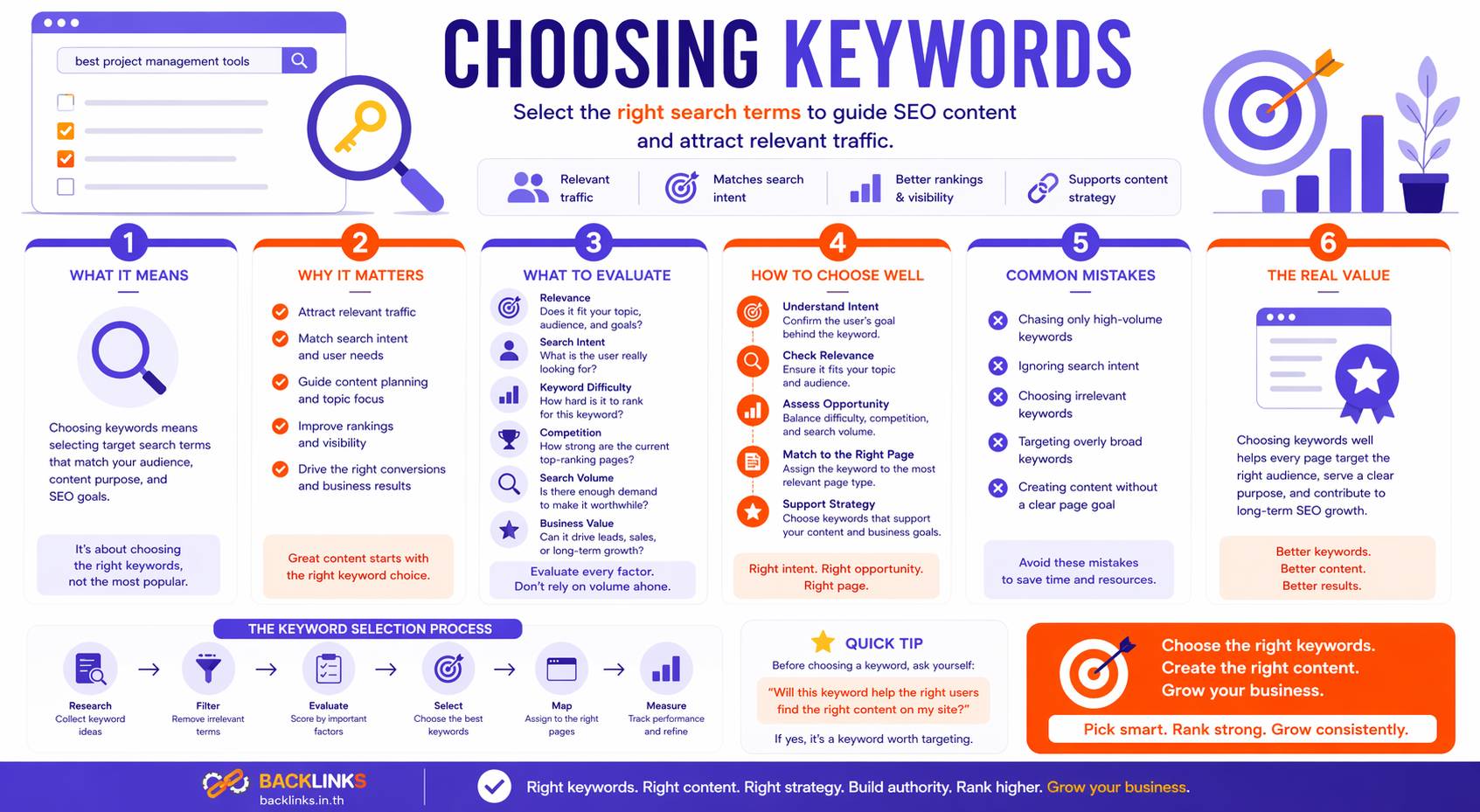
Choosing keywords is the process of selecting the search terms your website should target based on relevance, search intent, competition, and business value. It is one of the most important decisions in SEO because the keywords you choose shape what content you create, who you attract, and how realistic your ranking opportunities are.
Many websites struggle with SEO because they choose keywords too casually. They may target broad keywords because they have high search volume, copy competitors without understanding strategy, or create content around terms that do not match what their audience actually searches for.
Good keyword selection is more strategic. It requires understanding your audience, analyzing search intent, reviewing competition, and deciding which keywords can realistically support long-term organic growth.
This guide explains how choosing keywords works, why it matters, and how to select keywords that give your content a clearer purpose.
What Does Choosing Keywords Mean?
Choosing keywords means deciding which search terms a page or website should target in search engines.
A keyword can be a broad phrase, a specific question, a product-related term, a local search, or a detailed long-tail query. For example:
- SEO keywords
- what is keyword research
- how to choose keywords for SEO
- best keywords for blog posts
- keyword research tools for small business
Each keyword represents a different search need. Some users want information. Others want a process, comparison, solution, or service.
Choosing keywords is not simply picking the phrase with the highest search volume. It means selecting keywords that match your audience, your content goals, your website’s authority, and the type of page you plan to create.
A strong keyword choice should answer four questions:
- Is this keyword relevant to the website?
- Does the keyword match the right search intent?
- Is the competition realistic?
- Can the page provide a genuinely useful answer?
If the answer is yes, the keyword may be worth targeting.
Why Choosing Keywords Matters
Choosing keywords matters because every SEO page needs a clear target. Without that target, content can become unfocused, difficult to optimize, and less competitive in search results.
It Helps You Create Content with Purpose
A clear keyword gives a page direction.
For example, a page targeting “choosing keywords” should explain how to select keywords effectively. It should cover relevance, intent, competition, search volume, business value, and common mistakes.
Without a clear keyword, the article might drift into a general SEO discussion. That makes the content less useful for users and less clear for search engines.
Good keyword selection helps define the page’s purpose before writing begins.
It Improves Search Intent Alignment
Search intent is the reason behind a search. Choosing keywords carefully helps you understand what users expect from the page.
For example:
- “What are SEO keywords” requires a definition
- “How to choose keywords” requires a process
- “Best keyword research tools” requires a tool comparison
- “Keyword research service” may require a service page
These keywords are related, but they should not all be handled the same way.
If the content does not match the intent, rankings are difficult to achieve and maintain. Choosing the right keyword helps avoid this mismatch.
It Helps Attract Better Traffic
Not all traffic is useful.
A high-volume keyword may bring visitors who are too broad, too early in the journey, or not relevant to your business. A more specific keyword may bring fewer visitors but stronger engagement because it matches a clearer need.
Choosing keywords properly helps attract visitors who are more likely to read, explore, subscribe, inquire, or eventually convert.
The goal is not only more traffic. The goal is more relevant traffic.
It Reduces Wasted SEO Effort
SEO requires time and resources. Researching, writing, optimizing, publishing, and updating content all take effort.
If you choose the wrong keyword, that effort may not produce meaningful results. The keyword may be too competitive, too vague, too unrelated, or poorly matched to the page type.
A careful keyword selection process helps you avoid creating content that has little chance of performing.
It Supports a Better Website Structure
Choosing keywords also affects how your website is organized.
When each page targets a distinct keyword and intent, your content becomes easier to structure. Related pages can support each other, internal links become more natural, and users can move through topics more clearly.
For example, pages about keyword research, SEO keywords, types of keywords, long tail keywords, keyword strategy, keyword mapping, and choosing keywords can each serve a different purpose while supporting the same broader SEO topic.
Key Factors to Consider When Choosing Keywords
Choosing keywords requires balancing several factors. No single metric should decide whether a keyword is worth targeting.
Relevance
Relevance is the first filter.
A keyword should connect clearly to your website, audience, expertise, products, services, or content goals. If a keyword has high search volume but does not fit your audience, it is usually not worth prioritizing.
Ask:
- Is this keyword related to what we offer or explain?
- Would the visitor be part of our target audience?
- Can we answer this query better than competing pages?
- Does the keyword support our broader SEO goals?
Relevance matters more than volume. A smaller, highly relevant keyword is often more valuable than a broad keyword that attracts the wrong audience.
Search Intent
Search intent determines what kind of content the keyword requires.
Common intent types include:
- Informational: the user wants to learn
- Commercial: the user wants to compare options
- Transactional: the user is ready to take action
- Navigational: the user wants a specific brand or website
For example, “choosing keywords” has informational intent. Users want guidance on how to choose the right keywords, not a sales page.
Before targeting any keyword, review the search results and confirm what type of content users expect.
Search Volume
Search volume shows how often people search for a keyword.
It can help estimate demand, but it should not control the decision by itself. High-volume keywords are often broad and competitive. Low-volume keywords may be specific, relevant, and easier to rank for.
A keyword with lower search volume can still be valuable if it has clear intent and strong relevance.
The best approach is to use search volume as one signal, not the main strategy.
Keyword Difficulty
Keyword difficulty estimates how hard it may be to rank for a keyword.
Many SEO tools provide difficulty scores, but these scores are only estimates. You should also manually review the search results.
Look at:
- The authority of ranking websites
- The quality of ranking pages
- The depth of the content
- The freshness of the results
- Whether competing pages fully satisfy the query
- Whether your site can realistically compete
A keyword may look difficult but still be possible if existing pages are weak. A keyword may look easy but be less useful if it has poor relevance.
Business Value
Business value refers to how much a keyword supports your goals.
Some keywords attract early-stage learners. Others attract people comparing tools, services, or providers. Both can be useful, but they serve different roles.
For example:
- “What are keywords” supports education
- “How to choose keywords” supports practical learning
- “Keyword research tools” supports comparison
- “Keyword research service” supports conversion
A balanced SEO strategy includes different levels of business value, but priority should depend on your current goals.
Ranking Potential
Ranking potential is the realistic chance that your website can compete for the keyword.
This depends on:
- Your website authority
- Existing content strength
- Internal link support
- Backlink profile
- Topic coverage
- Competition level
- Content quality
For newer websites, specific long-tail keywords are often more realistic. For established websites, broader and more competitive keywords may become more achievable.
Choosing keywords should balance ambition with realism.
Content Fit
A keyword should fit the type of content you can create well.
If the keyword requires a detailed comparison, but you cannot provide useful comparisons, it may not be the right target. If the keyword requires original examples or practical experience, the content should be able to deliver that.
Ask:
- Can we satisfy this keyword with strong content?
- Do we have enough expertise to cover it properly?
- Does the keyword need examples, tools, visuals, or data?
- Would the page feel complete and useful?
A keyword is only valuable if you can create content that deserves to rank.
How to Choose Keywords for SEO
Choosing keywords works best when done through a structured process.
1. Start with Your Audience
Before using keyword tools, define who you are trying to reach.
Different audiences search differently. A beginner may search “what are SEO keywords,” while a marketing manager may search “how to build a keyword strategy.” A business owner may search “how to choose keywords for my website.”
Start by asking:
- Who is the target reader?
- What problem are they trying to solve?
- What language do they use?
- How much do they already know?
- What would they need next after reading the page?
Audience understanding helps prevent keyword choices that look good in tools but do not match real users.
2. Define the Page Purpose
Each page should have a clear purpose before keywords are finalized.
A page may be designed to:
- Explain a concept
- Teach a process
- Compare options
- Answer a specific question
- Support a service
- Help users make a decision
The keyword should match that purpose.
For example, this page is designed to explain how choosing keywords works. That makes “choosing keywords” a suitable primary keyword because it matches the informational purpose of the article.
3. Build a Keyword List
Next, collect possible keyword ideas.
Sources can include:
- Keyword research tools
- Search engine suggestions
- People Also Ask questions
- Competitor pages
- Google Search Console data
- Customer questions
- Sales conversations
- Website search data
- Existing content topics
For a topic like choosing keywords, related ideas might include:
- how to choose keywords
- choosing keywords for SEO
- how to pick SEO keywords
- keyword selection
- keyword targeting
- keyword research process
- how to choose keywords for a website
At this stage, collect ideas broadly. You can refine them later.
4. Group Similar Keywords
After collecting keyword ideas, group similar terms by meaning and intent.
For example, these keywords may belong together:
- choosing keywords
- how to choose keywords
- how to pick SEO keywords
- keyword selection for SEO
These terms all point toward a similar informational need.
However, these may need separate pages or sections:
- keyword research tools
- keyword mapping
- keyword strategy
- keyword difficulty
- search intent SEO
Grouping keywords helps avoid creating multiple pages that overlap too much.
5. Analyze Search Intent
Search intent should be confirmed before choosing the final keyword.
Review the search results for the keyword. Look at the pages currently ranking and ask:
- Are they guides, service pages, tools, or comparison articles?
- Are they beginner-friendly or advanced?
- How detailed are they?
- What questions do they answer?
- What format appears most often?
If the top results are educational guides, an informational article is likely appropriate. If product pages dominate, the keyword may have more transactional intent.
For “choosing keywords,” the expected content is educational and practical.
6. Check Competition
Once intent is clear, review competition.
Look at whether ranking pages are strong, useful, current, and well-structured. If the top results are from highly authoritative websites with comprehensive content, ranking may take longer.
However, competition should not automatically discourage you. A keyword may still be worth targeting if it is highly relevant and strategically important.
The key is to know whether the keyword is a short-term opportunity, a medium-term target, or a long-term goal.
7. Balance Volume with Specificity
Search volume is useful, but specificity often creates better opportunities.
For example, “keywords” is broad and unclear. “Choosing keywords for SEO content” is more specific and easier to address. The second phrase may have lower volume, but it gives clearer direction.
A good keyword strategy usually includes a mix of:
- Broad keywords for major topics
- Medium-tail keywords for focused pages
- Long-tail keywords for specific questions
Choosing keywords is about balance, not chasing the biggest number.
8. Select One Primary Keyword
Each important page should have one primary keyword.
The primary keyword defines the main topic of the page. It should guide the title, introduction, headings, and overall angle.
For this page, the primary keyword is “Choosing keywords.”
The page can also include related phrases, but they should support the main topic rather than compete with it.
9. Choose Supporting Keywords
Supporting keywords help cover the topic more completely.
For this page, supporting terms may include:
- how to choose keywords
- keyword selection
- SEO keyword selection
- keyword targeting
- keyword research
- search intent
- keyword difficulty
- long-tail keywords
These terms should be used naturally in the content where they add clarity.
10. Map the Keyword to the Right Page
After choosing the keyword, assign it to the correct page.
If an existing page already covers the topic, it may be better to update that page instead of creating a new one. If no suitable page exists, a new article may be appropriate.
This prevents duplication and keeps the website organized.
Choosing Keywords for Different Page Types
Different page types require different keyword choices.
Educational Articles
Educational articles should target informational keywords.
Examples include:
- choosing keywords
- what are SEO keywords
- why keyword research is important
- how to determine search intent
These pages should explain concepts clearly and help users understand the topic.
How-To Guides
How-to guides should target process-based keywords.
Examples include:
- how to choose keywords
- how to do keyword research
- how to map keywords to pages
- how to use keywords in content
These pages should provide step-by-step guidance.
Comparison Pages
Comparison pages should target commercial keywords.
Examples include:
- best keyword research tools
- Ahrefs vs Semrush
- keyword research tools comparison
- best SEO tools for beginners
These pages should help users evaluate options.
Service Pages
Service pages should target transactional or service-focused keywords.
Examples include:
- keyword research service
- SEO keyword strategy service
- SEO content optimization service
- hire SEO consultant
These pages should explain the service, build trust, and guide users toward action.
Local Pages
Local pages should target location-based keywords.
Examples include:
- SEO agency Bangkok
- keyword research service Thailand
- SEO consultant near me
These pages should include relevant local context, service details, and trust signals.
Common Mistakes When Choosing Keywords
Choosing Keywords Only by Search Volume
High search volume can be tempting, but it often leads to broad and competitive keywords.
A keyword with lower volume may be more valuable if it has clearer intent and better relevance.
Ignoring Search Intent
Intent mismatch is one of the biggest reasons SEO pages underperform.
If users want a guide, do not give them a sales page. If they want a comparison, do not give them only a definition.
Targeting Keywords That Are Too Competitive
Some keywords may be unrealistic for your current website authority.
It is fine to target competitive keywords as long-term goals, but your strategy should also include achievable opportunities.
Creating Separate Pages for Similar Keywords
Small wording differences do not always require separate pages.
For example, “choosing keywords,” “how to choose keywords,” and “keyword selection” may be covered together if the intent is the same.
Creating too many similar pages can cause overlap and weaken performance.
Choosing Keywords That Do Not Support Business Goals
A keyword may bring traffic but still have low value.
If the visitors are unlikely to engage with your website, explore related content, or fit your target audience, the keyword may not be worth prioritizing.
Forgetting Existing Content
Before creating a new page, check whether an existing page can be improved.
Updating existing content can sometimes be more effective than publishing a new article, especially if the page already has rankings or impressions.
Practical Guidance for Choosing Keywords
Start with relevance. A keyword should clearly connect to your audience and your website’s purpose.
Then analyze intent. Make sure the content format matches what users expect. If the keyword suggests a guide, create a guide. If it suggests comparison, create comparison content.
Next, review competition. Choose keywords that are realistic for your current website stage. Newer websites may benefit from specific long-tail keywords, while stronger websites can target broader terms.
Use search volume carefully. It should help you understand demand, but it should not override relevance or intent.
Finally, group related keywords and assign them to the right pages. This keeps your content organized and reduces overlap.
Timing and Expectations
Choosing keywords improves SEO planning immediately, but rankings take time.
After a page is published or updated, search engines need time to crawl, index, and evaluate it. Performance depends on content quality, competition, website authority, internal links, backlinks, and technical SEO.
For newer websites, carefully chosen long-tail keywords may create earlier opportunities. For established websites, broader keywords may become more realistic when supported by strong internal links and topic coverage.
Keyword selection should also be reviewed over time. Search behavior changes, competitors update content, and your website may gain authority. A keyword that was unrealistic before may become achievable later.
Conclusion
Choosing keywords is one of the most important parts of SEO content planning. The right keywords help you create focused content, match search intent, attract relevant visitors, and build a clearer website structure.
Strong keyword selection is not based only on search volume. It requires relevance, intent analysis, competition review, business value, and realistic judgment.
When you choose keywords carefully, every page has a stronger purpose. Your content becomes easier for users to understand and easier for search engines to match with the right queries.
Over time, a thoughtful approach to choosing keywords can support better rankings, stronger organic traffic, and more sustainable SEO growth.