
SEO Keywords: What They Are and How to Use Them Effectively
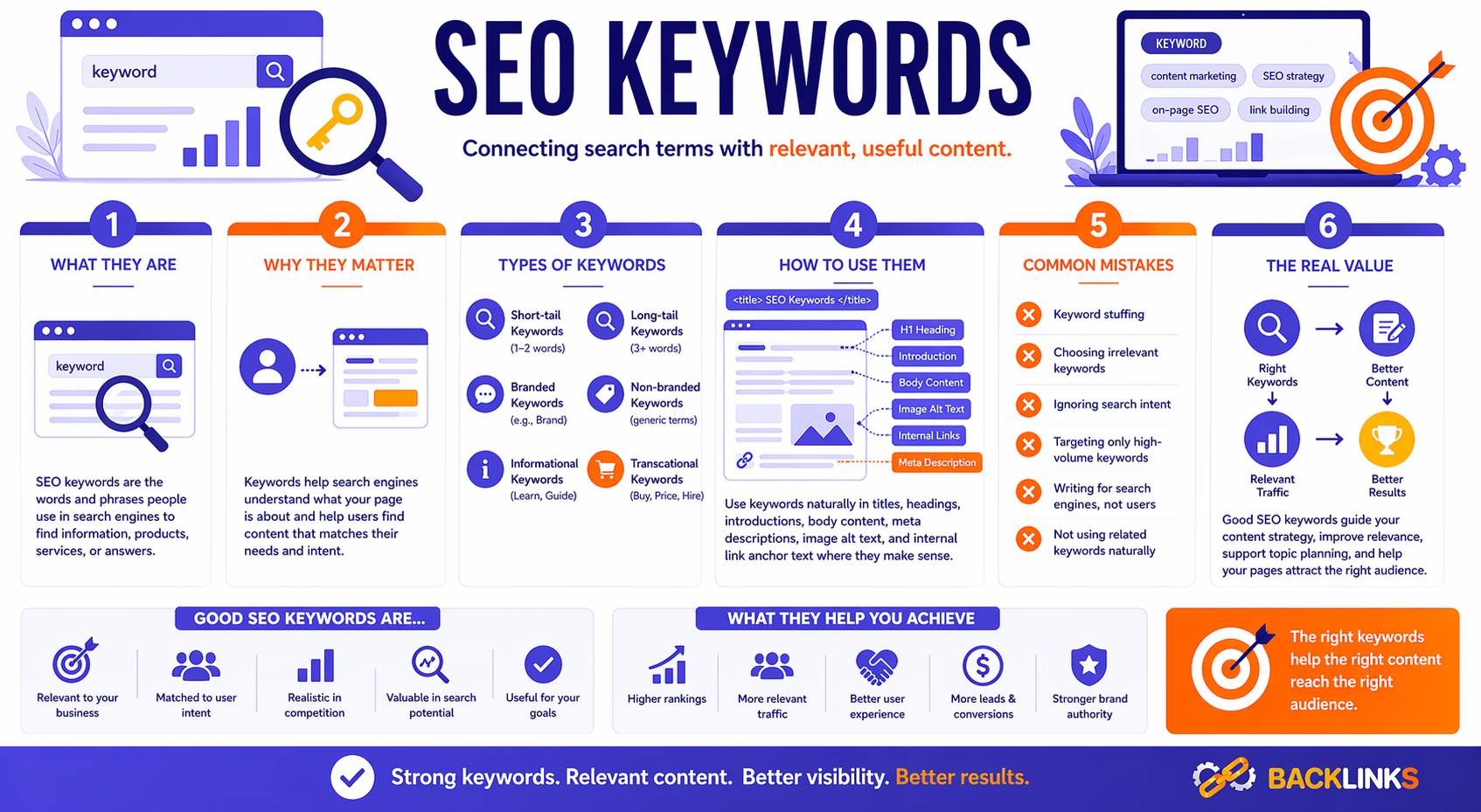
SEO keywords are the words and phrases people use in search engines when they are looking for information, products, services, or solutions. In search engine optimization, they help connect your website content with the search queries your audience already uses.
For many websites, keywords are treated too narrowly. Some people think SEO keywords are simply terms to repeat throughout a page. Others focus only on high-volume phrases without considering whether those searches are relevant, realistic, or aligned with user intent. Both approaches can lead to weak SEO performance.
Effective keyword use is not about forcing exact phrases into content. It is about understanding how people search, what they expect to find, and how your content can answer their needs better than competing pages.
This article explains what SEO keywords are, why they matter, the different types of keywords, and how to use them naturally in a modern SEO strategy.
What Are SEO Keywords?
SEO keywords are search terms that website owners target in order to help their pages appear in relevant search results.
A keyword can be:
- A single word, such as “SEO”
- A short phrase, such as “SEO keywords”
- A question, such as “what are SEO keywords”
- A detailed search query, such as “how to choose SEO keywords for a blog post”
In practical terms, SEO keywords represent demand. They show what people are searching for and how they describe their needs.
For example, someone searching “SEO keywords” likely wants to understand what keywords mean in SEO, how they work, and how to use them correctly. Someone searching “best SEO keyword tools” has a different intent and may be comparing software options.
This is why keywords should not be viewed as isolated phrases. Each keyword reflects a searcher’s goal, level of knowledge, and expected content type.
Why SEO Keywords Matter
SEO keywords matter because they help search engines and users understand what your content is about.
Search engines use many signals to evaluate pages, including content quality, relevance, links, page experience, and authority. Keywords are one part of that system. They give context to the topic of a page and help search engines match it with appropriate queries.
For users, keywords influence whether a page feels relevant. When someone searches for a specific phrase and sees that the page directly addresses that topic, they are more likely to click, read, and engage.
They Connect Content with Search Demand
A website may publish high-quality content, but if the content does not match how people search, it may struggle to gain visibility.
SEO keywords help bridge that gap. They show the language your audience uses and the topics they care about. This allows you to create content that is easier to discover and more aligned with real demand.
For example, a business might describe its service as “organic visibility consulting,” while users may search for “SEO help for small business.” Keyword research helps identify which language should guide content planning.
They Help Clarify Search Intent
Search intent is the reason behind a search query. It explains what the user wants to accomplish.
Different SEO keywords can indicate different intent:
- “What are SEO keywords” suggests the user wants a definition
- “How to find SEO keywords” suggests the user wants a process
- “SEO keyword tools” suggests the user may want software options
- “SEO keyword services” suggests the user may be closer to hiring help
Understanding intent is essential because the right keyword used in the wrong type of content will not perform well. A definition-based article will not satisfy someone looking for a tool comparison. A product page will not satisfy someone looking for a beginner explanation.
They Support Better Content Structure
SEO keywords can help organize content more clearly.
A page targeting “SEO keywords” may include sections about definitions, types of keywords, keyword research, search intent, placement, and common mistakes. Related but more specific topics may be covered in separate supporting articles, such as long-tail keywords, keyword difficulty, or using keywords in content.
This structure helps readers navigate the topic and helps search engines understand how different pages relate to one another.
They Improve On-Page SEO
Keywords are also important for on-page SEO. When used naturally, they can help clarify the topic of a page in key areas such as:
- Page title
- H1 heading
- Introduction
- H2 headings
- Meta title
- Meta description
- URL slug
- Body content
- Image alt text
- Internal link anchor text
The goal is not to place the keyword everywhere. The goal is to make the page clear, relevant, and easy to understand.
Types of SEO Keywords
Not all SEO keywords work the same way. Understanding different keyword types helps you choose the right terms for each page and avoid targeting keywords too broadly.
Primary Keywords
A primary keyword is the main keyword a page is designed to target.
For this article, the primary keyword is “SEO keywords.” The page should explain the topic clearly and cover the related ideas users expect to find when searching that phrase.
A primary keyword usually appears in the title, introduction, and relevant headings. However, it should be used naturally. Overusing the exact phrase can make content sound forced and reduce readability.
Secondary Keywords
Secondary keywords are closely related terms that support the primary keyword.
For a page about SEO keywords, secondary keyword ideas might include:
- search terms
- keyword research
- SEO keyword strategy
- keyword placement
- long-tail keywords
- search intent
- keyword optimization
- keyword analysis
Secondary keywords help expand the topic and show broader relevance. They also allow the page to rank for related queries without needing separate pages for every variation.
Short-Tail Keywords
Short-tail keywords are broad search terms, usually one to three words long.
Examples include:
- SEO
- keywords
- SEO tools
- keyword research
These keywords often have higher search volume, but they are also more competitive and less specific. A person searching “SEO” could be looking for a definition, a service provider, a course, a checklist, or a strategy guide.
Short-tail keywords can be valuable, but they usually require strong authority and comprehensive content to compete.
Long-Tail Keywords
Long-tail keywords are longer and more specific search queries.
Examples include:
- how to choose SEO keywords
- what are SEO keywords used for
- best SEO keywords for blog posts
- how many keywords should a page target
Long-tail keywords often have lower search volume, but they usually reveal clearer intent. They can be especially useful for newer websites, specialized topics, and content designed to answer specific questions.
A strong SEO strategy often combines broader keywords with long-tail opportunities.
Branded Keywords
Branded keywords include a company, product, or brand name.
Examples include:
- Google Keyword Planner
- Ahrefs keyword explorer
- Semrush keyword tool
Branded keywords are usually used by people who already know a specific brand. They can be valuable for reputation management, comparison content, and product-related searches.
Non-Branded Keywords
Non-branded keywords do not include a specific brand name.
Examples include:
- SEO keywords
- keyword research tools
- how to find keywords
- keyword difficulty
These keywords are important for reaching users who are still researching and have not chosen a specific brand or provider.
Informational Keywords
Informational keywords are used when someone wants to learn something.
Examples include:
- what are SEO keywords
- why are keywords important for SEO
- how do SEO keywords work
These keywords are useful for educational content and early-stage audience building.
Commercial Keywords
Commercial keywords indicate that the user is comparing options or evaluating solutions.
Examples include:
- best keyword research tools
- SEO keyword software
- keyword research tool comparison
These keywords often work well for comparison pages, reviews, and buying guides.
Transactional Keywords
Transactional keywords show that the user may be ready to take action.
Examples include:
- hire SEO keyword research service
- buy SEO keyword report
- SEO keyword consultant
These terms usually work better for service pages, product pages, or conversion-focused landing pages.
How SEO Keywords Work
SEO keywords work by helping search engines understand the subject and relevance of a page.
When search engines crawl a page, they analyze the content, headings, links, structured data, and surrounding context. Keywords help indicate what the page is about, but modern search engines do not rely only on exact-match phrases.
They also evaluate:
- Related terms
- Search intent
- Content depth
- Page quality
- Internal links
- External links
- User satisfaction signals
- Overall topical relevance
This means keyword optimization is no longer about repeating the same phrase. It is about creating a complete, useful page that answers the searcher’s need.
Exact Match Is Less Important Than Relevance
In older SEO practices, pages often repeated exact keywords many times. This approach is outdated and can make content feel unnatural.
Modern SEO focuses more on relevance and context. A page about SEO keywords can also use related phrases such as search terms, keyword targeting, keyword strategy, and keyword optimization. These terms help explain the topic more naturally.
Search engines can understand that these concepts are connected. This allows writers to create content that is useful for readers while still being optimized.
Search Intent Shapes Keyword Use
The same keyword can require different content depending on intent.
For example, “SEO keywords” is broad but informational. A page targeting this term should explain what SEO keywords are and how they are used.
A keyword like “SEO keyword tool” has a different expectation. Users likely want software options or tool features. A general definition article would not fully satisfy that search.
Before writing content, always ask what the searcher expects to find. The answer should guide the page format, headings, depth, examples, and internal links.
Keywords Help Define Page Purpose
Every SEO page should have a clear purpose.
A page targeting “SEO keywords” should not try to cover every part of SEO in detail. It should stay focused on keywords: what they are, how they work, why they matter, and how to use them properly.
Related topics can be mentioned and linked where relevant, but the main page should not become too broad. Clear focus helps both readers and search engines understand the page.
How to Choose SEO Keywords
Choosing SEO keywords requires more than checking search volume. The best keywords are relevant, realistic, and aligned with the page’s purpose.
Start with Audience Needs
Begin by thinking about your audience.
Ask:
- What problems are they trying to solve?
- What questions do they ask before making a decision?
- What language do they use?
- What level of knowledge do they have?
- Are they learning, comparing, or ready to act?
This step prevents you from choosing keywords that look attractive in tools but do not match your real audience.
Use Keyword Research
Keyword research helps you find search terms connected to your topic. It can reveal questions, variations, related searches, and opportunities you may not have considered.
For SEO keywords, research may reveal related topics such as:
- how to find SEO keywords
- how to use SEO keywords
- keyword research for SEO
- how many keywords per page
- keyword placement for SEO
- keyword difficulty
- long-tail keywords
These insights help shape the content and identify future article opportunities.
Evaluate Search Intent
Before targeting a keyword, review its intent.
If the keyword is informational, create an educational article. If it is commercial, create comparison or evaluation content. If it is transactional, create a page that supports action.
This matters because search engines tend to rank pages that match the dominant intent of the query.
Check Competition
Review the pages already ranking for the keyword.
Look at:
- Content format
- Content depth
- Domain strength
- Page quality
- Freshness
- Internal linking
- Gaps in the current results
A keyword may be worth targeting if you can create a clearer, more complete, or more useful page than what currently ranks.
Balance Volume and Relevance
High-volume keywords are not always the best choice. They may be too broad, too competitive, or too far from your business goals.
A lower-volume keyword with specific intent can be more valuable because it attracts a more relevant audience.
For example, “SEO” may bring broad interest, while “how to choose SEO keywords for blog content” attracts someone with a clearer need.
How to Use SEO Keywords in Content
SEO keywords should be used naturally and strategically. They should help clarify the topic, not interrupt the reading experience.
Use the Primary Keyword Early
The primary keyword should appear early in the content, ideally in the first paragraph. This helps confirm the topic for both readers and search engines.
For example, this article opens with the phrase “SEO keywords” because that is the main topic. The phrase is used naturally rather than forced.
Include Keywords in Headings Where Relevant
Headings help structure content. Including keywords or related terms in headings can improve clarity.
For example:
- What Are SEO Keywords?
- Types of SEO Keywords
- How to Choose SEO Keywords
- How to Use SEO Keywords in Content
These headings are useful because they describe the section clearly. They are not added only for keyword placement.
Write for Topic Coverage
Strong keyword use goes beyond exact matches. A useful page should cover related concepts that help answer the user’s question.
For SEO keywords, this may include keyword types, search intent, keyword research, keyword placement, keyword difficulty, and common mistakes.
Covering these ideas naturally improves relevance and makes the content more helpful.
Avoid Keyword Stuffing
Keyword stuffing means repeating keywords excessively or unnaturally.
This can make content difficult to read and may harm quality. Readers can quickly recognize when a page is written for search engines rather than people.
Instead of repeating the same phrase, use natural variations and related terms.
Optimize Metadata
SEO keywords can also support metadata.
A good meta title should include the primary keyword and communicate the page’s value. A good meta description should summarize what the page offers and encourage clicks without exaggeration.
Example meta title:
SEO Keywords: What They Are and How to Use Them
Example meta description:
Learn what SEO keywords are, why they matter, the main types of keywords, and how to use them naturally in content for better search visibility.
Use Internal Links Naturally
Internal links help users explore related topics and help search engines understand page relationships.
A page about SEO keywords may naturally link to articles about keyword research, search intent, long-tail keywords, content structure SEO, and using keywords in content.
Anchor text should be descriptive and varied. Avoid using the exact same keyword every time.
Common SEO Keyword Mistakes
Targeting Too Many Keywords on One Page
A page should have a clear main topic. Trying to target too many unrelated keywords can make the content unfocused.
It is fine for one page to rank for many related search terms, but those terms should share the same intent.
Creating Separate Pages for Similar Keywords
Some websites create multiple pages for keyword variations that mean almost the same thing. This can lead to overlap and internal competition.
For example, separate pages for “what are SEO keywords,” “SEO keywords meaning,” and “definition of SEO keywords” may be unnecessary if they all serve the same intent.
A stronger approach is to create one complete page that addresses the shared topic well.
Ignoring Search Intent
Using the right keyword is not enough. The content must match the user’s expectation.
If users want a definition, give them a clear explanation. If they want a tool list, provide tool comparisons. If they want a process, give them practical steps.
Intent mismatch is one of the most common reasons keyword-targeted pages underperform.
Choosing Keywords Only for Search Volume
Search volume is useful, but it can be misleading.
A high-volume keyword may attract broad, low-value traffic. A lower-volume keyword may attract users who are more relevant to your business.
Strong keyword selection considers volume, relevance, competition, and intent together.
Forgetting to Update Keywords
Search behavior changes over time. New topics appear, competitors update content, and search engines change how results are displayed.
Keyword research should be reviewed regularly, especially for important pages. Updating content based on new keyword opportunities can improve long-term performance.
Practical Guidance for SEO Keywords
Start by identifying the main purpose of each page. A page should target one primary topic and a group of closely related keywords.
Next, analyze the search intent behind the target keyword. Decide whether the page should educate, compare, explain a process, or support a conversion.
Then, review competing pages. Look for what they cover well and where they are incomplete. Your goal is not to copy them, but to create something more useful and better structured.
Use the primary keyword in important areas such as the H1, introduction, title tag, and relevant headings. Use secondary keywords naturally throughout the content where they improve clarity.
Finally, support the page with internal links. Connect related pages so users can continue learning and search engines can better understand your website’s topic coverage.
Timing and Expectations
Using SEO keywords correctly can improve content relevance immediately, but rankings take time.
Search engines need to crawl, index, and evaluate the page. Performance depends on several factors, including content quality, competition, website authority, internal links, backlinks, and technical SEO.
For newer websites, long-tail SEO keywords are often more realistic starting points because they are more specific and usually less competitive. For established websites, broader keywords may become achievable when supported by strong content and internal authority.
Keyword optimization should be treated as an ongoing process. Pages may need to be updated as search behavior changes and new opportunities appear.
Conclusion
SEO keywords are essential because they connect website content with real search behavior. They show what people are looking for, how they describe their needs, and what type of content they expect to find.
However, effective keyword use is not about repeating phrases. It is about understanding search intent, choosing relevant opportunities, structuring content clearly, and using keywords naturally.
A strong SEO keyword strategy helps improve relevance, attract better organic traffic, support content planning, and create a more useful website. When keywords are researched carefully and applied with good judgment, they become a practical foundation for long-term SEO growth.