
Why Technical SEO Is Important for Long-Term Search Performance
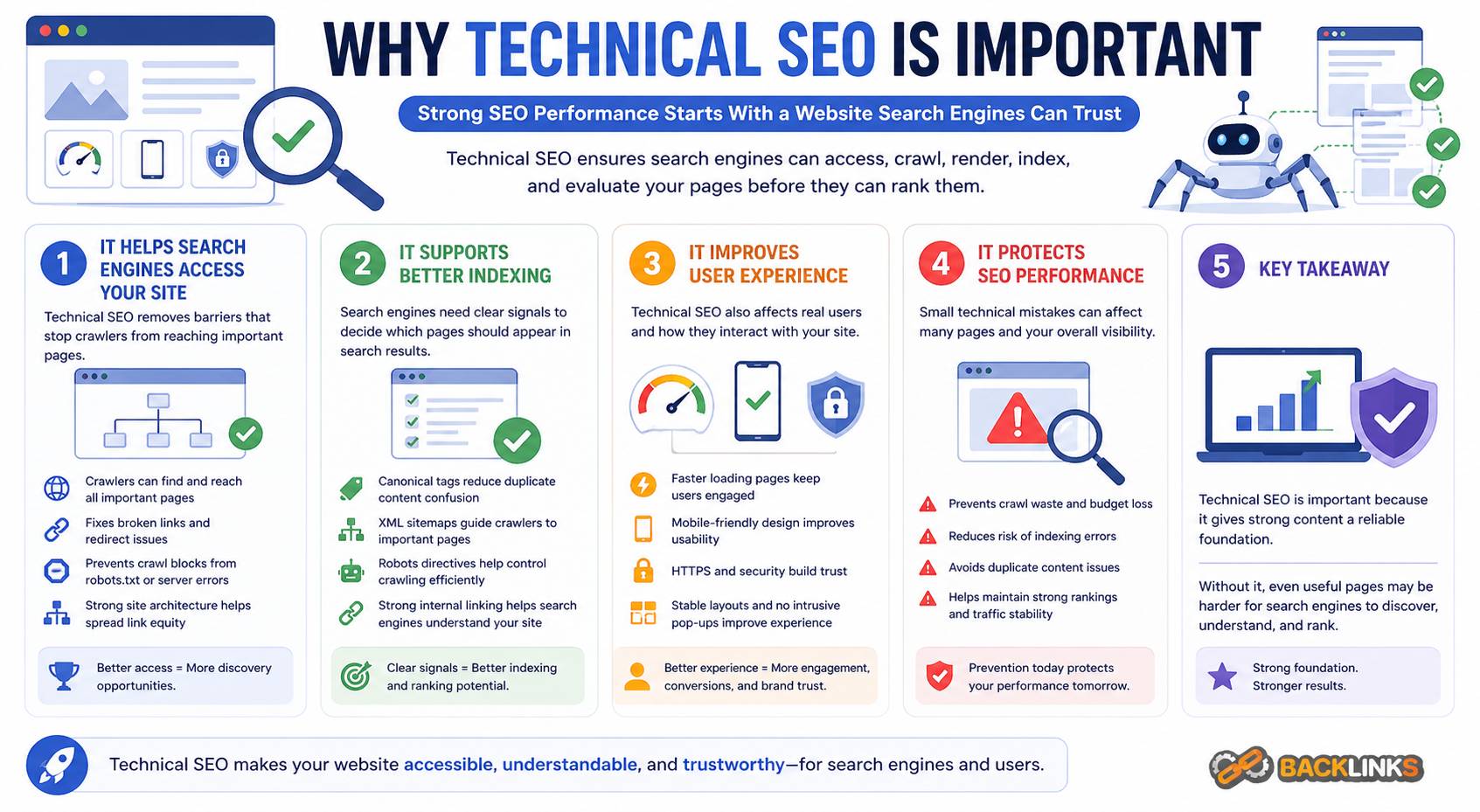
Why technical SEO is important comes down to one simple reality: search engines cannot rank what they cannot properly crawl, understand, and index. A website may have strong content, useful services, and a clear business offer, but technical issues can prevent those assets from performing in organic search.
Technical SEO is the foundation that supports the rest of an SEO strategy. It helps search engines access the right pages, interpret the website structure, process content correctly, and deliver a reliable experience to users. Without that foundation, content marketing, keyword targeting, internal linking, and authority building can all become less effective.
For business owners and marketers, technical SEO is not only a developer concern. It directly affects visibility, traffic, user experience, conversion opportunities, and the long-term stability of organic growth. This article explains why technical SEO matters, what problems it helps prevent, and how to approach it strategically.
What Is Technical SEO?
Technical SEO is the process of improving a website’s technical setup so search engines can crawl, render, index, and evaluate its pages effectively. It focuses on the infrastructure behind organic search performance rather than only the visible content on the page.
Technical SEO includes areas such as crawlability, indexability, site architecture, page speed, mobile usability, structured data, canonical tags, redirects, XML sitemaps, robots.txt files, internal linking, and status codes.
In practical terms, technical SEO helps answer several important questions:
- Can search engines find the page?
- Can they access and process the content?
- Can they understand which version of the page is the main one?
- Can they identify how the page fits into the broader website?
- Does the page provide a stable and usable experience for visitors?
When these signals are clear, search engines can process the website more efficiently. When they are unclear, even valuable pages may struggle to appear in search results.
Why Technical SEO Is Important
Technical SEO is important because it removes barriers between your website and search engines. Organic search depends on a sequence of steps. Search engines must discover a URL, crawl it, render it, understand it, decide whether to index it, and then evaluate whether it deserves to rank for relevant queries.
A technical problem at any stage can limit performance.
For example, a service page may be well written but accidentally marked as noindex. A product category may be valuable but buried too deeply in the site structure. A blog article may target the right keyword but load too slowly on mobile. A migrated page may lose visibility because redirects were not handled correctly.
These are not content problems. They are technical barriers that reduce the impact of otherwise useful pages.
Technical SEO matters because it protects the accessibility, clarity, and reliability of your website in search.
Technical SEO Helps Search Engines Crawl Your Website
Crawling is the process search engines use to discover and access URLs. If search engines cannot crawl important pages, those pages have little chance of performing in organic search.
A technically healthy website makes important pages easy to find through internal links, clean navigation, XML sitemaps, and logical site architecture. It avoids unnecessary obstacles such as broken links, redirect loops, blocked sections, and orphan pages.
Crawlability becomes especially important as a website grows. A small website with ten pages may be easy for search engines to process. A large ecommerce site, publisher, or SaaS website may have thousands of URLs created by categories, filters, tags, parameters, and templates. Without technical control, search engines may spend time crawling low-value URLs instead of the pages that matter most.
Good technical SEO helps search engines use their crawl activity more efficiently. It points them toward important content and reduces waste caused by duplicate, broken, or unnecessary pages.
Technical SEO Supports Proper Indexing
Crawling does not guarantee indexing. A page can be discovered by search engines but still not appear in search results.
Indexing is the process of storing and organizing pages so they can be considered for search results. Technical SEO helps make sure the right pages are eligible for indexing and the wrong pages are kept out.
This is where elements such as meta robots tags, canonical tags, HTTP status codes, and sitemap quality become important.
For example, a page with a noindex tag tells search engines not to include it in search results. This can be useful for low-value pages, but damaging if applied to important commercial or informational pages. Canonical tags help identify the preferred version of similar pages, but incorrect canonicalization can cause search engines to ignore the wrong URL.
Technical SEO creates discipline around indexation. It helps prevent situations where search engines index duplicate pages, thin pages, parameter URLs, or outdated content while missing the pages that should actually rank.
Technical SEO Improves Website Structure
Search engines use links and structure to understand how pages relate to one another. A clear website structure helps search engines identify the most important pages and understand the topics your website covers.
This is especially important for websites using a pillar-and-cluster content model. A broad topic page can introduce a major subject, while supporting pages cover specific subtopics in more detail. Technical SEO helps ensure these relationships are reflected in navigation, URL structure, internal links, breadcrumbs, and crawl paths.
A strong structure helps users as well. People can move naturally from broad information to more specific guidance. They can find related content without relying only on search or menu navigation.
Poor structure creates the opposite effect. Important pages may sit too deep in the website. Related pages may not link to each other. Search engines may struggle to understand which pages are central and which are supporting. Over time, this can weaken topical authority and reduce the impact of your content strategy.
Technical SEO Protects the Value of Content
Content is often the most visible part of SEO, but content depends on technical access. A high-quality article, service page, or product page can underperform if search engines cannot process it correctly.
Technical SEO protects the value of content by making sure pages are crawlable, indexable, internally linked, and technically consistent. It also helps prevent content from being split across multiple competing URLs.
Duplicate content is a common example. The same page may be accessible through different URL variations, tracking parameters, filter combinations, or trailing slash formats. Search engines may then have to decide which version to prioritize. If the signals are inconsistent, visibility can become diluted.
Canonical tags, redirects, clean internal links, and sitemap hygiene help consolidate signals around the preferred version of the content. This gives strong content a better chance to compete.
Technical SEO Strengthens Internal Linking
Internal links are both a user experience tool and a search engine discovery tool. They help visitors move through the website and help search engines understand which pages are connected.
Technical SEO is important because it makes internal linking more systematic. It identifies orphan pages, broken links, excessive crawl depth, and weak connections between related content.
For example, if a website publishes several articles about crawling, indexing, XML sitemaps, robots.txt, page speed, and structured data, those pages should not exist in isolation. They should connect naturally to the broader technical SEO topic and to each other where relevant.
Strong internal linking helps distribute authority across the site. It also gives search engines more context about page importance and topical relevance.
Internal linking should not be treated as a final step after publishing. It should be part of the website’s architecture and content planning from the beginning.
Technical SEO Improves User Experience
Technical SEO is not only about search engine bots. Many technical factors also affect the real user experience.
Page speed, mobile usability, layout stability, secure browsing, clean navigation, and functional redirects all influence how users interact with a website. If a page loads slowly, shifts while loading, breaks on mobile, or sends users through unnecessary redirects, the experience suffers.
Search visibility may bring users to the website, but technical quality affects what happens next. A slow product page can reduce purchases. A broken form can reduce leads. A confusing mobile layout can reduce engagement. A poorly handled redirect can cause users to abandon the journey entirely.
Technical SEO helps align search performance with business performance. It ensures that the website is not only discoverable, but also usable.
Technical SEO Helps Search Engines Understand Your Pages
Search engines need to understand page content, page purpose, and page relationships. Technical SEO provides signals that support this understanding.
Structured data is one example. It helps search engines interpret specific information, such as articles, products, breadcrumbs, organizations, local business details, events, and frequently asked questions. Structured data does not replace strong content, but it can make important information clearer.
HTML structure also matters. Clear headings, proper title tags, descriptive links, crawlable navigation, and accessible content all contribute to understanding. If important content is hidden, loaded poorly, or difficult to render, search engines may not interpret the page as intended.
Technical SEO reduces ambiguity. It helps search engines understand what each page is about, how pages relate to one another, and which pages are most important.
Technical SEO Reduces Duplicate Content Problems
Duplicate content is common, especially on larger websites. It can appear because of filters, tracking parameters, product variations, pagination, category paths, printer-friendly pages, or inconsistent URL rules.
The issue is not always that duplicate content creates a direct penalty. The bigger problem is confusion and signal dilution. If several URLs show the same or very similar content, search engines may not know which one to rank. Internal links and external links may also point to different versions, weakening the preferred page.
Technical SEO helps manage this through canonical tags, redirects, parameter handling, sitemap rules, and consistent internal linking.
For ecommerce websites, duplicate content control is particularly important. Product pages, category filters, sorting options, and variant URLs can quickly create many similar pages. Without a clear technical strategy, search engines may spend too much time processing low-value variations.
Technical SEO Supports Website Migrations
Website migrations are one of the most important moments for technical SEO. A migration may involve moving to a new domain, changing URL structures, redesigning templates, switching CMS platforms, or consolidating content.
Without technical planning, migrations can cause serious organic traffic losses. Pages may return errors. Redirects may be missing. Internal links may point to old URLs. Metadata or structured data may disappear. Important pages may become noindex by mistake.
Technical SEO helps reduce these risks through preparation and testing. A proper migration process includes URL mapping, redirect planning, crawl comparisons, sitemap updates, staging checks, analytics validation, and post-launch monitoring.
The goal is to preserve as much search equity and user continuity as possible. Migration problems are often preventable, but only when technical SEO is involved early enough.
Technical SEO Makes SEO Audits More Actionable
Many SEO audits produce long lists of issues, but not every issue has the same importance. Technical SEO is important because it helps separate critical problems from minor warnings.
A missing alt attribute on a decorative image is not as urgent as an accidental noindex tag on a key service page. A single broken link on an old post is not as serious as a sitewide canonical error affecting hundreds of pages.
A strong technical SEO approach prioritizes issues based on impact, scale, and business relevance. It focuses first on problems that affect important page types, such as service pages, product categories, location pages, lead generation pages, and high-performing content.
This makes SEO work more efficient. Instead of chasing every tool warning, the team can fix the issues most likely to improve search performance.
Common Problems Technical SEO Helps Prevent
Technical SEO helps prevent many problems that can quietly reduce organic visibility.
Common issues include:
- Important pages blocked from crawling
- Valuable pages marked as noindex
- Duplicate URLs competing with each other
- Broken internal links
- Redirect chains and redirect loops
- Slow mobile performance
- Non-indexable URLs included in sitemaps
- Poorly structured navigation
- Orphan pages with no internal links
- Incorrect canonical tags
- Missing or invalid structured data
- Soft 404 pages
- Crawling of low-value parameter URLs
These problems can exist for months without being obvious to users. A website may look fine on the surface while search engines are receiving confusing or inefficient signals.
Regular technical SEO checks help identify these issues before they become larger obstacles.
Why Technical SEO Is Important for Large Websites
Technical SEO becomes more important as website complexity increases.
Large websites often have more templates, more URL variations, more internal links, more redirects, and more content types. This creates more opportunities for technical problems.
Ecommerce websites may generate many filtered URLs. Publishers may have years of archived content. SaaS websites may have product pages, resources, documentation, and comparison pages. Multilingual websites may require hreflang implementation and regional URL structures.
At scale, small technical mistakes can affect thousands of pages. A single template error can create duplicate title tags across an entire section. A faulty canonical rule can remove many pages from search competition. A crawl trap can waste search engine resources on unimportant URLs.
For large websites, technical SEO is not optional maintenance. It is a core part of managing organic search at scale.
Why Technical SEO Is Important for Small Websites
Small websites also benefit from technical SEO, even if their issues are usually less complex.
For a local business, consultant, startup, or service provider, technical SEO helps ensure that important pages are easy to find, load properly, and can be indexed. A small website may not need advanced crawl budget management, but it still needs clean architecture, mobile usability, secure browsing, and clear indexation signals.
Small websites often have fewer opportunities to rank, so every important page matters. If a main service page is not indexed, loads poorly, or has weak internal links, the impact can be significant.
Technical SEO gives smaller websites a stronger foundation before they invest more heavily in content, local SEO, or authority building.
How to Prioritize Technical SEO Work
The best way to prioritize technical SEO is to focus on impact.
Start with the pages that matter most to the business. These may include homepage, service pages, product categories, product pages, pricing pages, location pages, comparison pages, and high-value informational content.
Then evaluate whether those pages are:
- Crawlable
- Indexable
- Internally linked
- Fast enough for users
- Mobile-friendly
- Free from duplicate URL conflicts
- Returning the correct status codes
- Supported by accurate metadata and structured data where relevant
After reviewing key pages, look for sitewide patterns. Template-level issues often deserve attention because they affect many pages at once.
Technical SEO should also be prioritized by risk. Migration preparation, accidental noindex tags, robots.txt problems, redirect errors, and canonical mistakes can have serious consequences and should be handled carefully.
How Long Technical SEO Takes to Show Results
Technical SEO results can appear at different speeds depending on the issue.
Some fixes may show results relatively quickly after search engines recrawl the affected pages. Examples include removing an accidental noindex tag, fixing a broken redirect, restoring access to blocked pages, or correcting a major sitemap problem.
Other changes take longer. Improving site architecture, consolidating duplicate content, optimizing internal links, and strengthening performance across many templates may require repeated crawling and evaluation before the full effect becomes visible.
Technical SEO should not be viewed as a one-time fix. Websites change continuously. New content, plugins, scripts, templates, redirects, and design changes can introduce new issues. Regular monitoring helps protect performance over time.
Practical Guidance for Managing Technical SEO
Technical SEO works best when it is integrated into normal website operations rather than handled only after problems appear.
SEO teams should be involved before major website changes, not only after launch. Developers should receive clear, specific recommendations. Content teams should understand how internal links, URL structure, and page templates affect visibility. Business stakeholders should understand that technical SEO protects the value of organic search investment.
A practical technical SEO process should include:
- Regular crawling of the website
- Monitoring indexation changes
- Reviewing Search Console data
- Checking important templates after updates
- Auditing redirects after URL changes
- Testing mobile and speed performance
- Validating structured data
- Reviewing sitemap and robots.txt files
- Checking internal links to important pages
The purpose is not to create unnecessary technical work. The purpose is to maintain a website that search engines and users can access reliably.
Conclusion
Why technical SEO is important can be summarized clearly: it allows search engines to find, process, understand, and trust your website. Without it, valuable content may remain hidden, rankings may become unstable, and organic traffic opportunities may be lost.
Technical SEO supports crawlability, indexability, site structure, page speed, mobile usability, internal linking, duplicate content control, structured data, redirects, and website migrations. These elements work together to create a stronger foundation for search performance.
For businesses serious about organic growth, technical SEO should not be treated as a minor backend task. It is a strategic part of SEO that protects content investment, improves user experience, and helps the website grow with fewer search visibility problems.