
Paid Backlinks SEO: Risks, Realities, and Strategic Use in Modern Linkbuilding
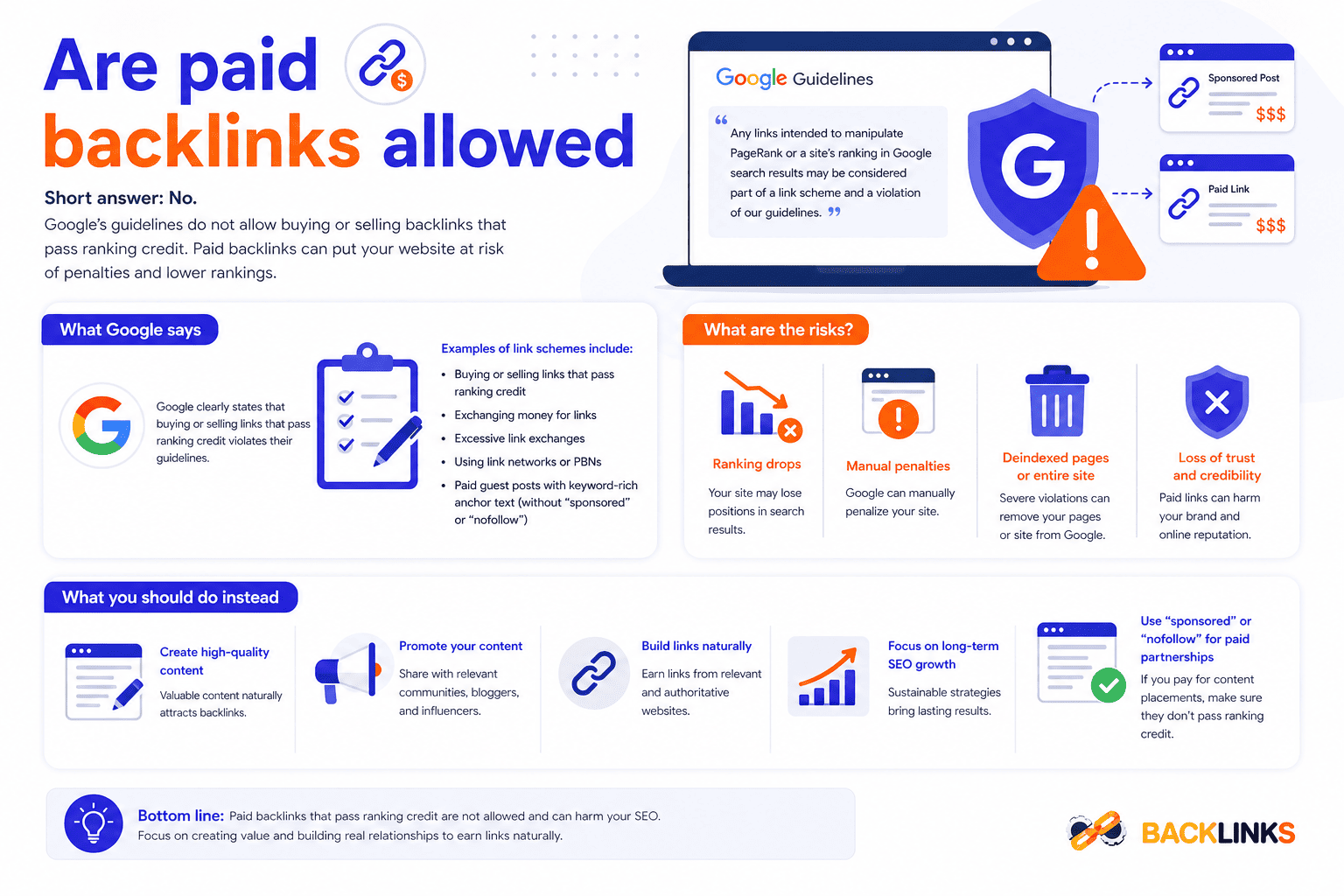
The topic of paid backlinks SEO sits in a gray area that many businesses struggle to navigate. On one side, backlinks remain a core ranking factor. On the other, search engines explicitly discourage manipulative link schemes.
This creates a practical dilemma. Many websites competing in search results are clearly benefiting from paid placements, yet the risks are real and poorly understood. As a result, decision-making around paid backlinks is often based on assumptions rather than strategy.
This article provides a clear, experience-driven perspective on paid backlinks SEO. It explains how it works, why it carries risk, and how to approach it in a way that aligns with long-term SEO performance rather than short-term gains.
What is Paid Backlinks SEO
Paid backlinks SEO refers to the practice of acquiring backlinks in exchange for money or other compensation, with the intent of influencing search engine rankings.
In practical terms, this can include:
- Paying for link placements within articles
- Sponsored content that includes dofollow links
- Buying links from networks or marketplaces
The key distinction is intent. If a link is acquired primarily to manipulate rankings rather than provide value to users, it falls under paid backlink practices from an SEO perspective.
Search engines, particularly Google, classify this as part of link schemes when it violates their guidelines.
Why Paid Backlinks SEO Matters
Influence on Rankings
Backlinks—paid or not—can influence rankings if they pass authority and relevance signals. This is why paid backlinks continue to exist in competitive niches.
However, the impact depends heavily on quality, context, and how naturally the links are integrated.
Competitive Pressure
In many industries, competitors are already investing in link acquisition, including paid methods. Ignoring this reality can put a website at a disadvantage, especially in saturated markets.
This does not mean adopting risky practices blindly, but it does require a clear understanding of how paid backlinks fit into the broader linkbuilding landscape.
Risk Management
The primary reason to understand paid backlinks SEO is not just performance, but risk. Poor execution can lead to:
- Ranking drops
- Manual actions
- Loss of trust signals
A strategic approach helps balance potential gains with acceptable risk levels.
How Paid Backlinks SEO Works
Paid backlinks influence SEO through the same mechanisms as organic links, but their effectiveness depends on how they are implemented.
Authority Transfer
When a link is placed on an external website, it can pass authority (link equity) to the target page. This is influenced by:
- The authority of the linking domain
- The relevance of the content
- The placement of the link within the page
A contextual link within relevant content typically has more impact than a link placed in low-visibility areas.
Context and Relevance
Search engines evaluate not just the link itself, but the context around it. Paid links that are embedded naturally within relevant content are harder to distinguish from organic links.
This is why some paid backlinks appear to perform well—they align with the same signals as editorial links.
Detection and Signals
Search engines use multiple signals to identify unnatural link patterns. These may include:
- Repetitive anchor text
- Sudden spikes in link acquisition
- Links from unrelated or low-quality sites
Paid backlinks that ignore these signals increase the likelihood of negative outcomes.
Important Subtopics in Paid Backlinks SEO
Paid vs Editorial Links
The distinction between paid and editorial links is not always visible externally, but it is important conceptually.
- Editorial links are earned based on content value
- Paid links are acquired through compensation
In practice, some paid placements attempt to mimic editorial standards. The closer they align with genuine content value, the more sustainable they tend to be.
Role Within a Linkbuilding Strategy
Paid backlinks should not be the foundation of a linkbuilding strategy. Instead, they may serve as a supporting component alongside:
- Content-driven link acquisition (e.g., linkbait content)
- Outreach-based strategies such as broken link building
- Organic mentions and citations
This diversified approach reduces reliance on any single method and improves overall resilience.
Relevance and Placement Quality
Not all paid links are equal. A high-cost link on a generic site may deliver less value than a lower-cost link on a highly relevant page.
Key factors to evaluate include:
- Topical alignment
- Content quality
- Traffic and engagement
- Editorial standards
These factors influence both SEO value and risk.
Anchor Text Strategy
Paid backlinks often introduce anchor text risk. Over-optimized anchors can signal manipulation.
A balanced approach includes:
- Brand anchors
- Partial keyword phrases
- Natural language variations
This aligns with broader best practices in linkbuilding and reduces detection risk.
Common Mistakes
Treating Paid Links as a Shortcut
One of the most common issues is viewing paid backlinks as a quick way to improve rankings. While short-term gains may occur, this approach often ignores long-term consequences.
Ignoring Link Relevance
Links from unrelated sites may pass limited value and weaken topical signals. Relevance should always be a priority, regardless of whether the link is paid.
Over-Scaling Too Quickly
Rapid increases in backlinks, especially from similar sources, can create unnatural patterns. This increases the likelihood of algorithmic filtering or penalties.
Neglecting Content Quality
Links pointing to weak or thin content provide limited benefit. Even strong backlinks cannot compensate for poor on-page quality.
Practical Guidance
Use Paid Backlinks Selectively
Paid backlinks should be used with clear intent and defined scope. Focus on pages where improved authority can have a measurable impact.
Prioritize Contextual Placement
If a link is paid for, its value depends on how it is placed. Contextual links within relevant content are more effective and more aligned with natural link patterns.
Combine with Content Strategy
Paid backlinks perform better when supported by strong content. Pages that provide genuine value are more likely to benefit from increased authority.
For example, a well-developed resource within your linkbuilding content cluster can serve as a stronger target for both paid and organic links.
Maintain a Balanced Link Profile
A healthy backlink profile includes a mix of:
- Organic links
- Outreach-based placements
- Limited paid links
This diversity helps maintain credibility and reduces reliance on any single tactic.
Timing and Expectations
The effects of paid backlinks can vary depending on implementation and competition.
In some cases:
- Ranking changes may appear within a few weeks
- More stable improvements take longer to develop
- Poor-quality links may have little or no impact
It is important to monitor performance over time and adjust strategy based on results rather than assumptions.
Conclusion
Paid backlinks SEO is not inherently effective or ineffective—it depends on how it is approached. The same mechanisms that allow backlinks to improve rankings also make them subject to scrutiny when used improperly.
A strategic perspective is essential. Paid backlinks should be evaluated in terms of relevance, placement quality, and integration with a broader linkbuilding strategy.
Used in isolation, they carry risk. Used selectively, alongside strong content and natural link acquisition methods, they can contribute to overall SEO performance.
The long-term objective should not be to rely on paid links, but to build a system where authority grows through a combination of credible signals. This approach aligns more closely with sustainable SEO and reduces exposure to unnecessary risk.