
What Is Keyword Research? A Practical Guide to Understanding Search Demand
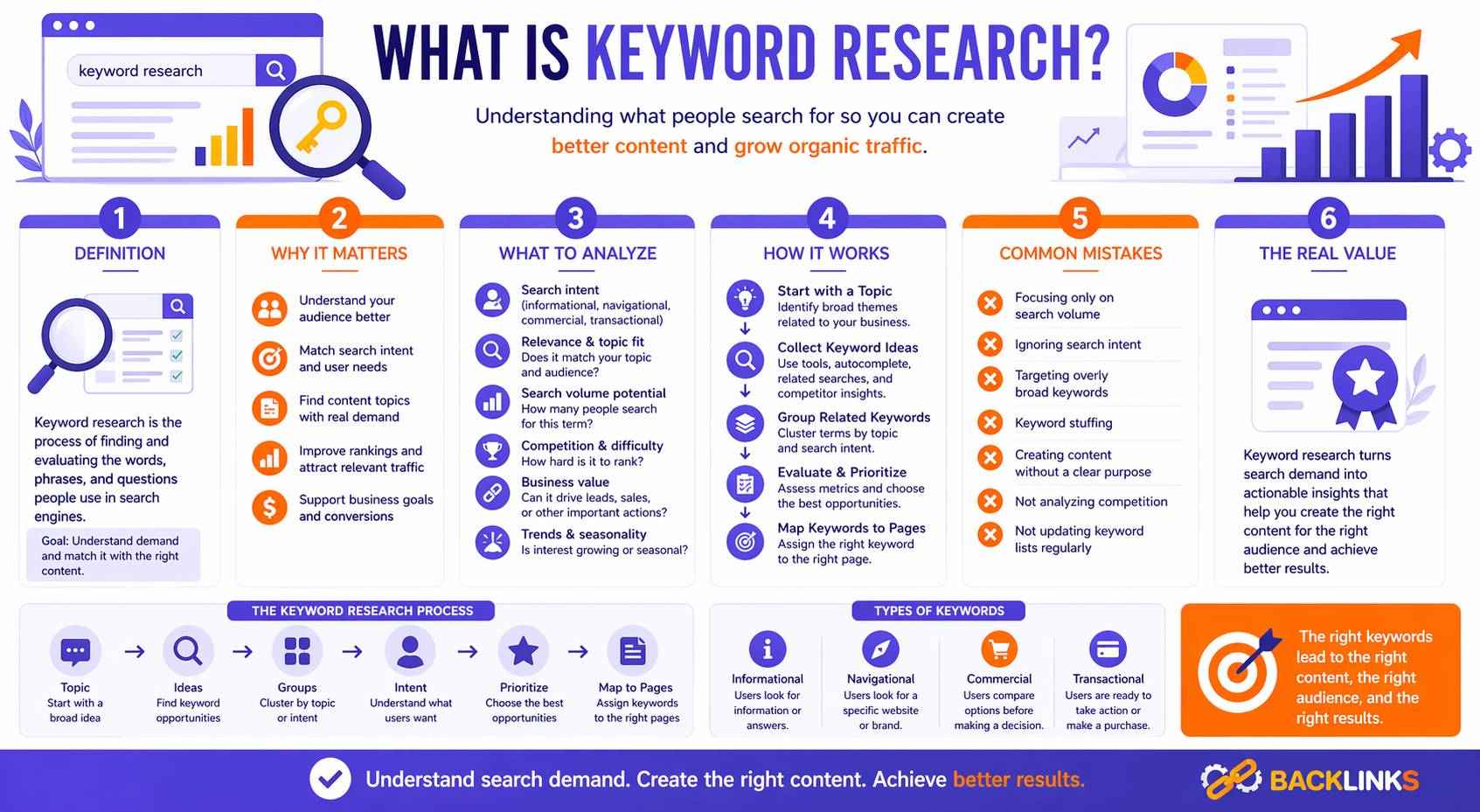
What is keyword research? Keyword research is the process of finding and analyzing the search terms people use in search engines so you can create content that matches real search demand, user intent, and SEO opportunities.
Keyword research is one of the first and most important steps in search engine optimization. Before you write content, optimize a page, or plan an SEO strategy, you need to understand what people are searching for and what they expect to find when they search.
Many websites publish content based on assumptions. They choose topics because they sound relevant internally, because competitors write about them, or because the business wants to promote a specific service. Sometimes that works, but often it leads to content that receives little traffic because it does not match real search demand.
Keyword research helps solve this problem. It gives you a clearer view of the words, phrases, questions, and topics your audience uses in search engines. More importantly, it helps you understand the intent behind those searches so you can create content that answers the right need.
This article explains what keyword research is, why it matters, how it works, and how to approach it correctly.
What Is Keyword Research?
Keyword research is the process of finding and analyzing the search terms people use in search engines.
In SEO, a keyword can be a single word, a short phrase, a full question, or a detailed search query. For example, “SEO” is a broad keyword, while “what is keyword research” is a more specific informational query. Both are keywords, but they represent different levels of intent and different content needs.
Keyword research helps identify:
- What people are searching for
- How often they search for it
- How competitive the search results are
- What type of content users expect
- Which topics are worth targeting with website content
At its simplest, keyword research connects your content with your audience’s search behavior. Instead of guessing what people want to know, you use search data and analysis to guide your content decisions.
However, keyword research is not just about collecting a long list of phrases. A useful keyword strategy requires interpretation. You need to understand which keywords are relevant, which are realistic to rank for, and which support your broader SEO goals.
Why Keyword Research Matters
Keyword research matters because SEO depends on relevance. Search engines aim to show users the most helpful result for their query. If your content does not match what users are looking for, it will be difficult to earn strong rankings, even if the writing is good.
It Helps You Understand Your Audience
People often search using different language than businesses use internally. A company may use technical terminology, while potential customers use simpler or problem-based phrases.
For example, an SEO specialist may talk about “search intent classification,” but a business owner may search for “how to choose the right keywords.” Both relate to SEO strategy, but the wording reflects different levels of knowledge.
Keyword research helps uncover this language gap. It shows how your audience describes their problems, questions, and goals.
It Improves Content Relevance
A page can only perform well in search if it is relevant to the query. Keyword research helps you decide what a page should cover, how detailed it should be, and which related questions should be answered.
For the keyword “what is keyword research,” users are likely looking for a clear explanation, practical examples, and a beginner-friendly overview. They are not necessarily ready for an advanced technical workflow or a sales-focused page.
Matching that expectation is essential.
It Supports Better SEO Planning
Keyword research helps you plan content in a structured way. Instead of publishing random articles, you can organize topics based on search demand, audience needs, and strategic value.
For example, a broad page about keyword research may connect naturally with more specific pages about long-tail keywords, search intent, keyword difficulty, competitor keyword analysis, and using keywords in content.
This creates a stronger learning path for users and a clearer topical structure for search engines.
It Helps Prioritize SEO Opportunities
Not every keyword is worth targeting. Some keywords are too competitive. Others have unclear intent or low relevance to your business.
Keyword research helps you prioritize opportunities based on:
- Relevance to your audience
- Search intent
- Ranking difficulty
- Business value
- Content fit
This makes SEO more efficient because your resources are focused on topics that have a clearer purpose.
How Keyword Research Works
Keyword research usually follows a logical process. The goal is to move from broad ideas to focused opportunities.
Start with Core Topics
The process often begins with broad topics related to your business, website, or area of expertise. These are sometimes called seed topics.
For an SEO website, examples might include:
- Keyword research
- On-page SEO
- Content optimization
- Internal linking
- Technical SEO
- Link building
These topics are starting points. They help you explore how people search around each subject.
Find Related Search Terms
Once you have a core topic, you can look for related search terms. These may include questions, comparisons, definitions, problems, and specific phrases.
For the topic “keyword research,” related searches might include:
- what is keyword research
- why is keyword research important
- how to do keyword research
- keyword research tools
- keyword difficulty
- long-tail keywords
- keyword strategy
- keyword mapping
These terms show the different angles people care about. Some are broad and educational. Others are more practical or tool-focused.
Understand Search Intent
Search intent is the reason behind a query. It explains what the user wants to accomplish.
Common types of search intent include:
- Informational: the user wants to learn something
- Commercial: the user is comparing options
- Transactional: the user is ready to take action
- Navigational: the user is looking for a specific website or brand
The keyword “what is keyword research” has informational intent. The user wants an explanation, not a product page. This means the content should educate clearly, define the concept, and provide useful context.
Search intent should guide the structure and tone of the page. If the intent is misunderstood, the content may fail to satisfy the user even if it includes the right keyword.
Evaluate Search Volume
Search volume estimates how often people search for a keyword within a certain period, usually per month.
Search volume can help you understand demand, but it should not be the only deciding factor. A high-volume keyword may be too broad or too competitive. A lower-volume keyword may attract a more specific and valuable audience.
For example, “SEO” may have high search volume, but it is broad and difficult to target. “what is keyword research” has a clearer educational intent, which makes it easier to shape into a useful article.
Review Keyword Difficulty
Keyword difficulty estimates how hard it may be to rank for a keyword. SEO tools often calculate this based on the strength of pages currently ranking in search results.
However, keyword difficulty should be treated as a guide, not a final decision. A keyword may look difficult, but if the current results are outdated, shallow, or poorly structured, there may still be an opportunity to create something better.
A realistic keyword decision considers both competition and your website’s current authority.
Analyze the Search Results
Reviewing the actual search results is one of the most important steps in keyword research.
The search results reveal what type of content search engines already consider relevant. You may see guides, definitions, videos, comparison pages, tools, or service pages.
For an informational keyword, ranking pages are usually educational. If most top results are beginner guides, your page should also provide a clear and accessible explanation while adding practical value.
Search result analysis helps you understand:
- What content format is expected
- How detailed the content should be
- Which questions are commonly answered
- What gaps exist in competing pages
Group Related Keywords
A common mistake is trying to create a separate page for every keyword variation. This can lead to thin or repetitive content.
Instead, related keywords should be grouped by topic and intent. For example, “what is keyword research,” “keyword research meaning,” and “keyword research definition” can likely be covered on the same page because they share the same intent.
However, “keyword research tools” may deserve its own page because the user expects tool recommendations, comparisons, or software guidance.
Grouping keywords correctly helps avoid content overlap and creates a cleaner website structure.
Important Concepts in Keyword Research
Primary Keywords
A primary keyword is the main search phrase a page targets. It represents the central topic of the page.
For this article, the primary keyword is “What is keyword research.” The content should answer that question clearly and naturally.
The primary keyword can appear in important places such as the title, introduction, headings, and body content. However, it should not be repeated excessively. Search engines can understand context, synonyms, and related phrases.
Secondary Keywords
Secondary keywords are related terms that support the main topic. They help search engines understand the page more completely.
For this topic, useful secondary terms may include:
- keyword research meaning
- SEO keyword research
- search intent
- keyword analysis
- keyword strategy
- long-tail keywords
These terms should be included naturally where they improve clarity.
Long-Tail Keywords
Long-tail keywords are longer, more specific search phrases. They often have lower search volume but clearer intent.
Examples include:
- what is keyword research in SEO
- why is keyword research important
- how does keyword research work
- what is keyword research used for
Long-tail keywords are useful because they often reflect specific questions. They can also be easier to rank for than broad terms.
Search Intent
Search intent is central to keyword research. A keyword is not just a phrase; it represents a need.
Two keywords may look similar but require different content. For example:
- “what is keyword research” needs a definition and explanation
- “keyword research tools” needs tool options
- “keyword research services” may need a service page
- “how to do keyword research” needs a step-by-step process
Understanding these differences helps you choose the right content format.
Common Mistakes in Keyword Research
Choosing Keywords Only by Search Volume
High search volume can be misleading. A keyword may attract many searches but have broad intent or intense competition.
A better approach is to consider search volume alongside relevance, intent, and ranking potential.
Ignoring Intent
Intent mismatch is one of the biggest reasons SEO content underperforms.
If users want a simple explanation and the page gives them a sales pitch, they are unlikely to stay. If users want a tool comparison and the page only defines the topic, the content will not satisfy the search.
Creating Overlapping Pages
Publishing multiple pages that target nearly identical keywords can cause confusion. Search engines may struggle to decide which page is most relevant, and the pages may compete with each other.
It is usually better to create one strong page for closely related keywords.
Using Keywords Unnaturally
Keyword research should guide content, not make it sound robotic.
The goal is to write clearly for humans while giving search engines enough context. Repeating the exact keyword too often can reduce quality and readability.
Not Updating Keyword Research
Search behavior changes over time. New competitors appear, search results shift, and user expectations evolve.
Keyword research should be reviewed regularly, especially for important SEO pages.
Practical Guidance for Better Keyword Research
Start with the audience, not the tool. Tools can provide keyword data, but they cannot fully understand your business, expertise, or customer needs.
Choose keywords that align with real problems your audience has. Then analyze the intent behind those searches and create content that directly satisfies that intent.
When planning content, group related terms together. Use one page to cover closely connected keyword variations, and create separate pages only when the intent is clearly different.
Review the search results before writing. This helps you understand what users and search engines expect. Look for opportunities to make your content clearer, more complete, or more useful than existing results.
Finally, connect related pages through internal links. A page explaining what keyword research is can naturally link to deeper topics such as how to do keyword research, search intent, long-tail keywords, and using keywords in content.
Timing and Expectations
Keyword research can provide immediate strategic clarity, but SEO results take time.
Once content is published, search engines need time to crawl, index, evaluate, and rank the page. Results may appear gradually depending on competition, content quality, website authority, and internal linking.
For newer websites, it is often better to focus on specific, lower-competition keywords first. For established websites, broader keywords may be more realistic if the site already has authority in the topic.
The key is consistency. Keyword research should guide ongoing content creation and optimization, not just a one-time project.
Conclusion
Keyword research is the process of understanding what people search for and using that insight to guide SEO content decisions.
It helps you understand audience language, match search intent, prioritize opportunities, and create content that has a clearer chance of ranking. More importantly, it prevents SEO from becoming guesswork.
For the keyword “what is keyword research,” the main takeaway is simple: keyword research is not just about finding popular terms. It is about understanding search demand and turning that understanding into useful, relevant, and well-structured content.
When done correctly, keyword research becomes the foundation for stronger SEO strategy, better content planning, and more sustainable organic growth.