
Linkbuilding: A Strategic Guide to Building Authority, Rankings, and Long-Term SEO Growth
Linkbuilding remains one of the most decisive factors in search engine optimization, yet it is also one of the most misapplied. Many websites either underestimate its importance or approach it with outdated tactics that no longer produce sustainable results.
At its core, linkbuilding is about trust. Search engines use backlinks as signals to evaluate whether your content deserves visibility. But not all links are equal, and not all strategies are effective.
This guide provides a comprehensive, strategic view of linkbuilding. It explains how backlinks influence rankings, how linkbuilding actually works in modern SEO, and how to build a process that supports long-term growth rather than short-term gains.
As a pillar page, this resource also connects to more specific topics such as outreach, anchor text, backlink analysis, and internal linking—each of which plays a role in a complete linkbuilding system.
What is Linkbuilding?
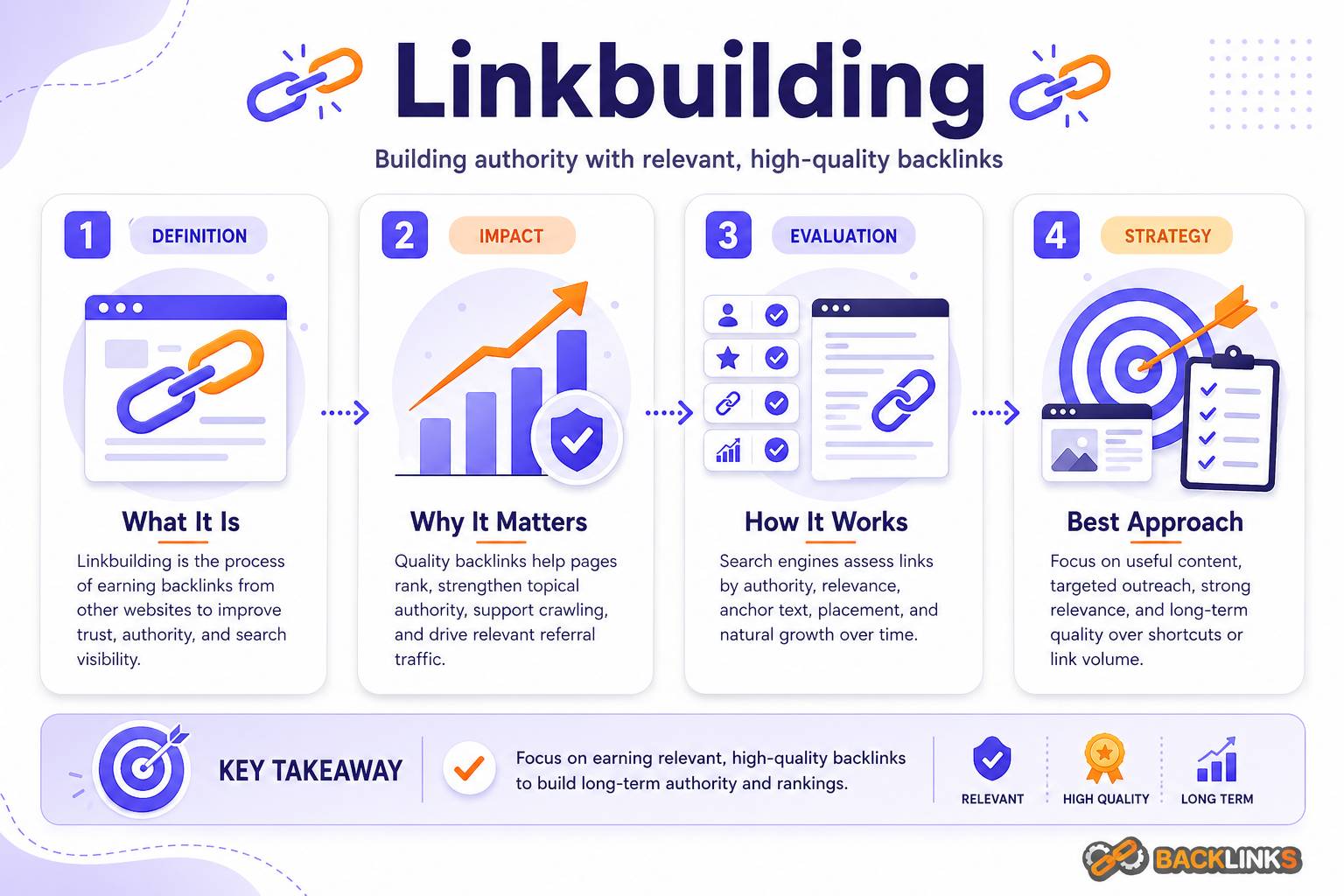
Linkbuilding is the process of acquiring hyperlinks from external websites to your own. These hyperlinks, or backlinks, act as signals that your content is credible, relevant, and worth referencing.
In practical terms, linkbuilding is not about collecting links. It is about earning recognition within your industry.
A backlink carries value when:
- It comes from a relevant and trustworthy source
- It is placed within meaningful, contextual content
- It exists because your content provides genuine value
Search engines interpret these signals collectively. A strong backlink profile suggests that your site is a reliable resource within its topic area.
Why Linkbuilding Matters
Authority and Ranking Power
Backlinks remain one of the strongest ranking factors because they represent external validation. When authoritative websites link to your content, they effectively transfer part of their trust to your site.
This becomes especially important in competitive search environments, where content quality alone is not enough to rank.
Search Engine Discovery and Crawling
Links are also essential for discovery. Search engines rely on links to find and crawl new pages. Without backlinks, important pages may remain under-indexed or overlooked.
A strong link profile ensures that your content is not only discovered but revisited more frequently.
Building Topical Authority
Linkbuilding contributes directly to topical authority. When multiple pages within a specific topic attract backlinks, it strengthens your site’s credibility in that area.
For example, if you build a content system around SEO, pages such as technical SEO audit, structured data SEO, and technical SEO tools collectively reinforce your authority when they earn relevant links.
This is where linkbuilding aligns with a broader content structure rather than operating as a separate activity.
Referral Traffic and Brand Visibility
Backlinks are not only about rankings. They also generate referral traffic from relevant audiences.
A well-placed link on an industry site can drive highly qualified visitors. Over time, this contributes to brand recognition and reinforces trust signals beyond search engines.
How Linkbuilding Works
Search engines evaluate backlinks using a combination of qualitative and contextual signals. Understanding these signals is critical to building an effective strategy.
Authority of the Linking Domain
Links from authoritative websites carry more weight than those from low-quality or newly created sites. Authority is influenced by the linking site’s own backlink profile, content quality, and trustworthiness.
Relevance of the Linking Page
Relevance is often underestimated. A link from a contextually related page is significantly more valuable than one from an unrelated source.
Search engines evaluate both the domain-level relevance and the topical focus of the linking page itself.
Anchor Text Signals
Anchor text provides context about the linked page. It helps search engines understand what the destination page is about.
However, anchor text must remain natural. Overusing exact-match keywords can appear manipulative and reduce trust.
This connects to broader content practices such as using keywords in content, where natural language and context take priority over forced optimization.
Placement and Visibility
Links placed within the main body of content—especially within editorial context—carry more value than links in navigation menus, footers, or sidebars.
Editorial links are typically the most powerful because they are given based on merit rather than placement.
Link Consistency and Growth Patterns
The pattern of link acquisition matters. A consistent, gradual increase in backlinks appears natural, while sudden spikes can raise concerns.
Sustainable linkbuilding focuses on steady growth rather than aggressive bursts.
How to Build a Linkbuilding Strategy
A successful linkbuilding strategy is not based on isolated tactics. It requires coordination between content, research, outreach, and ongoing analysis.
Build Content That Deserves Links
The foundation of linkbuilding is content quality. Without something worth linking to, outreach efforts become inefficient.
Link-worthy content typically includes:
- In-depth guides that solve real problems
- Original insights or perspectives
- Practical frameworks or processes
- Data-driven or experience-based content
Content optimization plays a key role here. Structuring content effectively and aligning it with search intent increases both visibility and link potential.
Identify Realistic Link Opportunities
Effective linkbuilding starts with understanding where links exist and where opportunities are realistic.
This includes:
- Analyzing competitor backlink profiles
- Identifying resource pages and curated lists
- Finding broken links that can be replaced
- Mapping content gaps in your niche
This process is closely related to SEO competitor analysis, which reveals patterns in how competitors earn links and where you can compete.
Outreach with Purpose
Outreach is often treated as a volume-based activity, but effectiveness depends on relevance and clarity.
A strong outreach approach focuses on:
- Explaining why your content is relevant to their audience
- Demonstrating value rather than asking for a favor
- Personalizing communication to avoid generic messaging
Relationship building is often more effective than one-time outreach campaigns. Over time, this creates repeat opportunities.
Promote Content Strategically
Even strong content needs visibility. Promotion ensures that the right people see your work.
This may involve:
- Sharing content within relevant communities
- Engaging with industry discussions
- Collaborating with other creators or websites
- Leveraging existing audiences
Promotion increases the probability of organic link acquisition.
Monitor, Evaluate, and Adjust
Linkbuilding is not a static process. You need to continuously evaluate performance.
Key aspects to monitor include:
- New backlinks acquired
- Lost or removed links
- Overall link quality
- Anchor text distribution
Regular analysis allows you to refine your strategy and focus on what produces results.
Key Linkbuilding Methods
Editorial Link Acquisition
These are links earned naturally because your content provides value. They are typically the most powerful and sustainable.
Editorial links often come from:
- Blog mentions
- Industry resources
- Expert references
Guest Content Contributions
Contributing content to relevant websites can be an effective way to earn backlinks, provided the focus remains on quality and relevance.
The goal is not just to place links, but to build authority and reach new audiences.
Resource Linkbuilding
Many websites maintain curated resource pages. If your content genuinely fits, these can be strong link opportunities.
Broken Link Building
This involves identifying broken links on other websites and offering your content as a replacement. It provides value by helping site owners fix issues.
Digital PR and Mentions
Earning mentions through press coverage, industry commentary, or unique insights can generate high-quality backlinks.
This approach requires a strong understanding of your niche and what attracts attention.
Internal Linking and Its Role in Linkbuilding
While external backlinks are the focus of linkbuilding, internal linking plays a critical supporting role.
Internal links:
- Distribute authority across your site
- Strengthen relationships between related pages
- Improve crawlability and indexing
For example, linking from this pillar page to more specific topics—such as content optimization tools or keyword research tools—helps reinforce topical connections.
This structure ensures that the value gained from backlinks benefits the entire site, not just individual pages.
Common Linkbuilding Mistakes
One of the most frequent mistakes is prioritizing quantity over quality. A large number of low-quality links provides limited value and can create risk.
Another issue is ignoring relevance. Links from unrelated sources contribute little to authority and may weaken your overall profile.
Over-optimized anchor text is also a common problem. Repeated use of exact-match keywords can signal manipulation.
Many websites also rely on shortcuts, such as buying links without evaluating quality. While this may produce short-term results, it often leads to long-term instability.
Finally, neglecting content quality makes linkbuilding significantly harder. Without strong content, even the best outreach strategies will struggle.
Practical Guidance for Sustainable Linkbuilding
A realistic approach to linkbuilding focuses on consistency, quality, and alignment with broader SEO goals.
Start by identifying your most important pages. These are typically:
- Pillar pages that define your core topics
- High-value commercial pages
- Content with strong informational intent
These pages should be the primary targets for linkbuilding efforts.
Next, build supporting content that reinforces these pages. For example, guides on content optimization strategy or keyword research with Google can attract links and strengthen your overall structure.
Develop a process rather than relying on isolated campaigns. This includes:
- Ongoing content creation
- Regular outreach
- Continuous backlink analysis
Most importantly, integrate linkbuilding into your overall SEO strategy. It should support rankings, authority, and conversions—not operate independently.
Timing and Expectations
Linkbuilding is inherently long-term. Results depend on consistency and cumulative effort.
In most cases:
- Initial impact may take several weeks
- Noticeable ranking improvements often take several months
- Strong authority growth requires sustained effort over time
Expect gradual progress rather than immediate results. The goal is to build a stable foundation that continues to grow.
Conclusion
Linkbuilding is not just about acquiring backlinks—it is about building credibility within your niche.
When approached strategically, it strengthens your site’s authority, improves rankings, and supports long-term visibility. When approached tactically or aggressively, it often leads to inconsistent or unsustainable results.
The most effective linkbuilding strategies are grounded in quality content, relevant relationships, and a clear understanding of how search engines evaluate trust.
As part of a broader SEO system, linkbuilding connects your content, reinforces your expertise, and helps establish your site as a reliable resource.
Over time, this creates a compounding effect—where authority grows, visibility increases, and your position within search becomes more stable and defensible.