
Content Optimization: How to Improve Content for Rankings, Relevance, and Conversions
Content optimization is the process of improving a page so it performs better for both search engines and human readers. Done properly, it helps content rank more consistently, satisfy search intent more accurately, and contribute more directly to business goals.
Many teams treat content optimization as a light editing pass. They update a title, add a keyword a few more times, and call the page finished. That approach rarely creates meaningful results. Strong content optimization is more strategic. It looks at relevance, structure, depth, usability, internal linking, topical alignment, and conversion value as part of the same system.
For businesses investing in search visibility, content optimization is not optional. Publishing content is only the starting point. The real advantage comes from refining pages so they compete effectively, support a broader site architecture, and deliver stronger outcomes over time.
This guide explains what content optimization is, why it matters, how it works, and how to approach it in a way that supports long-term SEO performance and commercial value.
What Is Content Optimization
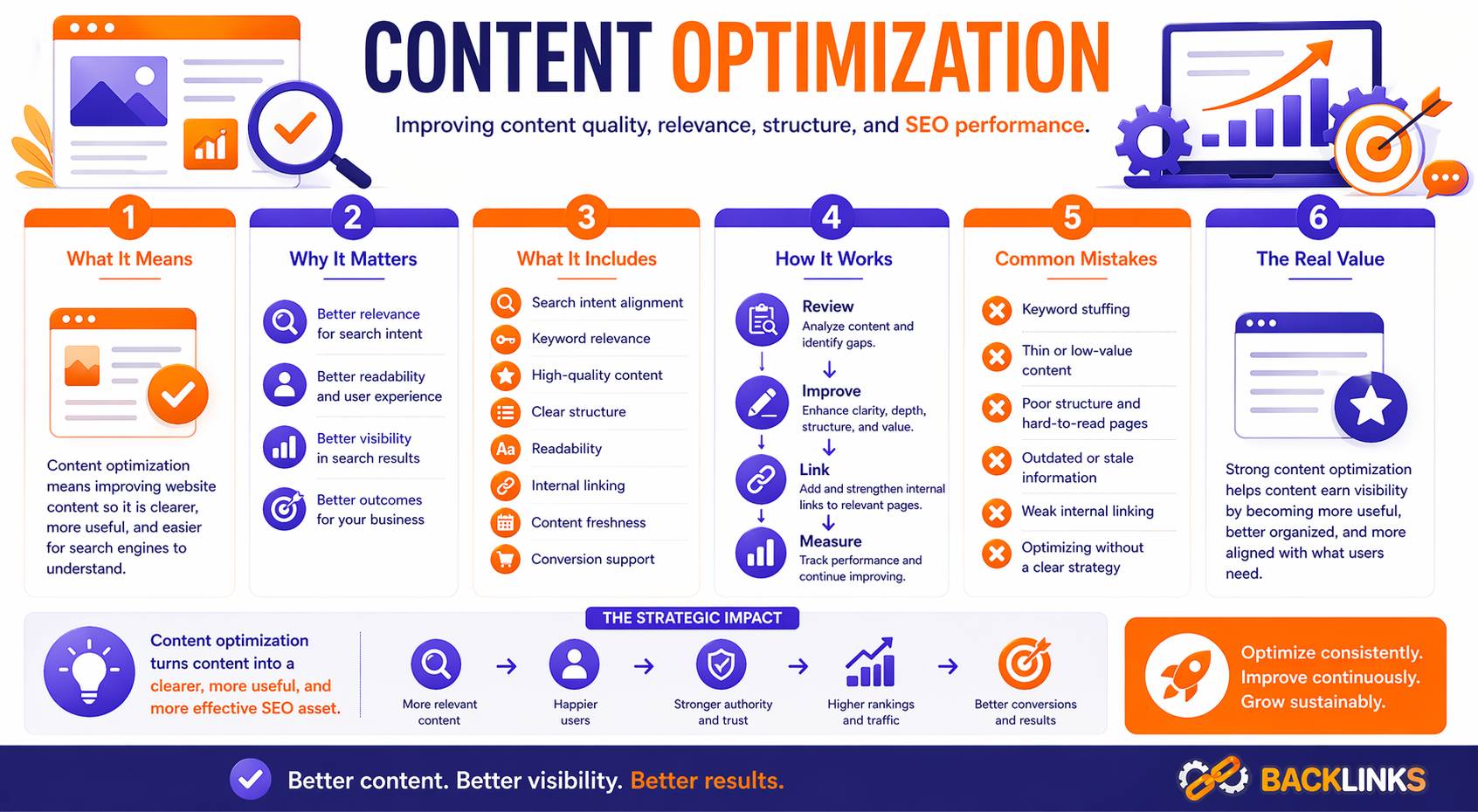
Content optimization is the process of improving existing or new content so it becomes more useful, more relevant, and more effective for its intended audience and search context.
In practical terms, content optimization means making sure a page aligns with the right search intent, covers the topic with sufficient depth, uses clear structure, targets the right terms naturally, and guides users toward the next logical step. That step may be learning more, exploring related pages, requesting a service, or making a purchase.
Content optimization sits at the intersection of SEO, UX, and content strategy. It is not limited to keyword placement. It includes decisions such as:
- whether the page format matches the query
- whether the content answers the real question behind the search
- whether headings and sections are logically structured
- whether internal links help users and search engines navigate related topics
- whether the content is current, accurate, and trustworthy
- whether the page supports a business objective without disrupting the informational intent
A useful way to define content optimization is this: it is the discipline of turning content from merely published into genuinely competitive.
Why Content Optimization Matters
Content optimization matters because search visibility does not come from having content alone. It comes from having content that deserves to rank and is easy for users to engage with.
It improves search relevance
Search engines evaluate whether a page is a strong match for a query. Pages that are vague, thin, outdated, or structurally weak often struggle even when they target the right topic. Content optimization improves clarity and relevance so the page better matches what searchers expect.
It increases the value of existing content
One of the most efficient ways to grow organic performance is to improve pages that already exist. In many cases, underperforming content does not need to be replaced. It needs to be strengthened. That may involve expanding key sections, clarifying intent, improving internal links, updating examples, or aligning the page more closely with the search landscape.
It supports rankings and conversions at the same time
For pages with informational and commercial value, optimization helps balance both goals. The page should educate the reader thoroughly enough to rank, while also making the business relevance clear enough to support conversion when the user is ready.
It strengthens topical authority
Content optimization is also important at the site level. When pages are refined so they connect clearly to related topics, avoid overlap, and cover their subject comprehensively, they contribute more effectively to a broader topical architecture.
How Content Optimization Works
Content optimization works by improving the signals that influence how a page is interpreted, ranked, and used.
At a strategic level, the process usually involves four questions:
- Does the page match the right intent?
- Does it cover the topic clearly and thoroughly?
- Is it structured in a way that supports readability and discoverability?
- Does it support the wider site and business goals?
When those questions are handled properly, the page becomes stronger not just as a piece of writing, but as an SEO asset.
Matching search intent
Intent alignment is the first priority. If the searcher wants a practical guide, a product page is usually the wrong format. If the searcher is comparing solutions, a broad educational article may not be enough. Content optimization often starts by checking whether the page actually fits the dominant intent behind the target keyword.
For a term like content optimization, the intent is usually mixed but still manageable. Users want a clear explanation of the concept, practical methods, and some indication of tools, services, or frameworks that can help them apply it. That means the page needs to educate without becoming purely theoretical.
Improving topical completeness
A page does not need to say everything about a subject, but it does need to cover the topic completely enough for its purpose. Content optimization often involves identifying missing subtopics, unanswered questions, or weak sections that reduce the page’s usefulness.
Completeness should be judged against intent, not word count. Some pages need expansion. Others need tighter focus.
Enhancing structure and readability
Content that is difficult to scan, navigate, or interpret performs poorly even when the information is technically strong. Better headings, cleaner section flow, more direct writing, and logical progression all improve how users engage with the page.
This also helps search engines understand the content more clearly.
Strengthening contextual signals
Optimization also includes reinforcing the page’s relevance through natural keyword usage, semantic coverage, supporting internal links, and alignment with related content across the site. These signals help search engines place the page in the right context.
The Core Elements of Content Optimization
Content optimization is most effective when it is treated as a multi-layer process rather than a single edit.
Keyword Targeting and Semantic Coverage
Keywords still matter, but not in the simplistic sense of repetition. Effective content optimization uses the primary keyword naturally in important areas such as the title, headings, introduction, and body where relevant. It also includes semantically related terms that help clarify the full subject.
For a page targeting content optimization, related concepts may include on-page SEO, content quality, search intent, content refreshes, internal linking, topic coverage, user engagement, and conversion-focused content. These terms help build topical clarity without forcing unnatural phrasing.
The goal is to signal relevance clearly while preserving readability and editorial quality.
Search Intent Alignment
A well-optimized page does not just mention the keyword. It satisfies the reason someone searched for it.
This requires understanding whether the user wants a definition, a tutorial, a checklist, a comparison, a service, or a decision framework. Many content failures come from trying to rank with the wrong page type.
Informational and commercial intent often overlap in B2B SEO. In those cases, the page should lead with education, then introduce practical solutions, methods, or service relevance in a way that feels earned rather than promotional.
Content Depth and Original Value
Content optimization should improve substance, not just format. Strong pages usually contain a clearer explanation, better prioritization of information, more realistic guidance, and more strategic framing than weaker competitors.
Original value does not always mean original research. It often means better judgment. That includes explaining trade-offs, acknowledging complexity, and showing how to apply the topic in real business conditions rather than describing it in abstract terms.
On-Page Structure
On-page structure shapes how both users and search engines consume content. This includes:
- clear H1 and H2 hierarchy
- logical section order
- concise paragraphs
- descriptive subheadings
- relevant internal links
- strong title and meta positioning
- consistent formatting that improves readability
A structurally strong page keeps the topic focused and makes the next section feel predictable rather than abrupt.
Internal Linking and Content Relationships
Content optimization should not happen in isolation. Each page should connect naturally to related pages across the site.
Internal linking helps search engines understand how topics relate to each other. It also improves user journeys by offering relevant next steps. On a site building topical depth, a content optimization page might logically link to pages about keyword research, on-page SEO, content audits, search intent, internal linking, and SEO content strategy.
These relationships matter because optimization is stronger when the page is positioned as part of a coherent topic ecosystem.
Freshness, Accuracy, and Trust
A page may be well written and still underperform because it is outdated, too generic, or no longer aligned with current search expectations. Content optimization often includes refreshing examples, removing dated assumptions, tightening claims, and improving factual accuracy.
Trust is especially important on pages that influence strategic decisions. Overstated promises and vague advice reduce credibility quickly.
How to Apply Content Optimization Strategically
The best approach to content optimization is methodical. Random edits rarely produce reliable improvements.
Start with page purpose
Before changing anything, define the page’s role. Is it intended to rank for a broad topic, support a commercial journey, strengthen a subject cluster, or improve conversions on existing traffic? Optimization becomes clearer when the page has a defined job.
Review performance and intent fit
Look at the current keyword profile, user behavior, and search landscape. If the page is attracting impressions for the wrong terms, struggling with engagement, or failing to convert relevant traffic, the issue may not be wording alone. It may be a mismatch between page format and user expectations.
Improve the highest-impact sections first
Not every paragraph deserves equal attention. Focus first on the title, introduction, heading structure, weak sections, missing subtopics, and internal links. These often have a disproportionate impact on how the page performs.
Refine for clarity, not just length
Adding content is useful only when it improves the page. Many pages need sharper positioning more than more words. Strong optimization removes fluff, clarifies intent, and expands only where the reader genuinely needs more context.
Connect the page to the broader site
A high-performing page rarely functions alone. Add or improve links to related supporting articles and ensure those supporting pages link back where appropriate. This strengthens the page’s contextual relevance and makes the overall site architecture more useful.
Important Subtopics in Content Optimization
A pillar page on content optimization should acknowledge the related disciplines that shape results.
Content Auditing
Content optimization often begins with an audit. This involves reviewing existing pages to identify outdated content, overlap, weak performance, intent mismatches, and structural issues. A good audit helps determine whether a page should be improved, merged, redirected, or removed.
On-Page SEO
On-page SEO is one of the operational layers of content optimization. It covers titles, headings, internal links, content hierarchy, and the strategic use of keywords. But on-page SEO is most effective when guided by a clear content strategy rather than applied mechanically.
Search Intent Analysis
Intent analysis is essential because it determines what the content should actually be. Optimizing a page without understanding why the search happens in the first place usually leads to weak outcomes.
Conversion-Focused Content
For commercially relevant pages, content optimization should also consider what happens after the reader gets the answer. The page should make the next step clear, whether that means contacting the business, exploring a related service, or reading a more specific guide.
Content Refresh Strategy
Optimization is not a one-time event. Important pages often need periodic updates to maintain relevance, improve accuracy, and keep pace with changes in the search landscape or the business itself.
Common Content Optimization Mistakes
Even experienced teams make predictable mistakes when optimizing content.
Treating optimization as keyword insertion
This is one of the most common problems. Adding the target phrase repeatedly does not make a page stronger. It often makes the writing worse and can obscure more important issues such as weak intent fit or shallow topic coverage.
Expanding content without improving value
Longer content is not automatically better. Pages that are expanded with filler, generic definitions, or repetitive subheadings often become less effective, not more.
Ignoring the user journey
A page may rank and still underperform commercially if it does not help users move forward. Optimization should consider what the user is likely to need next, especially on pages that sit between awareness and decision stages.
Overlooking internal context
A page can appear strong on its own but still fail to contribute effectively to the site if it duplicates nearby topics, lacks internal links, or sits awkwardly within the content structure.
Focusing only on publishing new content
Many sites chase growth by producing more pages while neglecting the pages they already have. In practice, optimization of existing content is often one of the highest-return SEO activities available.
Practical Guidance for Better Content Optimization
To improve content optimization in a way that supports both rankings and business results, use a disciplined process.
Begin by identifying pages that matter most. These are usually pages with strong business relevance, existing impressions, declining performance, or clear untapped potential.
Then assess each page against a consistent framework:
- intent match
- topic coverage
- structure and readability
- on-page SEO
- internal linking
- conversion support
- freshness and accuracy
Once the problems are clear, prioritize the changes most likely to improve performance. For one page, that may mean rewriting the introduction and expanding thin sections. For another, it may mean consolidating overlapping content and improving internal links. For another, it may mean reducing unnecessary copy and sharpening the commercial positioning.
Most importantly, treat optimization as an editorial and strategic activity, not just a technical one. The goal is to create pages that are easier to trust, easier to understand, and more useful in context.
Timing and Expectations
Content optimization can produce improvements faster than net-new content creation because the page may already have some history, indexation, and visibility. Even so, results are not immediate.
Some changes, such as stronger titles, clearer structure, or better internal links, can improve performance relatively quickly once search engines recrawl the page. More competitive gains, especially in crowded topics, may take longer and depend on the site’s broader authority and the strength of competing pages.
It is also important to recognize that not every page should be optimized indefinitely. Some pages need a strategic rewrite. Others should be merged into stronger assets. Optimization works best when paired with content governance rather than endless incremental editing.
Conclusion
Content optimization is the discipline of making content more competitive, more useful, and more aligned with both search intent and business goals.
At its best, it improves much more than keyword relevance. It strengthens clarity, depth, structure, internal linking, trust, and conversion pathways. It also helps a website build a more coherent content ecosystem, where each page supports broader topical authority rather than existing as an isolated asset.
For businesses that want stronger organic performance, content optimization should be treated as a core SEO capability. Publishing content is only the first step. Sustainable results come from refining that content until it genuinely deserves visibility and delivers value when users arrive.