
Content Audit: How to Evaluate and Improve Existing Content for Better SEO Performance
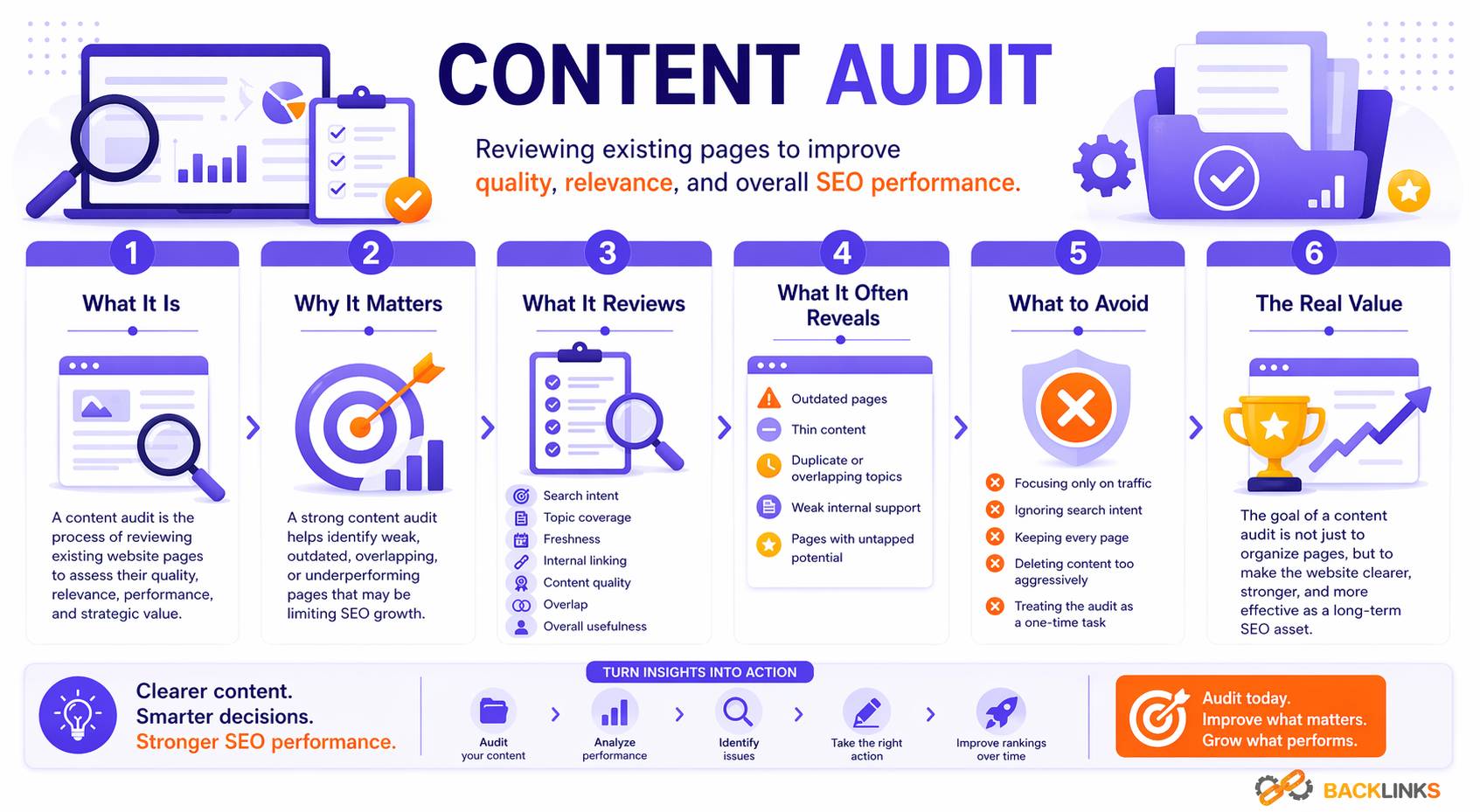
A content audit is the process of reviewing your existing website content to understand what is performing well, what is underperforming, what is outdated, and what should be improved, consolidated, or removed.
For SEO, this is one of the most valuable activities a website can undertake. Many sites do not struggle because they lack content. They struggle because their existing content is misaligned, outdated, overlapping, poorly structured, or disconnected from the rest of the website. A content audit helps identify those issues before they continue to weaken rankings, user experience, and organic growth.
Done properly, a content audit is not just an inventory exercise. It is a strategic review of how your content supports search intent, topical authority, internal linking, and business goals. It gives you a clearer view of what your site is actually doing, not just what it was originally supposed to do.
This guide explains what a content audit is, why it matters, how it works, and how to use it to make better SEO decisions.
What Is a Content Audit
A content audit is a structured evaluation of the pages on your website to assess their quality, relevance, performance, and strategic value.
In practical terms, it means looking at your content page by page and asking important questions:
- Is this page still useful?
- Does it match the right search intent?
- Is it attracting relevant traffic?
- Is it up to date?
- Does it overlap with another page?
- Does it support the broader structure of the site?
- Should it be improved, merged, redirected, or removed?
A content audit is not limited to blog posts. It can include service pages, landing pages, guides, category pages, resource pages, and any other content intended to rank, inform, or convert.
The goal is not simply to find weak pages. The goal is to understand how the content ecosystem of the site is functioning as a whole.

Why a Content Audit Matters
A content audit matters because content quality is cumulative. Search engines do not evaluate pages in complete isolation. The overall structure, consistency, and usefulness of a website influence how well individual pages perform.
It reveals hidden performance issues
Many websites have pages that generate impressions but few clicks, attract irrelevant traffic, compete with each other, or no longer reflect the current business. These issues are easy to miss if you only look at top-level traffic numbers.
A content audit surfaces those weaknesses clearly.
It improves content quality across the site
When weak, outdated, or duplicative pages remain untouched, they dilute the quality of the site. Auditing helps you identify where content needs stronger explanations, better structure, fresher information, or clearer positioning.
It reduces keyword cannibalization
One of the most common SEO problems is having multiple pages targeting similar queries without clear differentiation. A content audit helps identify overlap so you can consolidate or reposition pages more effectively.
It strengthens site architecture
A good audit does not just assess page quality. It also shows how content fits into the broader website structure. This helps improve internal linking, topical coverage, and the logical relationship between broad and specific pages.
It makes future content strategy smarter
Without an audit, content planning often becomes reactive. Teams keep publishing new pages without understanding what already exists. A content audit provides the foundation for better editorial decisions and more disciplined SEO growth.
How a Content Audit Works
A content audit works by combining content review with performance analysis and strategic decision-making.
The exact process varies by website size and business goals, but the core logic is consistent. You gather your content, evaluate it against clear criteria, and decide what action each page needs.
Start with a content inventory
The first step is identifying the pages you want to audit. For smaller sites, this may mean reviewing the full content library. For larger sites, you may start with a priority segment such as blog content, service pages, or pages in a specific topic area.
The purpose of the inventory is to create visibility. You need to know what exists before you can improve it.
Review performance data
A useful content audit looks beyond the page itself. You need to evaluate how each page is performing in terms of visibility, traffic, engagement, conversions, and keyword relevance.
Performance data helps distinguish between content that is truly weak and content that simply needs refinement.
Assess quality and intent alignment
Strong content should satisfy a clear search intent and provide enough depth for its purpose. During an audit, review whether each page still reflects what users searching that topic are likely to want.
A page may have decent traffic and still be strategically weak if it attracts the wrong audience or fails to support the next step in the user journey.
Identify structural and editorial issues
This includes problems such as:
- outdated information
- thin or incomplete coverage
- overlapping topics
- poor heading hierarchy
- weak internal links
- unclear page purpose
- inconsistent messaging
- low trust or low usefulness
These issues often explain why pages underperform even when the target topic appears sound.
Assign an action
Every page in a content audit should lead to a clear decision. In most cases, the page will fall into one of a few categories:
- keep as is
- update and improve
- merge with another page
- redirect
- remove
- rewrite for a different intent
Without a clear next action, an audit becomes documentation rather than strategy.
What to Evaluate During a Content Audit
A strong content audit looks at more than traffic. It evaluates each page in context.
Search Intent Match
This is one of the most important criteria. Does the page align with the reason behind the query it targets? A page that misses intent will usually struggle, even if it contains the right keywords.
For example, an informational query usually needs a helpful educational page. If the content leans too heavily into promotion, the mismatch can weaken performance.
Topic Coverage
The page should cover the topic clearly and sufficiently for its purpose. This does not mean every page needs to be long. It means the page should answer the main question well and include the supporting context users are likely to need.
Thin pages often fail because they stop too early.
Content Freshness
Some topics age quickly. Others stay stable for longer. A content audit helps identify where a page has become outdated, whether through old examples, obsolete guidance, or a search landscape that has changed since publication.
Refreshing important pages is often one of the highest-value outcomes of an audit.
Internal Linking
A page should not exist in isolation. Review whether it links naturally to related content and whether other relevant pages link back to it. Poor internal linking weakens discoverability, user flow, and topical coherence.
Overlap and Cannibalization
When multiple pages target very similar topics, search engines may struggle to determine which page should rank. This often leads to weaker visibility across all overlapping pages rather than stronger performance from one.
An audit helps identify where consolidation would strengthen the site.
Conversion Support
Even informational content should have a role within the broader website journey. Review whether the page supports a logical next step, whether through a related article, a service page, or another useful destination. This should feel natural and relevant, not forced.
Content Quality and Trust
Evaluate whether the page demonstrates expertise, clarity, and credibility. Weak pages often rely on generic definitions, vague advice, or repetitive wording. Strong pages explain the topic with accuracy, judgment, and practical relevance.
Common Types of Findings in a Content Audit
A content audit often reveals patterns, not just isolated page issues.
Underperforming pages with good potential
These are pages targeting worthwhile topics but lacking depth, structure, or intent alignment. They are usually strong candidates for updates rather than replacement.
Duplicate or overlapping content
These pages often compete for similar queries and weaken each other. In many cases, the best solution is to merge them into a stronger single page.
Outdated content
Some pages were once useful but no longer reflect current reality. This is common in fast-moving industries or in websites that publish heavily without regular maintenance.
Thin or low-value pages
These pages may exist because they were created to target a keyword rather than solve a real user need. They often add little value to the site and may be better removed or absorbed into stronger content.
Strong pages that need better support
Sometimes a page is good, but it is not performing as well as it should because it lacks internal links, topical support, or a strong position within the site structure. These pages often benefit from changes around them, not only within them.
Common Mistakes in a Content Audit
A content audit is only useful if it leads to sound decisions. Several mistakes reduce its value.
Focusing only on traffic
Traffic matters, but it is not the only metric that matters. A page with modest traffic may still be strategically important if it supports conversions, authority, or internal topic coverage.
Auditing without intent analysis
You cannot assess a page properly unless you understand what searchers are looking for. Without intent analysis, content decisions often become too superficial.
Keeping everything
Some teams are reluctant to merge, redirect, or remove content even when the page clearly adds little value. That hesitation often leaves the site bloated and unfocused.
Removing pages too aggressively
The opposite mistake also happens. A page should not be removed just because it has low traffic. Some pages play supporting roles in the site structure or serve valuable long-tail intent.
Treating the audit as a one-time cleanup
A content audit is not only for fixing old problems. It should also inform ongoing content governance. Websites change, search behavior shifts, and pages need periodic reassessment.
Practical Guidance for Running a Better Content Audit
If you want your content audit to lead to meaningful SEO improvements, start with a clear framework.
First, define the scope. Decide whether you are auditing the full site or a specific content segment. Then identify the criteria you will use consistently across pages, such as intent match, quality, freshness, internal linking, overlap, and business relevance.
Next, prioritize pages that matter most. Start with pages that already attract impressions, pages tied to important services or topics, pages with declining performance, or pages that sit in areas where the site structure feels weak.
As you review each page, avoid making decisions based on one metric. Look at the page in context. Consider not just what it does individually, but how it contributes to the broader website.
Then assign a clear action. A content audit becomes useful only when it leads to execution. Some pages need refinement. Some need consolidation. Some need to be repositioned. Some need to be retired.
Most importantly, treat the audit as a strategic process, not just an administrative task. The real value is not the spreadsheet. The real value is the improved judgment behind your content decisions.
Timing and Expectations
A content audit can produce value relatively quickly because it often identifies improvements within content that already exists and may already be indexed. Still, the results of implementing audit decisions depend on the scale and quality of the changes.
Refreshing strong pages, consolidating overlap, and improving internal linking can produce meaningful SEO gains over time. But not every change will create an immediate ranking shift. Search engines need time to recrawl, reprocess, and reassess the updated content.
It is also worth setting realistic expectations about scope. A thorough audit can uncover more work than expected. That is not a failure. It is often a sign that the site has accumulated content without enough maintenance discipline.
Conclusion
A content audit is one of the most important processes in SEO because it helps you understand whether your existing content is genuinely helping the website grow.
It reveals where pages are strong, where they are weak, where they overlap, and where they no longer serve a useful purpose. More importantly, it gives you a basis for improving the quality, clarity, and strategic alignment of the site as a whole.
For businesses serious about organic growth, a content audit should not be treated as an occasional housekeeping task. It should be part of how content is managed, improved, and governed over time. The goal is not just to have more pages. The goal is to maintain a website where each important page has a clear role, supports the broader structure, and deserves visibility in search.