
Rewriting Content: When and How to Improve Existing Pages for SEO
Rewriting content is the process of substantially revising an existing page to improve its quality, relevance, structure, and performance. In SEO, rewriting content is usually done when a page is outdated, underperforming, misaligned with search intent, or no longer strong enough to compete in search results.
This matters because not every weak page needs to be deleted, and not every declining page needs a minor update. Sometimes the original content is too limited, too unfocused, or too poorly structured to fix with small edits. In those cases, rewriting content is the better option.
For businesses and SEO teams, rewriting content can be one of the most effective ways to improve existing assets without starting from zero. A strong rewrite can turn a weak page into a useful, relevant, and competitive resource that better supports rankings, internal linking, and conversions.
What Is Rewriting Content
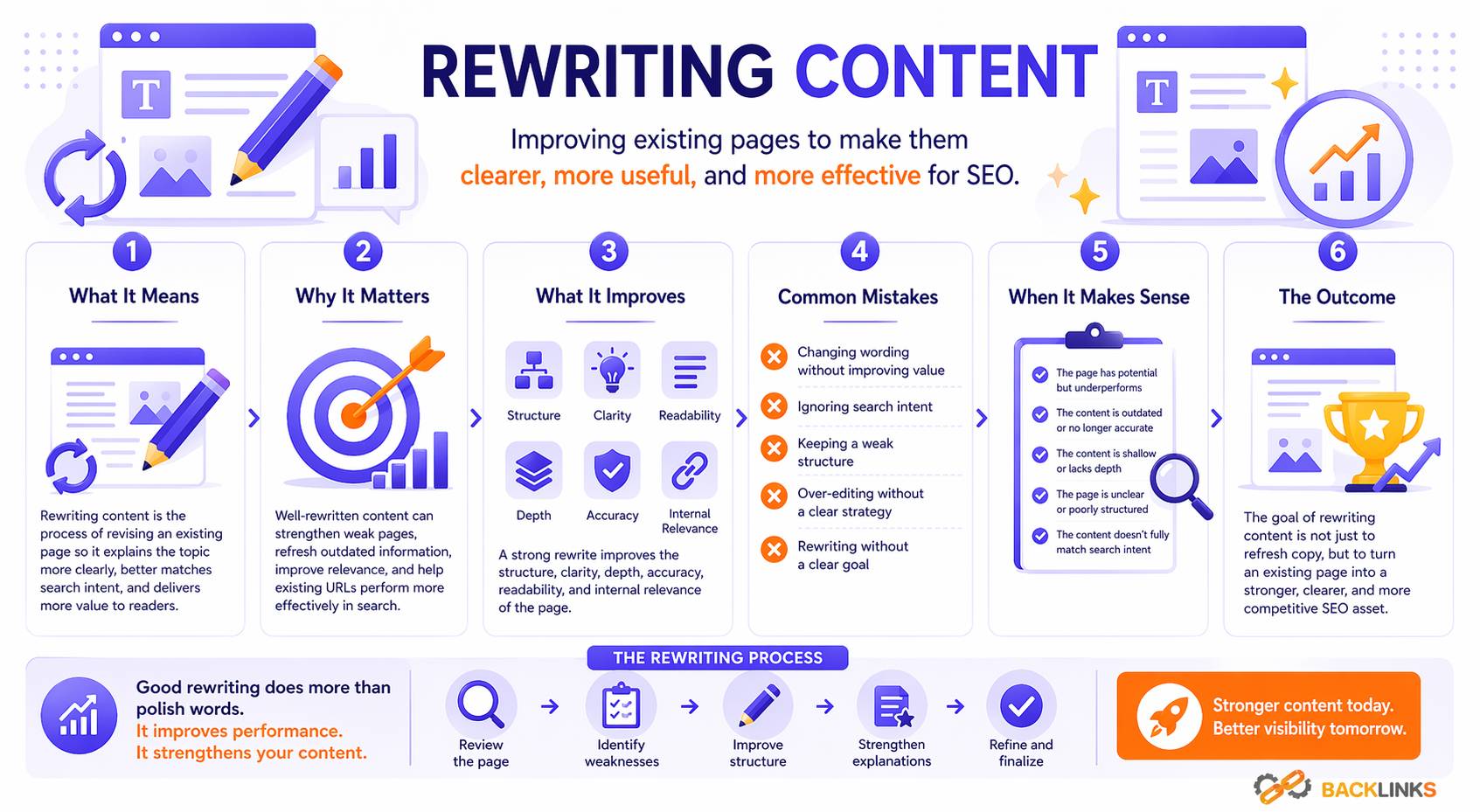
Rewriting content means rebuilding an existing page so it better serves its intended purpose.
That does not mean changing a few sentences or swapping in a few keywords. It means reworking the page at a deeper level. The rewrite may involve changing the structure, clarifying the page’s focus, expanding thin sections, removing unnecessary content, updating outdated points, and aligning the page more closely with search intent.
In practical terms, rewriting content is often needed when:
- the page targets the wrong intent
- the topic coverage is too shallow
- the structure is confusing or weak
- the content is outdated
- the writing lacks clarity or authority
- the page overlaps too heavily with another page
- the content no longer reflects the business or search landscape
A rewrite is usually more substantial than a refresh. A refresh improves what is already there. A rewrite rethinks the page so it can perform better strategically.
Why Rewriting Content Matters
Rewriting content matters because existing pages often have untapped potential. Many websites have content that covers relevant topics but fails to rank or convert because the execution is weak.
It improves underperforming content
Some pages target worthwhile keywords but never perform well because they were written too quickly, too narrowly, or without clear strategic direction. Rewriting content gives those pages a second chance.
It aligns the page with current search intent
Search behavior changes, and so do search results. A page that made sense when it was first published may no longer match what users expect now. Rewriting content helps realign the page with the intent behind the query.
It strengthens content quality
A weak article can damage trust even if the topic is relevant. Rewriting helps improve clarity, depth, usefulness, and credibility, which are all important for SEO and user experience.
It makes better use of existing authority
An existing page may already have indexation, links, or some ranking history. Rewriting content can be more efficient than publishing a completely new page because you are improving an asset that already exists within the site.
It supports site-wide content strategy
Rewriting content is often part of a broader effort to improve internal linking, reduce overlap, and build a more coherent topic structure across the website.
How Rewriting Content Works
Rewriting content works by replacing weak or outdated execution with a stronger version of the same page.
The goal is not to rewrite for the sake of rewriting. The goal is to make the page more competitive, more useful, and more aligned with the role it should play within the site.
Start with the page’s purpose
Before rewriting anything, you need to define what the page is supposed to do. Is it meant to rank for an informational keyword, support a commercial journey, explain a concept, or strengthen a related topic area?
Without that clarity, a rewrite can become cleaner in style but still weaker strategically.
Reassess search intent
One of the first things to check is whether the current page matches the intent behind the keyword. If the query is informational, the rewrite should focus on helping the reader understand the topic clearly. If the page previously leaned too far into promotion or covered the topic too broadly, that should be corrected.
Review what is weak
A content rewrite usually starts by identifying the parts of the page that are limiting performance. That may include a poor introduction, repetitive sections, shallow explanations, weak headings, missing subtopics, awkward keyword use, or a lack of internal links.
Rebuild the structure
In many cases, structure is the real problem. The information may exist, but it is buried or poorly organized. Rewriting content often means reorganizing the page so the topic is introduced more clearly, key sections are easier to follow, and the content progresses logically.
Strengthen substance
A rewrite should improve the value of the page, not just its wording. That means making the explanations sharper, more complete, and more strategically useful. Readers should leave with a clearer understanding of the topic and what to do next.
When Rewriting Content Is the Right Choice
Not every page needs a full rewrite. Sometimes a light update is enough. The challenge is knowing when deeper revision is justified.
The content is outdated
If the page no longer reflects current realities, guidance, or search expectations, rewriting may be necessary. Outdated pages often lose rankings gradually because they no longer feel useful or trustworthy.
The page has the right topic but weak execution
This is one of the most common cases. The keyword target may still be valid, but the content itself may be too generic, too thin, or too poorly structured to compete.
The page is misaligned with intent
A page that targets an informational query but reads like a sales page often struggles. Rewriting allows you to realign the content with what searchers actually want.
The page overlaps with nearby content
Sometimes a rewrite is needed because the page is too similar to other pages on the site. The solution may be to narrow its angle, clarify its purpose, or rewrite it as a more distinct supporting asset.
The page gets impressions but low engagement
If the page appears in search but fails to earn clicks, hold attention, or support conversion, the issue may be weak messaging, structure, or relevance. A rewrite can address those deeper problems.
Key Elements of Rewriting Content for SEO
A useful rewrite improves the page on multiple levels.
Search Intent Alignment
The rewritten page should match what users searching the target keyword are trying to learn. For a query like rewriting content, readers usually want to understand what it means, when to do it, why it matters, and how to approach it correctly.
That means the page should educate clearly and stay focused on practical guidance.
Stronger Topic Coverage
The rewrite should cover the topic more completely without becoming bloated. The aim is to include the key questions and subtopics that make the page genuinely useful.
Better Structure and Readability
A rewritten page should be easier to scan and understand. Clear headings, shorter paragraphs, better sequencing, and stronger transitions all make the page more effective.
Natural Keyword Usage
The target phrase should appear where it fits naturally, but the page should not feel repetitive. Rewriting content for SEO is about relevance and clarity, not keyword density.
Internal Linking
A rewritten page should connect properly to related content. That helps search engines understand its context and gives users useful next steps. Internal links should feel helpful and deliberate.
Trust and Clarity
A strong rewrite removes vague claims, unnecessary filler, and awkward phrasing. It replaces them with clearer explanations, more precise language, and more credible guidance.
Common Mistakes When Rewriting Content
Rewriting content can improve a page significantly, but only if the changes solve the real problem.
Rewriting without a strategy
Changing wording without reassessing page purpose, intent, and structure usually leads to cosmetic improvement rather than real performance gains.
Keeping too much of the weak original
Sometimes teams try to preserve most of the existing page even when it is fundamentally flawed. That often limits the quality of the rewrite. If the original structure is weak, it may need to be rebuilt rather than lightly edited.
Adding more words without improving value
A rewrite should improve usefulness, not just length. Extra sections, repeated ideas, and filler paragraphs often make the page worse.
Ignoring the broader site structure
A rewritten page should fit more clearly into the content ecosystem of the site. If it still overlaps with related pages or lacks internal links, some of the underlying SEO problem remains.
Over-optimizing the final version
Forced keyword placement, repetitive anchor text, and overly mechanical heading usage can weaken the quality of the rewritten page. The writing should still feel natural and expert.
Practical Guidance for Rewriting Content Effectively
A good rewrite starts by deciding what the page should become, not just what should be fixed.
Begin with the keyword target and search intent. Then review the current version honestly. Identify what is worth keeping, what needs to change, and what should be removed entirely.
Next, rebuild the outline. In many cases, it is easier to create a new structure than to keep patching the old one. Organize the rewrite around the reader’s real questions and the page’s strategic role.
Then rewrite with clarity and discipline. Focus on explaining the topic more effectively, strengthening the weak areas, and making sure the page has a distinct purpose. Add internal links where they genuinely help, and make sure the page leads naturally to related content.
Finally, review the page as both an editor and an SEO strategist. Check whether it is clearer, more useful, more relevant, and better connected to the rest of the site than the version it replaced.
Timing and Expectations
Rewriting content can improve performance faster than building a new page from scratch, especially when the existing URL already has some authority or visibility. But results still take time.
Search engines need to recrawl and reassess the page, and stronger results usually depend on how much the rewrite improved intent match, quality, and relevance. Some rewritten pages improve quickly. Others need additional support through better internal linking or stronger related content around them.
It is also important to set realistic expectations. Rewriting content is not a guaranteed ranking fix. If the topic is extremely competitive or the site lacks authority, the rewrite may improve the page without producing immediate top positions. Even so, a stronger page is still a better long-term asset.
Conclusion
Rewriting content is the process of substantially improving an existing page so it better matches search intent, delivers more value, and contributes more effectively to SEO performance.
It is the right approach when a page is outdated, underperforming, poorly structured, or too weak to compete through minor edits alone. A strong rewrite improves more than wording. It strengthens relevance, structure, clarity, internal linking, and trust.
For websites investing in long-term organic growth, rewriting content is often one of the most practical ways to improve what already exists. Instead of treating old pages as fixed, it allows you to turn them into stronger assets that better support rankings, users, and the broader content strategy.