
Optimize Internal Links: How to Improve Website Structure and SEO Performance
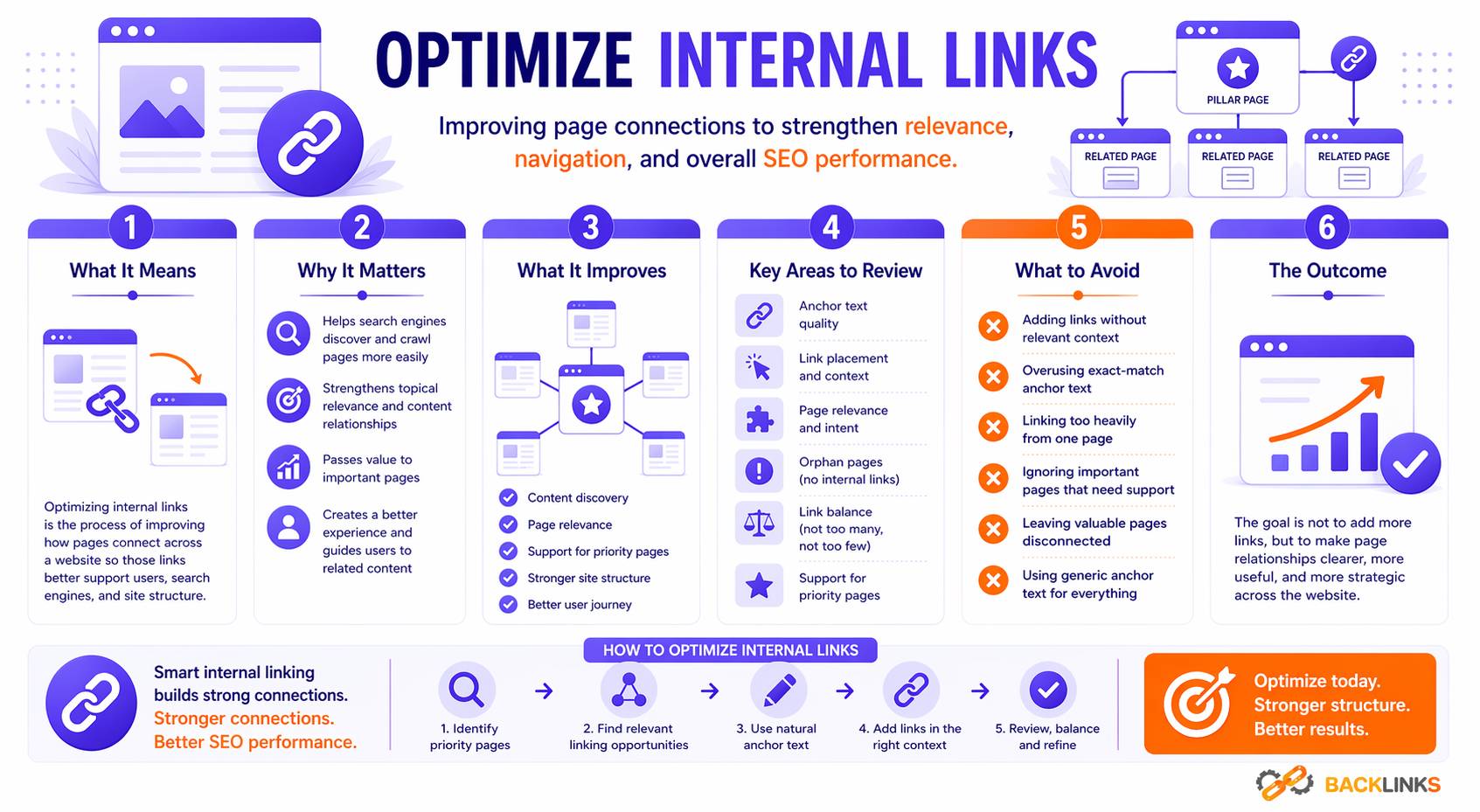
To optimize internal links means to improve how pages on your website connect to one another so both users and search engines can navigate the site more effectively. In SEO, internal linking is not just a technical detail. It is a strategic system that helps define page relationships, distribute authority, reinforce topical relevance, and guide visitors toward the next useful step.
This matters because strong content alone is often not enough. A page may be well written and still underperform if it is isolated, buried too deeply, or weakly connected to related content. Internal links help search engines understand which pages matter, how topics are related, and how your site is structured. They also make the user journey more intuitive, which improves the practical value of the site.
For websites building organic visibility, internal linking is one of the highest-leverage SEO activities available. It is fully under your control, it supports broader site architecture, and it strengthens the performance of both existing and newly published content.
What Does It Mean to Optimize Internal Links
To optimize internal links means improving the placement, purpose, anchor text, and structure of the links that connect pages within the same website.
In practical terms, that includes decisions such as:
- which pages should link to which
- where those links should appear in the content
- what anchor text should be used
- how often a page should be linked internally
- whether important pages are easy to reach
- whether the linking structure reflects topic relationships clearly
A strong internal linking strategy is not about adding as many links as possible. It is about creating useful, relevant, and intentional pathways across the site.
When internal links are optimized well, they do three things at once. They help search engines discover and interpret content. They help users explore related information naturally. And they help strengthen the hierarchy of the website by showing which pages are foundational and which pages are more specific supporting assets.
Why It Matters to Optimize Internal Links
Internal linking matters because it affects how search engines crawl your site, how they interpret content relationships, and how effectively users move through your website.
It improves crawlability and discovery
Search engines rely on links to find pages and understand how they connect. If important pages are poorly linked, buried deep within the site, or left orphaned, they may be crawled less efficiently or treated as less important.
Optimized internal links make content easier to reach and easier to understand in context.
It strengthens topical relevance
Internal links help define semantic relationships between pages. When a page about internal linking points to related articles on site architecture, content optimization, or anchor text strategy, those links reinforce the broader topic ecosystem of the site.
This helps search engines interpret not only individual pages, but also the subject depth of the website as a whole.
It supports page authority flow
Internal links help distribute value across the site. Pages that attract strong visibility or external links can pass contextual support to other important pages through thoughtful internal linking.
This does not mean internal links work like a simple formula. But they do help channel attention and importance across the website in a way that supports SEO performance.
It improves user journeys
Good internal links are useful for readers. They help people move from a broad explanation to a more detailed guide, from an educational article to a relevant service page, or from one supporting concept to another.
That improves navigation and helps the website feel more coherent.
How Internal Link Optimization Works
Optimizing internal links works by improving the relationship between content, structure, and page importance.
At a practical level, this means reviewing your site not just as a collection of pages, but as a connected system.
Start with page hierarchy
Every site has pages that should carry more weight than others. Broad topic pages, core service pages, and high-value resources should usually sit higher in the internal linking structure than narrow supporting pages.
When internal links reflect that hierarchy, the site becomes easier to interpret.
For example, a broader page on content optimization should naturally link to more specific supporting pages such as content audits, rewriting content, or content structure SEO. Those supporting pages should also link back where relevant. This creates a clear topical relationship instead of a loose set of disconnected articles.
Link contextually, not mechanically
The strongest internal links usually appear within the body content where they are most relevant. Contextual links carry more meaning than generic navigation alone because they connect ideas directly within the topic discussion.
A contextual link should feel like a natural next step. It should help the reader explore something related, not interrupt the flow with an irrelevant suggestion.
Use anchor text with intent
Anchor text helps signal what the linked page is about. But optimizing anchor text does not mean forcing exact-match keywords repeatedly.
Strong anchor text is usually descriptive, natural, and varied. Some links may use close-match phrasing. Others may use broader semantic anchors. The goal is clarity, not repetition.
Strengthen important pages deliberately
Not every page deserves the same level of internal linking support. Pages that target core business topics, strategic search terms, or key conversion paths usually deserve more deliberate internal link reinforcement.
This helps define site priorities more clearly.
Key Elements When You Optimize Internal Links
Internal link optimization works best when it is guided by a few core principles.
Relevance
A link should connect pages that genuinely belong together. Relevance is what makes internal linking useful rather than manipulative.
A page about optimizing internal links may naturally connect to related topics such as site architecture, anchor text, crawlability, content clusters, and on-page SEO. It would be less useful to link randomly to unrelated topics just because another page exists.
Anchor Text Quality
Anchor text should help users and search engines understand what the destination page covers.
Good anchor text is usually:
- specific enough to be useful
- natural within the sentence
- varied across the site
- aligned with the destination topic
Overusing the exact same anchor text repeatedly can make the linking pattern feel forced and reduces editorial quality.
Link Placement
Links placed within relevant content sections often carry more value than links placed in boilerplate elements alone. This does not make navigation links unimportant, but contextual links usually provide stronger topical signals and better user guidance.
Placement should be intentional. A link is most effective where the reader is likely to need it.
Site Hierarchy
Internal links should reflect the structure of the website. Broad pages should connect to narrower supporting pages, and supporting pages should link back to broader topic pages where appropriate.
This strengthens both discoverability and topical coherence.
Link Depth
Important pages should not be difficult to reach. If a valuable page requires too many clicks from the homepage or sits without supporting internal links, it may receive less attention from both users and search engines.
Optimizing internal links often means reducing unnecessary depth and making important content easier to access.
Content Relationships
Internal links work best when they reflect meaningful editorial relationships. The link structure should show how topics support one another across the site. This is especially important for websites building authority around a defined subject area.
How to Optimize Internal Links Strategically
A useful internal linking strategy starts with planning rather than random insertion.
Identify your priority pages
Begin by deciding which pages matter most. These may be pillar pages, high-conversion service pages, important category pages, or strategic cluster articles. Those pages should usually receive stronger internal linking support than lower-priority pages.
Map related content
Look at which pages naturally support each other. Internal linking should follow topic relationships, not just keyword similarity. Some pages deserve direct mutual links. Others should connect through a broader parent topic.
This mapping process helps prevent both underlinking and unnecessary overlap.
Add contextual links where they improve the reader experience
The best internal links often appear where the reader is likely to want more depth or a next step. Review existing content and look for places where a related page would genuinely add value.
Avoid adding links just to increase the count.
Improve anchor text variation
Review how key pages are being linked. If every internal link uses the exact same keyword-rich phrase, the pattern may be too rigid. Improve anchor text by introducing natural variation while keeping it descriptive and relevant.
Support new content intentionally
New pages often struggle not because the content is weak, but because they are not integrated into the site. When publishing new content, add internal links from existing relevant pages so the new URL enters the topical structure immediately.
Review orphan pages and weakly linked pages
Some pages receive almost no internal link support. These orphaned or weakly connected pages are often underperforming for structural reasons. Review whether they should be linked more clearly, merged into stronger content, or removed if they add little value.
Common Mistakes When You Optimize Internal Links
Internal linking is simple in principle, but many websites handle it poorly.
Adding links without relevance
This is one of the most common problems. A high volume of internal links does not help if the links are not contextually appropriate. Irrelevant links reduce usefulness and weaken editorial quality.
Overusing exact-match anchor text
Using the primary keyword every time you link to a page is unnecessary and often unnatural. Exact-match anchors should be used sparingly. Most internal links should sound natural in the sentence.
Ignoring site hierarchy
When the internal linking structure does not reflect page importance, the website becomes harder to interpret. Key pages may receive too little support while minor pages receive links without strategic reason.
Leaving important pages underlinked
Sometimes the pages that matter most are not linked often enough from relevant content. This weakens discoverability and reduces the contextual support those pages could receive.
Treating internal linking as an afterthought
Internal links should be part of content planning, not just a final edit before publishing. The strongest results come when internal linking is built into the content strategy from the beginning.
Practical Guidance for Better Internal Link Optimization
If you want to optimize internal links effectively, start by reviewing your website as a structure rather than as isolated pages. Ask which pages should lead, which pages support them, and whether those relationships are clearly reflected in the links.
Then audit key content areas. Look for pages that already attract traffic or target important topics, and assess whether they link naturally to related content. In many cases, the quickest improvements come from adding a few strong contextual links from relevant existing pages.
Next, review anchor text quality. Make sure it is descriptive and natural. Keep exact-match usage limited and focus on anchors that help the reader understand what they will find next.
Finally, maintain internal linking as an ongoing editorial habit. Every new article should be integrated into the wider site, and older articles should be revisited periodically to add links to newer relevant content.
The goal is not just to link more. The goal is to create a site where the relationships between pages are clear, useful, and strategically aligned.
Timing and Expectations
Optimizing internal links can improve SEO performance relatively quickly compared with more resource-heavy initiatives, because the changes are entirely within your control and often apply to content that already exists.
That said, outcomes still depend on the quality of the site, the competitiveness of the topic, and how meaningful the changes are. Better internal links can improve crawl paths, strengthen page relationships, and support rankings over time, but they are most effective when combined with strong content quality, intent alignment, and sound technical foundations.
Internal linking should be viewed as a compounding improvement, not a standalone shortcut. Its real value increases when the site architecture and content strategy are already moving in the right direction.
Conclusion
To optimize internal links is to improve how pages connect across your website so they support crawlability, topical relevance, user navigation, and broader SEO performance.
It is one of the most practical and underused parts of SEO because it strengthens what already exists. Good internal linking helps important pages receive the support they need, helps search engines understand topic relationships more clearly, and helps users move through the site with less friction.
For websites building long-term organic visibility, internal link optimization should be treated as a core strategic activity. It is not just about placing links. It is about building a clearer, stronger, and more useful content structure across the entire site.