
Content Optimization Tools: How to Choose and Use Them Effectively for SEO
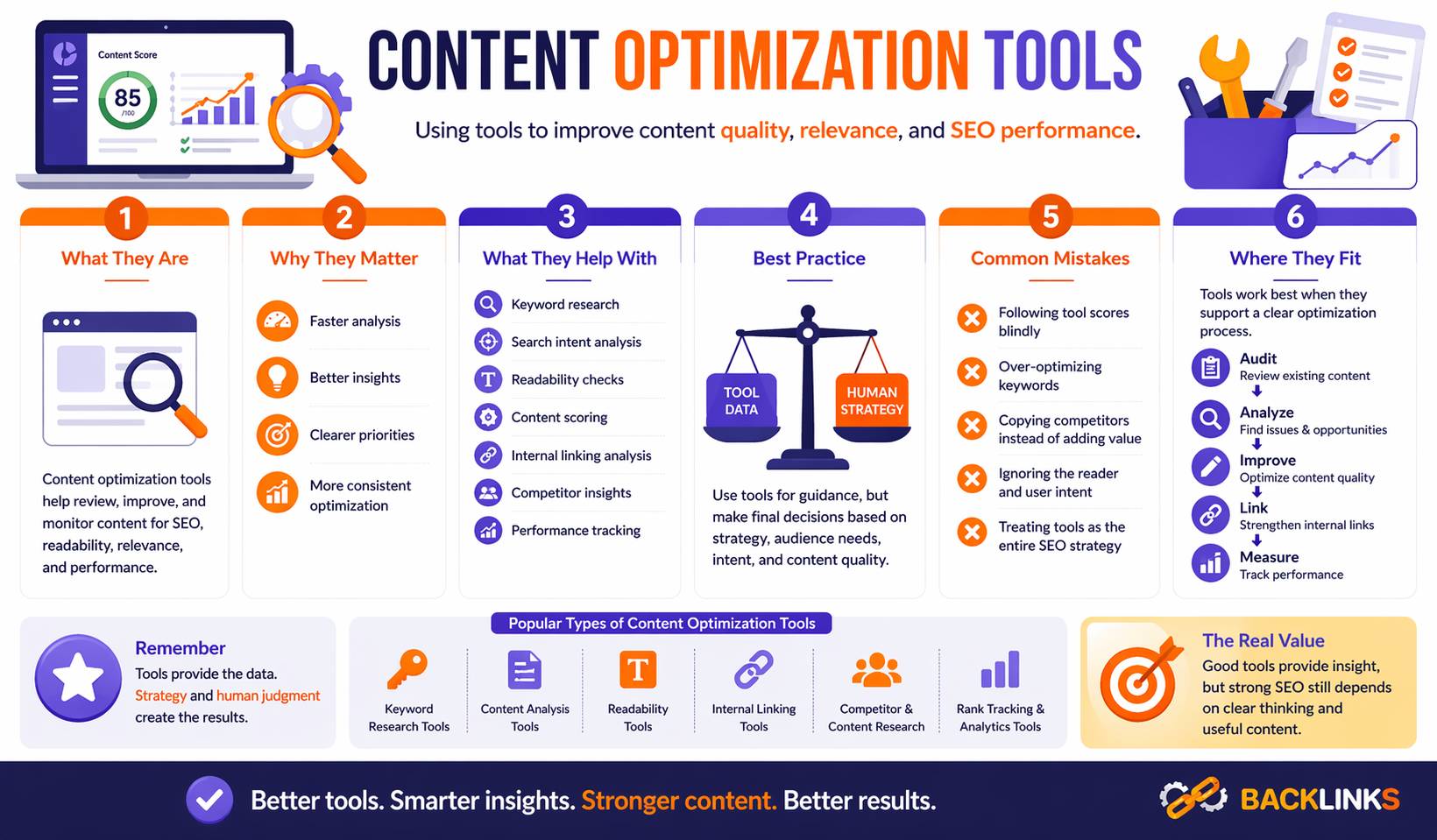
Content optimization tools help marketers, SEO teams, and business owners improve the quality, relevance, and performance of their content. They are used to refine pages so they align more closely with search intent, cover topics more effectively, strengthen on-page SEO, and compete more successfully in organic search.
That does not mean a tool can replace strategy. It cannot. A tool can surface patterns, identify gaps, and support decision-making, but it cannot determine page purpose, business relevance, or whether a piece of content genuinely deserves to rank. Used well, content optimization tools make skilled teams more efficient. Used poorly, they encourage formulaic writing and shallow SEO decisions.
For businesses investing in organic growth, understanding content optimization tools matters because the right toolset can improve workflows, strengthen content quality, and help turn underperforming pages into stronger SEO assets. The key is knowing what these tools are for, where they add value, and where human judgment still matters most.
What Are Content Optimization Tools
Content optimization tools are software platforms or features designed to help improve content for search visibility, topical relevance, readability, and performance.
In practical terms, they are used to support tasks such as:
- evaluating keyword relevance
- identifying topic gaps
- improving on-page structure
- reviewing internal linking opportunities
- analyzing competitor coverage
- measuring readability and clarity
- auditing existing content
- prioritizing updates to older pages
Some tools are focused narrowly on on-page recommendations. Others are broader platforms that combine content analysis, keyword research, performance tracking, and auditing workflows.
The important point is that content optimization tools do not create value on their own. Their value comes from helping teams make better editorial and SEO decisions.
Why Content Optimization Tools Matter
Content optimization tools matter because content performance is rarely improved by guesswork alone. Websites often have dozens or hundreds of pages competing for attention, and it becomes difficult to assess each one consistently without structured data and analysis.
They make content decisions more informed
A tool can help reveal whether a page is missing relevant subtopics, targeting the wrong terms, or underperforming compared with competing pages. This helps teams move beyond intuition and identify where improvement is actually needed.
They improve workflow efficiency
Manual content review is still important, but it can be slow and inconsistent at scale. Content optimization tools help speed up research, highlight patterns, and support repeatable processes across larger websites.
They help prioritize existing content improvements
Many SEO gains come from improving pages that already exist. Optimization tools can help identify which pages have the strongest potential based on factors such as visibility, keyword coverage, content quality, or untapped opportunities.
They support stronger editorial standards
Used properly, these tools encourage teams to think more clearly about relevance, completeness, and structure. They can help bring consistency to how content is evaluated and improved across the site.
How Content Optimization Tools Work
Content optimization tools work by analyzing content and comparing it against useful signals such as keyword usage, topic coverage, competitor patterns, content structure, readability, and performance data.
Different tools do this in different ways, but the general logic is similar. They assess the page, identify gaps or opportunities, and provide guidance on how to improve it.
Topic and keyword analysis
Many tools evaluate whether a page includes the language and concepts commonly associated with the target topic. This can help identify missing terms, thin coverage, or overly narrow treatment of the subject.
Used carefully, this supports better topical completeness. Used mechanically, it can lead to forced writing.
Content scoring and recommendations
Some tools assign a score to a page based on their internal criteria. That score may reflect content depth, optimization level, readability, or semantic relevance.
These scores can be useful as a reference point, but they should not become the goal. A page should not be rewritten to satisfy a tool if doing so weakens clarity or usefulness.
Competitive comparison
Some platforms compare your page against other ranking content for the same topic. This can highlight structural gaps, missing subtopics, or differences in content focus.
That does not mean you should imitate competitors closely. It means you can better understand what level of depth and breadth the search landscape currently expects.
Performance and audit support
Broader tools also help identify which pages should be optimized in the first place. They may surface declining pages, weak internal link support, overlapping content, or pages with strong impressions but low engagement.
This makes them especially useful for ongoing SEO management rather than one-time page edits.
Types of Content Optimization Tools
Not all content optimization tools serve the same purpose. It helps to think of them by function rather than by brand category alone.
On-Page Optimization Tools
These tools focus on improving individual pages. They often provide recommendations related to topic coverage, heading usage, semantic relevance, keyword usage, and content structure.
They are most useful when updating or drafting a page for a defined target query.
Content Audit Tools
Content audit tools help review large sets of pages to identify weak content, outdated pages, overlap, cannibalization, or opportunities for consolidation and refreshes.
These are especially valuable for mature websites with a large content inventory.
Keyword and Topic Research Tools
While not always labeled as content optimization tools, keyword research platforms play a major role in optimization because they help define what the page should target and what supporting topics should be covered.
Without this input, on-page optimization often becomes too narrow.
Internal Linking Tools
Some tools help identify internal link opportunities, orphan pages, or weak structural connections across the site. This is valuable because content optimization should not happen in isolation from site architecture.
Readability and Writing Support Tools
These tools focus more on clarity, sentence structure, grammar, and readability. They are useful because SEO content still needs to read well. A page that is technically optimized but awkward to consume is still weak.
What Good Content Optimization Tools Should Help You Do
The best content optimization tools are not the ones that produce the longest checklist. They are the ones that help you make stronger decisions.
Clarify page focus
A useful tool should help confirm whether a page is clearly aligned with one primary topic and one main intent. If the page is trying to do too much, no amount of surface optimization will fix it.
Identify meaningful gaps
A good tool should help you spot missing subtopics, weak sections, shallow coverage, or poorly supported pages. These are the issues that usually matter more than small keyword adjustments.
Improve content quality without forcing formulaic writing
The strongest tools support judgment. They guide you toward a more complete and relevant page without pushing you into robotic phrasing or repetitive wording.
Support scalable workflows
For growing websites, optimization tools are valuable because they create repeatable standards. They make it easier to review content consistently across a larger library and prioritize work based on real opportunity.
Connect optimization to strategy
A tool is most valuable when it helps improve content in a way that supports rankings, internal linking, topical depth, and business goals together. Optimization should not be reduced to isolated page scoring.
How to Use Content Optimization Tools Effectively
Content optimization tools are most useful when they support a disciplined process.
Start with strategy, not software
Before opening any tool, define the page’s purpose. What keyword or topic is it targeting? What is the search intent? What role should the page play in the wider site? Without those answers, tool recommendations are easy to misapply.
Use tools to support research
Good tools are excellent for identifying relevant subtopics, reviewing competing content patterns, and understanding where a page may be thin or misaligned. This is where they often add the most value.
Apply recommendations selectively
Not every recommendation deserves action. Some suggestions will improve the page. Others may add clutter, create repetition, or encourage over-optimization. Review tool output through the lens of clarity, usefulness, and strategy.
Evaluate the whole page, not just the score
A page can score well in a tool and still be strategically weak. It may target the wrong intent, overlap with another page, or fail to support the user’s next step. Always review the page in context.
Use tools for existing content, not only new drafts
Some of the best ROI comes from using optimization tools on pages that already have visibility or business relevance. Strong existing pages often need refinement more than replacement.
Common Mistakes When Using Content Optimization Tools
The main risk with content optimization tools is not that they exist. It is that they are often used too literally.
Writing to satisfy the tool instead of the user
This is the most common mistake. When teams optimize for a score rather than for usefulness, the content often becomes repetitive, bloated, or unnatural.
Treating every recommendation as equally important
Some recommendations address real weaknesses. Others are minor or irrelevant in context. Better results come from prioritizing meaningful changes rather than trying to complete every suggestion.
Ignoring search intent
A tool may help improve topical relevance, but it cannot always determine whether the page type itself is right for the keyword. If the intent is mismatched, the page may still underperform.
Over-expanding the content
Some teams use optimization tools as a reason to add more sections, more terms, and more volume than the page actually needs. This often weakens focus instead of improving depth.
Forgetting site-wide context
A page should be optimized in relation to the rest of the site. If a tool helps improve one page but that page still overlaps with another or lacks internal support, the overall SEO problem remains.
Practical Guidance for Choosing Content Optimization Tools
If you are deciding how to evaluate content optimization tools, focus less on marketing claims and more on fit.
Choose tools based on what your team actually needs. A small site may need stronger content audit visibility and keyword research more than advanced workflow features. A larger content operation may need collaboration, prioritization, and scalable content review processes.
Look for tools that help your team answer practical questions:
- Which pages should we improve first?
- What is missing from this page?
- Does this page match the right intent?
- Where are we overlapping?
- How can we strengthen internal relationships between pages?
- Which recommendations actually improve quality?
The right tool should make those questions easier to answer. It should not pressure the team into writing generic, score-chasing content.
Timing and Expectations
Content optimization tools can improve workflow and decision quality quickly, but they do not create SEO results on their own. The outcome depends on how well the recommendations are applied and whether the underlying content strategy is sound.
A tool may help you identify missing coverage or weak structure in a matter of minutes. The real gains come later, when those insights are turned into stronger pages, better internal linking, and more coherent content planning.
It is also important to be realistic. A tool cannot compensate for weak expertise, unclear positioning, or low-quality content strategy. It can support strong SEO work, but it cannot replace it.
Conclusion
Content optimization tools are useful because they help marketers and SEO teams analyze content more efficiently, identify meaningful gaps, and improve pages with greater consistency.
They are most valuable when used to support judgment rather than replace it. Good tools help you see where content is weak, where opportunities exist, and where your pages need stronger structure, relevance, and topical depth. But the final quality of the content still depends on strategic thinking and editorial skill.
For businesses serious about organic growth, content optimization tools can be a strong advantage when chosen carefully and used with discipline. The goal is not to produce content that looks optimized in a dashboard. The goal is to create content that is genuinely better, more useful, and more competitive in search.