
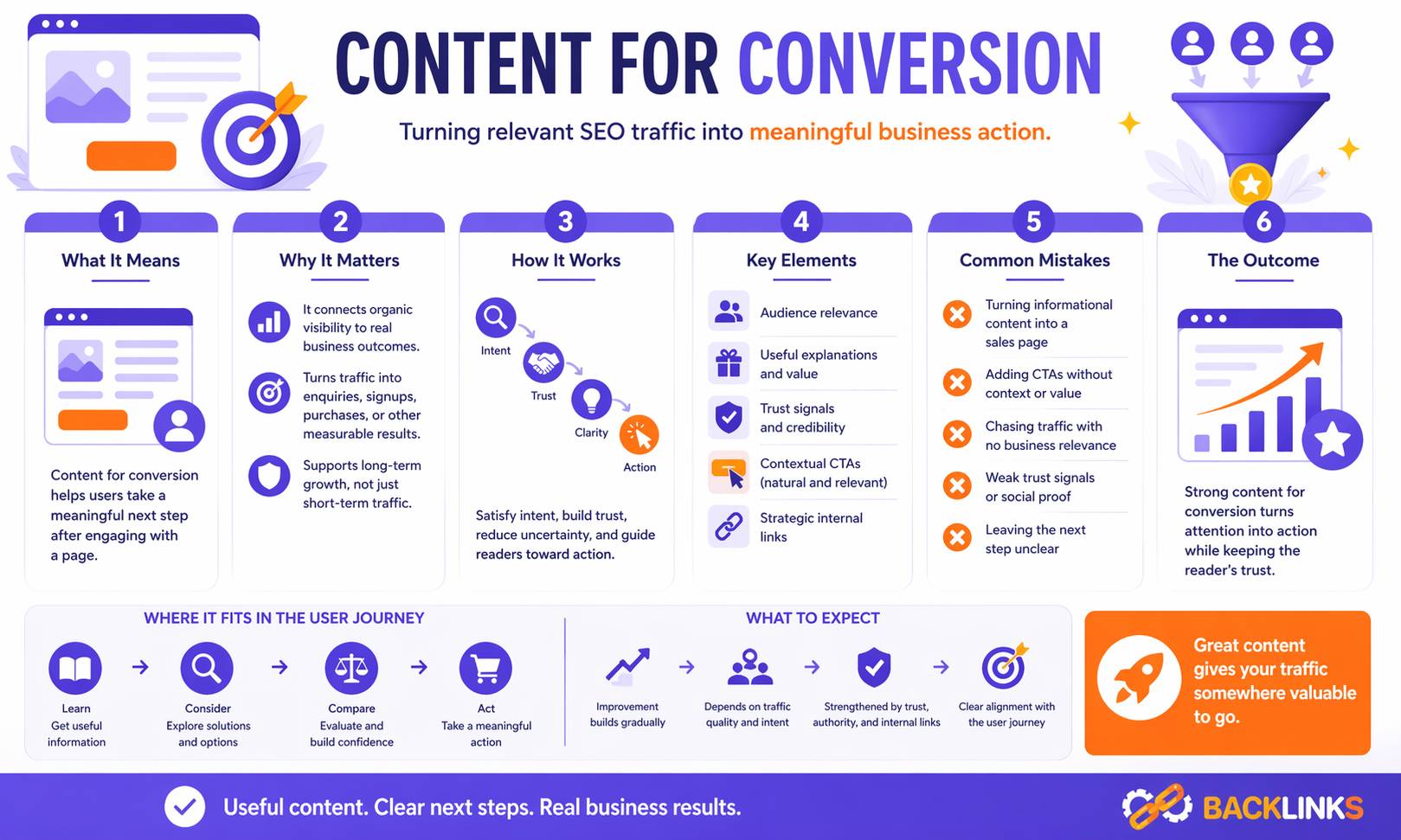
Content for Conversion: How to Create Content That Turns Traffic Into Business Results
Content for conversion is content designed not only to attract visitors, but to move them toward a meaningful business action. That action may be a contact form submission, a demo request, a phone call, a newsletter signup, or a purchase. In SEO and digital marketing, this matters because traffic alone is rarely the goal. The real goal is to turn relevant attention into measurable business value.
Many websites publish strong informational content but struggle to convert that visibility into leads or revenue. In most cases, the problem is not that the content is ranking. The problem is that it was created only to attract clicks, not to guide readers toward a logical next step. Content for conversion solves that by combining usefulness, relevance, trust, and strategic intent.
This does not mean every page should read like a sales page. In fact, that often weakens performance. Strong conversion-focused content respects the user’s intent, delivers real value, and introduces the next step in a way that feels natural rather than forced. For businesses building organic growth, that balance is essential.
What Is Content for Conversion
Content for conversion is content created to help users take action after they engage with a page.
In practical terms, it sits between pure information and pure selling. It answers questions, addresses concerns, builds trust, and gives the reader a clear reason to continue the journey. That journey may lead to a service page, a consultation request, a product page, or another lower-funnel asset.
Content for conversion does not always mean aggressive calls to action. It means the page has a clear commercial purpose underneath its informational value. It is designed to support a business outcome without undermining the user experience.
A strong conversion-focused page usually does several things well:
- matches the user’s intent
- explains the topic clearly
- builds credibility
- addresses hesitation or uncertainty
- creates a natural bridge to the next action
- makes that next action easy to understand
The key is alignment. If the content is useful but disconnected from business goals, it may generate traffic without results. If it pushes too hard for conversion, it may fail to rank or lose trust quickly.
Why Content for Conversion Matters
Content for conversion matters because visibility without action has limited business value. Organic traffic can be important, but traffic that does not lead anywhere often becomes a reporting metric rather than a growth asset.
It connects SEO to revenue
One of the biggest challenges in content marketing is proving commercial value. Conversion-focused content helps close that gap by creating a clearer link between organic visibility and business outcomes.
A page that attracts the right audience and moves some of that audience toward enquiry or purchase is far more valuable than a page that only accumulates visits.
It improves the quality of user journeys
Users often need more than information. They need direction. After learning about a problem or solution, they may want help evaluating options, understanding what to do next, or deciding whether your business is the right fit.
Content for conversion supports that decision-making process.
It makes content strategy more efficient
When content is created with both relevance and conversion potential in mind, the site becomes more efficient as a whole. Informational pages do not exist only to rank. They help support the broader marketing and sales journey.
It strengthens trust before the sales conversation
A lot of conversion happens before a form is submitted. Readers evaluate credibility, expertise, and fit long before they contact a business. Good conversion content helps shape that judgment by offering clear, realistic, and useful guidance.
How Content for Conversion Works
Content for conversion works by combining intent alignment with strategic persuasion.
The page must first satisfy the reason the user arrived. Only then can it guide the reader toward a next step. If the content fails the first part, it usually fails the second as well.
Start with the user’s real intent
The most important question is why the person searched in the first place. Informational intent still needs to be respected. If a user wants to understand a concept, the page should explain it clearly before introducing a service or commercial action.
That is especially important for a topic like content for conversion, where the reader is likely trying to understand the concept, not immediately buy something.
Build trust before asking for action
Conversion-focused content depends on trust. That trust comes from accuracy, clarity, strong judgment, and a realistic tone. Readers are more likely to take action when the content demonstrates expertise without exaggeration.
This is why overly promotional SEO content often underperforms. It tries to convert before it has earned credibility.
Reduce friction in the decision process
A conversion does not always fail because the offer is weak. Often it fails because the content leaves too many unanswered questions. Readers may not understand the benefit, the process, the next step, or why they should act now rather than later.
Content for conversion reduces that friction by making the decision path clearer.
Introduce the next step naturally
The best conversion content makes the next step feel like a continuation of the reader’s journey, not a hard shift into sales language. That may mean linking to a service page, inviting the user to request a consultation, or pointing them toward a more specific commercial page.
Key Elements of Content for Conversion
Conversion-focused content works best when several elements support each other.
Search Intent Alignment
A page must first match the reason behind the search. If the keyword intent is informational, the content should lead with education and clarity. Trying to force transactional messaging too early often reduces both SEO performance and trust.
Intent alignment is not separate from conversion. It is the foundation of it.
Clear Audience Relevance
Readers should be able to see quickly that the content is meant for them. That means addressing real problems, real priorities, and realistic business conditions rather than speaking in generic marketing language.
The more precisely the content reflects the audience’s situation, the easier it becomes to convert qualified readers.
Strong Explanatory Value
Conversion content still needs substance. Thin content with a call to action at the end is rarely persuasive. Readers need enough information to understand the topic, assess relevance, and feel confident moving forward.
This is especially true in service-based businesses and higher-consideration purchases.
Trust Signals
Trust can come from several places:
- clear and accurate explanations
- realistic claims
- confident but measured tone
- examples or scenarios where appropriate
- consistent site structure and internal linking
- pages that demonstrate subject expertise
Trust is often what separates content that gets read from content that converts.
Logical Calls to Action
A call to action should fit the stage of the reader. On informational pages, the best CTA is often softer and more contextual than on a landing page. It may invite the user to learn more, explore a related service, or take a low-friction next step.
The CTA should feel earned by the content.
Internal Linking to Commercially Relevant Pages
Internal linking plays an important role in content for conversion. A strong informational page can support business outcomes by linking naturally to service pages, category pages, case studies, or more decision-oriented resources.
This helps move readers from research to action without making the page itself overly commercial.
Types of Content That Support Conversion
Not all content converts in the same way. Different page types support different stages of the journey.
Educational Content with Commercial Relevance
These pages explain important topics while naturally connecting them to services or solutions. They work well when the topic has strong informational intent but also clear business value.
Comparison and Evaluation Content
These pages help users assess options, understand trade-offs, and move closer to a decision. They are often strong conversion assets because the searcher is already evaluating solutions.
Problem-Solution Content
This type of content speaks directly to a pain point and explains how to solve it. It can convert well because it connects user need with a clear path forward.
Service-Supporting Content
Some articles exist to strengthen nearby service pages. They may rank for informational queries, build trust, and then guide users toward a commercially relevant destination through internal links and contextual calls to action.
How to Create Content for Conversion Effectively
A strong conversion content process starts with strategy, not with CTA placement.
Define the business goal of the page
Before writing, decide what conversion the page should support. That does not mean every page must push for the same action. Some pages may support soft conversions. Others may support direct enquiries. The important point is that the page should have a clear role.
Match the conversion path to the intent
The next step should make sense for the user’s stage. A top-of-funnel informational article may be better suited to guiding the reader toward a related service overview or a more specific supporting article rather than asking for an immediate sale.
Write for usefulness first
The page still needs to be genuinely helpful. The stronger the informational value, the easier it is to build trust and create momentum toward a conversion.
Address real objections and uncertainties
Readers often hesitate because they are unsure about cost, fit, timing, complexity, or whether a solution actually applies to them. Good content for conversion anticipates those concerns and addresses them in a calm, practical way.
Use calls to action with context
A CTA works best when it follows naturally from the section before it. If the page has just explained a challenge or opportunity clearly, the invitation to take the next step feels more relevant.
Support the page with internal links
A well-structured site helps conversion content work harder. Informational pages should link to relevant service pages and related decision-stage content where appropriate. This creates a smoother journey across the website.
Common Mistakes With Content for Conversion
Many pages fail to convert because they misunderstand the relationship between SEO content and commercial intent.
Turning informational content into a sales page
This is one of the most common mistakes. If the keyword intent is informational, the page must deliver real informational value. Pushing sales language too early usually weakens performance.
Adding calls to action without strategic fit
A CTA is not effective just because it exists. It needs to match the reader’s stage, the page’s purpose, and the surrounding content.
Focusing on traffic without business relevance
Some content attracts attention but has little commercial connection to the business. That may still have branding value, but it is weak conversion content. Stronger results come from topics where audience need and business relevance overlap clearly.
Ignoring trust and credibility
Readers do not convert because a button is visible. They convert because the content made them feel informed, confident, and understood. Weak trust signals undermine that process.
Leaving the next step unclear
Some pages provide useful information but do not guide the reader anywhere. That leaves conversion potential unrealized. Even informational content should help users understand what to do next.
Practical Guidance for Better Conversion-Focused Content
If you want content to support conversions more effectively, start by identifying the pages that already attract relevant traffic or target commercially meaningful topics. These pages often offer the strongest opportunities.
Then review them with a clear framework. Ask whether the page matches intent, demonstrates expertise, builds trust, and offers a logical next step. In many cases, the biggest improvements come not from rewriting the entire article, but from strengthening weak sections, improving internal links, and refining calls to action.
It is also important to think in terms of page relationships. A single article may not convert directly, but it can still play a crucial role by guiding readers toward a page that does. This is why site structure and internal linking matter so much in conversion-focused SEO.
Most importantly, avoid false choices between ranking and converting. Strong content can do both when it is built with the right balance of usefulness, trust, and commercial awareness.
Timing and Expectations
Content for conversion often improves gradually rather than all at once. Some gains may come from better calls to action or stronger internal links, but the broader effect usually depends on traffic quality, user trust, site authority, and how clearly the content fits within the larger journey.
It is also important to be realistic. Not every informational page will convert directly, and not every topic should be forced into a conversion role. Some pages are better at introducing the audience, while others are better at closing demand. What matters is that the content system as a whole supports movement toward business outcomes.
Conclusion
Content for conversion is content that turns relevant visibility into meaningful action. It does this by combining clear informational value with trust, strategic guidance, and a natural path to the next step.
It is not about making every page sound more sales-driven. It is about making content more purposeful. When done well, it helps businesses get more value from their SEO efforts by connecting rankings and traffic to real commercial outcomes.
For websites investing in organic growth, content for conversion should be treated as a core part of content strategy. Useful content attracts attention. Conversion-focused content ensures that attention has somewhere valuable to go.