
Using Keywords in Content: How to Improve SEO Without Over-Optimizing
Using keywords in content means placing the right search terms in the right places so search engines can understand the topic of a page and users can quickly see that the content matches what they are looking for.
That sounds simple, but keyword use is one of the most misunderstood parts of SEO. Many people still treat it as a density exercise, where success comes from repeating a phrase as often as possible. That approach is outdated and usually makes content worse. Strong SEO content uses keywords with precision, context, and restraint.
For business owners, marketers, and SEO professionals, the real goal is not to add more keywords. It is to make the content clearly relevant to the target query while keeping the page natural, useful, and credible. When handled properly, keyword usage improves rankings, strengthens topical relevance, and supports a better reader experience.
What Does Using Keywords in Content Mean
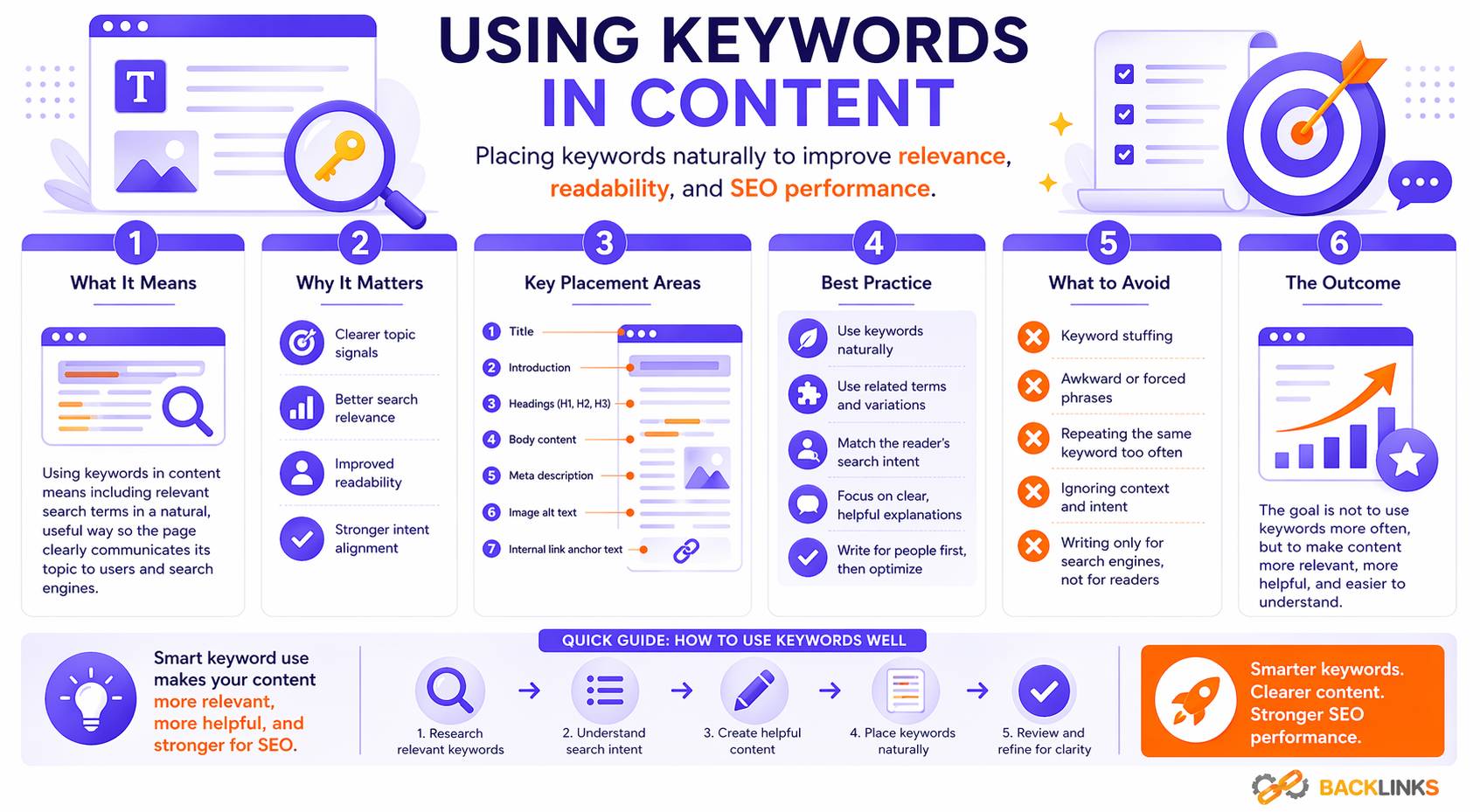
Using keywords in content means incorporating the terms and phrases people search for into a page in a way that helps search engines interpret the topic and helps readers confirm they are in the right place.
In practical terms, that includes the primary keyword, closely related phrases, and supporting language that naturally belongs to the topic. The goal is not to force every variation into the page. The goal is to signal relevance clearly and consistently.
A well-optimized page usually uses keywords in places such as:
- the page title
- the H1 heading
- the introduction
- selected H2 subheadings where natural
- the main body content
- image alt text where relevant
- internal anchor text where appropriate
- metadata such as the title tag and meta description
Good keyword use is about context. A page should sound like it was written by someone who understands the topic, not by someone trying to satisfy a formula.
Why Using Keywords in Content Matters
Keywords matter because they help connect your content to search demand. If you do not use the language your audience searches for, your content may be less visible even if the information itself is strong.
It helps search engines understand page relevance
Search engines use on-page language as one of many signals to understand what a page is about. If the main topic is unclear, the page may struggle to rank for the right queries.
Clear keyword usage reinforces topical focus.
It helps match search intent
Searchers often make quick judgments based on visible wording in titles, headings, and introductions. When the language on the page reflects the topic they searched for, the page feels more relevant immediately.
It supports stronger content targeting
Keyword use also helps content stay focused. If a page is built around a clear target phrase and related concepts, it is easier to keep the article aligned with one main intent rather than drifting into unrelated areas.
It improves internal consistency across the site
Using keywords well helps define how pages relate to one another. This matters for internal linking, topic organization, and avoiding overlap between pages targeting similar searches.
How Using Keywords in Content Works
Using keywords in content works by combining strategic placement with natural language.
A page does not rank well because a phrase appears a certain number of times. It performs better when the overall content clearly reflects the target topic, aligns with search intent, and covers the subject in a useful way.
Start with one primary keyword
Every page should usually have one main keyword target. That keeps the content focused and helps avoid confusion about what the page is trying to rank for.
For this topic, the primary keyword is using keywords in content. The page should clearly revolve around that phrase and its practical meaning.
Add related terms naturally
A strong page also includes semantically related language. These are the supporting terms that naturally belong to the subject, such as keyword placement, keyword stuffing, search intent, on-page SEO, keyword relevance, and content optimization.
These terms help build context without making the writing repetitive.
Place keywords where they matter most
Some locations carry more weight than others. The title, H1, opening paragraph, and key subheadings are especially useful because they establish the page’s focus early.
That does not mean the exact phrase must appear everywhere. It means the topic should be obvious from the beginning.
Keep the writing natural
Search engines are better than they used to be at understanding meaning, context, and topical relationships. That makes awkward repetition unnecessary. In fact, over-optimized writing often weakens quality and trust.
The page should read like expert communication first and SEO content second.
Where to Use Keywords in Content
Keyword placement matters, but it should always serve clarity rather than force repetition.
Title and H1
The title is one of the clearest places to use the primary keyword because it signals the page topic immediately. The H1 should also reinforce the main subject naturally.
This helps both search engines and readers understand what the page covers.
Introduction
The opening paragraph should use the primary keyword early where it fits naturally. This confirms topical relevance and helps set expectations for the rest of the page.
A good introduction does not just insert the phrase. It frames the topic clearly.
H2 and H3 Headings
Subheadings can include the primary keyword or partial variations when that improves clarity. More often, headings should reflect meaningful subtopics rather than repeat the same phrase mechanically.
Useful headings make the page easier to scan and strengthen semantic structure.
Body Content
The body should use the primary keyword where relevant, along with related phrases that support the topic. The emphasis should stay on usefulness and flow.
If the phrase feels unnatural in a sentence, it is usually better to use a close variation or rewrite the sentence more clearly.
Metadata
The title tag and meta description are also useful places for keyword relevance. They help shape how the page appears in search results and can improve click-through performance when written well.
Internal Links
Internal anchor text can reinforce topic relationships, but it should remain natural and varied. Using the exact same anchor repeatedly across the site is rarely necessary.
Important Principles for Using Keywords in Content
Strong keyword usage depends on judgment, not formulas.
Relevance Comes Before Frequency
The first question is whether the keyword belongs on the page at all. If the page is not a strong match for the keyword’s intent, adding the phrase more often will not solve the problem.
A relevant page with moderate keyword usage is far stronger than an irrelevant page with aggressive repetition.
Context Matters More Than Density
Keyword density is one of the least useful ways to think about modern SEO writing. What matters more is whether the content covers the topic clearly and includes the language that naturally belongs to it.
A well-written page often ranks because it demonstrates topical completeness, not because it hits a percentage target.
Variations Improve Naturalness
You do not need to repeat the exact phrase every time. Partial matches, synonyms, and closely related wording often create a stronger reading experience while still reinforcing relevance.
This also helps avoid a mechanical tone.
Intent Should Guide Usage
Keyword usage should reflect what the searcher is trying to accomplish. Informational pages should use keywords in a way that supports explanation and learning. Commercial pages may need more solution-oriented language. The wording should fit the page type and audience expectation.
Common Mistakes When Using Keywords in Content
Many SEO problems come from treating keywords as a formula instead of a communication tool.
Keyword stuffing
This is the most obvious mistake. Repeating the same keyword excessively makes the writing weaker and can reduce credibility. It also tends to signal that the content was written for search engines rather than people.
Forcing exact-match phrasing everywhere
The exact keyword does not need to appear in every heading, paragraph, and anchor text. Overuse creates awkward writing and reduces flexibility.
Ignoring search intent
A page can use the target phrase correctly and still fail if it does not satisfy the reason behind the search. Intent mismatch is usually a bigger problem than low keyword frequency.
Targeting too many keywords on one page
When a page tries to rank for several unrelated or only loosely related topics, it often loses focus. It becomes harder for search engines to understand the main topic, and harder for users to get a clear answer.
Writing around keywords instead of ideas
Some content sounds unnatural because it was built by inserting phrases into prewritten sentences rather than explaining the subject clearly. Strong SEO writing starts with the idea, then integrates keyword relevance into the explanation.
How to Use Keywords in Content Effectively
The best way to use keywords is to start with the topic and the search intent, then write a page that genuinely addresses that need.
Begin by choosing one clear primary keyword. Then identify the related terms and subtopics that naturally belong to the subject. Use those terms to shape the outline, not just the editing process.
Next, place the primary keyword in the most important areas where it fits naturally. Make sure the title, introduction, and major sections clearly reflect the page topic. After that, focus on writing with clarity and depth rather than trying to increase repetition.
Once the draft is complete, review it for balance. Check whether the page sounds natural, whether the topic is obvious, and whether the wording supports both search visibility and readability. If the keyword stands out too much, the page is probably over-optimized. If the topic feels vague, the page may need stronger relevance signals.
A good final check is simple: would the content still read well if you were not thinking about SEO? If the answer is yes, and the topic is still clear, the keyword usage is probably in a strong range.
Timing and Expectations
Using keywords in content correctly can improve relevance and help a page compete more effectively, but it should not be treated as a standalone ranking shortcut.
Better keyword usage can strengthen a page relatively quickly when the topic is already sound and the content is otherwise useful. But rankings also depend on content quality, site authority, internal linking, technical health, and competition.
That is why keyword optimization should be viewed as part of a broader SEO system. It helps search engines understand the page more clearly, but it works best when the rest of the page deserves visibility too.
Conclusion
Using keywords in content is the practice of making your page clearly relevant to the terms people search for without sacrificing quality, readability, or trust.
Done properly, it helps search engines interpret the topic, helps users recognize the page as relevant, and supports stronger SEO performance over time. Done poorly, it creates awkward, repetitive content that weakens the page instead of improving it.
The most effective approach is simple in principle: choose the right keyword, match the right intent, use the phrase where it matters, and write naturally around the real topic. That is how keyword usage supports long-term SEO value instead of becoming a mechanical exercise.