
Why Keyword Research Is Important for SEO Success
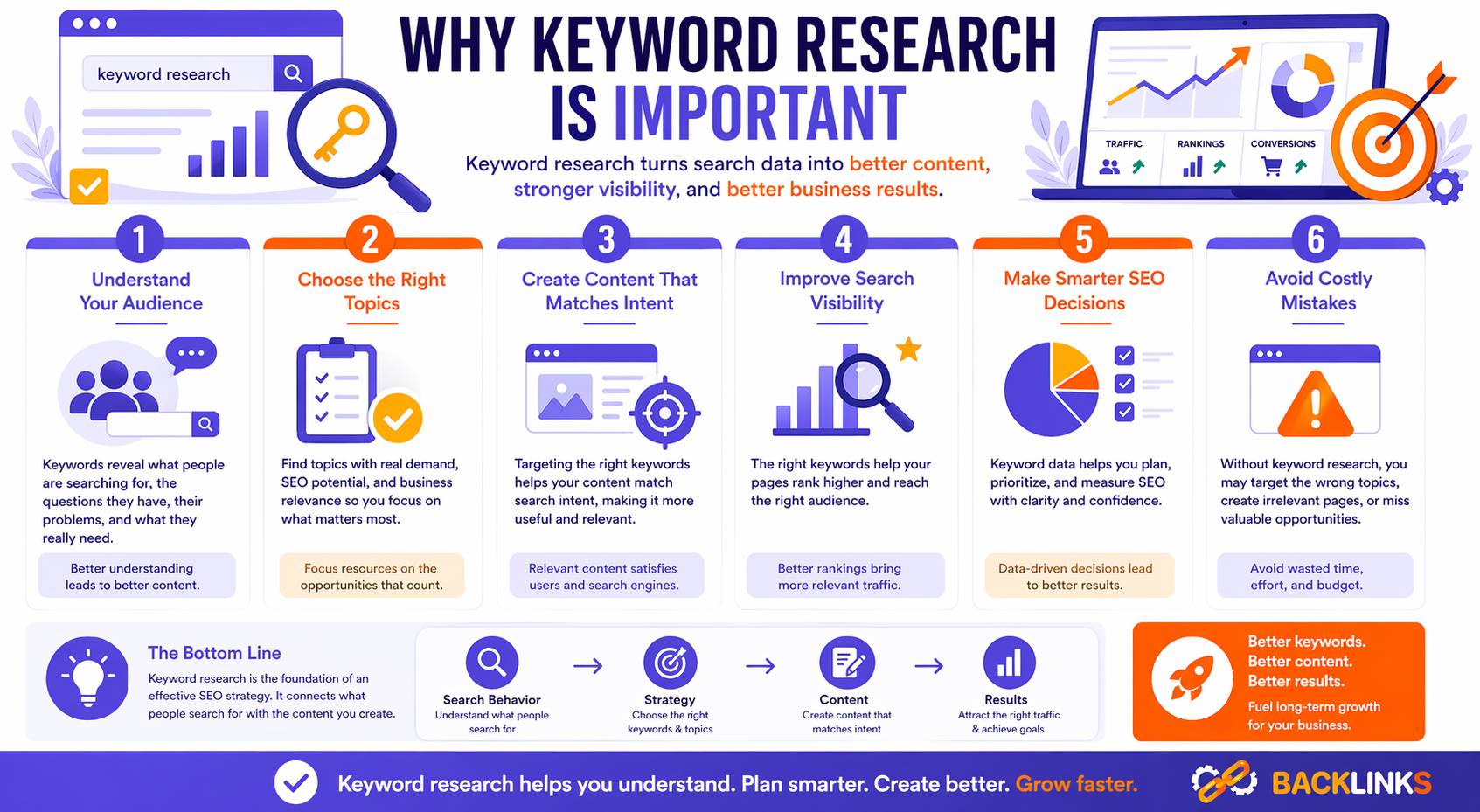
Why keyword research is important comes down to one simple reason: SEO works best when your content matches what people are already searching for. Without keyword research, content decisions are often based on assumptions, internal language, or broad topics that may not reflect real search demand.
A business may publish useful articles, optimize page titles, and improve website performance, but still struggle to gain organic traffic if the content is not aligned with user intent. Keyword research helps avoid that problem by showing what your audience searches for, how they phrase their questions, and what kind of content they expect to find.
This article explains why keyword research matters, how it supports SEO strategy, and what can go wrong when it is ignored.
What Is Keyword Research?
Keyword research is the process of finding and analyzing the search terms people use in search engines. These terms may be short phrases, detailed questions, product comparisons, or problem-based searches.
For example, someone may search for:
- “what is keyword research”
- “why keyword research is important”
- “how to do keyword research”
- “keyword research tools”
- “best keywords for SEO”
Each search reflects a different need. Some users want a definition. Others want a process, a tool, or a strategic explanation.
Keyword research helps you understand those differences so you can create the right content for the right search. It is not only about finding popular keywords. It is about understanding search demand, user intent, competition, and relevance.
Why Keyword Research Is Important
Keyword research is important because it connects SEO strategy with real audience behavior. It helps you create content based on evidence rather than guesswork.
When done correctly, keyword research improves how you plan, write, optimize, and organize website content. It also helps you avoid wasting time on topics that do not attract the right visitors.
It Helps You Understand What Your Audience Wants
One of the biggest advantages of keyword research is that it reveals how people actually search.
Businesses often describe their services using internal or technical language. Customers may use simpler, more direct, or problem-focused terms. If your website only uses the language of your business, it may miss the language of your audience.
For example, an SEO specialist may talk about “search visibility,” while a business owner may search for “how to get my website on Google.” Both topics are related, but the wording is different.
Keyword research helps close this gap. It shows the phrases, questions, and concerns your audience uses when looking for information. This makes your content more relevant and easier to find.
It Aligns Content with Search Intent
Search intent is the reason behind a search query. It explains what the user wants to accomplish.
For example:
- “what is keyword research” means the user wants a definition or explanation
- “how to do keyword research” means the user wants a process
- “keyword research tools” means the user may be looking for software options
- “keyword research services” may indicate interest in hiring help
These keywords are related, but they require different types of content.
This is one reason why keyword research is important for SEO. It helps you understand whether a page should be educational, instructional, comparative, or conversion-focused.
If the content format does not match the intent, the page may struggle to rank. Even if the article is well written, users may leave if it does not answer the specific need behind their search.
It Helps You Create More Relevant Content
Keyword research gives structure to content creation. Instead of writing broadly about a topic, you can focus on the specific questions and subtopics users care about.
For example, a page about keyword research may need to explain:
- What keyword research means
- Why it matters
- How search intent works
- How to evaluate keyword difficulty
- Why long-tail keywords are useful
- How keyword research supports content planning
This makes the content more complete and useful. It also helps search engines understand the page’s relevance to the topic.
Relevant content is not created by repeating a keyword many times. It is created by answering the searcher’s question clearly and covering the topic at the right depth.
It Improves SEO Planning
Keyword research is important because it gives direction to your SEO strategy.
Without research, content planning can become random. A website may publish articles whenever an idea comes up, without knowing whether the topic has search demand or fits into the wider SEO plan.
Keyword research helps you decide:
- Which topics are worth targeting
- Which pages should be created first
- Which existing pages need improvement
- Which keywords are too competitive
- Which long-tail opportunities are more realistic
- How different pages should connect internally
This makes SEO more organized and strategic. It also helps content teams avoid duplication and unnecessary work.
It Helps Prioritize the Right Opportunities
Not every keyword deserves the same level of attention.
Some keywords have high search volume but are too broad. Others have strong business relevance but low search volume. Some are highly competitive, while others may be easier to rank for with a focused article.
Keyword research helps you evaluate opportunities based on several factors:
- Search volume
- Search intent
- Keyword difficulty
- Business relevance
- Content quality of competing pages
- Your website’s current authority
This prevents you from chasing keywords only because they look popular. A lower-volume keyword with clear intent may be more valuable than a high-volume keyword that attracts the wrong audience.
It Helps Attract Better Organic Traffic
The goal of SEO is not just to increase traffic. The goal is to attract relevant traffic.
A page can rank for a broad keyword and bring many visitors, but those visitors may not be interested in your services, products, or deeper content. In that case, traffic numbers may increase without meaningful business impact.
Keyword research helps you target searches that match your audience and goals.
For example, a visitor searching “why keyword research is important” is likely trying to understand the strategic value of keyword research. This person may be learning SEO, planning content, or evaluating whether keyword research should be part of their marketing process.
That traffic is more relevant than traffic from an unrelated broad topic.
It Supports Better Website Structure
Keyword research also helps with website structure.
When you understand how topics relate to each other, you can organize content more logically. Broad topics can be supported by more specific articles. Related pages can be connected through internal links. This helps users navigate the site and helps search engines understand relationships between pages.
For example, a website may have separate pages covering:
- Keyword research
- What keyword research is
- Why keyword research is important
- How to do keyword research
- Long-tail keywords
- Search intent
- Keyword difficulty
- Using keywords in content
Each page has a distinct purpose, but together they create stronger topical coverage.
This structure is especially useful for SEO because search engines can better understand the depth of your content around a subject.
It Reduces Content Overlap
Content overlap happens when multiple pages target similar keywords or answer the same question in slightly different ways.
For example, if a website creates separate pages for “why keyword research matters,” “importance of keyword research,” and “why keyword research is important,” those pages may compete with each other.
Keyword research helps prevent this by showing which keyword variations share the same intent. Closely related phrases can often be combined into one strong page, while different intents can be separated into different articles.
This improves content quality and avoids unnecessary duplication.
It Helps You Compete More Realistically
Keyword research helps you understand the competitive landscape before investing in content.
Some keywords are dominated by large, authoritative websites. Competing for those terms may require a long-term strategy, strong content, internal links, backlinks, and topical depth.
Other keywords may be more achievable, especially if existing results are weak, outdated, or too general.
By reviewing search results and keyword difficulty, you can choose opportunities that match your current position. This is especially important for newer websites that need to build authority gradually.
A realistic keyword strategy balances ambition with practicality.
It Improves On-Page SEO
Keyword research directly supports on-page SEO.
Once you know the target keyword and related terms, you can optimize important page elements such as:
- H1 heading
- Meta title
- Meta description
- URL slug
- H2 headings
- Body content
- Image alt text
- Internal link anchors
This does not mean forcing keywords into every section. It means using relevant terms naturally so users and search engines can understand the page clearly.
For example, a page targeting “why keyword research is important” should explain the value of keyword research, not simply repeat the phrase. Strong on-page SEO comes from relevance, clarity, and useful coverage.
It Supports Content Optimization
Keyword research is not only useful before writing. It is also valuable when improving existing content.
You may discover that an old page ranks for keywords it does not fully address. You may find missing subtopics, weak headings, or opportunities to add clearer explanations. You may also identify pages that should be merged because they compete for the same intent.
Content optimization based on keyword research may include:
- Expanding thin sections
- Adding missing questions
- Improving title tags and headings
- Updating outdated examples
- Strengthening internal links
- Reorganizing content for clarity
- Adding related keyword coverage
This makes existing content more useful and more competitive.
It Helps Build Long-Term SEO Growth
SEO growth is rarely the result of one article or one keyword. It comes from consistent, strategic coverage of relevant topics over time.
Keyword research helps guide that long-term growth. It shows which topics to cover now, which to develop later, and how each page should support the overall website.
Over time, a well-researched content strategy can help a website earn visibility across many related searches. This improves topical strength and creates more opportunities for organic traffic.
The value of keyword research compounds because each well-targeted page can support other related pages through internal links and shared topical relevance.
Common Mistakes When Keyword Research Is Ignored
Writing Content Based Only on Assumptions
A common mistake is assuming that a topic is valuable because it is important to the business.
A topic may be important internally, but if people do not search for it in that form, the content may struggle to attract organic traffic. Keyword research helps translate business priorities into searchable topics.
Targeting Keywords That Are Too Broad
Broad keywords often have high volume, but they are usually more competitive and less specific.
For example, “SEO” is much harder to target than “why keyword research is important.” A more specific keyword gives clearer direction and usually reflects a more defined user need.
Ignoring Low-Volume Keywords
Some websites ignore low-volume keywords because they seem too small. This can be a mistake.
Low-volume keywords may have strong intent, lower competition, and higher relevance. They can also support broader visibility when grouped into a strong content strategy.
Misunderstanding Search Intent
If a keyword is informational, the page should educate. If it is commercial, the page may need comparisons or recommendations. If it is transactional, the page should support action.
Ignoring intent often leads to content that does not match user expectations.
Overusing Keywords
Keyword research should improve content, not make it repetitive.
Using the primary keyword naturally is important, but overusing it can make the writing awkward. Search engines understand related phrases and context, so the focus should be on clear, useful content.
Practical Guidance for Using Keyword Research Effectively
Start with your audience. Before looking at tools, define who you are trying to reach and what problems they need to solve.
Then collect keyword ideas around those problems. Look for phrases that show clear intent and connect to your business or content goals.
Next, review the search results. This helps you understand what type of page is currently performing and what users likely expect.
After that, prioritize keywords based on relevance, intent, competition, and strategic value. Avoid choosing keywords only because they have high search volume.
Finally, use keyword research to guide content creation, internal linking, and updates. The strongest SEO strategies use keyword research continuously, not just at the beginning of a campaign.
Timing and Expectations
Keyword research can improve strategy immediately, but SEO results take time.
Once content is published or updated, search engines need time to crawl, index, and evaluate the page. Rankings may change gradually based on content quality, competition, internal links, backlinks, and website authority.
For newer websites, keyword research is especially useful for identifying realistic opportunities. These may include specific informational searches, long-tail keywords, or less competitive topics.
For established websites, keyword research can uncover content gaps, refresh opportunities, and areas where existing authority can be used more effectively.
The important point is that keyword research creates direction. It does not guarantee instant rankings, but it improves the quality of SEO decisions.
Conclusion
Understanding why keyword research is important helps you see SEO as a strategic process rather than a guessing game.
Keyword research reveals what people search for, how they express their needs, and what type of content they expect. It helps you align content with search intent, prioritize realistic opportunities, improve website structure, and attract more relevant organic traffic.
Without keyword research, content can easily become disconnected from real demand. With it, every page has a clearer purpose.
For long-term SEO growth, keyword research should be treated as an ongoing practice. It should guide new content, improve existing pages, support internal linking, and help your website become a more useful resource for the topics your audience cares about.