
Long Tail Keywords: What They Are and Why They Matter for SEO
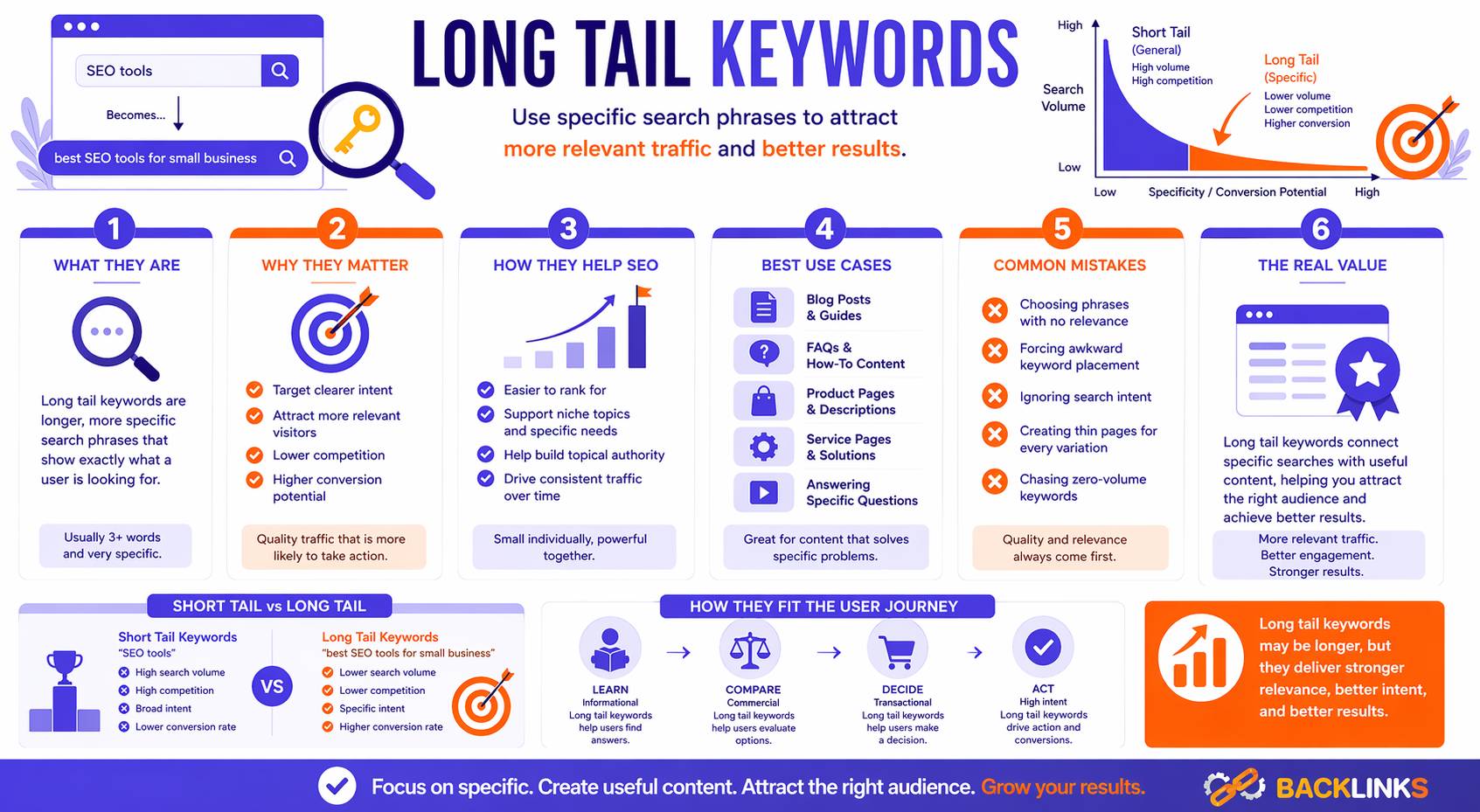
Long tail keywords are specific search phrases that usually contain several words and reflect a clearer search intent than broad, general keywords. They may have lower search volume individually, but they often attract more relevant visitors because the searcher knows more precisely what they are looking for.
In SEO, long tail keywords are especially useful for websites that want to build organic visibility in a realistic and sustainable way. Instead of competing only for broad, highly competitive terms, you can target more specific searches that match your audience’s questions, problems, and decision-making process.
For example, the keyword “SEO” is broad and highly competitive. A phrase like “how to use long tail keywords for blog content” is more specific. It tells you what the user wants, what type of answer they expect, and how the content should be structured.
This article explains what long tail keywords are, why they matter, how they work, and how to use them effectively in SEO content planning.
What Are Long Tail Keywords?
Long tail keywords are longer, more specific search queries that usually target a narrower topic or intent.
They are called “long tail” because of the way keyword demand is distributed. A small number of broad keywords receive very high search volume, while a much larger number of specific keywords receive lower individual search volume. Together, these specific searches can represent a large share of total search demand.
Examples of broad keywords include:
- SEO
- keyword research
- backlinks
- content marketing
Examples of long tail keywords include:
- how to find long tail keywords for SEO
- long tail keywords for small business websites
- best way to use long tail keywords in blog posts
- difference between short tail and long tail keywords
- why long tail keywords are easier to rank for
The main difference is specificity. Broad keywords often have unclear intent, while long tail keywords usually reveal what the user wants more clearly.
Why Long Tail Keywords Matter
Long tail keywords matter because they help websites target search queries with clearer intent, lower competition, and stronger relevance.
Many websites focus too much on high-volume keywords. While those keywords can be valuable, they are often difficult to rank for and may attract users with mixed intentions. Long tail keywords provide a more practical way to reach people who are searching for specific answers.
They Usually Have Clearer Search Intent
Search intent is easier to understand when the query is specific.
For example, someone searching “keywords” could want many different things. They may want a definition, examples, tools, strategy, or a guide. The intent is broad.
Someone searching “how to choose long tail keywords for SEO” has a clearer need. They want a practical explanation of how to select specific keywords for search optimization.
This clarity helps you create content that directly answers the query. When your content matches intent well, users are more likely to stay, read, and engage.
They Are Often Less Competitive
Long tail keywords usually have lower competition than broad keywords.
A broad keyword like “SEO” may be targeted by large websites, software companies, agencies, publishers, and educational platforms. Competing for that keyword can be difficult, especially for newer or smaller websites.
A long tail keyword like “long tail keywords for local SEO strategy” is more specific. Fewer pages may target it directly, which can create a more realistic ranking opportunity.
This does not mean every long tail keyword is easy. Some specific keywords can still be competitive. However, long tail keywords often give websites a better chance of gaining visibility when chosen carefully.
They Attract More Relevant Traffic
Traffic quality matters more than traffic volume.
A broad keyword may bring many visitors, but those visitors may have different needs. Some may only want a quick definition. Others may be looking for tools, services, examples, or advanced strategies.
Long tail keywords attract users with more specific intent. This often leads to better engagement because the page can answer the query more directly.
For example, a visitor searching “how to use long tail keywords in content optimization” is likely interested in practical SEO implementation. If your page addresses that need clearly, the traffic is more relevant than traffic from a vague broad keyword.
They Support Better Content Planning
Long tail keywords are useful for planning focused articles and improving existing content.
They help reveal:
- Specific questions users ask
- Subtopics worth covering
- Problems users need solved
- Gaps in existing content
- Opportunities for supporting pages
For example, a broad topic like keyword research can include many long tail opportunities, such as “how to find low competition keywords,” “how to group keywords by intent,” and “how many keywords should a page target.”
These searches can guide future content and help build stronger coverage around a topic.
They Help Newer Websites Build Momentum
Newer websites often struggle to compete for broad keywords because they have limited authority, fewer backlinks, and less established topical coverage.
Long tail keywords can provide a more realistic starting point. By targeting specific questions and lower-competition searches, a website can begin earning impressions, clicks, and rankings.
Over time, this can help build topical relevance and support visibility for more competitive terms.
Long Tail Keywords vs. Short Tail Keywords
Understanding the difference between long tail and short tail keywords helps you decide how to use each one.
Short Tail Keywords
Short tail keywords are broad search terms, usually one to three words long.
Examples include:
- SEO
- keywords
- keyword research
- digital marketing
These keywords often have higher search volume, but they also tend to be more competitive and less specific.
A short tail keyword can be useful for defining a major topic, but it may be difficult to target directly without strong authority and comprehensive content.
Long Tail Keywords
Long tail keywords are more specific search phrases.
Examples include:
- how to do keyword research for a new website
- types of keywords in SEO with examples
- how to find long tail keywords for blog posts
- best long tail keywords for service pages
These keywords often have lower search volume, but they usually reveal more about the user’s need.
A strong SEO strategy should not choose only one type. Short tail keywords can help define broad topic areas, while long tail keywords help capture specific search demand and support deeper content coverage.
How Long Tail Keywords Work in SEO
Long tail keywords work by helping pages match specific search queries more closely.
Search engines aim to return results that satisfy the user’s intent. When a page answers a specific question clearly, it has a better chance of being relevant for that query.
For example, a general page about keyword research may mention long tail keywords briefly. But a dedicated page about long tail keywords can explain the concept in more detail, provide examples, compare them with short tail keywords, and show how to use them.
This deeper focus helps the page become more useful for users searching specifically about long tail keywords.
They Improve Topical Relevance
Long tail keywords often represent subtopics within a larger subject.
For example, within keyword research, long tail keyword topics may include:
- how to find long tail keywords
- how to use long tail keywords
- long tail keywords vs short tail keywords
- long tail keywords for local SEO
- long tail keywords for blog posts
Covering these related searches helps your website demonstrate depth around the broader topic.
They Help Pages Rank for Multiple Queries
A well-written page can rank for many related long tail searches, not just one keyword.
For example, a page about “long tail keywords” may also rank for:
- what are long tail keywords
- long tail keyword examples
- why long tail keywords matter
- how long tail keywords help SEO
- how to choose long tail keywords
This is why content should focus on the full topic, not only exact-match keyword repetition.
They Reflect Natural Search Behavior
People often search in detailed phrases, especially when they are looking for specific answers.
As users become more comfortable with conversational search, voice search, and question-based queries, long tail searches become even more important. Many users search in full questions rather than short keyword fragments.
This makes natural, helpful content especially valuable.
Types of Long Tail Keywords
Long tail keywords can be grouped by intent and purpose.
Informational Long Tail Keywords
Informational long tail keywords are used when someone wants to learn something.
Examples include:
- what are long tail keywords in SEO
- why are long tail keywords important
- how do long tail keywords work
- examples of long tail keywords
These keywords are useful for educational articles, guides, FAQs, and explanatory content.
Commercial Long Tail Keywords
Commercial long tail keywords are used when someone is comparing options or evaluating solutions.
Examples include:
- best tools to find long tail keywords
- best keyword research tools for long tail keywords
- long tail keyword research tool comparison
- free vs paid long tail keyword tools
These keywords may work better for comparison articles, tool lists, or buying guides.
Transactional Long Tail Keywords
Transactional long tail keywords show that the user may be ready to take action.
Examples include:
- hire long tail keyword research service
- buy keyword research report for SEO
- SEO keyword research service for small business
- content optimization service for long tail keywords
These keywords are usually better suited for service pages, landing pages, or conversion-focused content.
Local Long Tail Keywords
Local long tail keywords include geographic intent.
Examples include:
- SEO keyword research service in Bangkok
- local SEO keywords for restaurants in Thailand
- long tail keywords for local business websites
- keyword research consultant near me
These keywords are useful for businesses targeting specific locations.
How to Find Long Tail Keywords
Finding long tail keywords requires a mix of tools, search analysis, and audience understanding.
Start with a Broad Topic
Begin with a broad topic related to your website.
For example:
- Keyword research
- SEO keywords
- Content optimization
- Internal linking
- On-page SEO
Then expand that topic into more specific questions and subtopics.
For “long tail keywords,” related ideas might include:
- How to find long tail keywords
- Why long tail keywords are important
- Long tail keyword examples
- Long tail keywords vs short tail keywords
- How to use long tail keywords in content
Use Search Suggestions
Search suggestions can reveal how people naturally phrase queries.
When you type a broad topic into a search engine, autocomplete suggestions often show specific long tail searches. These suggestions are useful because they reflect real user behavior.
You can also review related searches and “People also ask” questions to find additional ideas.
Review Existing Search Results
Search result pages can show what users expect from a keyword.
Look at the pages already ranking for long tail queries. Notice the content format, headings, examples, and level of detail. This helps you understand whether the keyword requires a guide, list, comparison, definition, or practical tutorial.
Use Keyword Research Tools
Keyword research tools can help identify long tail keywords, search volume, difficulty, and related terms.
Useful tool features may include:
- Related keyword suggestions
- Question keywords
- Keyword difficulty scores
- Competitor keyword data
- Search volume estimates
- SERP analysis
Tools are helpful, but they should not make decisions for you. Always evaluate relevance and intent manually.
Analyze Competitor Pages
Competitor research can reveal long tail keywords that similar websites rank for.
You can look for:
- Questions competitors answer
- Subtopics they cover
- Keywords they rank for
- Gaps in their content
- Weak pages that could be improved upon
The goal is not to copy competitors. It is to understand the search landscape and identify opportunities to create better content.
Use Customer and Sales Questions
Some of the best long tail keyword ideas come from real audience questions.
Review:
- Customer emails
- Sales calls
- Support tickets
- Comments
- Community discussions
- Frequently asked questions
- On-site search data
These sources reveal the exact language people use when describing their needs. Many of those phrases can become valuable long tail keyword opportunities.
How to Use Long Tail Keywords in Content
Long tail keywords should guide content naturally. They should not be forced into every sentence.
Use the Keyword in Important Areas
A long tail keyword can be used in:
- Page title
- H1 heading
- Introduction
- Relevant headings
- Body content
- Meta title
- Meta description
- URL slug where appropriate
- Internal link anchor text
For example, if the target keyword is “long tail keywords,” it should appear early in the article and in a few relevant headings. Related phrases can be used throughout the content.
Answer the Specific Query Clearly
Long tail keywords often represent specific questions. The content should answer those questions directly.
If the keyword is “how to find long tail keywords,” the page should explain actual methods. If the keyword is “long tail keywords vs short tail keywords,” the page should compare both clearly.
Avoid writing around the topic without answering the searcher’s need.
Use Natural Variations
A page does not need to repeat the exact same phrase constantly.
For a topic like long tail keywords, natural variations include:
- long tail search queries
- specific keywords
- longer keyword phrases
- low competition keywords
- detailed search terms
- intent-driven keywords
These variations improve readability and help cover the topic more naturally.
Connect Related Pages
Long tail keyword content often works best when connected to related pages.
A page about long tail keywords may naturally link to articles about keyword research, SEO keywords, types of keywords, search intent, and using keywords in content.
Internal links help users continue learning and help search engines understand topic relationships.
Common Mistakes with Long Tail Keywords
Assuming Low Volume Means Low Value
Many long tail keywords have low search volume, but that does not mean they are useless.
Specific queries can attract highly relevant visitors. Also, keyword tools may underreport search demand for niche terms.
A page that ranks for many related long tail keywords can produce meaningful traffic over time.
Creating Too Many Thin Pages
Some websites create separate pages for every long tail variation. This can lead to thin, repetitive content.
For example, separate pages for “what are long tail keywords,” “long tail keyword meaning,” and “definition of long tail keywords” may overlap too much.
It is usually better to group closely related long tail queries into one strong page.
Ignoring Search Intent
Even long tail keywords need intent analysis.
Two long tail keywords may look similar but require different content. “How to find long tail keywords” needs a process. “Best tools for long tail keywords” needs tool recommendations. “Long tail keywords service” may need a service page.
Content should match the intent behind the phrase.
Overusing Exact-Match Phrases
Long tail keywords can sound awkward when repeated too often.
For example, repeating “how to find long tail keywords for SEO” many times in one article would feel unnatural. Use the exact phrase where it fits, then rely on natural language and related terms.
Targeting Irrelevant Specific Queries
Not every specific keyword is worth targeting.
A keyword may be easy to rank for but irrelevant to your audience or business goals. Long tail keywords should still align with your expertise, content plan, and target audience.
Practical Guidance for Long Tail Keyword Strategy
Start by identifying broad topics that matter to your audience. Then break those topics into specific questions, problems, and use cases.
Prioritize long tail keywords that have clear intent and strong relevance. Do not focus only on volume. A specific keyword with lower search volume can be valuable if it attracts the right reader.
Group related long tail keywords together. If several phrases share the same intent, cover them in one complete article rather than creating multiple similar pages.
Use long tail keywords to strengthen your content plan. They can guide new articles, improve existing pages, and help you build deeper coverage around important SEO topics.
Finally, monitor performance. A page may begin ranking for long tail keywords you did not target directly. These queries can reveal opportunities to expand sections, add internal links, or create new supporting content.
Timing and Expectations
Long tail keywords can often create earlier SEO opportunities than broad keywords, but results still take time.
After publishing, search engines need to crawl, index, and evaluate the page. Rankings depend on content quality, competition, website authority, internal links, backlinks, and technical SEO.
For newer websites, long tail keywords are often a practical starting point because they are more specific and usually less competitive. For established websites, they can help capture deeper topic coverage and improve visibility across many related queries.
Long tail keyword strategy works best as a consistent process. Over time, many specific rankings can combine into meaningful organic traffic.
Conclusion
Long tail keywords are an important part of effective SEO because they reflect specific search needs, clearer intent, and often more realistic ranking opportunities.
They may not always have high search volume individually, but they can attract relevant visitors who know what they are looking for. They also help websites build stronger topic coverage, answer detailed questions, and compete more effectively in search results.
The best approach is not to chase every long tail keyword separately. Instead, use them strategically to understand your audience, create focused content, and support a well-organized SEO strategy.
When used correctly, long tail keywords can become one of the most practical ways to grow organic visibility and attract search traffic that is both relevant and useful.