
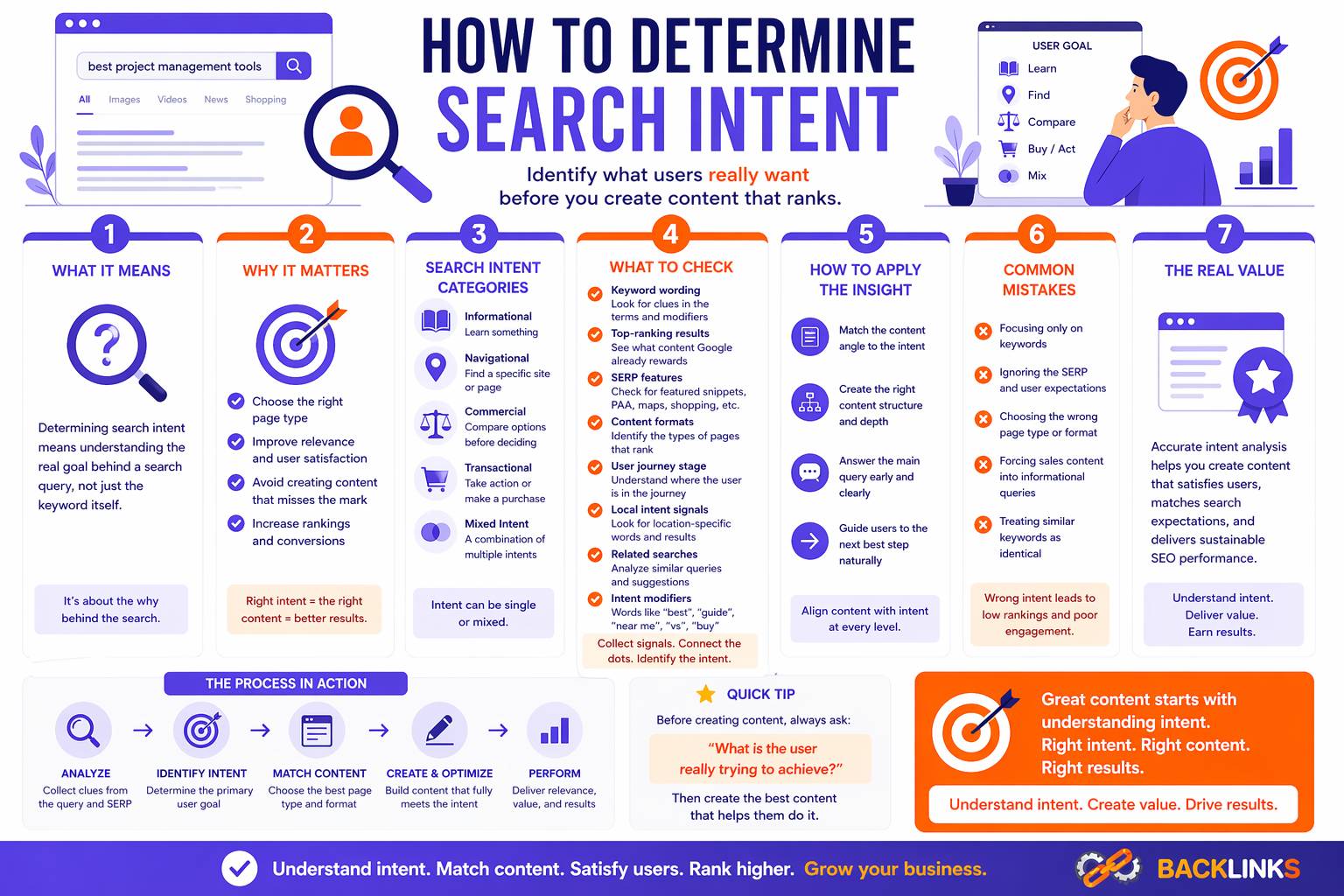
How to Determine Search Intent and Create Content That Matches User Needs
To determine search intent, you need to understand the reason behind a search query and what the user expects to find after clicking a result. Search intent is not just about the keyword itself. It is about the goal behind the keyword.
This matters because search engines aim to show results that satisfy users. A page can include the right keyword, have strong writing, and follow on-page SEO basics, but still underperform if it does not match the intent behind the search.
For example, someone searching “what is search intent” wants an explanation. Someone searching “best keyword research tools” wants options to compare. Someone searching “SEO agency near me” likely wants a service provider. These searches require different page types, even though they all relate to SEO.
This guide explains how to determine search intent accurately, what signals to review, and how to apply intent analysis when planning SEO content.
What Does It Mean to Determine Search Intent?
To determine search intent means identifying what a user wants to accomplish when they enter a query into a search engine.
The user may want to:
- Learn something
- Find a specific website
- Compare options
- Buy a product
- Hire a service
- Solve a problem
- Complete a task
In SEO, intent analysis helps you decide what kind of page should target a keyword. It also helps you understand what content structure, depth, tone, and call to action will best satisfy the searcher.
A keyword is not useful by itself unless you understand the need behind it. Two keywords can look similar but require different content.
For example:
- “search intent SEO” needs a broad educational explanation
- “how to determine search intent” needs a practical method
- “search intent tools” may need a list or comparison
- “SEO content strategy service” likely needs a service page
Determining intent helps prevent content mismatch.
Why Search Intent Matters
Search intent matters because search engines evaluate whether a result satisfies the user’s query. If your page does not meet the user’s expectation, it may struggle to rank or keep rankings over time.
It Helps You Choose the Right Page Type
The most common mistake in SEO content planning is creating the wrong type of page for a keyword.
If users want a step-by-step guide, a short definition may not be enough. If users want a product comparison, a general educational article may miss the point. If users want a service provider, a long informational article may not convert well.
Determining search intent helps you decide whether to create:
- An educational guide
- A tutorial
- A comparison article
- A product page
- A service page
- A location page
- A checklist
- A glossary-style definition
The page type should match what users are most likely looking for.
It Improves Content Relevance
A page becomes more relevant when it answers the searcher’s actual need.
For example, a page targeting “determine search intent” should not only define search intent. It should explain how to identify intent using keyword clues, search results, SERP features, content formats, and user journey signals.
This makes the content more useful and better aligned with the query.
It Prevents Wasted SEO Effort
Creating content takes time. If the page targets the right keyword but the wrong intent, much of that effort may be wasted.
Intent analysis helps reduce that risk before writing begins. It gives the content a clearer purpose and makes optimization more strategic.
The Main Types of Search Intent
Before you can determine search intent, you need to understand the main intent categories.
Informational Intent
Informational intent means the user wants to learn something.
Examples include:
- what is keyword research
- how to determine search intent
- why keyword research is important
- types of keywords
- search intent SEO
These queries usually require educational content such as guides, definitions, tutorials, examples, or explanations.
Navigational Intent
Navigational intent means the user wants to reach a specific website, brand, tool, or page.
Examples include:
- Google Search Console
- Semrush login
- Ahrefs keyword explorer
- Moz blog
For these searches, the user already has a destination in mind.
Commercial Intent
Commercial intent means the user is researching options before making a decision.
Examples include:
- best keyword research tools
- Ahrefs vs Semrush
- top SEO software
- best content optimization tools
These users may want comparisons, reviews, pros and cons, pricing details, or recommendations.
Transactional Intent
Transactional intent means the user is ready or close to ready to take action.
Examples include:
- hire SEO consultant
- buy keyword research report
- SEO audit service
- book SEO consultation
These queries are usually better suited to service pages, product pages, landing pages, or conversion-focused content.
Mixed Intent
Some keywords have mixed intent. This means different users searching the same phrase may want different things.
For example, “keyword research tools” could mean the user wants a list of tools, a free tool, a comparison, or a specific product page.
When intent is mixed, the search results become especially important. They show which type of content search engines currently consider most useful.
How to Determine Search Intent
Determining search intent requires a structured process. You should not rely on the keyword alone.
1. Study the Keyword Wording
The wording of a query often gives the first clue.
Informational keywords often include terms such as:
- what is
- how to
- why
- guide
- examples
- meaning
- tips
- tutorial
Commercial keywords often include:
- best
- top
- review
- comparison
- vs
- alternatives
Transactional keywords often include:
- buy
- hire
- service
- pricing
- quote
- book
- near me
Navigational keywords often include brand names, product names, or website names.
For example, “how to determine search intent” clearly suggests an informational and practical intent. The user wants a method, not just a definition.
2. Review the Search Results
The search results are one of the strongest intent signals.
Search engines have already tested and evaluated different types of pages for the query. The pages ranking at the top can reveal what users expect.
When reviewing results, ask:
- Are the top pages guides, service pages, tools, comparison posts, or product pages?
- Are they beginner-focused or advanced?
- Are they short explanations or detailed tutorials?
- Do they include examples, templates, screenshots, or lists?
- Are videos or visual results prominent?
- Are local results appearing?
If most results are educational guides, the intent is likely informational. If comparison articles dominate, commercial intent is likely stronger. If service pages or local results dominate, the query may have transactional or local intent.
3. Look at SERP Features
SERP features are special elements that appear in search results. They can reveal what kind of answer users want.
Common SERP features include:
- Featured snippets
- People Also Ask boxes
- Videos
- Image packs
- Local packs
- Shopping results
- Site links
- Knowledge panels
For example, a featured snippet often suggests that users want a quick answer. People Also Ask boxes suggest related informational questions. Local packs suggest geographic or service-based intent. Shopping results suggest transactional intent.
SERP features help you understand not only the topic, but also the format and immediacy of the user’s need.
4. Analyze the Ranking Page Formats
Look beyond the titles. Open the ranking pages and review how they are structured.
Pay attention to:
- The main heading
- Section headings
- Content depth
- Examples used
- Whether the page is educational or promotional
- Whether the page includes tools, checklists, or comparisons
- The type of call to action
If most ranking pages include step-by-step instructions, users probably expect a process. If most include product tables or comparison criteria, users likely want help evaluating options.
This helps you decide how your own page should be structured.
5. Identify the User’s Stage of Awareness
Search intent often connects to the user journey.
A user may be at one of several stages:
- Problem-aware: They know they have a problem but may not know the solution
- Solution-aware: They know the type of solution they need
- Product-aware: They are comparing providers, tools, or services
- Ready to act: They are prepared to buy, contact, or sign up
For example:
- “What is keyword research” is early-stage
- “How to do keyword research” is practical and educational
- “Best keyword research tools” is comparison-stage
- “Keyword research service” is closer to action
Understanding the user’s stage helps you decide how much context to provide and what next step is appropriate.
6. Check for Local Intent
Some searches have local intent, even if the query does not include a city name.
Examples include:
- SEO agency near me
- digital marketing consultant
- website design service
- local SEO expert
Search engines may show local map results when they believe users want nearby options.
If local results appear, the content strategy may require location-specific pages, local business information, reviews, service area details, or Google Business Profile optimization.
7. Compare Similar Keywords
Similar keywords may have different intent. Comparing them helps avoid mistakes.
For example:
- “search intent SEO” suggests a broad educational page
- “determine search intent” suggests a practical how-to page
- “search intent examples” suggests example-focused content
- “search intent tool” suggests software or tool-related content
These keywords should not always be treated the same. Each may require a different angle or page structure.
8. Look for Intent Modifiers
Intent modifiers are words that reveal what the searcher wants.
Examples include:
- “how” means the user likely wants instructions
- “best” means the user likely wants recommendations
- “near me” means the user likely wants local results
- “pricing” means the user may be evaluating cost
- “examples” means the user wants practical illustrations
- “template” means the user wants something usable
Modifiers are especially helpful when deciding whether a keyword belongs in an article, comparison page, service page, or resource page.
How to Apply Search Intent to SEO Content
Once you determine search intent, use that insight to shape the content.
Choose the Right Content Angle
The angle is the specific way you approach the topic.
For “determine search intent,” the best angle is practical and instructional. Users want to know how to identify intent accurately. A strong page should provide a clear process, examples, and common mistakes.
A purely theoretical article would be less useful.
Match the Heading Structure to the User’s Questions
Headings should reflect the questions users are likely asking.
For this topic, useful sections include:
- What does it mean to determine search intent?
- Why search intent matters
- Types of search intent
- How to determine search intent
- Common mistakes
- Practical guidance
This structure makes the content easier to scan and more aligned with informational intent.
Answer the Main Question Early
For informational content, answer the query early in the article.
Do not make users scroll through long background sections before explaining the core concept. A clear early answer improves usefulness and keeps the page focused.
Cover Supporting Questions
A complete page should also answer related questions that support the main topic.
For example:
- What are the four types of search intent?
- How do you know if intent is informational or commercial?
- Can one keyword have more than one intent?
- Why do search results matter when analyzing intent?
- How often should intent be reviewed?
These questions strengthen the page without drifting away from the main keyword.
Use Internal Links Naturally
Internal links should guide users to related topics.
A page about how to determine search intent may naturally link to articles about search intent SEO, keyword research, SEO keywords, types of keywords, long tail keywords, and using keywords in content.
These links help users continue learning and help search engines understand the relationship between related pages.
Common Mistakes When Determining Search Intent
Relying Only on the Keyword
The keyword gives clues, but it does not tell the full story.
Always check the search results before deciding intent. Search engines may interpret a keyword differently from how you first expect.
Ignoring Mixed Intent
Some queries serve more than one user need. If you ignore mixed intent, your content may feel incomplete.
In these cases, identify the dominant intent and decide whether your page should address secondary needs briefly.
Copying Competitors Without Improving the Content
Search results show what currently works, but your goal is not to copy competing pages.
Use competitor pages to understand expectations, then create content that is clearer, more useful, and better structured.
Using the Wrong Page Type
A common mistake is writing a blog post when users want a product page, or creating a service page when users want a guide.
Page type should always follow intent.
Treating Intent as Permanent
Search intent can change. Search results shift as users behave differently, competitors update content, and search engines refine their interpretation.
Important pages should be reviewed regularly.
Practical Guidance for Better Intent Analysis
Start with the keyword, but do not stop there. Read the wording, identify modifiers, and form an initial hypothesis about intent.
Then review the search results. Look at the dominant page types, SERP features, ranking formats, and content depth. This will either confirm or challenge your first assumption.
Next, decide what the user needs most. Are they learning, comparing, buying, navigating, or looking locally? Use that answer to choose the right page type and content structure.
Finally, create content that satisfies the primary intent clearly. Avoid adding unrelated sections just to make the page longer. Strong intent alignment is about usefulness, not volume.
Timing and Expectations
Determining search intent improves content planning immediately, but SEO performance still takes time.
After publishing or updating a page, search engines need time to crawl, index, and evaluate the content. Results depend on competition, content quality, website authority, internal links, backlinks, and technical SEO.
For existing pages, improving intent alignment can help explain why a page is underperforming. If the content targets the right keyword but uses the wrong format, restructuring the page may improve relevance.
For new pages, intent analysis gives the content a stronger foundation from the beginning.
Conclusion
Learning how to determine search intent is essential for effective SEO content planning. Keywords tell you what people search for, but intent tells you what they want.
By reviewing keyword wording, search results, SERP features, ranking page formats, user journey stage, and intent modifiers, you can create content that better matches user expectations.
The strongest SEO pages do not simply include the right keyword. They satisfy the right need in the right format.
When search intent guides your strategy, your content becomes more relevant, more useful, and more competitive in search results.