
Keyword Strategy: How to Choose and Use Keywords with Purpose
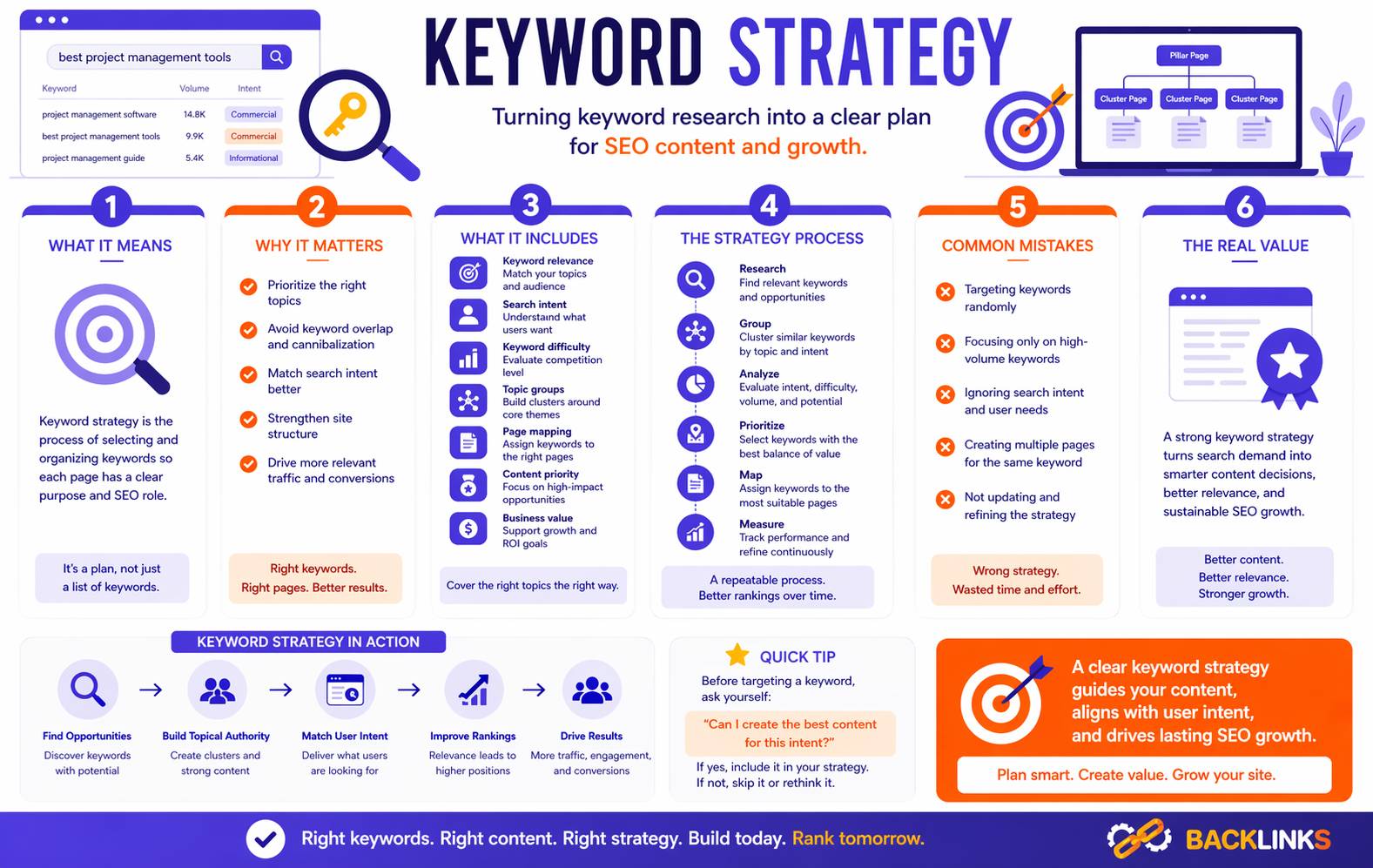
Keyword strategy is the process of choosing, organizing, and applying keywords in a way that supports clear SEO goals. It is not just about finding search terms with high volume. A strong keyword strategy connects audience demand, search intent, content planning, website structure, and long-term organic growth.
Many websites do keyword research but never turn it into a real strategy. They collect keywords, export lists from SEO tools, and choose topics based on volume. The result is often a disconnected content plan: some pages overlap, some target unrealistic keywords, and others attract traffic that does not support the business.
A good keyword strategy solves that problem. It helps you decide which keywords matter, which pages should target them, how topics should connect, and how your content can compete realistically in search results.
This article explains what keyword strategy is, why it matters, how it works, and how to build one that supports sustainable SEO performance.
What Is Keyword Strategy?
Keyword strategy is a structured plan for using keywords to guide SEO content creation and optimization.
It includes more than keyword research. Keyword research helps you discover and analyze search terms. Keyword strategy turns that research into decisions.
A keyword strategy answers questions such as:
- Which keywords should the website target?
- Which keywords are realistic to rank for?
- Which keywords support business goals?
- Which pages should be created or improved?
- Which keywords should be grouped together?
- How should pages connect through internal links?
- Which topics should be prioritized first?
In practical terms, keyword strategy is the bridge between search data and SEO execution.
Without strategy, keywords are just a list. With strategy, they become a roadmap for building relevant, useful, and competitive content.
Why Keyword Strategy Matters
Keyword strategy matters because SEO success depends on focus. A website cannot target every keyword at once, and not every keyword is worth targeting.
A clear strategy helps you use time and resources more effectively.
It Gives SEO Direction
SEO becomes easier to manage when every page has a clear purpose.
A keyword strategy helps define what each page should target and why. This prevents content teams from creating articles randomly or choosing topics based only on internal preference.
Instead of asking, “What should we write next?” a strong keyword strategy helps answer:
- Which topic has demand?
- Which intent should we serve?
- Which page type is needed?
- Which keyword supports our current goals?
- Which content gap should we close first?
This gives SEO a practical direction rather than relying on guesswork.
It Connects Keywords with Search Intent
A keyword only becomes useful when you understand the intent behind it.
For example:
- “What is keyword research” needs an educational explanation
- “How to do keyword research” needs a practical process
- “Keyword research tools” may need a comparison or tool-focused article
- “Keyword research service” may need a service page
A keyword strategy helps separate these intents so each page serves the right purpose.
This is important because using the right keyword on the wrong page type often leads to weak performance. Search engines want to rank pages that match what users expect to find.
It Prevents Keyword Cannibalization
Keyword cannibalization happens when multiple pages compete for the same or very similar search intent.
For example, a website may create separate articles for:
- “Keyword strategy”
- “SEO keyword strategy”
- “How to create a keyword strategy”
- “Keyword strategy for SEO”
If these pages answer the same question in similar ways, search engines may struggle to identify which page should rank. The pages may weaken each other instead of building authority.
A keyword strategy helps avoid this by mapping each keyword group to one clear page.
It Helps Prioritize SEO Opportunities
Not all keywords have the same value.
Some keywords have high search volume but are too broad or competitive. Others have lower volume but clearer intent and stronger relevance. Some keywords may support early-stage education, while others support conversions.
A good keyword strategy evaluates keywords based on:
- Search intent
- Relevance
- Competition
- Search volume
- Business value
- Content fit
- Current website authority
This helps you choose opportunities that are both useful and realistic.
It Supports Better Website Structure
Keyword strategy helps organize content into a logical structure.
Broad topics can be supported by more specific articles. Related pages can link to each other naturally. Each page can have a distinct role within the wider SEO plan.
For example, a website covering SEO may organize content around keyword research, SEO keywords, types of keywords, long tail keywords, search intent, and using keywords in content.
This creates a clearer learning path for users and helps search engines understand the relationship between related topics.
Core Elements of a Keyword Strategy
A strong keyword strategy includes several connected elements. Each one helps turn keyword data into practical SEO decisions.
Audience Understanding
Before choosing keywords, you need to understand who the content is for.
Different audiences search differently. A beginner may search “what are SEO keywords,” while an experienced marketer may search “keyword mapping for content strategy.” Both relate to keywords, but they require different content depth and language.
Audience understanding helps you choose keywords that match the reader’s knowledge level, problems, and goals.
Ask:
- Who are we trying to reach?
- What problems do they need to solve?
- What terms do they use?
- What stage of awareness are they in?
- What would make the content genuinely useful for them?
This prevents your strategy from being driven only by keyword tools.
Search Intent
Search intent is one of the most important parts of keyword strategy.
Every keyword should be reviewed based on what the user wants to accomplish. A keyword may be informational, commercial, transactional, navigational, or mixed.
Intent should guide:
- Page type
- Content depth
- Heading structure
- Examples
- Calls to action
- Internal links
For informational keywords, users usually want explanations, guides, examples, or tutorials. For commercial keywords, they may want comparisons. For transactional keywords, they may want pricing, services, or contact options.
A keyword strategy that ignores intent will often create mismatched content.
Keyword Relevance
A keyword may have search volume, but it still needs to be relevant to the website.
Relevance means the keyword connects to your audience, expertise, services, products, or content goals.
For example, a website focused on SEO may find digital marketing keywords with high volume. Some may be useful, but others may be too broad or unrelated to the site’s main authority.
Choosing relevant keywords helps attract visitors who are more likely to engage with the content and continue through the website.
Keyword Difficulty
Keyword difficulty helps estimate how hard it may be to rank for a keyword.
However, difficulty scores should not be followed blindly. They are useful indicators, but they cannot fully judge content quality, topical relevance, internal links, or the actual weakness of competing pages.
A strong keyword strategy considers:
- How strong the ranking pages are
- Whether the current results are useful
- Whether your site can create something better
- Whether internal links can support the page
- Whether the keyword is realistic for your website stage
Competitive keywords may still be worth targeting, but they may require a longer timeline.
Search Volume
Search volume shows how often people search for a keyword. It is useful, but it should not be the only priority.
High-volume keywords can be attractive, but they are often broad and competitive. Lower-volume keywords may have clearer intent and stronger relevance.
A good keyword strategy balances search volume with intent and business value.
The goal is not only to get more traffic. The goal is to attract traffic that matters.
Business Value
Business value refers to how closely a keyword supports your goals.
Some keywords bring early-stage visitors who are learning. Others bring users who are closer to taking action. Both can be useful, but they serve different roles.
For example:
- “What is keyword research” builds awareness
- “How to do keyword research” supports practical learning
- “Keyword research tools” supports comparison
- “Keyword research service” supports conversion
A balanced keyword strategy includes keywords across different stages, but prioritization should reflect your business objectives.
How to Build a Keyword Strategy
Building a keyword strategy requires a step-by-step approach. The goal is to move from broad research to clear content decisions.
1. Define Your SEO Goals
Start by clarifying what the keyword strategy should achieve.
Common SEO goals include:
- Increasing organic traffic
- Building authority around a topic
- Supporting lead generation
- Improving rankings for important services
- Expanding visibility for educational content
- Improving existing content performance
Different goals require different keyword choices.
If your goal is awareness, informational keywords may be important. If your goal is inquiries, commercial and transactional keywords may need more focus.
2. Identify Core Topics
Core topics are the main areas your website should be known for.
For an SEO website, core topics may include:
- Keyword research
- On-page SEO
- Content optimization
- Internal linking
- Link building
- Technical SEO
- SEO strategy
These topics become the foundation of your keyword strategy. They help ensure that individual keyword choices support a larger direction.
3. Collect Keyword Ideas
Next, gather keyword ideas around each core topic.
Sources may include:
- Keyword research tools
- Search suggestions
- People Also Ask questions
- Competitor pages
- Existing Google Search Console data
- Customer questions
- Sales conversations
- Website search data
For a topic like keyword strategy, related keyword ideas may include:
- SEO keyword strategy
- how to create a keyword strategy
- keyword strategy for SEO
- keyword mapping
- keyword targeting
- keyword planning
- keyword prioritization
At this stage, the goal is discovery. Evaluation comes later.
4. Analyze Search Intent
Once you have keyword ideas, classify them by intent.
Ask what the user likely wants:
- A definition?
- A step-by-step guide?
- A comparison?
- A tool?
- A service?
- A template?
- A local provider?
Then review the search results to confirm. The ranking pages often reveal what type of content users expect.
Intent analysis helps prevent the mistake of creating the wrong page for the keyword.
5. Group Keywords by Topic and Intent
After analyzing intent, group related keywords together.
Keywords that share the same intent can usually be targeted by one strong page. Keywords with different intent may need separate pages.
For example, these could likely belong together:
- keyword strategy
- SEO keyword strategy
- keyword strategy for SEO
- what is keyword strategy
But these may need different pages:
- keyword strategy tools
- keyword mapping template
- keyword research service
- how to do keyword research
Grouping keywords correctly helps avoid duplicate content and keeps each page focused.
6. Choose a Primary Keyword for Each Page
Each important page should have one clear primary keyword.
The primary keyword represents the main topic of the page. It should guide the title, introduction, headings, and overall angle.
For this article, the primary keyword is “Keyword strategy.”
Supporting terms can be used throughout the page, but they should not distract from the main topic.
7. Assign Secondary Keywords
Secondary keywords help support the primary keyword.
For a page about keyword strategy, secondary keyword ideas may include:
- SEO keyword strategy
- keyword planning
- keyword targeting
- keyword mapping
- keyword prioritization
- search intent
- keyword research strategy
These terms should be used naturally where they add context.
Secondary keywords help search engines understand the topic more fully and can help the page rank for related queries.
8. Map Keywords to Existing and New Pages
Keyword mapping connects keywords to specific URLs.
Some keywords may fit existing pages that need improvement. Others may require new pages.
A keyword map may include:
- Primary keyword
- Secondary keywords
- Search intent
- Current URL or new URL
- Recommended page type
- Priority level
- Internal link opportunities
This turns keyword research into an actionable content plan.
9. Prioritize Based on Opportunity
Once keywords are mapped, decide what to work on first.
Good prioritization considers:
- Relevance
- Search intent clarity
- Competition
- Business value
- Content gaps
- Existing rankings
- Internal link support
- Required effort
A keyword with moderate volume and strong relevance may be more valuable than a high-volume keyword with weak intent fit.
For newer websites, specific long tail keywords are often more realistic. For established websites, broader terms may become more achievable.
10. Plan Internal Links
Internal linking should be part of keyword strategy from the beginning.
Related pages should connect naturally. This helps users move between topics and helps search engines understand content relationships.
For example, a page about keyword strategy may link to articles about keyword research, SEO keywords, types of keywords, long tail keywords, search intent SEO, and how to determine search intent.
Internal links should use descriptive anchor text. Avoid repeating the exact same anchor every time.
Applying Keyword Strategy to Content Creation
Keyword strategy should guide how content is planned, written, and optimized.
Create Content for One Main Intent
Each page should focus on one primary intent.
A page targeting “keyword strategy” should explain what keyword strategy is and how to build one. It should not turn into a general guide covering every part of SEO in equal depth.
Related topics can be mentioned and linked, but the page should stay focused.
Build the Structure Before Writing
Before drafting content, create a heading structure based on the keyword and user intent.
For a keyword strategy page, useful sections include:
- What keyword strategy means
- Why it matters
- Core elements
- How to build a strategy
- Common mistakes
- Practical guidance
This makes the article easier to write and easier for readers to follow.
Use Keywords Naturally
A keyword strategy should not lead to keyword stuffing.
Use the primary keyword in important areas such as the title, introduction, H1, and relevant headings. Use secondary keywords naturally in the body where they improve clarity.
The content should sound like expert guidance, not a list of repeated phrases.
Address Related Questions
A strong page should answer questions that naturally support the main topic.
For keyword strategy, related questions may include:
- What is the difference between keyword research and keyword strategy?
- How do you choose keyword priorities?
- How many keywords should one page target?
- How do you avoid keyword cannibalization?
- How often should keyword strategy be updated?
Answering these questions improves usefulness and topic coverage.
Connect Strategy with Content Updates
Keyword strategy is not only for new content. It is also useful for improving existing pages.
Existing pages may need:
- Better keyword targeting
- Updated headings
- Stronger internal links
- Clearer intent alignment
- Expanded sections
- Consolidation with overlapping pages
- Improved metadata
Updating existing content can sometimes create faster gains than publishing new content because the page already has history, impressions, or rankings.
Common Keyword Strategy Mistakes
Choosing Keywords Based Only on Volume
Search volume is useful, but it can be misleading.
A keyword with high volume may be too broad, too competitive, or poorly aligned with your audience. A lower-volume keyword may attract more qualified visitors.
Prioritize relevance and intent before volume.
Ignoring Search Intent
Intent mismatch is one of the most common SEO problems.
If users want a guide and you give them a service page, the content may not perform. If users want a comparison and you give them a definition, the page may fail to satisfy the query.
Intent should guide every keyword decision.
Targeting Too Many Keywords on One Page
A page can rank for many related keywords, but it should not target many unrelated intents.
Trying to cover too many different keyword goals on one page often creates unfocused content.
Keep each page centered on one main topic and one primary intent.
Creating Multiple Pages for the Same Intent
Publishing too many similar pages can create overlap.
For example, if several articles all explain “how to create a keyword strategy,” they may compete with each other.
A better approach is to consolidate similar intent into one strong page and use related pages only when the search intent is distinct.
Forgetting Internal Links
A keyword strategy without internal links is incomplete.
Internal links help distribute authority, guide users, and show relationships between pages. They are especially important when building visibility across related SEO topics.
Not Updating the Strategy
Keyword strategy should evolve.
Search behavior changes. Competitors update content. Your website gains authority. New opportunities appear. Old content may become outdated.
Reviewing the strategy regularly helps keep SEO focused and competitive.
Practical Guidance for a Strong Keyword Strategy
Start with the audience and business goals before looking at keyword tools. This ensures that the strategy is grounded in relevance, not just search volume.
Use keyword research to discover opportunities, but use judgment to choose priorities. A good keyword should have a clear purpose, match user intent, and fit your website’s authority level.
Group related keywords carefully. If terms share the same meaning and intent, target them with one strong page. If they represent different needs, create separate content.
Build pages that serve users first. Use keywords to clarify the topic, structure the content, and connect related pages. Avoid forcing exact-match phrases where they do not sound natural.
Finally, treat keyword strategy as an ongoing process. Monitor rankings, impressions, clicks, engagement, and conversions. Use that data to refine content and improve future decisions.
Timing and Expectations
A keyword strategy can improve SEO planning immediately, but ranking results take time.
After new content is published or existing content is updated, search engines need time to crawl, index, and evaluate the page. Performance depends on competition, content quality, website authority, internal links, backlinks, and technical SEO.
For newer websites, results may come first from specific, lower-competition keywords. For established websites, broader opportunities may become more realistic.
The best results usually come from consistent execution. A keyword strategy is not a one-time document. It should guide ongoing content creation, content updates, internal linking, and performance reviews.
Conclusion
Keyword strategy is essential because it turns keyword research into clear SEO action. It helps you choose the right keywords, match search intent, prioritize opportunities, avoid content overlap, and build a more organized website.
A strong strategy does not chase every keyword with search volume. It focuses on the terms that are relevant, realistic, and useful for the audience.
When keyword strategy guides your content planning, every page has a clearer purpose. Your content becomes easier for users to navigate and easier for search engines to understand.
Over time, this creates a stronger foundation for sustainable organic growth.