
Keyword Mapping: How to Organize Keywords into a Clear SEO Content Plan
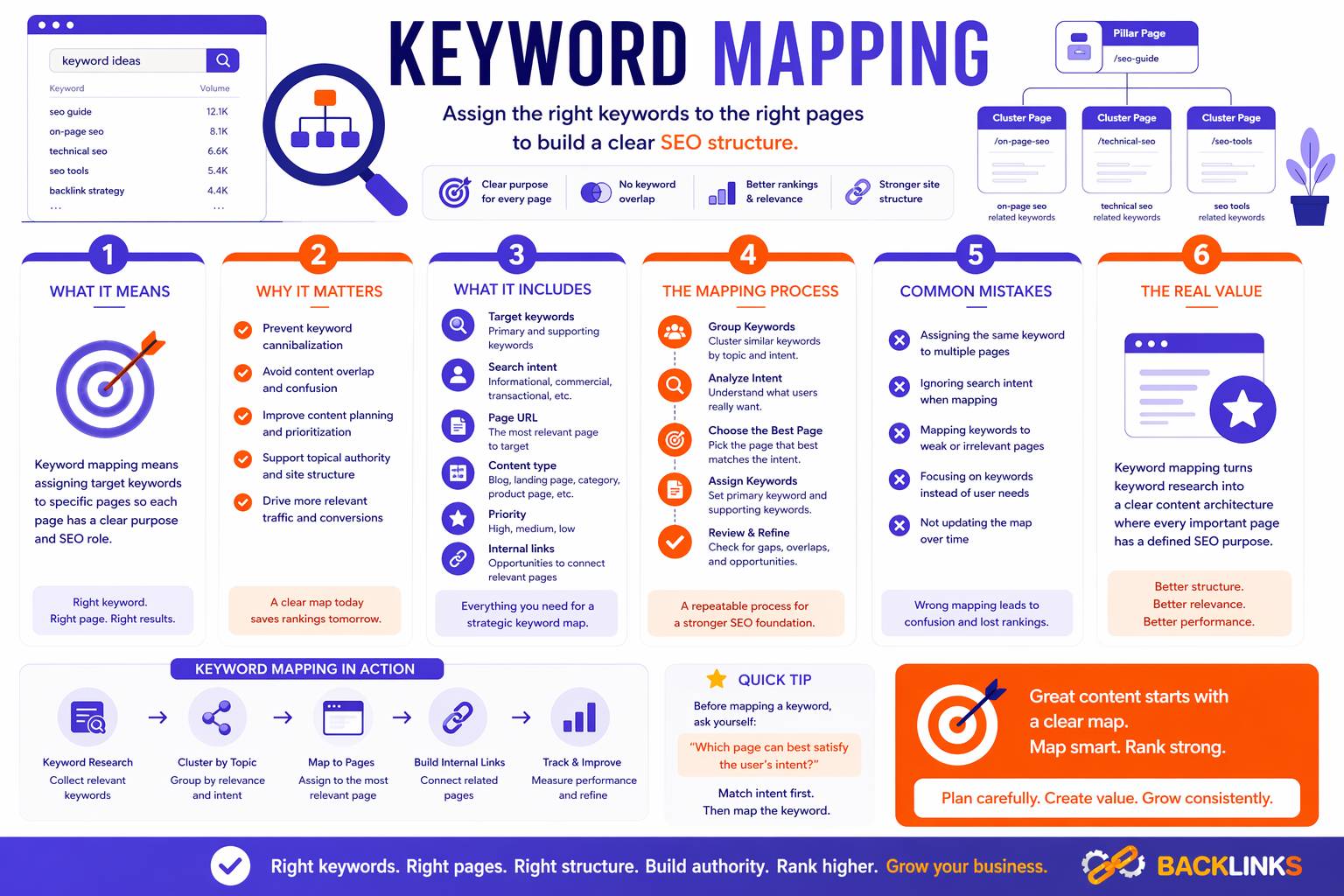
Keyword mapping is the process of assigning target keywords to specific pages on your website so each page has a clear SEO purpose. It helps you decide which keyword belongs on which URL, which pages need to be created, which existing pages should be improved, and how related content should connect.
Many websites do keyword research but stop too early. They collect keywords, sort them by search volume, and choose topics to write about, but they do not clearly map those keywords to actual pages. This often leads to overlapping content, missed opportunities, weak internal linking, and confusion about which page should rank for which query.
Keyword mapping solves that problem by turning keyword research into a practical content structure. It helps every important page target a clear topic, match search intent, and support the wider SEO strategy.
This article explains what keyword mapping is, why it matters, how it works, and how to create a useful keyword map for SEO.
What Is Keyword Mapping?
Keyword mapping is the process of matching keywords to specific pages or planned pages on a website.
A keyword map usually shows:
- The primary keyword for each page
- Supporting keywords
- Search intent
- Page type
- Current or planned URL
- Internal link opportunities
- Priority level
- Content status
In simple terms, keyword mapping answers this question:
Which page should target this keyword?
For example, if your keyword research includes terms such as “keyword research,” “what is keyword research,” “keyword strategy,” and “keyword mapping,” each keyword needs a clear destination.
Some keywords may belong on existing pages. Others may need new pages. Some keyword variations may be grouped together because they share the same intent. Others should be separated because they require different content.
Keyword mapping helps make those decisions before content is written or updated.
Why Keyword Mapping Matters
Keyword mapping matters because SEO works better when each page has a distinct purpose.
Without a keyword map, websites often publish content inconsistently. Multiple pages may target similar keywords, while important topics may be missing entirely. Over time, this can weaken organic performance.
It Prevents Keyword Cannibalization
Keyword cannibalization happens when multiple pages compete for the same or very similar search intent.
For example, a website might have separate articles targeting:
- keyword mapping
- SEO keyword mapping
- keyword mapping strategy
- how to map keywords
If all of these pages cover the same idea in a similar way, search engines may struggle to decide which one should rank. Instead of strengthening the topic, the pages may compete with each other.
Keyword mapping helps prevent this by assigning one main keyword group to one clear page.
It Gives Every Page a Clear Purpose
Each SEO page should have a clear role.
A page about “keyword mapping” should explain what keyword mapping is and how to do it. A page about “keyword strategy” should focus on choosing and prioritizing keywords. A page about “how to do keyword research” should explain the research process.
These topics are related, but they are not identical.
Keyword mapping helps define the boundaries between pages so each one stays focused. This improves both readability and search relevance.
It Improves Website Structure
Keyword mapping helps organize content logically.
When keywords are mapped properly, broad topics can be supported by more specific pages. Related pages can be linked naturally. Users can move from general concepts to deeper guidance without feeling lost.
For example, a website covering SEO may connect pages about:
- Keyword research
- SEO keywords
- Types of keywords
- Long tail keywords
- Search intent SEO
- Keyword strategy
- Keyword mapping
- Using keywords in content
Each page serves a different need, but together they create stronger topic coverage.
It Supports Better Internal Linking
Internal links are easier to plan when you know which pages are connected by topic.
A keyword map can show which pages should link to each other and what anchor text may be appropriate. This helps distribute authority across the site and makes it easier for search engines to understand relationships between pages.
For example, a page about keyword mapping may naturally link to keyword research, keyword strategy, search intent, and using keywords in content.
It Helps Prioritize Content Work
Keyword mapping also helps decide what to work on first.
A keyword map can show:
- Which important keywords already have pages
- Which pages need optimization
- Which topics are missing
- Which pages overlap
- Which URLs should be consolidated
- Which content has the highest strategic value
This makes SEO planning more efficient and less reactive.
How Keyword Mapping Works
Keyword mapping turns keyword research into a structured content plan. The process usually begins with a keyword list and ends with a page-by-page roadmap.
Start with Keyword Research
Before you can map keywords, you need keyword data.
This includes:
- Primary keywords
- Secondary keywords
- Long tail keywords
- Search volume
- Keyword difficulty
- Search intent
- Related questions
- Competitor keywords
Keyword mapping depends on the quality of the research. If the keyword list is too shallow, the map will miss important opportunities. If the list is too broad and unfiltered, the map may become confusing.
Start with keywords that are relevant to your audience, business goals, and content strategy.
Group Keywords by Intent
The next step is grouping keywords by search intent.
Search intent tells you what the user wants to accomplish. It may be informational, commercial, transactional, navigational, or mixed.
For example:
- “What is keyword mapping” has informational intent
- “How to create a keyword map” has instructional intent
- “Keyword mapping template” may suggest the user wants a usable resource
- “Keyword mapping service” has stronger transactional intent
These keywords are related, but they may not all belong on the same page.
Grouping by intent helps you avoid combining keywords that require different content formats.
Choose a Primary Keyword for Each Page
Each important page should have one primary keyword.
The primary keyword defines the main topic of the page. It should guide the H1, title tag, introduction, heading structure, and overall angle.
For this article, the primary keyword is “Keyword mapping.”
A page can rank for many related terms, but it should still have one clear primary focus. Without that focus, the content may become too broad or unclear.
Assign Secondary Keywords
Secondary keywords support the primary keyword. They help expand the topic and make the content more complete.
For a page about keyword mapping, secondary keyword ideas may include:
- SEO keyword mapping
- keyword map
- keyword mapping process
- keyword mapping strategy
- keyword-to-page mapping
- keyword grouping
- keyword cannibalization
- content mapping
These should be used naturally where they add value. They should not be forced into the content just for keyword coverage.
Match Keywords to Existing Pages
Once keywords are grouped, check whether your website already has pages that can target them.
For each keyword group, ask:
- Is there already a relevant page?
- Does that page match the search intent?
- Is the page strong enough to compete?
- Does the content need updating?
- Is another page targeting the same keyword?
- Should the page be expanded, merged, or redirected?
This step is especially important for established websites. Often, improving an existing page is more efficient than creating a new one.
Identify New Page Opportunities
Some keyword groups will not have a suitable existing page. These become new content opportunities.
For example, if your site has a main page about keyword research but no dedicated page about keyword mapping, creating a focused article may make sense.
New pages should only be created when the keyword group has a distinct intent. Avoid creating separate pages for minor wording differences if the user expectation is the same.
Define Internal Link Relationships
Keyword mapping should include internal linking opportunities.
For each page, identify:
- Parent or broader related pages
- More specific supporting pages
- Related articles
- Service or conversion pages where relevant
- Natural anchor text options
For example, a page about keyword mapping may link to:
- Keyword research
- Keyword strategy
- SEO keywords
- Search intent SEO
- Using keywords in content
Internal links should feel helpful to the reader, not forced.
Important Elements of a Keyword Map
A keyword map can be simple or detailed depending on the size of the website. For most SEO projects, the following elements are useful.
Target URL
The target URL shows where the keyword group will be assigned.
This may be an existing URL or a planned new URL.
For example:
- /keyword-research/
- /keyword-strategy/
- /keyword-mapping/
- /search-intent-seo/
Keeping URLs organized helps content teams understand where each topic belongs.
Primary Keyword
The primary keyword is the main target for the page.
For a keyword mapping article, the primary keyword is “Keyword mapping.” This should appear naturally in key areas such as the H1, introduction, title tag, and body content.
Secondary Keywords
Secondary keywords are related terms that support the page.
They help guide subtopics and improve relevance. However, they should not turn the page into an unfocused article.
Search Intent
Search intent should be included in the keyword map because it determines the content format.
For “keyword mapping,” the intent is informational. Users want to understand what it is, why it matters, and how to do it.
For “keyword mapping template,” the intent may be more resource-focused. Users may expect a downloadable or usable format.
Page Type
The keyword map should identify what type of page is needed.
Examples include:
- Educational article
- Step-by-step guide
- Comparison page
- Service page
- Product page
- Resource page
- Location page
Choosing the right page type is essential for matching intent.
Content Status
A keyword map should show whether the page is:
- Existing
- Planned
- Needs updating
- Needs consolidation
- Needs redirecting
- Published
- Under review
This makes the map useful for ongoing content management.
Priority
Not all pages should be worked on at the same time.
Priority can be based on:
- Business relevance
- Search demand
- Ranking potential
- Content gap importance
- Current performance
- Conversion value
- Internal linking value
A keyword map should help teams decide what to handle first.
How to Create a Keyword Map
Creating a keyword map requires both analysis and judgment. The goal is not to build a complicated spreadsheet. The goal is to make clear SEO decisions.
1. Collect Your Keyword Data
Start with a list of relevant keywords.
Use sources such as:
- Keyword research tools
- Google Search Console
- Search suggestions
- People Also Ask results
- Competitor analysis
- Existing website rankings
- Customer questions
- Sales and support conversations
Include search volume, difficulty, and intent where available.
2. Clean and Organize the List
Remove keywords that are irrelevant, duplicated, or too far from your business goals.
Then group similar phrases together.
For example, these may belong together:
- keyword mapping
- SEO keyword mapping
- what is keyword mapping
- keyword mapping process
These may require separate decisions:
- keyword mapping template
- keyword mapping tool
- keyword mapping service
Cleaning the list makes the map easier to use.
3. Analyze Search Intent
For each keyword group, identify the dominant intent.
Do not rely only on the wording. Review the search results to see what type of content ranks.
Ask:
- Do users want a definition?
- Do they want a process?
- Do they want a tool?
- Do they want a service?
- Do they want a template?
- Do they want examples?
This step prevents mismatched content.
4. Group Keywords into Page Topics
After intent analysis, group keywords into page topics.
A page topic is a set of keywords that can be answered by one page.
For example, one page could target:
- keyword mapping
- SEO keyword mapping
- keyword mapping process
- keyword-to-page mapping
But a separate page may be needed for:
- keyword mapping template
This is because users searching for a template may expect a practical resource rather than only an explanation.
5. Match Groups to Existing URLs
Review your current website and assign keyword groups to relevant existing pages where possible.
If an existing page already matches the topic and intent, update it rather than creating a duplicate page.
If the page only partially matches, decide whether to expand it or create a new page.
6. Identify Content Gaps
Content gaps are important keyword groups that do not have a suitable page.
These gaps become future content opportunities.
For example, if your site covers keyword research and search intent but does not explain keyword mapping, this page fills a logical gap.
7. Resolve Overlapping Pages
If multiple pages target the same intent, decide which page should be the main one.
You may need to:
- Merge similar pages
- Redirect outdated pages
- Rewrite pages to target different intents
- Adjust internal links
- Update titles and headings
This helps reduce keyword cannibalization and strengthens the preferred page.
8. Plan Internal Links
Once each keyword group has a target page, plan internal links.
A keyword map can show where links should be added and which anchor text variations make sense.
For example:
- From “Keyword research” to “Keyword mapping”
- From “Keyword strategy” to “Keyword mapping”
- From “Search intent SEO” to “Keyword mapping”
- From “Using keywords in content” to “Keyword mapping”
This creates a stronger and more connected content structure.
9. Use the Map During Content Creation
A keyword map should guide writers and editors.
Before writing, the content brief should include:
- Primary keyword
- Secondary keywords
- Search intent
- Target audience
- Page purpose
- Suggested headings
- Internal links
- Related pages to avoid overlapping
This helps the content stay focused.
10. Update the Map Over Time
Keyword mapping is not a one-time task.
As your website grows, you should update the map when:
- New content is published
- Existing pages are optimized
- Search intent changes
- New keyword opportunities appear
- Pages begin competing with each other
- Old content becomes outdated
- Rankings shift
A keyword map becomes more valuable when it is maintained.
Keyword Mapping Example
Here is a simple conceptual example.
A website about SEO may have these keyword groups:
“Keyword research” should belong to a broad educational page explaining the full process.
“What is keyword research” should belong to a focused informational page that defines the concept clearly.
“Why keyword research is important” should belong to a focused page explaining the value and benefits.
“Keyword strategy” should belong to a page about choosing, prioritizing, and organizing keywords.
“Keyword mapping” should belong to a page about assigning keywords to URLs and planning content structure.
“Using keywords in content” should belong to a page about applying keywords naturally in headings, copy, metadata, and internal links.
Each page is related, but each has a different purpose. Keyword mapping helps keep those purposes clear.
Common Keyword Mapping Mistakes
Mapping One Keyword per Page Too Rigidly
A page should usually have one primary keyword, but that does not mean it should target only one keyword.
A strong page can rank for many related terms. Mapping should group keywords by topic and intent, not isolate every variation.
Ignoring Search Intent
Keyword mapping fails when keywords are grouped only by wording.
For example, “keyword mapping” and “keyword mapping service” both include similar words, but they have different intent. One is informational. The other may be transactional.
Intent should guide page assignments.
Creating Too Many Similar Pages
Some websites create separate pages for small keyword differences. This can produce thin content and internal competition.
If keywords share the same meaning and intent, they usually belong on one strong page.
Forgetting Existing Content
Keyword mapping should not focus only on new content.
Existing pages may already have authority, rankings, and backlinks. Updating or repositioning them can be more effective than creating new pages from scratch.
Not Planning Internal Links
A keyword map without internal linking guidance is incomplete.
Internal links help connect related pages and support SEO performance. They should be planned alongside keyword assignments.
Not Updating the Map
A keyword map becomes outdated if it is not maintained.
As search behavior changes and new content is added, the map should be reviewed and refined.
Practical Guidance for Better Keyword Mapping
Start simple. A keyword map does not need to be overly complex to be useful. For many websites, a clear spreadsheet with keywords, URLs, intent, page type, and priority is enough.
Focus on intent before volume. A keyword with high search volume is not useful if it is assigned to the wrong page type.
Group related keywords together. Avoid creating separate pages for every variation unless the intent is clearly different.
Review existing pages before planning new ones. You may find that an older page can be updated to target the keyword more effectively.
Use keyword mapping to guide internal linking. Each mapped page should have logical connections to related content.
Finally, treat keyword mapping as part of ongoing SEO management. It should support content planning, optimization, consolidation, and performance reviews.
Timing and Expectations
Keyword mapping can improve SEO planning immediately because it clarifies what each page should target. However, ranking improvements take time.
After pages are created, updated, consolidated, or internally linked, search engines need time to crawl and reassess them. Performance depends on content quality, competition, website authority, internal links, backlinks, and technical SEO.
For newer websites, keyword mapping helps focus effort on realistic opportunities. For established websites, it can uncover overlap, missed keywords, and content gaps that may be limiting performance.
The value of keyword mapping grows over time because it keeps your content strategy organized as the site expands.
Conclusion
Keyword mapping is essential because it turns keyword research into a clear SEO content plan. It shows which keywords belong on which pages, which pages need to be created or improved, and how related content should connect.
A strong keyword map helps prevent cannibalization, improve website structure, guide internal linking, and make content planning more strategic.
The goal is not to create a complicated document. The goal is to give every important page a clear purpose.
When keyword mapping is done well, your website becomes easier for users to navigate and easier for search engines to understand. Over time, that clarity supports stronger organic visibility and more sustainable SEO growth.