
Keyword Search Volume: What It Means and How to Use It in SEO
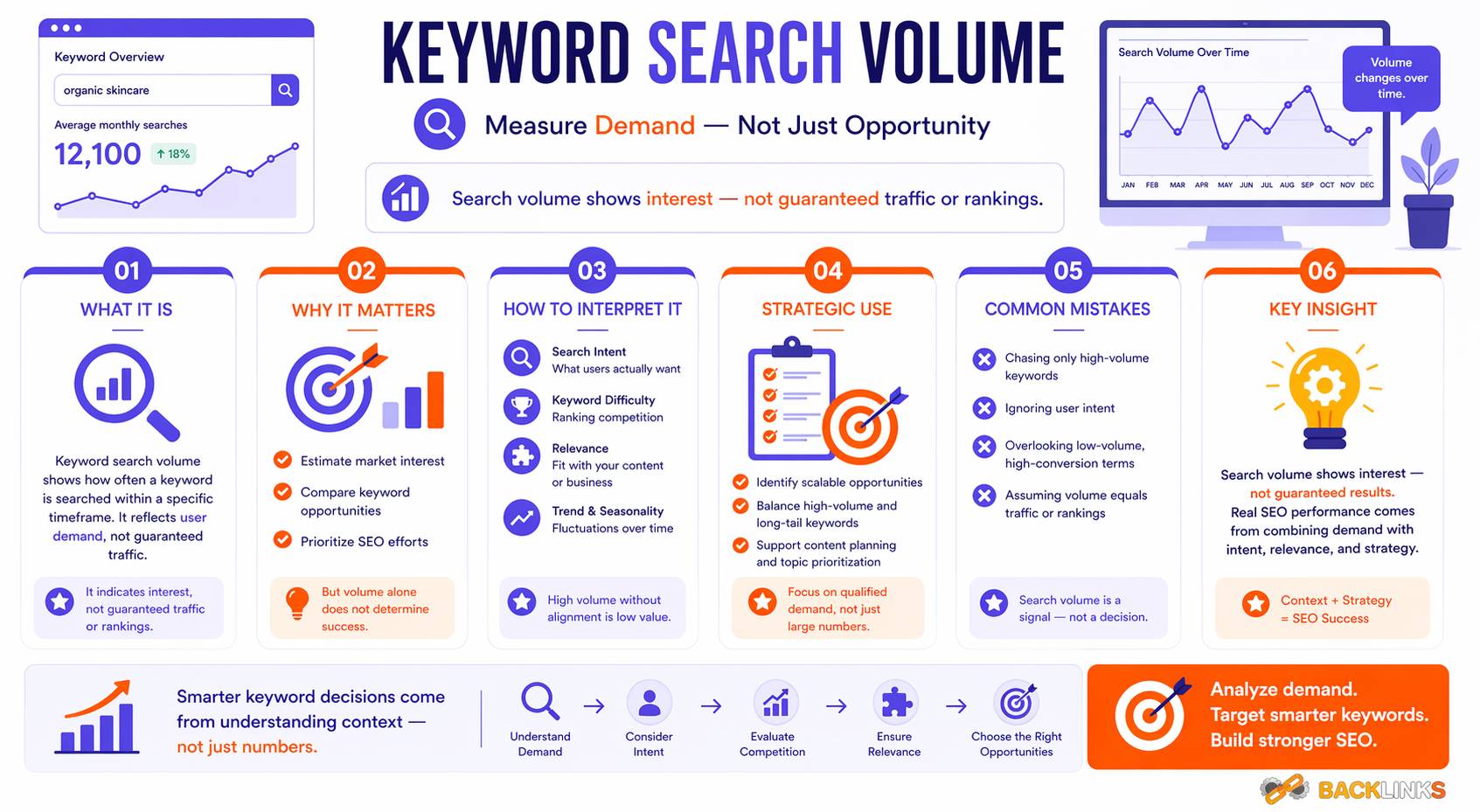
Keyword search volume is the estimated number of times a keyword is searched within a specific period, usually measured monthly. In SEO, it helps you understand how much demand exists for a search term and whether a topic may be worth targeting with content.
Search volume is one of the most commonly used keyword metrics, but it is also one of the most misunderstood. Many websites choose keywords mainly because they have high search volume. That can be risky. A high-volume keyword may be too broad, too competitive, or poorly aligned with your audience. A lower-volume keyword may attract fewer searches but bring more relevant visitors with clearer intent.
Keyword search volume should guide SEO decisions, not control them. It works best when combined with search intent, keyword difficulty, business relevance, content quality, and realistic ranking potential.
This article explains what keyword search volume means, why it matters, how it is measured, and how to use it correctly when planning SEO content.
What Is Keyword Search Volume?
Keyword search volume is an estimate of how often people search for a specific keyword in a search engine over a defined period.
Most SEO tools show search volume as an average number of monthly searches. For example, a keyword may be listed as having 1,000 monthly searches, meaning the tool estimates that users search for that term around 1,000 times per month.
However, search volume is not exact. Different tools may show different numbers because they use different data sources, estimation methods, locations, and update schedules.
Search volume can vary based on:
- Country or region
- Language
- Search engine
- Seasonality
- Trends
- Device behavior
- Tool database size
- Data freshness
For this reason, keyword search volume should be treated as a directional metric. It helps compare relative demand between keywords, but it should not be viewed as a guaranteed traffic number.
Why Keyword Search Volume Matters
Keyword search volume matters because it helps you understand demand. Before creating content, you need to know whether people are actually searching for the topic and how much interest exists.
It Helps Estimate Search Demand
Search volume gives you a rough idea of how often users search for a keyword.
For example, if one keyword has significantly more search volume than another closely related term, that may influence which phrase you use as the primary keyword.
However, search demand should always be interpreted with context. A keyword with more searches is not automatically better. It must still match your audience, intent, and SEO goals.
It Helps Prioritize Content Topics
SEO teams often have more keyword ideas than they can produce immediately. Search volume can help prioritize which topics may deserve attention first.
For example, if several keywords have similar relevance and competition levels, the one with stronger search demand may be a better initial priority.
Search volume becomes more useful when combined with other factors such as:
- Search intent
- Keyword difficulty
- Business value
- Existing content gaps
- Internal link opportunities
- Ranking potential
Used this way, search volume helps support better content planning.
It Helps Compare Keyword Variations
Different people may search for the same idea using different wording.
For example:
- keyword search volume
- search volume keywords
- monthly keyword searches
- keyword volume
- SEO search volume
These phrases may be related, but one may have stronger demand or clearer intent than the others.
Search volume helps you choose the most useful primary keyword while still covering natural variations in the content.
It Helps Identify Long-Tail Opportunities
Long-tail keywords often have lower individual search volume, but they can be highly valuable because they show specific intent.
For example:
- how to check keyword search volume
- what is a good keyword search volume
- keyword search volume for SEO
- high volume vs low volume keywords
These keywords may not have large numbers individually, but together they can support meaningful traffic and strong topic coverage.
It Helps Forecast Potential Traffic
Search volume can help estimate potential traffic, but it should be used carefully.
A keyword with 10,000 monthly searches does not mean your page will receive 10,000 visits. Actual traffic depends on ranking position, click-through rate, SERP features, search intent, competing results, and how many users click organic listings.
Search volume is a starting point for forecasting, not a traffic guarantee.
How Keyword Search Volume Works
Keyword search volume is usually calculated by keyword tools using search data, clickstream data, advertising data, historical trends, and estimation models.
The exact method varies by tool, which is why numbers can differ across platforms.
Monthly Average Search Volume
Most keyword tools report average monthly search volume.
This means the tool estimates how many times a keyword is searched per month, often based on historical data over a period such as the past 12 months.
This is useful for comparing demand, but it can hide seasonal changes.
For example, a keyword may average 5,000 searches per month but receive most of those searches during a specific season. If you only look at the average, you may miss timing patterns.
Location-Based Search Volume
Search volume changes by location.
A keyword may have high volume globally but low volume in your target country. Another keyword may be small globally but valuable in a specific market.
For businesses targeting Thailand, the United States, the United Kingdom, or any other defined market, location settings matter. Always review keyword search volume for the region you actually want to reach.
Language-Based Search Volume
Language affects keyword demand.
Users in different markets may search for the same topic in different languages or with different phrasing. Even within English, search behavior can vary between countries.
If your website targets a specific language audience, keyword research should reflect that audience’s language and search habits.
Seasonal Search Volume
Some keywords have seasonal demand.
Examples include searches related to holidays, events, tax deadlines, school terms, travel seasons, or annual planning.
For seasonal keywords, average monthly search volume may not tell the full story. You need to understand when the keyword peaks and plan content early enough for search engines to crawl, index, and evaluate the page.
Trending Search Volume
Some keywords rise quickly due to news, technology changes, social media attention, product launches, or industry shifts.
Trending keywords may create short-term opportunities, but they can also decline quickly. Before prioritizing a trend, consider whether the topic has long-term value or only temporary interest.
High Search Volume vs Low Search Volume Keywords
Both high-volume and low-volume keywords can be useful. The right choice depends on your goals, website authority, and search intent.
High Search Volume Keywords
High search volume keywords receive many searches.
Examples may include broad terms such as:
- SEO
- keywords
- keyword research
- digital marketing
- content marketing
These keywords can offer large traffic potential, but they often come with challenges.
High-volume keywords are usually:
- More competitive
- Broader in intent
- Harder to satisfy completely
- More likely to attract mixed audiences
- Dominated by established websites
They can be valuable as long-term targets, but they may not be the best starting point for every website.
Low Search Volume Keywords
Low search volume keywords receive fewer searches, but they can still be valuable.
Examples include:
- how to check keyword search volume
- keyword search volume for local SEO
- what is a good search volume for SEO
- how accurate are keyword search volume tools
These keywords often have clearer intent. They may also be easier to rank for and more closely aligned with specific user needs.
Low-volume keywords are especially useful for:
- New websites
- Niche topics
- Specialized services
- Long-tail SEO strategies
- Highly specific informational content
A keyword does not need huge volume to be worth targeting. It needs to be relevant and useful.
Zero Search Volume Keywords
Some tools show certain keywords as having zero search volume. This does not always mean nobody searches for them.
A “zero volume” keyword may still be valuable if:
- The tool does not have enough data
- The query is very specific
- The search is new or emerging
- The keyword is niche
- The query appears in Search Console
- The phrase has strong business relevance
Zero-volume keywords can be useful when they answer specific questions your audience actually asks.
For example, a very specific technical SEO query may show no volume in a tool but still bring qualified visitors if the page ranks for related long-tail searches.
What Is a Good Keyword Search Volume?
There is no universal “good” keyword search volume. A good search volume depends on the website, industry, competition, audience, and business goal.
For a large publisher, a keyword with 500 monthly searches may seem small. For a specialized service business, that same keyword may be highly valuable if it attracts the right audience.
A good keyword search volume should be judged alongside:
- Relevance
- Search intent
- Keyword difficulty
- Conversion potential
- Content fit
- Website authority
- Topic importance
- Internal linking value
A lower-volume keyword with strong intent can be better than a high-volume keyword with weak relevance.
Search Volume and Search Intent
Search volume tells you how often people search. Search intent tells you why they search.
Both are necessary.
A keyword with high search volume but unclear intent may be difficult to target effectively. A keyword with lower search volume but clear intent may be easier to satisfy and more useful for SEO.
For example:
- “keywords” has broad intent
- “keyword search volume” has clearer informational intent
- “how to check keyword search volume” has practical intent
- “keyword research tool pricing” has commercial or transactional intent
Before choosing a keyword, ask what the user expects. Search volume alone cannot answer that.
Search Volume and Keyword Difficulty
Keyword difficulty estimates how hard it may be to rank for a keyword.
High-volume keywords often have higher difficulty, but this is not always true. Some lower-volume keywords can still be competitive if they have strong business value. Some high-volume keywords may have weak content in the results, creating an opportunity.
When evaluating a keyword, consider both volume and difficulty.
A useful keyword may have:
- Moderate volume
- Clear intent
- Realistic difficulty
- Strong relevance
- Weak competing content
This combination is often more practical than chasing the highest-volume keyword in a topic.
Search Volume and Business Value
A keyword can have strong search volume but low business value.
For example, a broad informational keyword may bring many visitors who are not likely to become customers. Meanwhile, a specific keyword with lower volume may attract users who are closer to making a decision.
Business value depends on the relationship between the keyword and your goals.
Ask:
- Does this keyword attract the right audience?
- Does it support our services, products, or expertise?
- Is the user likely to engage with related content?
- Can this keyword support future conversions?
- Does it help build authority in an important topic?
The best keyword choices balance demand with strategic value.
How to Use Keyword Search Volume in SEO
Keyword search volume should be used as part of a larger decision-making process.
1. Use Search Volume to Compare Keywords
Start by comparing similar keywords.
If two keywords have the same intent, the one with stronger search volume may be a better primary keyword. The lower-volume variation can still be included naturally as a supporting term.
For example, if “keyword search volume” has stronger demand than “monthly keyword searches,” you may use the first as the primary keyword and mention the second where relevant.
2. Do Not Choose Keywords by Volume Alone
Avoid selecting keywords only because they have the largest numbers.
High-volume keywords may be too broad, too competitive, or poorly aligned with your audience.
Always evaluate:
- Search intent
- Relevance
- Competition
- Business value
- Content quality requirements
- Ranking potential
Search volume is useful, but it is only one part of the decision.
3. Look for Realistic Opportunities
For newer websites, very high-volume keywords may not be realistic immediately.
A better approach may be to target specific, lower-volume keywords that are easier to rank for and more aligned with clear user intent.
Over time, these pages can help build topic strength and support broader keyword targets.
4. Combine High-Volume and Long-Tail Keywords
A strong SEO strategy usually includes a mix of keyword types.
High-volume keywords can define major topics. Long-tail keywords can capture specific questions and support deeper coverage.
For example, a website may target a broad topic like “keyword research” while also creating focused pages for:
- keyword search volume
- keyword difficulty
- keyword mapping
- choosing keywords
- long tail keywords
This creates broader coverage and more realistic ranking opportunities.
5. Use Search Volume to Plan Content Priority
When several keywords are relevant and realistic, search volume can help decide which content to create first.
However, priority should also consider strategic fit. A lower-volume topic may deserve priority if it fills an important content gap or supports a key page.
6. Review Search Volume by Location
If your audience is in a specific market, use local search volume instead of global volume.
Global data can be misleading. A keyword may look large worldwide but have limited demand in your target region.
For local or regional SEO, location-specific search volume is much more useful.
7. Check Seasonality Before Publishing
If a keyword has seasonal demand, publish or update content before the peak period.
Search engines need time to crawl, index, and evaluate content. Waiting until demand peaks may be too late.
Use seasonality insights to plan ahead.
8. Validate with Real Performance Data
Once content is published, use actual performance data to refine your strategy.
Google Search Console can show which queries generate impressions and clicks for your pages. This helps you understand whether your keyword assumptions were accurate.
You may discover that a page ranks for long-tail keywords you did not originally target. These insights can guide updates and future content.
Common Mistakes with Keyword Search Volume
Treating Search Volume as Exact
Search volume is an estimate. It should not be treated as a precise number.
Different tools may report different volumes. Use the metric directionally rather than literally.
Ignoring Search Intent
A keyword with strong volume may still be a poor choice if the intent does not match your page.
Always review the search results to understand what users expect.
Choosing Only High-Volume Keywords
High-volume keywords can be attractive, but they are often competitive and broad.
A strategy based only on high-volume keywords may miss easier, more relevant opportunities.
Dismissing Low-Volume Keywords
Low-volume keywords can attract highly relevant visitors.
They are often valuable for niche topics, specific questions, and long-tail SEO.
Confusing Search Volume with Traffic
Search volume is not the same as website traffic.
Even if a keyword has high monthly searches, your page will only receive a share of clicks if it ranks well and earns clicks from the search results.
Ignoring SERP Features
Some search results include featured snippets, ads, local packs, videos, or other features that may reduce organic clicks.
A keyword may have high volume but lower organic click potential if the results page is crowded.
Not Updating Keyword Data
Search behavior changes over time.
Keyword search volume should be reviewed periodically, especially for important pages, seasonal topics, and industries that change quickly.
Practical Guidance for Using Keyword Search Volume
Use keyword search volume as a decision-support metric, not as the main strategy.
Start by identifying relevant keywords. Then review search volume to understand demand. Next, analyze intent, competition, and business value. Finally, decide whether the keyword deserves a new page, an update to an existing page, or only a supporting mention within broader content.
When comparing keywords, prioritize those that combine clear intent, realistic competition, and strong relevance. Do not ignore low-volume keywords if they match your audience closely.
For content planning, use search volume to balance your roadmap. Include broader topics for long-term growth and specific long-tail topics for more achievable visibility.
For existing content, compare search volume with performance data. If a page appears for a keyword with demand but has weak clicks or low ranking positions, it may need better optimization, stronger internal links, or clearer content alignment.
Timing and Expectations
Keyword search volume can help you choose better topics immediately, but SEO results take time.
After publishing or updating content, search engines need time to crawl, index, and evaluate the page. Rankings depend on content quality, search intent alignment, competition, website authority, internal links, backlinks, and technical SEO.
High-volume keywords usually take longer to rank for because competition is stronger. Lower-volume and long-tail keywords may produce earlier opportunities, especially when the content answers the query clearly.
The best results come from using search volume consistently as part of ongoing keyword research, content planning, and performance review.
Conclusion
Keyword search volume is an important SEO metric because it helps estimate demand for a search term. It shows how often people may search for a keyword and helps compare opportunities during content planning.
However, search volume should never be used alone. A keyword with high volume is not always the best target, and a keyword with low volume is not automatically unimportant.
The strongest SEO decisions combine search volume with search intent, relevance, keyword difficulty, business value, and realistic ranking potential.
When used correctly, keyword search volume helps you prioritize smarter, avoid wasted effort, and create content that better matches real search demand.