
Keyword Research Tools: How to Choose and Use the Right Tools for SEO
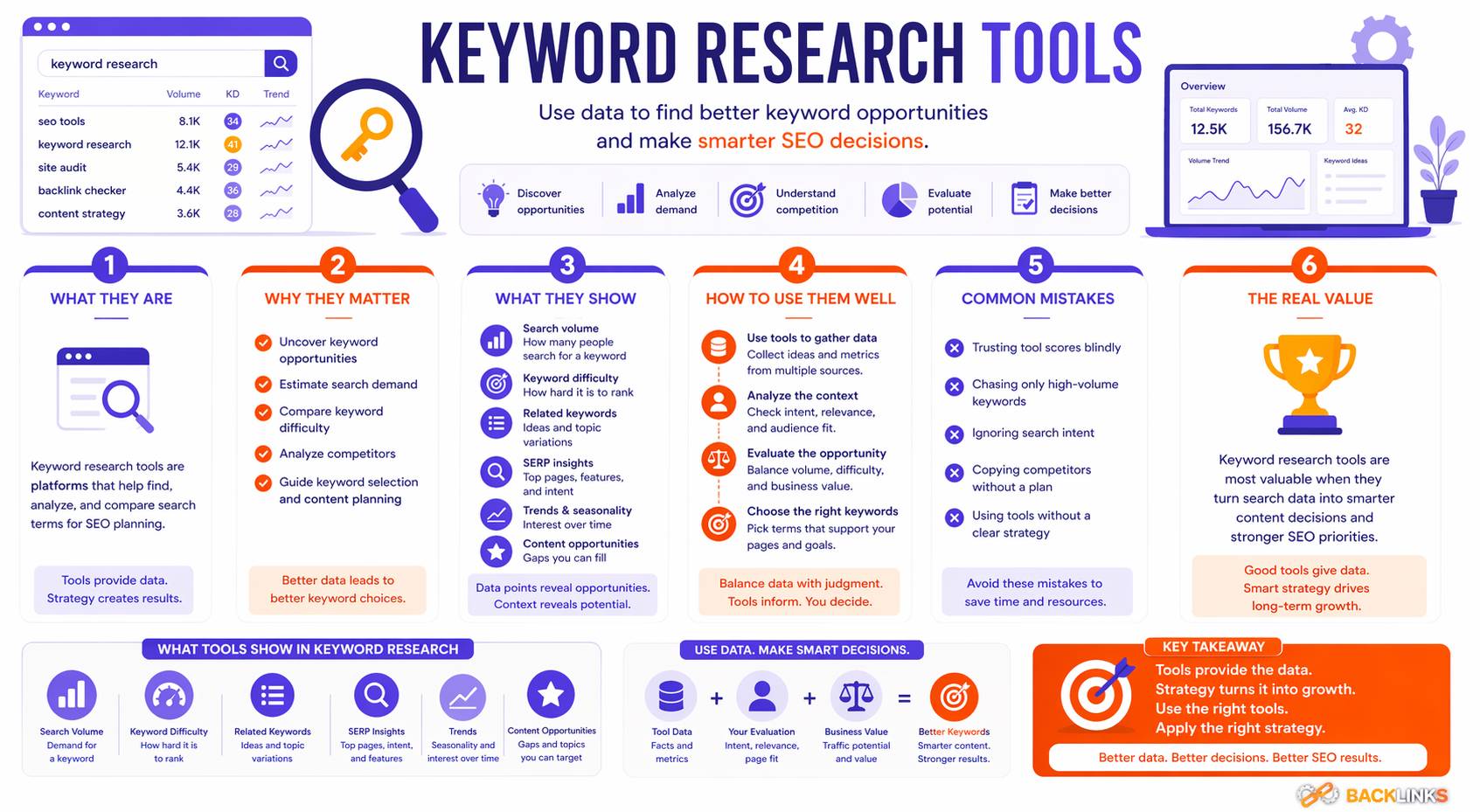
Keyword research tools help you discover, analyze, and prioritize the search terms people use in search engines. They provide data that can guide SEO content planning, keyword selection, search intent analysis, competitor research, and ongoing optimization.
However, keyword research tools are often misunderstood. They are useful, but they do not replace strategy. A tool can show search volume, keyword difficulty, related terms, and ranking pages, but it cannot fully understand your audience, business goals, content quality, or real competitive position.
The best results come from using keyword research tools with judgment. Instead of treating tool data as absolute truth, SEO professionals use it as evidence to support better decisions.
This article explains what keyword research tools are, why they matter, what types of tools exist, and how to use them effectively without letting the data mislead your strategy.
What Are Keyword Research Tools?
Keyword research tools are platforms or software features that help identify and evaluate keywords for SEO.
They can help you find:
- Keywords people search for
- Estimated search volume
- Keyword difficulty
- Related search terms
- Long-tail keyword ideas
- Questions users ask
- Competitor keyword rankings
- Search result patterns
- Content gaps
- Ranking opportunities
In practical terms, keyword research tools help turn broad topic ideas into specific keyword opportunities.
For example, if your topic is “keyword research,” a tool may reveal related searches such as “keyword research tools,” “how to do keyword research,” “long tail keywords,” “keyword strategy,” and “keyword mapping.”
This gives you a clearer view of how people search around the topic and how different pages might be planned.
Why Keyword Research Tools Matter
Keyword research tools matter because they help reduce guesswork. Without tools, content planning often depends only on intuition, internal opinions, or competitor imitation.
Tools provide useful data, but that data must be interpreted carefully.
They Help Identify Search Demand
A keyword may sound important, but that does not mean people search for it in meaningful numbers.
Keyword research tools help estimate demand by showing search volume and related queries. This helps content teams understand which topics have real search interest.
However, search volume should not be treated as the only measure of value. A lower-volume keyword can still be highly useful if it matches strong user intent and business relevance.
They Reveal How People Phrase Searches
Businesses often use different language from their audience. Keyword research tools help reveal the actual words and phrases people use when searching.
For example, a company may talk about “organic search visibility,” while users may search for “how to rank higher on Google.” Both ideas are related, but the audience language is different.
Using the right language helps content feel more relevant and easier to find.
They Support Search Intent Analysis
Many keyword research tools show ranking pages, keyword modifiers, SERP features, and related questions. These clues help you understand search intent.
For example:
- Keywords with “what is” usually suggest informational intent
- Keywords with “best” often suggest comparison intent
- Keywords with “service” or “pricing” may suggest transactional intent
- Keywords with brand names often suggest navigational intent
Tools can help identify these patterns, but you should always review the actual search results before deciding what type of content to create.
They Help Find Long-Tail Keywords
Long-tail keywords are specific search phrases that often have clearer intent and lower competition.
Keyword research tools are useful for finding these opportunities because they can surface detailed queries that may not be obvious from broad topic brainstorming.
Examples include:
- how to choose keyword research tools
- best keyword research tools for beginners
- free keyword research tools for SEO
- keyword research tools for content planning
These searches may have lower individual volume, but they can attract highly relevant visitors.
They Improve Competitor Research
Many SEO tools allow you to review which keywords competing websites rank for.
This can reveal:
- Topics competitors cover
- Keywords they rank for
- Pages driving their organic traffic
- Content gaps they have not addressed well
- Opportunities where your content could be stronger
Competitor research should not be used to copy blindly. It should help you understand the search landscape and identify ways to create more useful content.
Types of Keyword Research Tools
Different tools serve different purposes. Some are designed for broad SEO research, while others focus on search trends, content optimization, analytics, or competitive analysis.
SEO Keyword Databases
SEO keyword databases are tools that collect and estimate keyword data at scale.
They often provide:
- Search volume
- Keyword difficulty
- Related keywords
- SERP overview
- Competitor rankings
- Keyword suggestions
- Content gap analysis
These tools are useful for building keyword lists, reviewing competition, and planning content.
They are especially helpful when you need a broad view of a topic and want to identify multiple keyword opportunities from one starting point.
Search Engine Tools
Search engine tools include features and platforms provided directly by search engines.
These may include:
- Search suggestions
- Related searches
- People Also Ask results
- Search Console data
- Advertising keyword planners
These tools can be useful because they reflect real search behavior and actual website performance.
Search suggestions and related searches are helpful for discovering how users phrase queries. Search Console data is especially valuable because it shows keywords your own website already receives impressions and clicks for.
Competitor Analysis Tools
Competitor analysis tools help you understand what is working for other websites in your market.
They can show:
- Competitor ranking keywords
- Top-performing pages
- Organic traffic estimates
- Backlink data
- Content gaps
- Keyword overlap
This type of analysis is useful when building a keyword strategy because it shows where competitors are strong and where opportunities may exist.
However, competitor data should be used carefully. A keyword that works for a competitor may not be right for your website if the audience, authority level, or business model is different.
Content Optimization Tools
Content optimization tools help apply keyword research during writing and editing.
They may analyze:
- Related terms
- Topic coverage
- Headings
- Readability
- Content length
- Semantic relevance
- Competitor content structure
These tools can be useful for improving content completeness, but they should not control the writing. The goal is not to satisfy a tool score. The goal is to satisfy the user’s search intent with clear, useful content.
Analytics Tools
Analytics tools help measure what happens after content is published.
They can show:
- Organic traffic
- Landing page performance
- Engagement
- Conversions
- Queries generating clicks
- Pages gaining or losing visibility
Keyword research should not stop when content is published. Analytics tools help refine your strategy based on real performance.
For example, a page may begin ranking for unexpected long-tail queries. That data can guide content updates or new article ideas.
Trend Research Tools
Trend tools help identify changes in search interest over time.
They are useful for:
- Seasonal topics
- Emerging trends
- Industry shifts
- Content timing
- Comparing topic interest
Trend data can help avoid targeting topics that are declining or identify opportunities before they become highly competitive.
However, trend tools should be used with context. A short-term spike does not always mean a topic has long-term SEO value.
Question Research Tools
Question-based tools help identify the questions people ask around a topic.
These questions are useful for informational content because they reveal specific user needs.
For example, around keyword research tools, users may ask:
- What are keyword research tools?
- Are free keyword research tools accurate?
- How do keyword research tools estimate volume?
- What is the best tool for finding long-tail keywords?
- Do keyword research tools show search intent?
These questions can guide headings, FAQs, and supporting sections.
Key Features to Look for in Keyword Research Tools
Not every keyword research tool needs every feature. The right tool depends on your goals, budget, and workflow.
Keyword Suggestions
A good keyword research tool should help generate keyword ideas from a broad topic.
Useful suggestions may include:
- Related keywords
- Long-tail keywords
- Questions
- Similar phrases
- Keyword variations
- Topic ideas
This helps expand your research beyond obvious terms.
Search Volume Data
Search volume estimates how often people search for a keyword.
This helps you understand demand, but the numbers are estimates. Different tools may show different volumes because they use different data sources and calculation methods.
Use search volume as a directional signal, not an exact measurement.
Keyword Difficulty
Keyword difficulty estimates how competitive a keyword may be.
This is useful for prioritization, but it should not replace manual review. A difficulty score cannot fully evaluate whether competing content is outdated, shallow, or poorly aligned with intent.
Always check the search results before making a final decision.
SERP Analysis
SERP analysis shows which pages currently rank for a keyword.
This helps you understand:
- Content format
- Dominant search intent
- Competing domains
- Result freshness
- SERP features
- Content depth
SERP analysis is one of the most important features because it connects keyword data with the actual search environment.
Competitor Keyword Data
Competitor keyword data helps identify opportunities by showing what similar websites rank for.
This can reveal topics you have not covered, pages that need improvement, and keywords where competitors may be vulnerable.
Use competitor data as inspiration, not instruction.
Filtering and Grouping
Good tools should allow filtering by search volume, difficulty, intent, keyword length, location, language, or ranking position.
Filtering helps turn large keyword lists into usable groups.
Keyword grouping is especially useful because modern SEO focuses on topics and intent rather than isolated phrases.
Location and Language Settings
If your audience is in a specific country or language market, location and language settings matter.
Search behavior can vary significantly by region. A keyword that has demand in one market may not have the same demand elsewhere.
For businesses targeting Thailand, for example, keyword tools should support the relevant language, country, and search market where possible.
Export and Collaboration Features
For teams, export and collaboration features can be useful.
These help turn keyword research into content briefs, editorial calendars, and keyword maps.
A tool is more valuable when its data can be used easily by strategists, writers, editors, and SEO managers.
How to Use Keyword Research Tools Effectively
Keyword research tools are most useful when they support a structured process.
Start with a Clear Topic
Before opening a tool, define the topic you want to research.
For example, instead of starting with a vague idea like “SEO,” start with a more specific area such as “keyword research tools,” “long-tail keywords,” or “search intent.”
This keeps the research focused and prevents the keyword list from becoming too broad.
Generate Keyword Ideas
Use the tool to find keyword variations around the topic.
Look for:
- Main keyword variations
- Question keywords
- Long-tail searches
- Related topics
- Comparison terms
- Problem-based queries
At this stage, collect possibilities without making final decisions too quickly.
Analyze Search Intent
Once you have a keyword list, classify the intent behind each keyword.
Ask:
- Does the user want to learn?
- Are they comparing tools?
- Are they looking for a specific brand?
- Are they ready to buy or sign up?
- Do they want a template, checklist, or process?
Then review the search results to confirm.
For example, “keyword research tools” may be informational or commercial depending on the search results. Users may want to understand what these tools do, or they may want a list of options.
Review Competition
Use the tool’s SERP data and manual review to understand competition.
Look at the ranking pages and ask:
- Are they strong and comprehensive?
- Are they from highly authoritative websites?
- Do they match the intent well?
- Are they outdated or thin?
- Can your page provide a better answer?
This helps decide whether the keyword is realistic.
Group Keywords by Topic
Do not create a separate page for every keyword.
Group related keywords based on meaning and intent. For example, these terms may fit one page:
- keyword research tools
- SEO keyword research tools
- what are keyword research tools
- how keyword research tools work
But these may deserve separate pages:
- free keyword research tools
- keyword research tools comparison
- keyword research tools for YouTube
- keyword research tools for local SEO
The decision depends on whether the user intent is the same or different.
Map Keywords to Pages
After grouping, assign each keyword group to a page.
Some groups may fit existing pages. Others may require new pages.
This step turns keyword research into a content plan and helps avoid overlap.
Use Tool Data with Human Judgment
Tool data is useful, but it is not perfect.
Search volume can be inaccurate. Keyword difficulty can be misleading. Competitor traffic estimates are not exact. Related keyword suggestions may include irrelevant terms.
The final decision should consider audience relevance, search intent, business value, content quality, and realistic ranking potential.
Free vs Paid Keyword Research Tools
Both free and paid tools can be useful. The right choice depends on your needs.
Free Keyword Research Tools
Free tools are useful for early research, small websites, and basic content planning.
They can help identify:
- Search suggestions
- Related searches
- Questions
- Search trends
- Existing website queries
- Basic keyword ideas
Free tools are often enough to begin keyword research, especially if you combine multiple sources.
However, free tools may provide limited data, fewer filters, or less competitive analysis.
Paid Keyword Research Tools
Paid tools usually provide deeper data and more advanced features.
They may include:
- Larger keyword databases
- Keyword difficulty scores
- Competitor analysis
- SERP history
- Content gap reports
- Rank tracking
- Backlink data
- Advanced filtering
- Team workflows
Paid tools are often useful for agencies, growing websites, competitive industries, and larger SEO projects.
However, paying for a tool does not guarantee better strategy. The value depends on how well the data is interpreted and applied.
Common Mistakes When Using Keyword Research Tools
Trusting Search Volume Too Much
Search volume is an estimate, not a guarantee.
A keyword with high volume may not bring qualified traffic. A lower-volume keyword may be more relevant and easier to rank for.
Use volume as one factor, not the deciding factor.
Ignoring Search Intent
A tool can show that a keyword has demand, but you still need to understand what users expect.
If the content format does not match intent, the page may underperform.
Always review the search results before creating content.
Following Keyword Difficulty Scores Blindly
Keyword difficulty scores can help prioritize, but they are not absolute.
A keyword may appear difficult because strong domains rank for it, but their content may be weak. Another keyword may appear easy but still be hard to rank for because the intent is unclear or dominated by specific result types.
Manual analysis is still necessary.
Exporting Huge Keyword Lists Without Strategy
Large keyword lists can create confusion.
The goal is not to collect as many keywords as possible. The goal is to identify useful opportunities and organize them into a clear content plan.
A smaller, well-prioritized keyword list is more valuable than a large spreadsheet no one uses.
Copying Competitor Keywords Without Context
Competitor keyword data is useful, but not every competitor keyword should become your target.
A competitor may rank for keywords that do not match your audience or goals. They may also have stronger authority or a different business model.
Use competitor data to find opportunities, not to copy strategy blindly.
Optimizing for Tool Scores Instead of Users
Some content optimization tools provide scores based on keyword usage or topic coverage.
These scores can be helpful, but they should not replace editorial judgment. A page can score well in a tool and still feel awkward, repetitive, or unhelpful.
The user’s need should always come first.
Practical Guidance for Choosing Keyword Research Tools
Start by defining what you need the tool to do.
If you are building a new content plan, prioritize keyword discovery, search volume, difficulty, and SERP analysis. If you are improving existing content, prioritize Search Console data, content gap analysis, and ranking queries. If you are studying competitors, prioritize competitor keyword and page-level data.
For most SEO workflows, a good setup includes:
- A tool for keyword discovery
- A tool for actual website performance data
- A way to review search results manually
- A system for organizing keyword groups and page assignments
Do not choose a tool only because it has the largest database or most features. Choose tools that support your workflow and help you make better decisions.
The best keyword research tool is the one that helps you understand your audience, prioritize clearly, and create content that satisfies search intent.
Timing and Expectations
Keyword research tools can provide insights quickly, but SEO results take time.
A tool may help you identify opportunities in one session, but rankings depend on how well you apply the research. Search engines still need to crawl, index, and evaluate your content. Competition, website authority, internal links, backlinks, technical SEO, and content quality all affect performance.
Keyword research tools are most valuable when used continuously. They can help plan new content, update old pages, monitor rankings, identify new opportunities, and refine your strategy over time.
For newer websites, tools can help find specific long-tail opportunities. For established websites, they can uncover content gaps, keyword overlap, and pages that need optimization.
Conclusion
Keyword research tools are valuable because they help you understand search demand, discover keyword opportunities, analyze competition, and plan better SEO content.
However, tools are only one part of the process. They provide data, but strategy comes from interpreting that data correctly. Search volume, keyword difficulty, and competitor rankings should support your decisions, not control them.
The most effective use of keyword research tools combines data with search intent analysis, audience understanding, content quality, and realistic prioritization.
When used properly, keyword research tools help turn SEO from guesswork into a clearer, more structured process. They make it easier to choose the right topics, create more relevant content, and build long-term organic visibility.