
What Is Technical SEO? A Clear Guide to Building a Search-Friendly Website
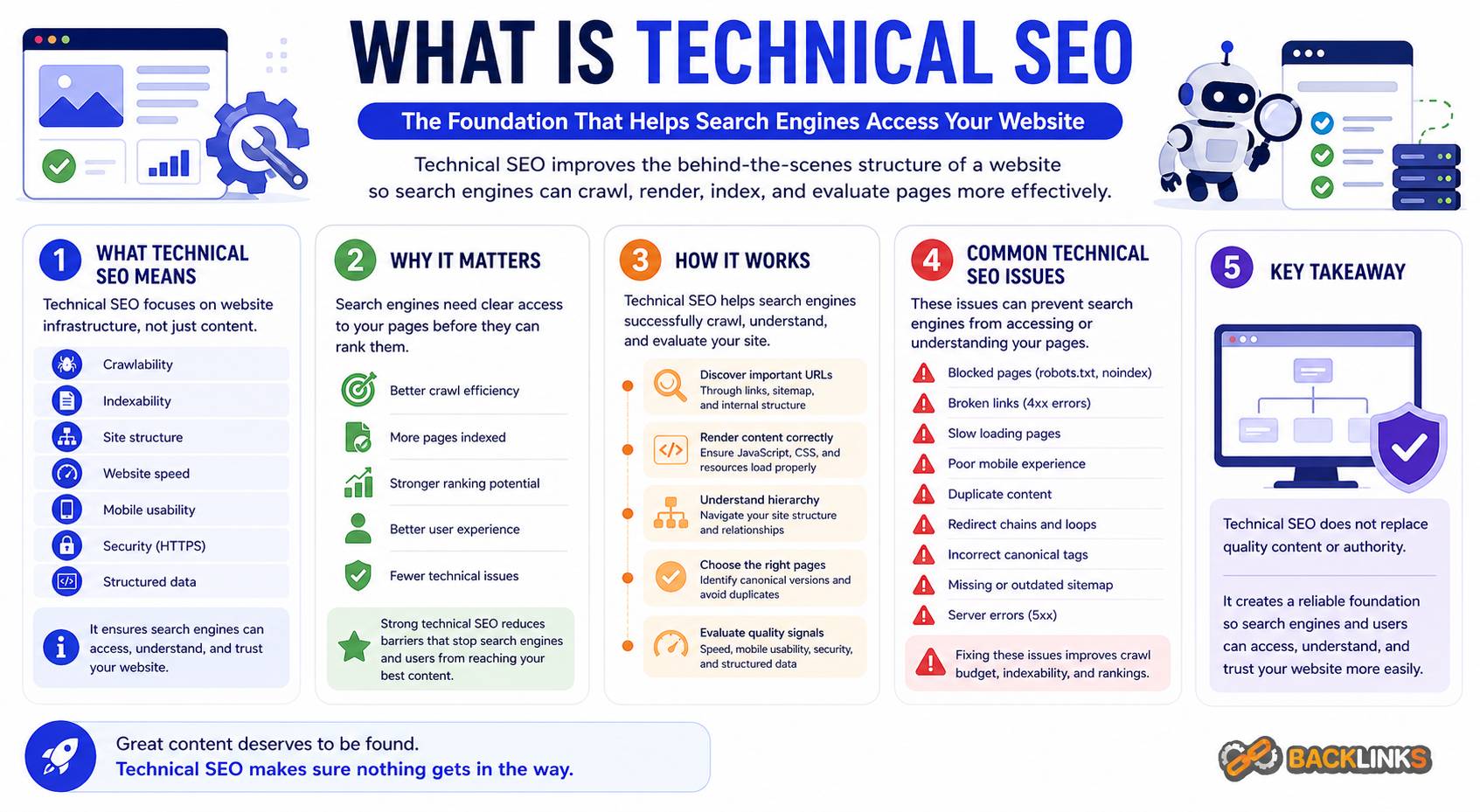
What is technical SEO? Technical SEO is the process of optimizing the technical foundation of a website so search engines can crawl, understand, index, and evaluate its pages correctly. It focuses on the behind-the-scenes elements that affect how well a website can perform in organic search.
A website may have strong content, useful products, and a clear business offer, but technical problems can still limit its visibility. If search engines cannot access important pages, understand the site structure, process the content, or identify the correct version of a URL, the website may struggle to rank even when the content itself is valuable.
This article explains what technical SEO means, why it matters, how it works, and which areas deserve attention first. It is designed as a clear introduction for business owners, marketers, and SEO teams who want to understand the role technical SEO plays in long-term search performance.
What Is Technical SEO?
Technical SEO refers to the work done to make a website easier for search engines to crawl, render, index, and rank. It covers the technical systems that support organic visibility, including site structure, page speed, mobile usability, internal links, redirects, canonical tags, XML sitemaps, robots.txt files, structured data, and indexation controls.
In simple terms, technical SEO helps search engines answer four important questions:
- Can this page be found?
- Can this page be accessed?
- Can this page be understood?
- Should this page be included in search results?
If the answer to any of these questions is unclear, the page may not perform as well as it should.
Technical SEO is not the same as writing content or building backlinks. It does not focus mainly on keywords, article structure, or persuasive copy. Instead, it supports those efforts by making sure the website’s technical setup does not prevent important pages from being discovered, interpreted, and shown to users.
Why Technical SEO Matters
Search engines rely on technical signals to process websites efficiently. They do not manually review every page in the way a person would. They use crawlers to discover URLs, follow links, read code, process content, and decide which pages should be added to the index.
When a website has technical issues, several problems can occur.
Important pages may not be crawled. Duplicate pages may compete with each other. Search engines may index low-value URLs instead of the main pages. Slow pages may create a poor user experience. Broken redirects may waste authority. Weak internal linking may make deeper content harder to discover.
Technical SEO matters because it protects the visibility of your most important pages. It also helps search engines understand the structure and purpose of your website more clearly.
For a small website, technical SEO may involve basic checks such as making sure pages are indexable, mobile-friendly, and fast enough. For a larger website, it can become more complex. Ecommerce sites, publishers, SaaS platforms, marketplaces, and multilingual websites often need more advanced technical controls because they generate many URLs, templates, filters, parameters, and content variations.
How Technical SEO Works
Technical SEO works by improving the way search engines interact with your website. It reduces friction during crawling and indexing, clarifies which pages matter most, and improves the experience users have after arriving from search.
The process usually involves several connected areas.
Crawlability
Crawlability refers to whether search engine bots can discover and access your pages. If a page cannot be crawled, it is unlikely to appear in search results.
Search engines usually discover pages through internal links, XML sitemaps, external links, and previously known URLs. A technically sound website makes important pages easy to find through clear navigation and logical internal linking.
Common crawlability issues include blocked URLs, broken links, orphan pages, redirect loops, and pages that can only be reached through forms or scripts. These issues make it harder for search engines to understand the full website.
For most websites, improving crawlability starts with a simple question: can search engines reach every important page through normal links?
Indexability
Indexability refers to whether a page can be included in a search engine’s index. A page may be crawlable but still not indexable.
This can happen when a page has a noindex tag, points to another URL with a canonical tag, returns the wrong status code, or is considered too thin, duplicate, or low value.
Indexability matters because only indexed pages can appear in search results. If an important page is accidentally marked as noindex, it may disappear from organic search. If many low-value pages are indexable, search engines may spend time processing URLs that do not support the site’s goals.
Good technical SEO helps make sure the right pages are indexable and the wrong pages are kept out of search results.
Site Structure
Site structure is the way pages are organized and connected. A clear structure helps both users and search engines understand what the website is about.
A strong structure usually starts with broad, important pages and then supports them with more specific pages. For example, a main technical SEO page may be supported by pages about crawlability, indexing, XML sitemaps, canonical tags, structured data, page speed, and website migrations.
This type of organization helps search engines understand topical relationships. It also helps users move from a general concept to more detailed information.
Poor site structure can make valuable content feel isolated. If important pages are buried too deeply or receive few internal links, they may be crawled less often and appear less important.
URL Structure
URLs should be clear, stable, and easy to understand. A good URL reflects the topic of the page without being unnecessarily long or confusing.
Clean URL structure helps users and search engines understand page purpose. It also reduces the chance of duplicate or competing URL variations.
Problems can appear when a website creates multiple versions of the same page through tracking parameters, filters, sort options, uppercase and lowercase variations, or inconsistent trailing slashes. These issues can dilute signals and make the site harder to manage.
Technical SEO helps control these variations through redirects, canonical tags, internal linking rules, and sitemap hygiene.
Page Speed and Performance
Page speed is an important part of technical SEO because users expect websites to load quickly and work smoothly. Slow pages can reduce engagement, increase frustration, and weaken the overall search experience.
Performance issues are often caused by large images, heavy JavaScript, poor hosting, unoptimized code, excessive third-party scripts, slow server response times, or inefficient templates.
Technical SEO does not require every website to be stripped down to the simplest possible design. The goal is to balance visual quality, functionality, and speed. A page should support the business objective while remaining efficient and usable.
Performance work is often shared between SEO specialists, developers, designers, and analytics teams.
Mobile Usability
Mobile usability is central to technical SEO because many users search, browse, and convert on mobile devices. A page that works well on desktop but poorly on mobile can create serious performance problems.
Mobile-friendly pages should be easy to read, navigate, and interact with. Important content should be available on mobile, not hidden or removed. Buttons and links should be easy to tap. Layouts should be stable. Forms should be simple to complete.
Technical SEO reviews should compare the mobile and desktop experience to make sure search engines and users receive a consistent, complete version of the page.
Structured Data
Structured data is code that helps search engines understand specific information on a page. It can describe content types such as articles, products, breadcrumbs, organizations, local businesses, events, and frequently asked questions.
Structured data does not replace strong content. It also does not guarantee better rankings. Its purpose is to make information clearer and more machine-readable.
For example, breadcrumb structured data can help explain the page’s position in the site hierarchy. Product structured data can help identify product details. Organization structured data can clarify business information.
The key rule is accuracy. Structured data should match the visible content on the page and should be implemented consistently.
Canonical Tags and Duplicate Content
Duplicate content happens when the same or very similar content appears on more than one URL. This is common on websites with filters, parameters, product variants, category pages, printer-friendly pages, or tracking URLs.
Duplicate content is not always a penalty issue, but it can create confusion. Search engines may not know which URL should be treated as the main version. Internal links and external signals may also become split across multiple pages.
Canonical tags help identify the preferred version of a page. They are especially useful when duplicate or near-duplicate URLs are necessary for technical or user experience reasons.
However, canonical tags must be used carefully. If they point to the wrong URL, they can prevent important pages from being indexed correctly.
Redirects and Status Codes
Redirects and status codes tell browsers and search engines what is happening with a URL.
A live page usually returns a 200 status code. A permanently moved page usually uses a 301 redirect. A missing page may return a 404 or 410 status code.
These signals matter because they affect crawling, indexing, and authority consolidation. Redirecting an old page to the most relevant new page helps preserve continuity for users and search engines. Redirecting everything to the homepage, however, often creates a poor experience and weakens relevance.
Technical SEO checks should identify broken pages, redirect chains, redirect loops, soft 404s, and incorrect status codes.
XML Sitemaps and Robots.txt
XML sitemaps and robots.txt files are basic but important technical SEO tools.
An XML sitemap helps search engines discover important URLs. It should include clean, canonical, indexable pages that you actually want search engines to process.
A robots.txt file gives instructions about which areas of the site crawlers should or should not access. It can help reduce crawl waste, but it should be used carefully. Blocking the wrong section can prevent search engines from accessing important content.
These files should support the website’s SEO strategy. They should not be treated as set-and-forget technical files.
Common Technical SEO Mistakes
One common mistake is assuming that technical SEO only matters when something breaks. In reality, technical issues often build slowly as a website grows. New templates, plugins, tracking scripts, category filters, and content updates can all create problems over time.
Another mistake is focusing only on tool warnings without considering business impact. SEO audit tools often produce long lists of issues, but not every warning deserves the same priority. A noindex tag on a key service page is far more serious than a minor warning on a low-value page.
A third mistake is ignoring internal links. Many websites publish useful pages but fail to connect them properly. Without internal links, search engines may struggle to understand relationships between topics.
Other common mistakes include:
- Indexing too many low-value pages
- Blocking important pages in robots.txt
- Using canonical tags incorrectly
- Letting redirect chains grow over time
- Publishing pages with slow mobile performance
- Including non-indexable URLs in XML sitemaps
- Changing URLs without a redirect plan
- Treating technical SEO as a one-time project
How to Approach Technical SEO
A good technical SEO process starts with priorities. The goal is not to fix every possible issue immediately. The goal is to identify the technical problems that are most likely to affect important pages, rankings, traffic, and conversions.
Start with the pages that matter most to the business. These may include service pages, product categories, high-intent landing pages, location pages, major blog guides, and pages that already receive organic traffic.
Then review whether those pages are crawlable, indexable, internally linked, fast, mobile-friendly, and technically consistent.
After that, look for sitewide patterns. Template-level issues are often more important than isolated page issues because they affect many URLs at once. For example, a faulty canonical tag across an entire section may be more urgent than one broken link on an old article.
Technical SEO should also involve collaboration. Many fixes require developer support, CMS changes, design adjustments, or analytics validation. Clear communication matters. Recommendations should explain the issue, the affected URLs, the desired outcome, and how the fix should be tested.
How Long Does Technical SEO Take?
The timeline for technical SEO results depends on the issue being fixed and how often search engines recrawl the affected pages.
Some changes can have a visible impact relatively quickly. For example, removing an accidental noindex tag from an important page can allow it to return to search results after recrawling.
Other improvements take longer. Site architecture changes, internal linking improvements, duplicate content cleanup, and large-scale performance work may require more time before the results are clear.
Technical SEO should be viewed as an ongoing process. Websites are not static. Pages are added, removed, redesigned, redirected, and updated. Regular technical reviews help prevent small problems from becoming larger obstacles.
Technical SEO in the Bigger SEO Strategy
Technical SEO is one part of a complete SEO strategy. It works alongside keyword research, content planning, content optimization, internal linking, authority building, and conversion optimization.
A technically strong website with weak content may still struggle to rank. A content-rich website with poor technical foundations may also underperform. The best results usually come when technical quality and content quality support each other.
For example, keyword research helps identify what users are searching for. Content strategy turns those insights into useful pages. Technical SEO makes sure those pages can be found, indexed, understood, and delivered efficiently.
This is why technical SEO should not be separated completely from broader SEO planning. It is the foundation that allows other SEO work to perform more effectively.
Conclusion
Technical SEO is the practice of improving the technical foundation of a website so search engines can crawl, index, understand, and evaluate its pages correctly. It covers crawlability, indexability, site structure, page speed, mobile usability, structured data, redirects, canonical tags, XML sitemaps, robots.txt files, and other technical signals.
The purpose of technical SEO is not to chase every minor audit warning. Its purpose is to remove barriers that prevent important pages from performing in search.
For businesses that depend on organic visibility, technical SEO is essential. It helps protect the value of content, improves search engine access, supports a better user experience, and creates a stronger foundation for long-term SEO growth.