
Technical SEO Audit: How to Identify and Fix Website Issues That Affect Search Performance
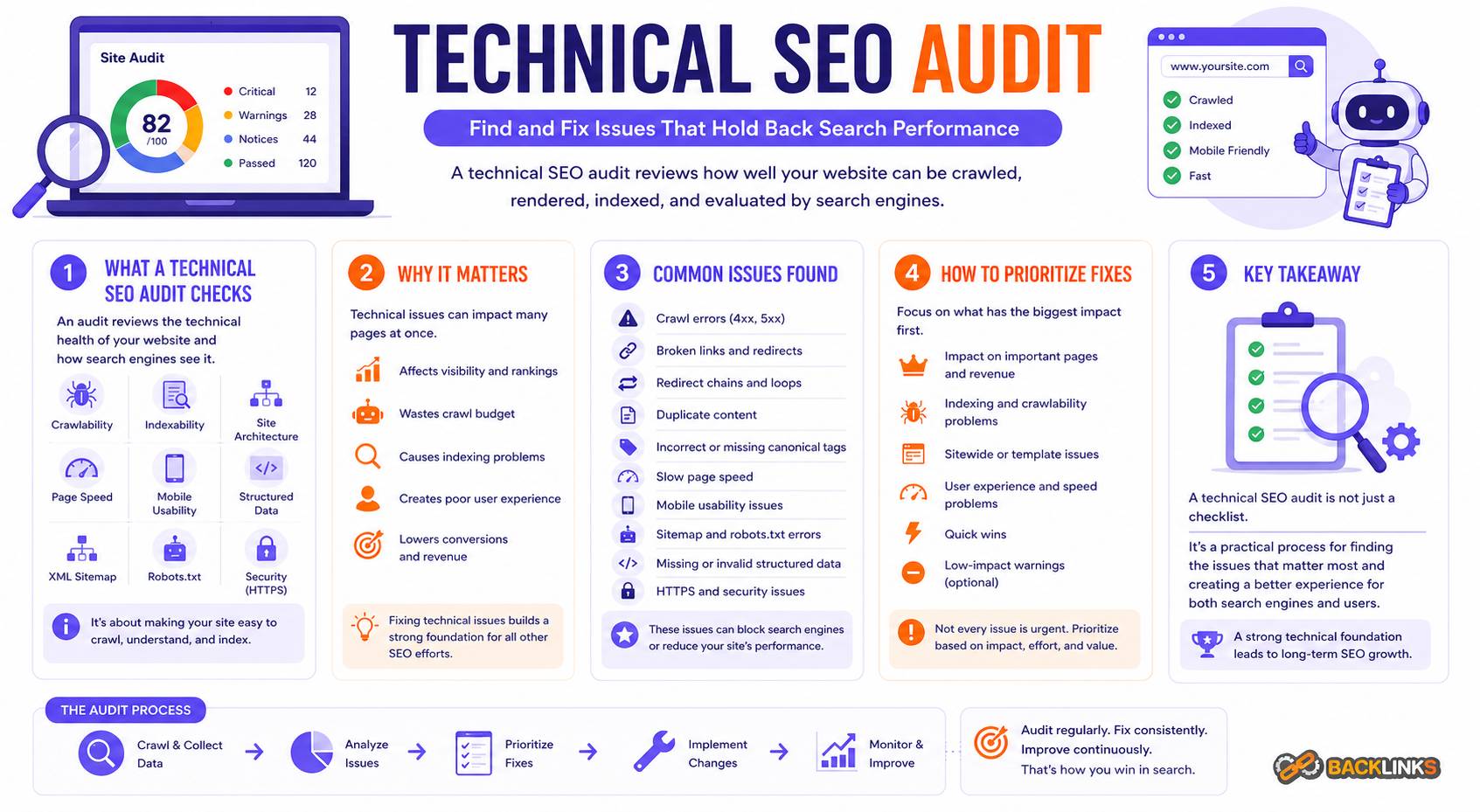
Technical SEO audit is the process of analyzing a website’s technical setup to identify issues that may prevent search engines from crawling, indexing, and understanding its pages effectively. It is a core part of technical SEO because even strong content cannot perform well if the website has structural or technical problems.
A technical SEO audit helps uncover hidden issues that are not always visible to users. A website may look fine on the surface, but technical errors can limit visibility, waste crawl resources, and reduce organic traffic.
This guide explains what a technical SEO audit is, why it matters, how it works, and how to approach it in a practical and strategic way.
What Is a Technical SEO Audit?
A technical SEO audit is a structured review of a website’s technical elements to ensure search engines can properly access, crawl, index, and interpret its content.
It focuses on the infrastructure behind SEO performance rather than content quality alone. The audit identifies technical barriers that may affect rankings, visibility, and user experience.
In practical terms, a technical SEO audit answers questions such as:
- Can search engines crawl the website efficiently?
- Are important pages indexable?
- Are there duplicate URL issues?
- Is the site structure clear and logical?
- Are pages loading fast enough?
- Are there errors affecting accessibility?
- Are technical signals consistent?
The goal is not just to find problems, but to understand which issues matter most and how they affect business outcomes.
Why a Technical SEO Audit Matters
A technical SEO audit matters because it protects the foundation of organic search performance.
Without a proper audit, websites can develop hidden issues over time. New pages, CMS updates, plugins, design changes, tracking scripts, and content additions can introduce technical problems.
These issues may include:
- Important pages not being indexed
- Duplicate content confusion
- Broken internal links
- Slow page performance
- Incorrect canonical tags
- Crawl inefficiencies
- Redirect problems
Even small issues can scale across large websites. A single template error can affect hundreds or thousands of pages.
A technical SEO audit helps identify these problems early and ensures that search engines can process the website correctly.
How a Technical SEO Audit Works
A technical SEO audit works by analyzing both individual pages and sitewide patterns. It combines data from crawling tools, search engine reports, and manual checks.
The process usually involves several stages.
First, the website is crawled to collect data about URLs, status codes, internal links, and technical elements.
Second, indexation and search engine data are reviewed to understand which pages are included in search results and which are excluded.
Third, patterns are identified across templates and sections of the site. This helps prioritize issues that affect many pages.
Finally, findings are translated into actionable recommendations.
The audit should not be a list of errors. It should provide clear insight into what needs to be fixed and why it matters.
Key Areas Covered in a Technical SEO Audit
A complete technical SEO audit covers multiple areas that affect how search engines interact with a website.
Crawlability
Crawlability determines whether search engines can discover and access pages.
An audit should check:
- Internal linking structure
- Broken links
- Orphan pages
- Robots.txt rules
- Crawl depth
- Redirect chains and loops
If important pages cannot be crawled, they are unlikely to perform in search.
Indexability
Indexability determines whether pages can appear in search results.
An audit should review:
- Noindex tags
- Canonical tags
- Status codes
- Sitemap inclusion
- Duplicate content signals
It is important to ensure that valuable pages are indexable while low-value pages are managed properly.
URL Structure
URL structure affects clarity, organization, and duplicate control.
An audit should check:
- Consistency of URLs
- Use of parameters
- Duplicate URL variations
- Clean and descriptive paths
A clear URL structure supports both users and search engines.
Internal Linking
Internal links help search engines understand page relationships and importance.
An audit should identify:
- Weak internal linking
- Missing links to important pages
- Overly deep pages
- Broken internal links
Strong internal linking improves crawl efficiency and content visibility.
Page Speed and Performance
Performance affects both user experience and crawl efficiency.
An audit should review:
- Page load speed
- Mobile performance
- Large images
- Heavy scripts
- Core Web Vitals metrics
Slow pages can reduce engagement and limit SEO performance.
Mobile Usability
Mobile usability is essential for modern SEO.
An audit should check:
- Mobile layout issues
- Readability
- Tap targets
- Responsive design consistency
A page should be usable and complete on mobile devices.
Structured Data
Structured data helps search engines interpret content.
An audit should verify:
- Correct schema usage
- Alignment with page content
- Missing or incorrect fields
Structured data should be accurate and consistent.
Duplicate Content
Duplicate content can create confusion and dilute signals.
An audit should identify:
- Multiple URL versions
- Parameter-based duplication
- Canonical issues
- Similar pages targeting the same topic
Proper management ensures clarity.
Redirects and Status Codes
Redirects and status codes control how pages are handled.
An audit should check:
- 301 and 302 redirects
- Broken pages (404)
- Soft 404 issues
- Redirect chains
Incorrect handling can affect both users and search engines.
XML Sitemaps and Robots.txt
These files guide search engine behavior.
An audit should review:
- Sitemap accuracy
- Inclusion of correct URLs
- Robots.txt rules
- Alignment between sitemap and crawlability
These signals should support the overall SEO strategy.
Common Technical SEO Audit Mistakes
Many audits fail because they focus on volume instead of impact.
One common mistake is treating every issue as equally important. Not all problems affect SEO performance in the same way. A minor warning on a low-value page is less important than a major issue on a key landing page.
Another mistake is relying only on automated tools. Tools can identify problems, but they do not always explain business impact or context.
Other common mistakes include:
- Ignoring template-level issues
- Failing to prioritize fixes
- Not validating findings manually
- Overlooking mobile performance
- Not checking indexation data
- Treating audits as one-time tasks
A good audit should be strategic, not just technical.
How to Prioritize Technical SEO Audit Findings
Prioritization is one of the most important parts of a technical SEO audit.
Start by focusing on high-impact pages, such as:
- Service pages
- Product pages
- Category pages
- High-traffic blog content
- Conversion-focused pages
Then evaluate issues based on:
- Impact on search visibility
- Number of affected pages
- Severity of the problem
- Ease of implementation
Template-level issues often deserve higher priority because they affect many pages at once.
The goal is to fix the problems that will create the biggest improvement in performance.
Technical SEO Audit for Different Website Types
Different websites require different audit approaches.
For small business websites, audits may focus on basic issues such as indexability, mobile usability, and page speed.
For ecommerce websites, audits often focus on URL control, duplicate content, filters, and product page structure.
For publishers and blogs, audits may focus on internal linking, content structure, archives, and crawl efficiency.
For SaaS websites, audits often involve product pages, documentation, and complex site structures.
The audit should reflect how the website is built and how users interact with it.
How Often Should You Run a Technical SEO Audit?
Technical SEO audits should not be treated as one-time projects.
Websites change constantly. New content, plugins, scripts, templates, and updates can introduce new issues.
A full audit may be done periodically, but smaller checks should happen regularly. It is especially important to review technical SEO after:
- Website redesigns
- CMS changes
- Large content updates
- Migrations
- New feature launches
Ongoing monitoring helps prevent small issues from becoming larger problems.
How Long It Takes to See Results
The impact of a technical SEO audit depends on the issues being fixed.
Some changes may show results relatively quickly. For example, fixing a noindex tag on an important page can restore visibility after search engines recrawl it.
Other changes take longer. Improvements in site structure, internal linking, or performance may require multiple crawls and gradual evaluation.
Search engines need time to process changes, so results should be monitored over time.
Practical Guidance for Running a Technical SEO Audit
A successful technical SEO audit should be practical and focused.
Start with clear goals. Identify which pages and sections matter most to the business.
Use tools to gather data, but validate findings manually. Understand not just what is wrong, but why it matters.
Communicate clearly with developers and stakeholders. Recommendations should be specific, actionable, and tied to outcomes.
Track progress after fixes are implemented. Monitor indexation, crawl behavior, rankings, and user engagement.
Technical SEO audits should support long-term growth, not just short-term fixes.
Conclusion
A technical SEO audit is essential for maintaining a healthy, high-performing website. It helps identify issues that can prevent search engines from crawling, indexing, and understanding your content.
By reviewing crawlability, indexability, site structure, performance, and technical signals, a technical SEO audit provides a clear path to improvement.
The most effective audits focus on impact, prioritize key issues, and align technical fixes with business goals. When done properly, a technical SEO audit strengthens the foundation of SEO and supports sustainable organic growth.