
Technical SEO Tools: How to Analyze and Improve Your Website’s Technical Performance
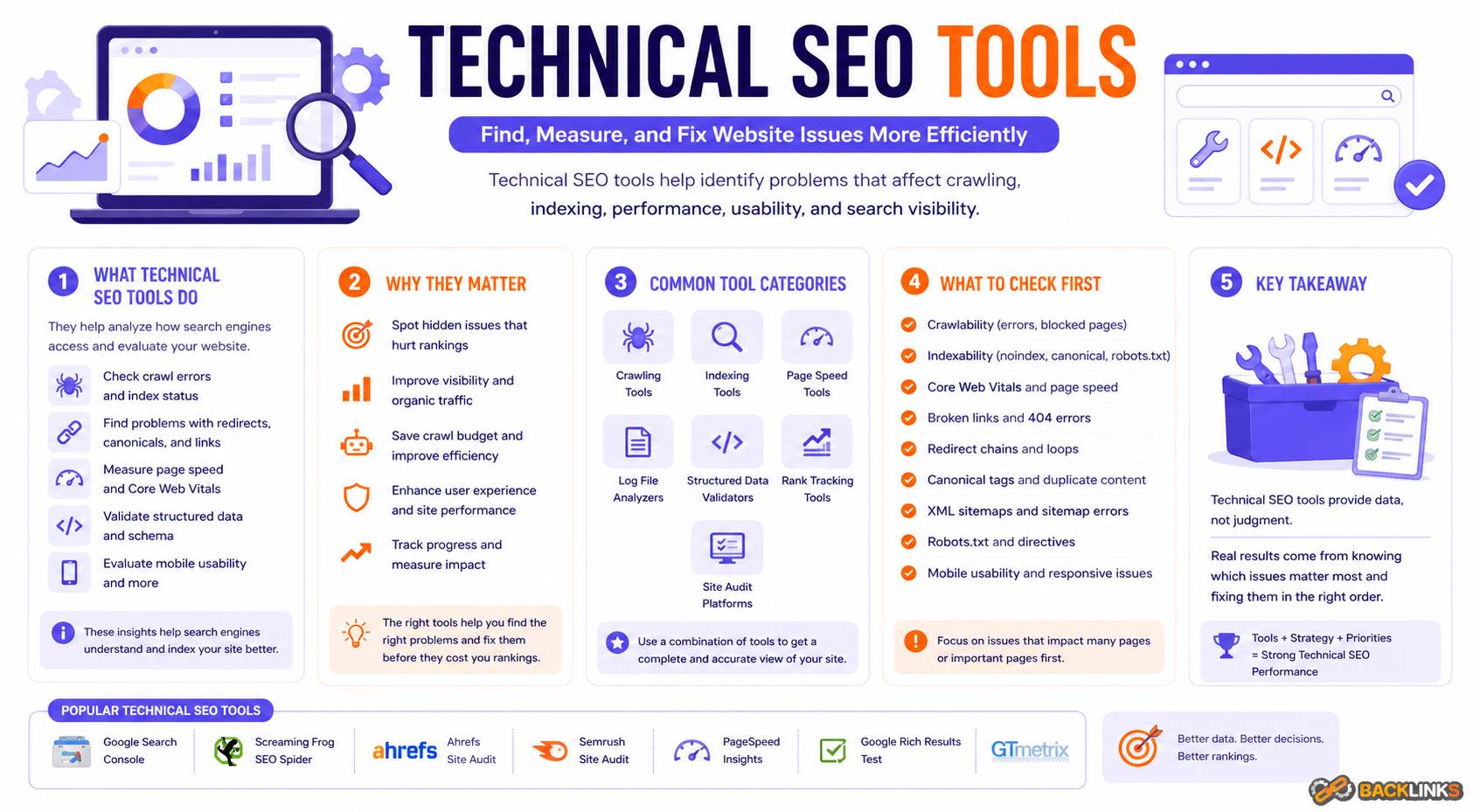
Technical SEO tools are software solutions that help analyze, monitor, and improve the technical aspects of a website. They are essential for identifying issues that affect crawling, indexing, site structure, page speed, and overall search performance.
A website can have strong content and a clear strategy, but without the right tools, it is difficult to detect technical problems at scale. Technical SEO tools provide visibility into how search engines interact with a site and where improvements are needed.
This guide explains what technical SEO tools are, why they matter, the types available, and how to use them effectively.
What Are Technical SEO Tools?
Technical SEO tools are platforms or applications used to evaluate a website’s technical health. They collect data about URLs, site structure, performance, and search engine behavior to help identify issues that may impact visibility.
These tools can analyze:
- Crawlability and indexation
- Internal linking structure
- Page speed and performance
- Duplicate content and canonicalization
- Redirects and status codes
- XML sitemaps and robots.txt
- Structured data
- Mobile usability
In practical terms, technical SEO tools help answer questions such as:
- Are important pages being indexed?
- Are there crawl errors or broken links?
- Is the website structure efficient?
- Are pages loading quickly?
- Are duplicate URLs creating confusion?
They provide data that would be difficult to gather manually, especially for larger websites.
Why Technical SEO Tools Matter
Technical SEO tools matter because they make complex website analysis manageable and scalable.
Without tools, identifying technical issues would require manually checking every page, link, and signal. This is not realistic for most websites.
Technical SEO tools help:
- Detect hidden technical issues
- Monitor changes over time
- Analyze large numbers of URLs
- Validate SEO implementations
- Support decision-making with data
- Prioritize fixes based on impact
They are especially important for websites with many pages, such as ecommerce sites, publishers, and SaaS platforms. However, even smaller websites benefit from regular technical checks.
Types of Technical SEO Tools
Different tools serve different purposes. A complete technical SEO workflow usually involves several types of tools.
Website Crawling Tools
Crawling tools simulate how search engine bots explore a website. They collect data about URLs, links, status codes, metadata, and structure.
These tools help identify:
- Broken links
- Redirect chains
- Orphan pages
- Duplicate content
- Missing metadata
- Crawl depth issues
They are essential for understanding how a site is structured and how pages are connected.
Search Engine Data Tools
Search engine tools provide direct insights into how a website is performing in search.
They help analyze:
- Indexation status
- Search queries and impressions
- Crawl activity
- Coverage issues
- Page experience signals
These tools are valuable because they reflect real search engine behavior rather than simulated data.
Page Speed and Performance Tools
Performance tools analyze how quickly and efficiently pages load.
They provide insights into:
- Load time
- Core Web Vitals
- Resource usage
- Rendering delays
- Mobile performance
These tools help identify technical issues affecting user experience and page performance.
Log File Analysis Tools
Log file analysis tools examine server logs to understand how search engine crawlers interact with a website.
They help answer questions such as:
- Which pages are being crawled most often?
- Are important pages being ignored?
- Is crawl budget being wasted on low-value URLs?
This level of analysis is especially useful for large websites.
Structured Data Testing Tools
These tools validate structured data implementation and check for errors.
They help ensure that:
- Markup is correctly formatted
- Required properties are included
- Structured data matches page content
This supports better search result presentation.
Rank and Monitoring Tools
While not purely technical, monitoring tools help track the impact of technical changes.
They provide data on:
- Rankings
- Organic traffic trends
- Keyword visibility
- Page performance over time
This helps connect technical improvements with real outcomes.
Key Features to Look for in Technical SEO Tools
Not all tools are equally useful. When choosing tools, focus on features that support your SEO goals.
Important features include:
- Accurate crawling and reporting
- Clear issue categorization
- Customizable reports
- Integration with analytics or search data
- Ability to handle large websites
- Regular updates and support
- Exportable data for analysis
The goal is not to use as many tools as possible, but to use the right tools effectively.
How to Use Technical SEO Tools Effectively
Technical SEO tools are only valuable if used strategically. Running a tool without understanding the output can lead to confusion or wasted effort.
Focus on High-Impact Issues
Tools often generate long lists of warnings. Not all issues are equally important.
Prioritize issues that affect:
- Indexation of important pages
- Crawl accessibility
- Duplicate content
- Site performance
- Key templates
Avoid spending time on low-impact warnings that do not affect business outcomes.
Combine Multiple Data Sources
No single tool provides a complete picture. Combine data from crawling tools, search engine reports, and performance tools.
For example:
- Use a crawler to identify broken links
- Use search data to confirm indexation
- Use performance tools to assess speed issues
Combining sources improves accuracy.
Validate Findings Manually
Tools can highlight potential issues, but they do not always reflect real-world impact.
Always validate:
- Whether the issue exists on important pages
- Whether it affects users or search engines
- Whether it requires immediate action
Manual review helps avoid unnecessary fixes.
Track Changes Over Time
Technical SEO is not static. Websites change, and new issues can appear.
Use tools to monitor:
- Crawl errors
- Indexation trends
- Performance changes
- Structured data updates
Tracking helps identify patterns and measure improvements.
Common Mistakes When Using Technical SEO Tools
One common mistake is relying entirely on tool scores. A high score does not guarantee strong SEO performance, and a low score does not always indicate a serious problem.
Another mistake is trying to fix every issue at once. This can lead to wasted effort and confusion.
Other common mistakes include:
- Ignoring business priorities
- Not validating tool data
- Overlooking mobile performance
- Focusing only on the homepage
- Misinterpreting duplicate content warnings
- Treating all issues as equal
- Not revisiting audits after changes
Tools should support decision-making, not replace it.
Technical SEO Tools for Different Website Types
Different websites benefit from different tool combinations.
For small websites, basic crawling tools and search engine data tools may be enough to identify key issues.
For ecommerce websites, more advanced tools may be needed to manage product pages, filters, and large URL sets.
For publishers, tools that track content performance, internal linking, and crawl efficiency are important.
For SaaS websites, tools that support complex site structures and documentation are valuable.
The choice of tools should reflect the complexity of the website.
How Often to Use Technical SEO Tools
Technical SEO tools should be used regularly, not just during one-time audits.
Regular checks help identify new issues as they appear.
Key moments to use tools include:
- Before and after website changes
- During content updates
- After migrations
- When traffic or rankings change unexpectedly
Ongoing monitoring helps maintain a healthy technical foundation.
How Long It Takes to See Results
The impact of changes identified through technical SEO tools depends on the issue.
Fixing major problems, such as indexation errors or broken redirects, may show results relatively quickly after search engines recrawl the site.
Other improvements, such as site structure changes or performance optimization, may take longer to reflect in rankings and traffic.
Tools help track these changes, but patience and monitoring are important.
Practical Guidance for Using Technical SEO Tools
The best approach is to treat tools as part of a structured workflow.
Start with a clear objective. Identify what you want to improve, such as crawlability, performance, or indexation.
Use tools to gather data, but focus on insights rather than raw reports.
Prioritize issues based on impact and relevance.
Work with developers and stakeholders to implement changes.
Monitor results and adjust as needed.
Technical SEO tools are most effective when used as part of a continuous improvement process.
Conclusion
Technical SEO tools are essential for analyzing and improving a website’s technical performance. They provide visibility into crawlability, indexation, structure, and performance that would be difficult to assess manually.
However, tools alone do not improve SEO. Their value comes from how they are used.
By focusing on high-impact issues, validating findings, and aligning technical improvements with business goals, technical SEO tools can support stronger search performance and a more reliable website foundation.