
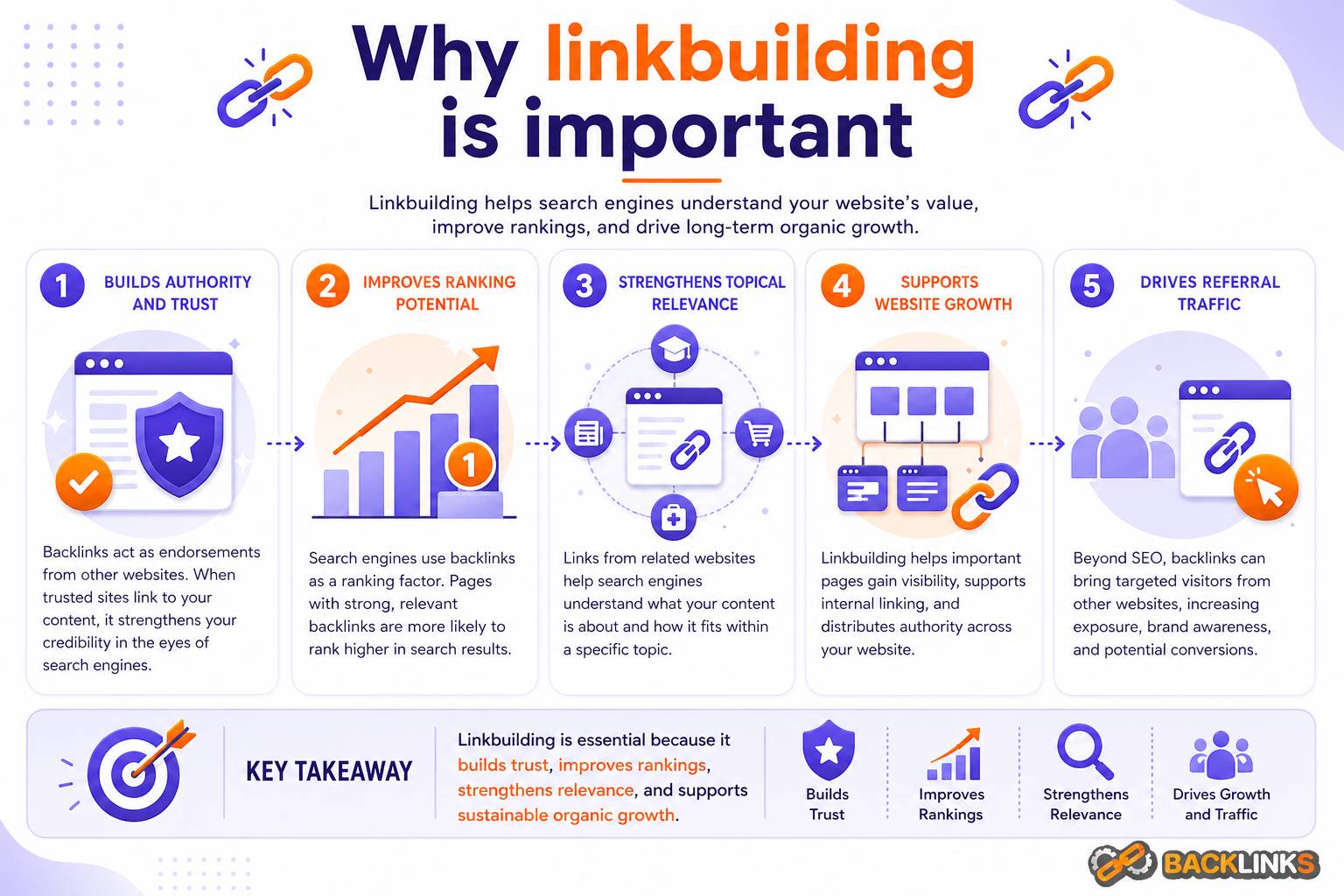
Why Linkbuilding Is Important for SEO Growth
Why linkbuilding is important is a key question for any business that wants stronger organic visibility, better rankings, and long-term search authority. Linkbuilding matters because backlinks help search engines understand which websites are trusted, which pages deserve attention, and which resources are valuable enough to be referenced by others.
A website can have well-written content, clean technical SEO, and strong keyword targeting, but still struggle to compete if it has little authority. Backlinks help close that gap by showing search engines that other websites recognize your content as useful or credible.
This article explains why linkbuilding matters, how it supports SEO performance, and why it should be treated as a long-term authority-building process rather than a short-term ranking tactic.
What Is Linkbuilding?
Linkbuilding is the process of earning hyperlinks from other websites to your own website. These links are known as backlinks or inbound links.
When another website links to your page, it creates a pathway between their content and yours. From an SEO perspective, that link can act as a signal of trust, relevance, and authority.
For example, if a respected marketing website links to your guide about SEO strategy, search engines may interpret that link as a sign that your content has value. The stronger and more relevant the linking website is, the more meaningful that signal can be.
Linkbuilding is not simply about collecting as many links as possible. Modern SEO focuses on quality, relevance, context, and natural link patterns. A few strong links from relevant sources can be more valuable than many weak links from unrelated websites.
Why Linkbuilding Is Important for SEO
Linkbuilding is important because search engines use backlinks as external validation. On-page content tells search engines what your page is about. Backlinks help show whether other websites trust that content enough to reference it.
This distinction matters. Anyone can publish content and claim expertise. Backlinks provide an external signal that others have found the content useful, credible, or worth citing.
Backlinks Help Build Website Authority
Authority is one of the main reasons linkbuilding matters.
Search engines aim to rank pages that are helpful, trustworthy, and relevant. Backlinks help support that evaluation by showing that other sites recognize your website as a useful source.
When high-quality websites link to your content, they can pass authority to your page. This authority may strengthen your ability to rank for competitive search terms.
Authority works at both the page level and the website level. A single page can become stronger when it earns backlinks, while a website can become more trusted over time as multiple pages earn links from relevant sources.
This is why linkbuilding should not be viewed as a one-time activity. It contributes to the broader reputation of your website.
Linkbuilding Supports Better Rankings
Backlinks are not the only ranking factor, but they remain highly influential, especially in competitive search results.
When two pages are similar in quality, relevance, and search intent alignment, backlinks can be a deciding factor. A page with stronger external signals may have a better chance of ranking above a page with little or no backlink support.
This is especially important for difficult keywords. In competitive industries, many websites already have optimized content. Linkbuilding helps separate pages that are merely published from pages that are trusted and referenced.
However, rankings do not improve simply because a page has more links. Search engines evaluate link quality carefully. Relevant links from trusted websites carry more value than random links from weak or unrelated sources.
Linkbuilding Helps Search Engines Discover Content
Links are also important for discovery.
Search engines crawl the web by following links. When another website links to your content, it gives search engines another route to find, crawl, and understand your page.
This is particularly useful for:
- New websites with limited visibility
- Newly published pages
- Content that has not yet earned many internal links
- Important pages that need stronger crawl signals
A page that receives links from external sources may be discovered and revisited more efficiently. This does not guarantee rankings, but it helps search engines include the page in their evaluation process.
Linkbuilding Strengthens Topical Authority
Linkbuilding is not only about individual pages. It also supports broader topical authority.
When your website consistently earns backlinks to content within a specific subject area, search engines can begin to associate your site with that topic.
For example, a website that publishes strong SEO content may build authority by earning links to articles about keyword research, technical SEO, content optimization, and linkbuilding. Over time, these signals help reinforce the site’s expertise across the wider subject.
This is especially powerful when external backlinks are supported by strong internal linking. Backlinks bring authority into the site, while internal links help distribute that authority to related pages.
Backlinks Add Context and Relevance
A backlink does more than point from one page to another. It also provides context.
Search engines can evaluate:
- The topic of the linking page
- The relevance of the linking website
- The anchor text used in the link
- The surrounding content near the link
- The relationship between the source page and destination page
This context helps search engines understand what your page is about and how it fits within a broader topic.
For example, a link from a relevant SEO article to a linkbuilding guide sends a stronger contextual signal than a link from an unrelated page about a completely different subject.
This is why relevance matters so much. Linkbuilding is not just about authority; it is also about topic alignment.
Linkbuilding Can Drive Referral Traffic
Although SEO is often the main focus, backlinks can also send direct referral traffic.
A link from a relevant website can bring visitors who are already interested in your topic, product, or service. These visitors may be more qualified than general traffic because they arrive through a trusted recommendation.
For example, if an industry blog links to your guide as a recommended resource, readers who click that link may already be interested in learning more. This can support brand awareness, engagement, and conversions.
Referral traffic is not always the largest traffic source, but it can be valuable when the link comes from a relevant audience.
Linkbuilding Builds Brand Credibility
Backlinks can also influence how people perceive your brand.
When your website is mentioned or referenced by credible sources, it creates a trust signal for users as well as search engines. People are more likely to view your business as reliable when they see it cited by websites they already trust.
This is especially important in industries where expertise matters. A backlink from a respected publication, association, partner, or niche website can support credibility beyond rankings.
Over time, consistent mentions across relevant sources can help strengthen brand recognition and authority.
Linkbuilding Supports Competitive SEO
In many industries, linkbuilding is necessary because competitors are already doing it.
If competing websites have strong backlink profiles and your site does not, it can be difficult to outrank them even with strong content. Search engines may see competitors as more established, trusted, or authoritative.
Competitive backlink analysis can reveal:
- Which websites link to competitors
- Which content types attract links
- Which pages have the strongest authority
- Where realistic link opportunities exist
This insight helps shape a smarter SEO strategy. Instead of guessing where to build links, you can study what already works in your market.
Linkbuilding Helps Important Pages Perform Better
Not every page attracts links naturally. Informational content often earns backlinks more easily than commercial pages because it provides educational value.
For this reason, many SEO strategies use informational content to attract backlinks, then use internal links to support important business pages.
For example, an in-depth guide about SEO may earn links from external websites. That guide can then link internally to related service pages, product pages, or conversion-focused resources.
This approach allows linkbuilding to support both visibility and business goals without forcing every backlink directly to a commercial page.
Common Mistakes That Reduce the Value of Linkbuilding
One common mistake is focusing on quantity instead of quality. Many weak links will not necessarily improve performance and may create risk if they come from low-quality sources.
Another mistake is ignoring relevance. A link from an unrelated website may not help search engines understand your authority in a specific topic.
Some websites also overuse exact-match anchor text. While anchor text helps provide context, unnatural repetition can make a backlink profile look manipulative.
Another issue is building links to pages that are not useful or well-optimized. Backlinks can support visibility, but they cannot fully compensate for thin content, poor structure, or weak search intent alignment.
Finally, businesses often expect linkbuilding to produce immediate results. In reality, linkbuilding works gradually as search engines discover, evaluate, and trust the signals over time.
How to Approach Linkbuilding Strategically
A strong linkbuilding strategy begins with valuable content. Before pursuing backlinks, make sure your target pages are clear, useful, and worth referencing.
Then identify the pages that deserve link support. These may include:
- In-depth educational guides
- Original research or insights
- Useful tools or templates
- Important authority-building pages
- Content that supports commercial goals through internal links
Next, look for relevant link opportunities. These may come from industry blogs, resource pages, partner websites, expert roundups, digital PR, or broken link building.
Outreach should be personalized and value-focused. The goal is not simply to ask for a link, but to explain why your content is useful for the other website’s audience.
Finally, monitor the results. Track new backlinks, lost links, anchor text, referring domains, and the quality of linking pages. This helps you understand whether your strategy is building real authority or simply increasing link count.
Timing and Expectations
Linkbuilding takes time. Search engines need to discover new links, evaluate their quality, and understand how they fit into your website’s broader authority profile.
Some links may influence rankings within weeks, while stronger results often take several months. The timeline depends on competition, content quality, website history, and the strength of the links earned.
A sustainable strategy focuses on consistent progress rather than sudden spikes. Building relevant links steadily over time is safer and more reliable than chasing quick gains.
Conclusion
Understanding why linkbuilding is important helps clarify its role in SEO. Backlinks support authority, rankings, discovery, topical relevance, referral traffic, and brand credibility.
However, effective linkbuilding is not about collecting random links. It is about earning relevant, trustworthy references that strengthen your website’s position in search.
The strongest results come from combining valuable content, smart internal linking, careful outreach, and long-term consistency. When linkbuilding is handled strategically, it becomes more than an SEO tactic. It becomes a foundation for lasting authority and sustainable organic growth.