
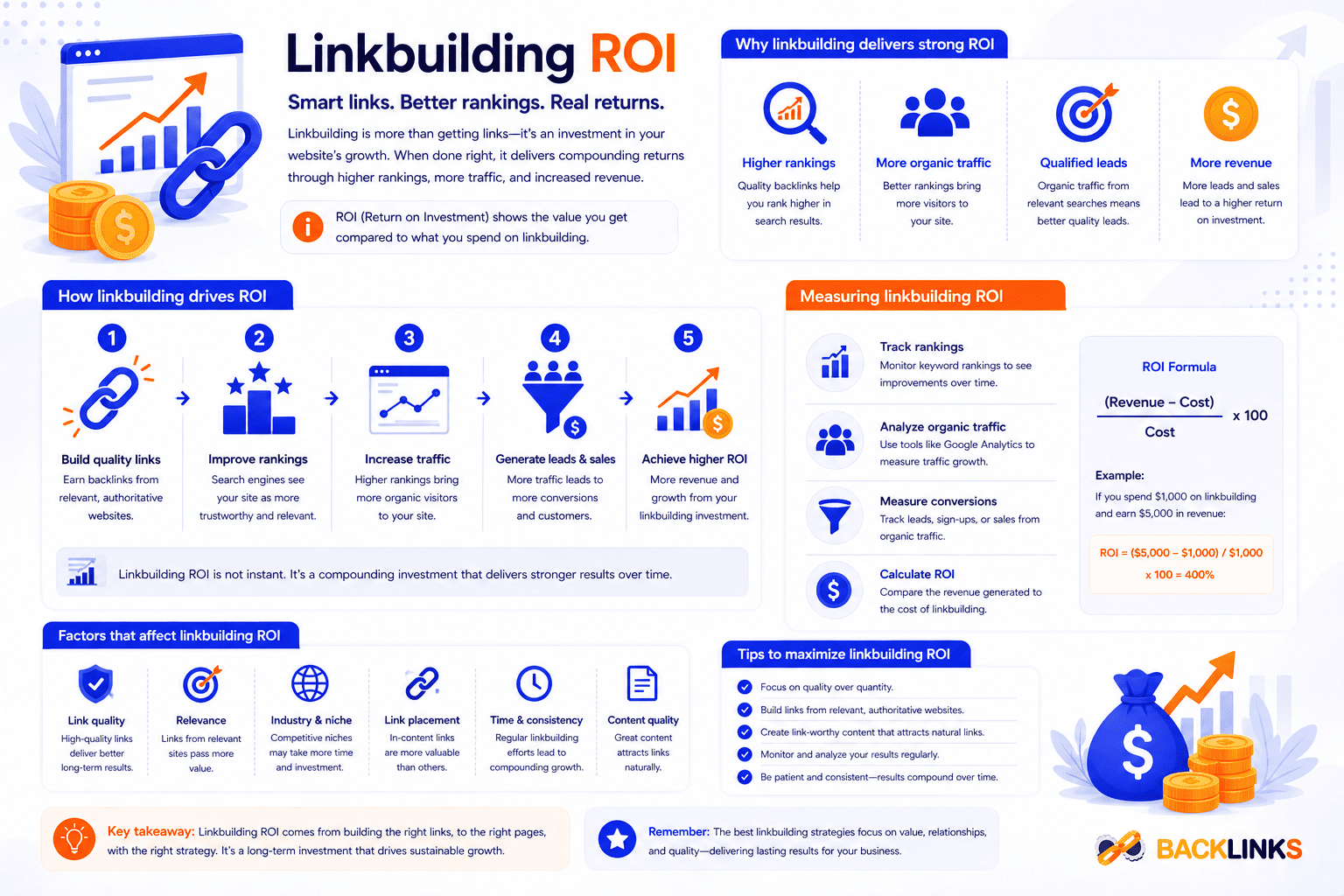
How to Measure and Maximize the Real Value of Backlinks
Linkbuilding is often treated as a necessary investment in SEO, but far fewer businesses have a clear framework for evaluating its return. Budgets are allocated, links are acquired, and rankings may improve—but the actual Linkbuilding ROI remains unclear.
This lack of clarity creates a common problem: companies either underinvest in linkbuilding because they cannot justify the cost, or overspend on tactics that deliver little measurable impact.
Understanding Linkbuilding ROI is not just about tracking rankings. It requires connecting backlinks to broader business outcomes such as organic traffic growth, lead generation, and revenue contribution.
This cluster page focuses specifically on how to evaluate, interpret, and improve Linkbuilding ROI. It builds on the broader principles outlined in the main guide to linkbuilding and narrows the focus to performance measurement and strategic decision-making.
What is Linkbuilding ROI
Linkbuilding ROI refers to the return generated from investments in acquiring backlinks. In practical terms, it measures whether the cost of link acquisition is justified by the value it creates for the business.
Unlike paid advertising, where ROI can often be tracked directly, Linkbuilding ROI is more complex. The impact of backlinks is indirect and accumulative, influencing multiple layers of SEO performance.
A realistic definition of Linkbuilding ROI includes:
- Improvements in keyword rankings
- Growth in organic traffic
- Increased conversions from organic channels
- Strengthening of domain authority over time
Because these outcomes are interconnected, Linkbuilding ROI should not be evaluated through a single metric.
Why Linkbuilding ROI Matters
Budget Allocation and Decision-Making
Without a clear understanding of ROI, it becomes difficult to decide how much to invest in linkbuilding or which strategies to prioritize. Businesses may either cut back prematurely or continue funding ineffective campaigns.
Long-Term SEO Sustainability
Linkbuilding is not a short-term tactic. Evaluating ROI helps ensure that your strategy supports sustainable growth rather than temporary ranking spikes.
Performance Accountability
For agencies and in-house teams alike, Linkbuilding ROI provides a framework for demonstrating value. It shifts the conversation from “how many links were built” to “what impact those links created.”
How Linkbuilding ROI Works in Practice
Linkbuilding ROI is not calculated through a simple formula. Instead, it is assessed by connecting multiple performance signals over time.
Step 1: Define the Investment
This includes all costs associated with linkbuilding:
- Content creation
- Outreach and relationship building
- Link placement fees
- Internal resources
Understanding the full cost is essential before evaluating returns.
Step 2: Track Ranking Improvements
Backlinks influence rankings, particularly for competitive keywords. Tracking keyword movement helps identify whether linkbuilding efforts are contributing to improved visibility.
This is often supported by cluster-level analysis, where specific pages targeted by backlinks show measurable ranking changes.
Step 3: Measure Organic Traffic Growth
As rankings improve, organic traffic should increase. However, this relationship is not always linear. Factors such as search intent, click-through rates, and competition also play a role.
The key is to isolate pages that received backlinks and monitor their traffic trends over time.
Step 4: Connect Traffic to Conversions
Traffic alone does not define ROI. The critical question is whether that traffic contributes to business outcomes.
This may include:
- Leads
- Sales
- Sign-ups
- Other conversion events
Attribution models can help, but it is important to recognize that SEO often plays a supporting role in multi-touch journeys.
Important Subtopics in Linkbuilding ROI
Direct vs Indirect ROI
Not all value from linkbuilding is immediately measurable.
Direct ROI includes outcomes such as increased conversions from organic traffic.
Indirect ROI includes:
- Brand visibility
- Increased trust signals
- Improved crawl efficiency
- Stronger internal linking impact
Both should be considered when evaluating performance.
Page-Level vs Domain-Level Impact
Backlinks can influence both individual pages and the domain as a whole.
- Page-level impact: Improved rankings for specific keywords
- Domain-level impact: Increased authority across multiple pages
This distinction is important when interpreting results. A link may not significantly move one page but can contribute to broader site performance.
Link Quality vs Cost Efficiency
Higher-cost links are not always higher-value links. Evaluating ROI requires balancing:
- Relevance
- Authority
- Placement quality
- Cost per link
In many cases, a well-placed contextual link on a relevant site delivers better ROI than a more expensive but less relevant placement.
Role of Internal Linking
Internal linking plays a critical role in amplifying Linkbuilding ROI. Authority gained from backlinks can be distributed across your site, strengthening multiple pages.
This is especially important in a pillar-and-cluster structure, where a central topic page supports multiple related articles.
Common Mistakes in Measuring Linkbuilding ROI
Focusing Only on Rankings
Ranking improvements are important, but they do not tell the full story. A keyword moving from position 8 to 3 may have a significant impact, while moving from 30 to 20 may not.
Ignoring Time Lag
Linkbuilding effects are rarely immediate. Evaluating ROI too early can lead to incorrect conclusions and premature strategy changes.
Treating All Links Equally
Not all backlinks contribute equally to ROI. Failing to differentiate between high-quality and low-quality links can distort performance analysis.
Overlooking Conversion Data
Traffic without conversions provides limited value. ROI must be tied to business outcomes, not just visibility metrics.
Practical Guidance for Improving Linkbuilding ROI
Align Linkbuilding with Business Goals
Start by identifying which pages drive the most value. These may be product pages, service pages, or high-intent content.
Focus linkbuilding efforts on these pages rather than distributing links evenly across the site.
Prioritize High-Impact Opportunities
Look for opportunities where backlinks are likely to influence rankings for valuable keywords. This often involves:
- Pages already ranking on page two
- Keywords with clear commercial intent
- Content that is already performing but lacks authority
Integrate with Content Strategy
Linkbuilding works best when combined with strong content. Pages that offer unique insights, data, or practical value are more likely to benefit from backlinks.
Monitor Performance Consistently
ROI evaluation should be ongoing. Track:
- Ranking trends
- Traffic patterns
- Conversion performance
This allows for adjustments and optimization over time.
Timing and Expectations
Linkbuilding ROI develops gradually. It is influenced by factors such as competition, domain authority, and existing content quality.
In most cases:
- Early signals may appear within a few weeks
- Noticeable ranking improvements often take several months
- Full ROI may take longer, particularly in competitive niches
It is important to set expectations accordingly and avoid judging performance too quickly.
Conclusion
Linkbuilding ROI is not a simple metric, but it is a critical concept for making informed SEO decisions. It requires a structured approach that connects backlinks to rankings, traffic, and ultimately business outcomes.
When approached strategically, Linkbuilding becomes more than a cost—it becomes a long-term investment in authority and visibility.
By focusing on relevance, quality, and alignment with broader SEO goals, businesses can not only measure Linkbuilding ROI more effectively but also improve it over time.