
Black Hat vs White Hat Linkbuilding: Understanding the Trade-Offs in Modern SEO
Linkbuilding remains one of the most influential factors in search engine rankings, but not all linkbuilding approaches are equal. The distinction between black hat vs white hat linkbuilding is often presented as a simple ethical divide. In practice, the reality is more nuanced.
Businesses frequently face a strategic decision: prioritize speed and short-term gains, or focus on sustainability and long-term authority. Misunderstanding this distinction can lead to wasted resources, unstable rankings, or even penalties.
This article provides a clear, experience-based perspective on black hat vs white hat linkbuilding. It explains how each approach works, where the risks lie, and how to make informed decisions within a broader SEO strategy.
What is Black Hat vs White Hat Linkbuilding
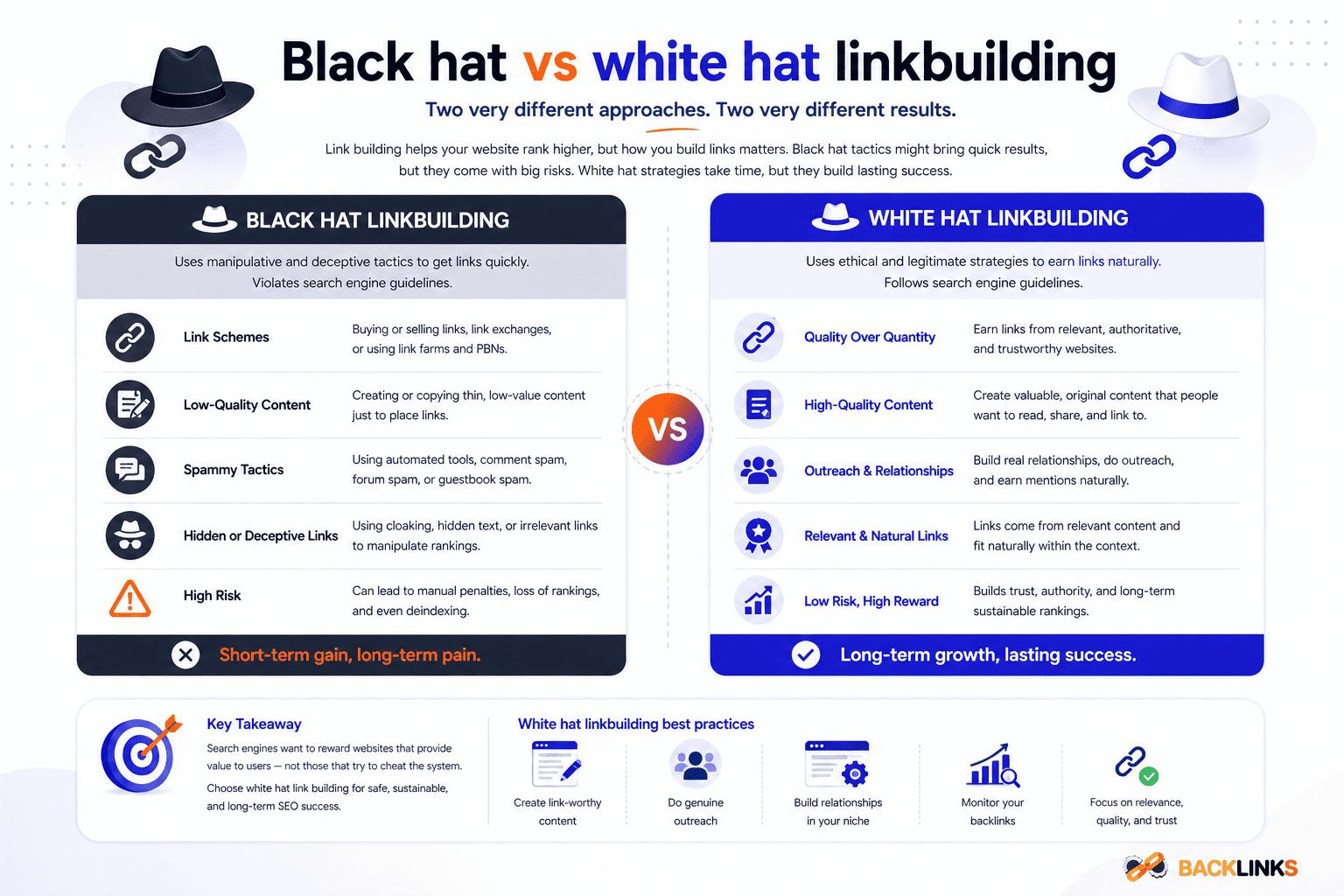
At its core, the difference between black hat and white hat linkbuilding comes down to intent and compliance with search engine guidelines.
White hat linkbuilding focuses on earning backlinks through legitimate, value-driven methods. These links are typically editorial, relevant, and aligned with user benefit.
Black hat linkbuilding involves manipulating search rankings through tactics that violate or attempt to bypass search engine guidelines. These links are often artificial, scaled aggressively, and designed primarily for ranking impact.
In practical terms, the distinction is not always binary. Many strategies exist on a spectrum, with some approaches blending elements of both depending on execution.
Why This Distinction Matters
Impact on Rankings and Stability
Both approaches can influence rankings, but their long-term effects differ significantly.
White hat methods tend to produce gradual, stable improvements. Black hat tactics may generate faster gains but often lack durability and can reverse unexpectedly.
Risk Exposure
The primary difference is risk. Black hat linkbuilding increases the likelihood of:
- Algorithmic devaluation
- Manual penalties
- Loss of trust signals
White hat strategies reduce these risks by aligning with how search engines evaluate quality.
Strategic Alignment
For businesses building long-term authority, especially within a structured content system, consistency matters. A short-term gain that disrupts long-term performance can undermine the entire SEO investment.
How Black Hat and White Hat Linkbuilding Work
White Hat Linkbuilding Mechanics
White hat linkbuilding relies on earning links through value and relevance. Common approaches include:
- Creating high-quality, reference-worthy content
- Outreach to relevant websites for editorial placements
- Leveraging strategies like broken link building
- Developing linkbait content that attracts natural citations
These methods depend on content strength and relationship-building rather than manipulation.
Black Hat Linkbuilding Mechanics
Black hat tactics focus on generating backlinks at scale, often with minimal regard for quality or relevance. Examples include:
- Private blog networks (PBNs) with low editorial standards
- Automated link generation
- Buying large volumes of low-quality links
- Over-optimized anchor text strategies
The objective is to artificially inflate authority signals.
Important Subtopics in Black Hat vs White Hat Linkbuilding
The Gray Area Between Approaches
In practice, not all linkbuilding fits neatly into black or white categories.
For example, paid backlinks can be implemented in ways that mimic editorial placements or in ways that clearly violate guidelines. The difference lies in execution, relevance, and intent.
Understanding this gray area is essential for making informed decisions rather than relying on rigid definitions.
Role Within a Broader Linkbuilding Strategy
White hat methods are typically the foundation of a sustainable strategy. They integrate naturally with content development and internal linking structures.
Black hat tactics, when used, are often isolated and short-term. They rarely integrate well with a long-term content architecture.
For sites following a pillar-and-cluster model, maintaining consistency in link quality is particularly important. Authority gained at the pillar level should support cluster pages through internal linking, which depends on stable external signals.
Relevance and Context
Regardless of approach, relevance remains a critical factor.
A highly relevant link from a modest site can outperform a low-relevance link from a high-authority domain. Black hat strategies often overlook this, focusing instead on volume or metrics that do not reflect true value.
Common Mistakes
Assuming White Hat Means Slow Results
White hat linkbuilding is often perceived as too slow. While it typically requires more effort, well-executed strategies can produce meaningful results within competitive timelines.
The issue is not speed, but expectations and consistency.
Overestimating Short-Term Gains
Black hat tactics may produce initial ranking improvements, but these gains are often unstable. Relying on them as a primary strategy increases long-term risk.
Ignoring Content Quality
Both approaches fail without strong content. Even aggressive linkbuilding cannot sustain rankings if the underlying pages do not meet user expectations.
Misjudging Risk Tolerance
Different businesses have different risk profiles. Treating all linkbuilding decisions as purely technical ignores the broader business context.
Practical Guidance
Define Your Risk Strategy
Before choosing an approach, clarify your tolerance for risk.
- If long-term stability is critical, prioritize white hat methods
- If operating in a highly competitive niche, understand the trade-offs before adopting more aggressive tactics
This decision should align with business goals, not just SEO metrics.
Build a Strong Foundation
A sustainable linkbuilding strategy starts with:
- High-quality content
- Clear topical focus
- Effective internal linking
Without this foundation, even high-quality backlinks will have limited impact.
Use White Hat as the Core Strategy
White hat linkbuilding should form the majority of your efforts. This includes:
- Creating linkable assets
- Leveraging outreach where appropriate
- Integrating with your content cluster
This approach builds authority that compounds over time.
Approach Gray-Area Tactics Carefully
If considering tactics that fall outside strict white hat definitions, evaluate:
- Relevance and placement quality
- Anchor text diversity
- Link acquisition patterns
The goal is to avoid signals that appear manipulative, even if the method itself is commonly used.
Timing and Expectations
The timeline for results varies depending on the approach.
White hat linkbuilding typically produces:
- Gradual ranking improvements
- Increasing stability over time
- Compounding authority benefits
Black hat tactics may show:
- Faster initial movement
- Higher volatility
- Greater risk of sudden decline
In most cases, sustainable growth requires patience and consistent execution rather than rapid scaling.
Conclusion
The discussion around black hat vs white hat linkbuilding is not just about ethics—it is about strategy, risk, and long-term performance.
White hat approaches align with how search engines evaluate quality, making them more reliable for building lasting authority. Black hat tactics, while sometimes effective in the short term, introduce uncertainty that can undermine broader SEO efforts.
For most businesses, the objective should not be to choose one extreme, but to understand the implications of each approach and make decisions accordingly.
A well-structured linkbuilding strategy, supported by strong content and internal linking, provides a more stable path to growth. Over time, this consistency becomes a competitive advantage that is difficult to replicate through shortcuts.