
Google Penalties from Backlinks: Causes, Detection, and Recovery Strategies
Backlinks are a foundational element of SEO, but they also introduce one of the most misunderstood risks: penalties related to unnatural linking. Many websites invest in linkbuilding without fully understanding how search engines evaluate link quality and patterns.
The result is often confusion. Rankings drop, traffic declines, and the cause is unclear. In some cases, the issue is tied directly to google penalties backlinks—either through manual actions or algorithmic devaluation.
This article explains how backlink-related penalties work, what triggers them, and how to respond effectively. The goal is not just to avoid penalties, but to build a backlink profile that remains stable under evolving search engine standards.
What are Google Penalties from Backlinks
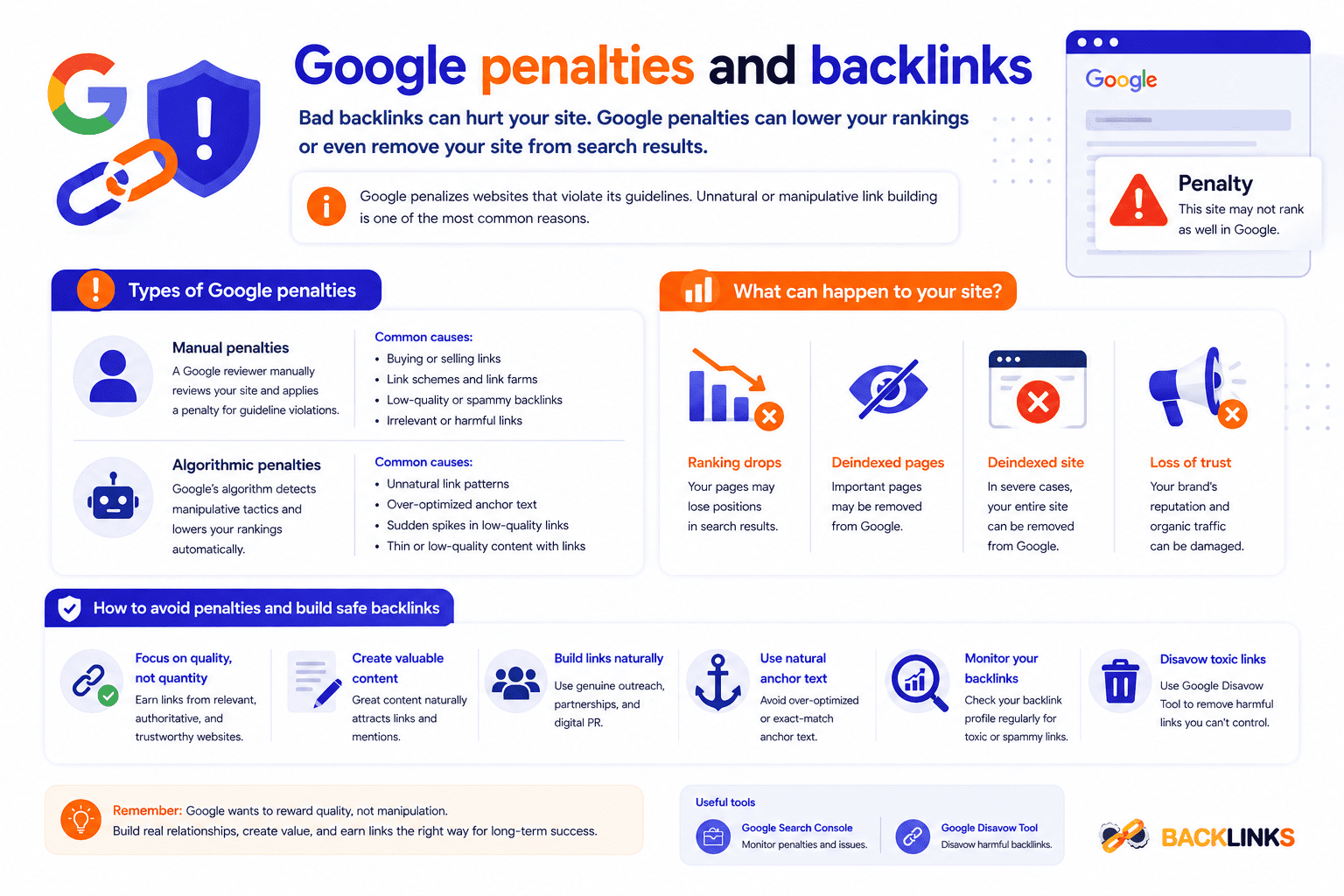
Google penalties from backlinks refer to negative ranking impacts caused by link profiles that violate search engine guidelines or appear manipulative.
These penalties fall into two main categories:
- Manual actions: Applied by human reviewers when a site is flagged for unnatural links
- Algorithmic adjustments: Automatic devaluation of links or rankings based on detected patterns
In practical terms, a penalty does not always mean a complete removal from search results. More often, it results in:
- Loss of rankings for specific keywords
- Reduced trust signals across the domain
- Devaluation of certain backlinks
Understanding the difference between penalty types is essential for diagnosing and resolving issues.
Why Backlink Penalties Matter
Direct Impact on Rankings
Backlink penalties can significantly reduce visibility, especially for pages that rely heavily on external links for authority. A site may lose positions across multiple keywords, not just isolated queries.
Loss of Link Value
Even without a formal penalty, low-quality or suspicious links may simply be ignored. This reduces the effectiveness of linkbuilding efforts and lowers overall ROI.
Long-Term Trust Signals
Repeated issues with unnatural links can affect how a domain is evaluated over time. Recovery is possible, but rebuilding trust often requires sustained effort.
Strategic Risk in Linkbuilding
Understanding penalties is critical when evaluating different linkbuilding approaches, including gray-area tactics such as paid placements. The risk is not always immediate, but it accumulates through patterns.
How Google Evaluates Backlinks
Search engines assess backlinks using a combination of signals rather than a single metric.
Link Quality and Relevance
Google evaluates whether links come from relevant, trustworthy sources. A link from an unrelated or low-quality site carries less value and may contribute to risk.
Anchor Text Patterns
Over-optimized anchor text—particularly repeated exact-match keywords—can indicate manipulation. Natural link profiles tend to include a mix of branded, generic, and partial anchors.
Link Velocity and Patterns
The rate at which links are acquired matters. Sudden spikes, especially from similar sources, can appear unnatural.
Network Signals
Links originating from interconnected or low-quality networks may be flagged. This is common in poorly maintained private blog networks or automated link schemes.
Important Subtopics in Google Penalties Backlinks
Manual Actions vs Algorithmic Effects
Manual Actions
Manual penalties are explicitly communicated through tools such as Google Search Console. They typically include details about the issue, such as “unnatural links to your site.”
These require direct remediation and reconsideration requests.
Algorithmic Devaluation
Algorithmic effects are more subtle. There is no direct notification, but rankings decline as links are discounted or signals are reduced.
In many cases, this is tied to updates that refine how link quality is evaluated.
Toxic vs Low-Value Links
Not all problematic links are harmful in the same way.
- Toxic links may contribute to penalties or manual actions
- Low-value links are simply ignored and provide no benefit
Understanding this distinction prevents overreaction, such as unnecessary disavow efforts.
Role of Intent and Patterns
Google does not evaluate links in isolation. It looks for patterns that suggest manipulation.
For example:
- Consistent use of commercial anchor text
- Links from unrelated niches
- Repeated placements across similar domains
This pattern-based evaluation is why isolated links rarely cause issues, but systematic practices can.
Common Mistakes
Overusing Exact-Match Anchors
One of the most frequent issues is aggressive anchor text optimization. Repeating the same keyword across multiple backlinks creates a clear pattern.
Relying on Low-Quality Link Sources
Links from poorly maintained sites, thin content pages, or obvious link farms contribute little value and increase risk.
Reacting Too Late
Many sites only investigate backlinks after a significant drop in traffic. By that point, the issue may be widespread and harder to resolve.
Misdiagnosing the Problem
Not every ranking drop is caused by backlinks. Technical issues, content quality, or algorithm updates can also play a role. Incorrect diagnosis leads to ineffective solutions.
Practical Guidance
Audit Your Backlink Profile Regularly
A proactive approach is essential. Regular audits help identify:
- Unusual spikes in link acquisition
- Patterns in anchor text usage
- Links from irrelevant or suspicious domains
This allows issues to be addressed before they escalate.
Focus on Link Quality Over Volume
Building fewer, high-quality links reduces risk and improves long-term performance. Relevance and placement context should guide decision-making.
Maintain Anchor Text Diversity
A natural backlink profile includes variation. Avoid concentrating too heavily on commercial keywords.
Use Disavow Carefully
The disavow tool should be used selectively. It is most appropriate when:
- There is clear evidence of harmful links
- A manual action has been applied
- Removal of links is not feasible
Overuse can lead to unnecessary loss of legitimate link value.
Align Linkbuilding with Content Strategy
Strong content reduces reliance on aggressive link tactics. For example, creating valuable resources or linkbait content can attract natural backlinks, lowering the need for higher-risk methods.
Timing and Expectations
Recovery from backlink-related penalties varies depending on the severity and type of issue.
- Manual actions may take weeks to resolve after submitting a reconsideration request
- Algorithmic effects may take longer, often depending on when search engines re-evaluate the site
- Full recovery can require several months, particularly if the link profile needs significant restructuring
It is important to approach recovery with patience and consistency rather than expecting immediate results.
Conclusion
Google penalties from backlinks are not random events. They are the result of patterns that signal manipulation or low-quality linkbuilding practices.
Understanding how these penalties work allows for more informed decisions—not just in recovery, but in prevention. A well-managed backlink profile focuses on relevance, diversity, and long-term value.
Rather than treating penalties as isolated incidents, they should be viewed as feedback on overall strategy. By aligning linkbuilding efforts with quality standards and integrating them into a broader SEO framework, it is possible to build authority without exposing the site to unnecessary risk.
Sustainable SEO depends on consistency. The goal is not simply to avoid penalties, but to create a link profile that remains resilient as search engine evaluation continues to evolve.