
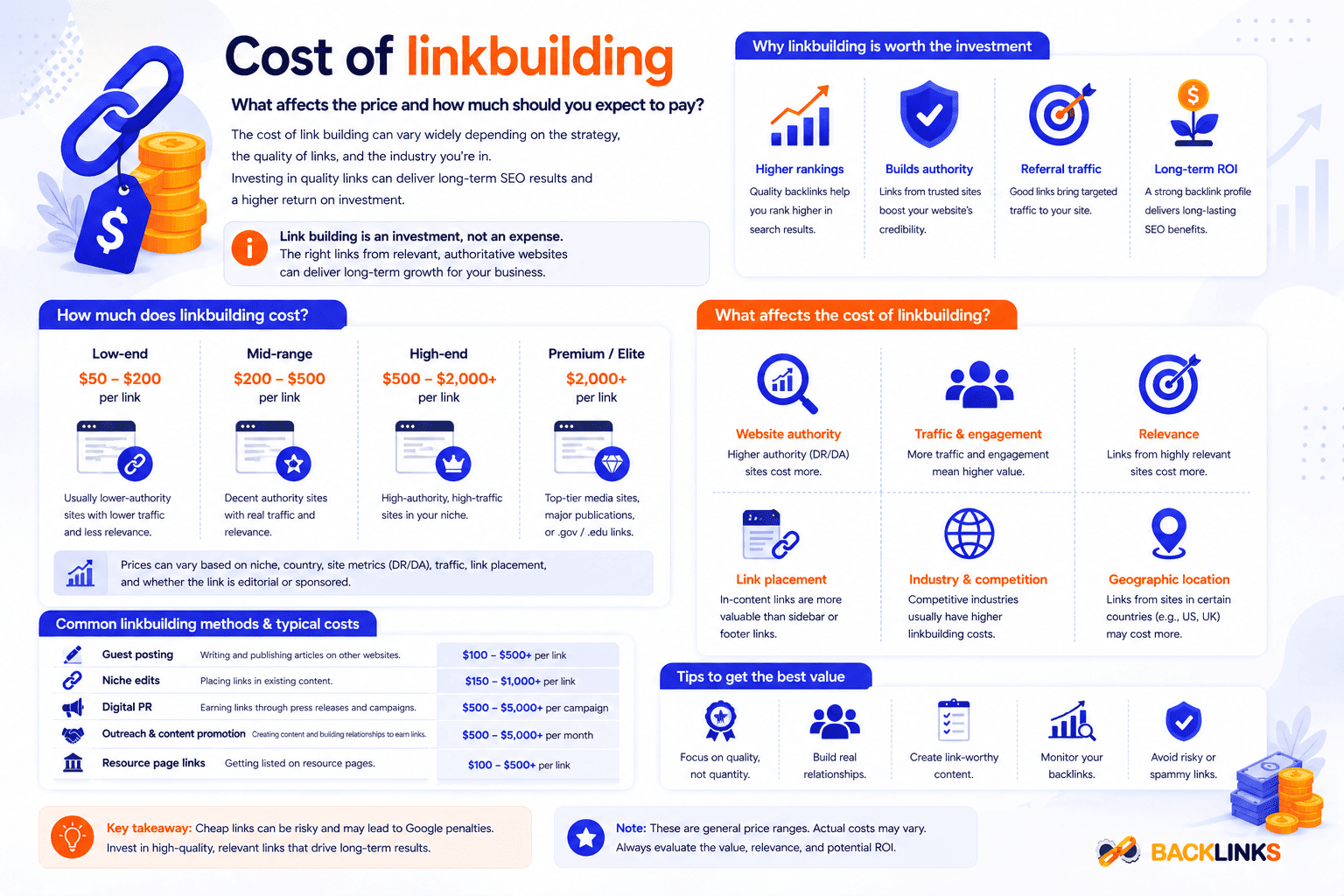
Linkbuilding Cost: What You’re Really Paying For and How to Evaluate It
Linkbuilding is often one of the most debated areas of SEO budgeting. Businesses know that backlinks are important, but when it comes to cost, the landscape is unclear. Prices vary widely, results are inconsistent, and expectations are often misaligned.
Some companies invest heavily without seeing proportional returns. Others underinvest and fail to compete in search results. The issue is not just how much linkbuilding costs, but how that cost is structured and evaluated.
This article breaks down linkbuilding cost from a strategic perspective. It explains what drives cost, how to interpret pricing, and how to align investment with meaningful SEO outcomes.
What is Linkbuilding Cost
Linkbuilding cost refers to the total investment required to acquire backlinks as part of an SEO strategy.
In practical terms, this includes more than just paying for links. It often involves:
- Content creation
- Outreach and relationship building
- Placement fees or sponsorships
- Internal resources and time
The cost can be direct (e.g., paying for a link placement) or indirect (e.g., producing high-quality content that attracts links).
Understanding linkbuilding cost requires looking at the full process, not just the final link.
Why Linkbuilding Cost Matters
Budget Allocation
Linkbuilding is typically one of the most resource-intensive aspects of SEO. Without a clear understanding of cost, it becomes difficult to allocate budget effectively across channels such as content, technical optimization, and paid acquisition.
ROI Evaluation
Cost alone is not meaningful without context. A high-cost link may deliver strong value if it improves rankings for high-intent keywords. A low-cost link may deliver little or no impact.
Evaluating linkbuilding cost is closely tied to understanding ROI, particularly how backlinks contribute to traffic and conversions.
Competitive Positioning
In competitive industries, linkbuilding investment often reflects the level of competition. Underestimating cost can result in slow progress or inability to rank for key terms.
How Linkbuilding Cost Works
Linkbuilding cost is shaped by multiple variables rather than a fixed pricing model.
Content Development
High-quality backlinks often depend on strong content. This includes:
- Research-driven articles
- Resource pages
- Linkbait content designed to attract references
The cost here is tied to quality, depth, and uniqueness.
Outreach and Acquisition
Building relationships and securing placements requires time and effort. This includes:
- Prospecting relevant websites
- Communicating with site owners
- Negotiating placements
Even when links are not paid for directly, outreach has a cost in terms of labor.
Placement Fees
In some cases, websites charge for publishing content or including links. These fees vary based on:
- Domain authority
- Traffic levels
- Niche relevance
- Editorial standards
This is often where the most visible variation in linkbuilding cost occurs.
Internal Resources
For in-house teams, cost includes:
- Staff time
- Tools and software
- Ongoing management and analysis
These indirect costs are often overlooked but can be significant.
Important Subtopics in Linkbuilding Cost
Cost vs Value
A key mistake is equating cost with value. Higher-priced links are not automatically better.
Value depends on:
- Relevance to your niche
- Placement within content
- Potential impact on rankings
A well-placed link on a relevant site may deliver more value than a more expensive but less relevant option.
Link Type and Pricing Differences
Different linkbuilding approaches have different cost structures.
- Outreach-based links may require more time but lower direct fees
- Paid placements may have higher upfront costs
- Content-driven strategies may shift cost toward creation rather than acquisition
Understanding these differences helps in choosing the right mix.
Role Within a Content Cluster
In a pillar-and-cluster model, linkbuilding cost should be aligned with strategic priorities.
For example:
- Investing in links to a central pillar page can strengthen the entire topic
- Supporting cluster pages may require fewer links but benefit from internal linking
This approach improves cost efficiency by focusing on high-impact areas.
Cost of Poor Quality Links
Low-cost links often come with hidden costs:
- Limited or no ranking impact
- Potential risk to backlink profile quality
- Need for future cleanup or disavow
In many cases, these costs outweigh the initial savings.
Common Mistakes
Focusing Only on Price Per Link
Evaluating linkbuilding purely on cost per link ignores context. A cheaper link is not necessarily a better investment.
Underestimating Content Costs
Content is a major driver of linkbuilding success. Skipping investment in content often reduces the effectiveness of backlinks.
Over-Reliance on One Method
Relying solely on paid links or a single acquisition method can increase risk and reduce long-term effectiveness.
Ignoring Long-Term Impact
Short-term cost savings can lead to long-term inefficiencies if links do not contribute to sustainable growth.
Practical Guidance
Define Clear Objectives
Before investing in linkbuilding, identify:
- Target pages
- Priority keywords
- Business outcomes (traffic, leads, revenue)
This ensures that cost is aligned with measurable goals.
Prioritize High-Impact Pages
Focus linkbuilding efforts on pages that can deliver meaningful results. These are often:
- Pages ranking on page two
- Content targeting high-intent queries
- Core pages within your topic cluster
This improves cost efficiency by concentrating resources where they matter most.
Balance Cost Across Methods
A diversified approach typically delivers better results. This may include:
- Content-driven link acquisition
- Outreach-based placements
- Selective use of paid links
Balancing methods helps control cost while maintaining quality.
Evaluate Links Holistically
When assessing a link, consider:
- Relevance
- Content context
- Site quality
- Potential traffic and visibility
This approach provides a more accurate view of value than cost alone.
Timing and Expectations
Linkbuilding cost should be evaluated over time, not in isolation.
In most cases:
- Initial investments may not produce immediate results
- Rankings improve gradually as authority builds
- The value of backlinks compounds over months
Short-term evaluation often underestimates the true impact of linkbuilding.
Conclusion
Linkbuilding cost is not a fixed number—it is a reflection of strategy, quality, and execution. Understanding what drives cost allows businesses to make more informed decisions and avoid common pitfalls.
Rather than focusing on the cheapest option or the highest volume, the goal should be to invest in links that support long-term authority and relevance.
When aligned with a structured content strategy and clear objectives, linkbuilding becomes a scalable investment rather than an unpredictable expense. Over time, this approach leads to more stable rankings, stronger visibility, and more efficient use of resources.