
Guest Blogging Linkbuilding: How to Build Authority Through Strategic Content Placement
Guest blogging has been part of SEO for years, but its role has changed significantly. What was once a volume-driven tactic is now a more refined, quality-focused strategy.
Today, guest blogging linkbuilding is less about acquiring as many backlinks as possible and more about placing the right links in the right context. The difference is critical. Poor execution leads to low-value links or even risk, while strategic execution contributes directly to authority, rankings, and long-term visibility.
This article explains how guest blogging linkbuilding works in modern SEO, why it still matters, and how to apply it effectively within a structured content and linkbuilding strategy.
What is Guest Blogging Linkbuilding
Guest blogging linkbuilding is the process of publishing content on external websites to earn backlinks that support your own site’s SEO performance.
In practical terms, it involves:
- Contributing original content to a third-party website
- Embedding contextual links within that content
- Aligning the content with both the host site’s audience and your SEO goals
The defining characteristic is that the link is earned through content contribution rather than direct placement or automation.
However, not all guest blogging qualifies as effective linkbuilding. The value depends on relevance, editorial quality, and how naturally the link fits into the content.
Why Guest Blogging Linkbuilding Matters
Delivers Contextual Backlinks
Guest blogging allows you to place links within the body of relevant content. These contextual placements are among the strongest types of backlinks because they align with how search engines interpret natural linking behavior.
Strengthens Topical Authority
Publishing content on relevant websites reinforces your association with specific topics. This contributes to topical authority, especially when combined with a well-structured content cluster on your own site.
Provides Controlled Link Placement
Unlike passive link acquisition methods, guest blogging gives you control over:
- The content
- The topic
- The placement of the link
This control makes it easier to align backlinks with strategic priorities.
Supports Broader Linkbuilding Strategy
Guest blogging works well alongside other approaches such as niche edits, content-driven linkbuilding, and linkbait content. It fills a specific role by combining content creation with link acquisition.
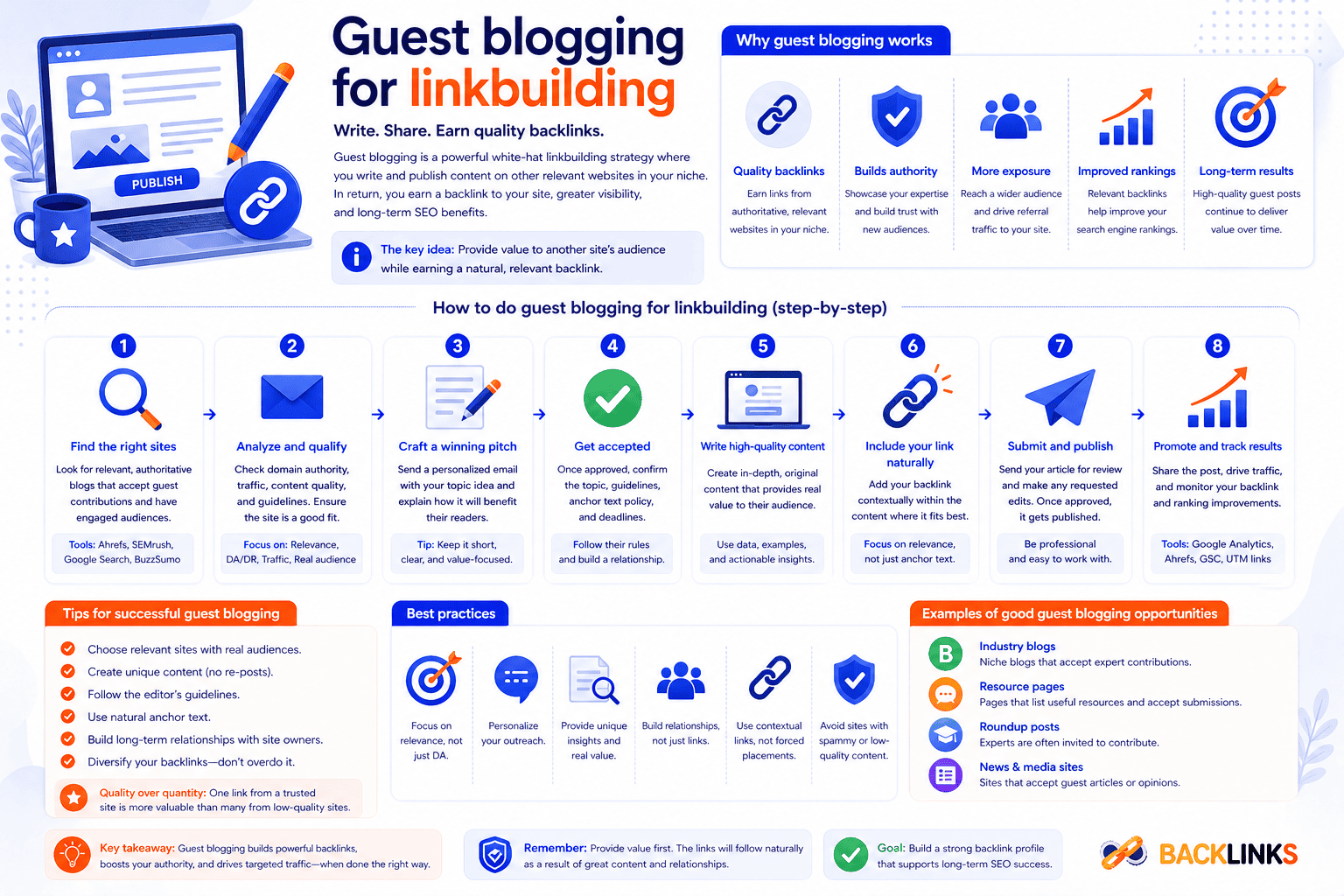
How Guest Blogging Linkbuilding Works
Effective guest blogging requires more than writing and publishing content. It is a structured process that prioritizes relevance and value.
Step 1: Identify High-Quality Opportunities
Start by selecting websites that are:
- Relevant to your niche
- Consistent in content quality
- Active and regularly updated
Avoid focusing solely on metrics. A smaller, relevant site often provides more value than a larger, unrelated one.
Step 2: Understand the Audience and Content Style
Before creating content, analyze:
- The tone and format of existing articles
- The topics that perform well
- The level of depth expected
This ensures your content fits naturally and increases the likelihood of acceptance.
Step 3: Create Valuable, Non-Promotional Content
The content should stand on its own. It should:
- Provide useful insights or explanations
- Address a specific topic clearly
- Align with the host site’s audience
Content that feels promotional or generic reduces both acceptance rates and SEO value.
Step 4: Insert Links Strategically
Links should be placed within relevant sections of the content. They should:
- Support the surrounding topic
- Use natural anchor text
- Add value to the reader
Forced or irrelevant links are often ignored or removed.
Important Subtopics in Guest Blogging Linkbuilding
Relevance Over Authority
A common misconception is that higher authority always means better links. In reality, relevance often plays a more important role.
A contextual link from a niche-specific site can outperform a link from a broader but less relevant platform.
Anchor Text Strategy
Anchor text should reflect natural usage patterns. This includes:
- Brand mentions
- Partial keyword phrases
- Descriptive anchors
Overuse of exact-match keywords can create patterns that reduce trust and increase risk.
Editorial Standards and Link Value
The quality of the host site’s content directly affects the value of the link.
Sites with strong editorial standards tend to:
- Publish more relevant content
- Maintain consistency
- Provide better contextual environments for links
Low-quality sites may offer easy placements but deliver limited SEO benefit.
Integration with Content Clusters
Guest blogging should support your internal structure.
For example, links can point to:
- Core topic pages within your linkbuilding strategy
- Supporting cluster pages that cover specific subtopics
This allows external authority to strengthen multiple pages through internal linking.
Common Mistakes
Focusing on Quantity
Publishing large numbers of guest posts on low-quality sites rarely produces meaningful results. Quality and relevance should take priority.
Ignoring Content Fit
Content that does not align with the host site’s audience is less likely to perform well and may not provide strong link value.
Over-Optimizing Links
Using the same anchor text repeatedly across guest posts creates unnatural patterns. This is a common issue in poorly managed campaigns.
Treating Guest Blogging as Transactional
Approaching guest blogging purely as a link exchange reduces its effectiveness. The focus should be on contributing value, not just acquiring links.
Practical Guidance
Prioritize Strategic Placement
Focus on placements where:
- The content aligns closely with your niche
- The link supports a relevant topic
- The site maintains consistent quality
This approach improves both SEO value and long-term stability.
Align with Your Content Strategy
Guest blogging should reinforce your existing content.
For example, linking to key pages within your content cluster—such as those covering linkbuilding cost or content-driven strategies—helps strengthen your overall topic authority.
Maintain Consistency
Linkbuilding through guest blogging is most effective when done consistently. A steady flow of high-quality placements builds authority over time.
Combine with Other Linkbuilding Methods
Use guest blogging alongside:
- Content-driven linkbuilding
- Linkbait content
- Niche edits
This creates a more natural and diversified backlink profile.
Timing and Expectations
Guest blogging linkbuilding produces results over time rather than immediately.
Typically:
- Links are indexed within days or weeks
- Ranking improvements develop gradually
- Long-term impact depends on consistency and link quality
It is important to evaluate performance over months, not weeks.
Conclusion
Guest blogging linkbuilding remains a valuable strategy when applied with a focus on quality, relevance, and strategic alignment.
The shift from volume-based tactics to value-driven execution reflects how search engines evaluate backlinks today. Links that are embedded within meaningful content and relevant contexts carry more weight and provide more sustainable results.
When integrated into a broader SEO framework, guest blogging becomes more than a linkbuilding tactic. It becomes a structured method for building authority, supporting content clusters, and strengthening long-term search visibility.
The key is consistency and intent. By prioritizing meaningful placements over quick wins, you create a link profile that supports growth rather than temporary gains.