
Linkbuilding Content Marketing: How to Earn Backlinks Through Strategic Content
Many linkbuilding strategies focus on acquisition tactics—outreach, placements, or partnerships. While these methods can be effective, they often require continuous effort and do not always scale efficiently.
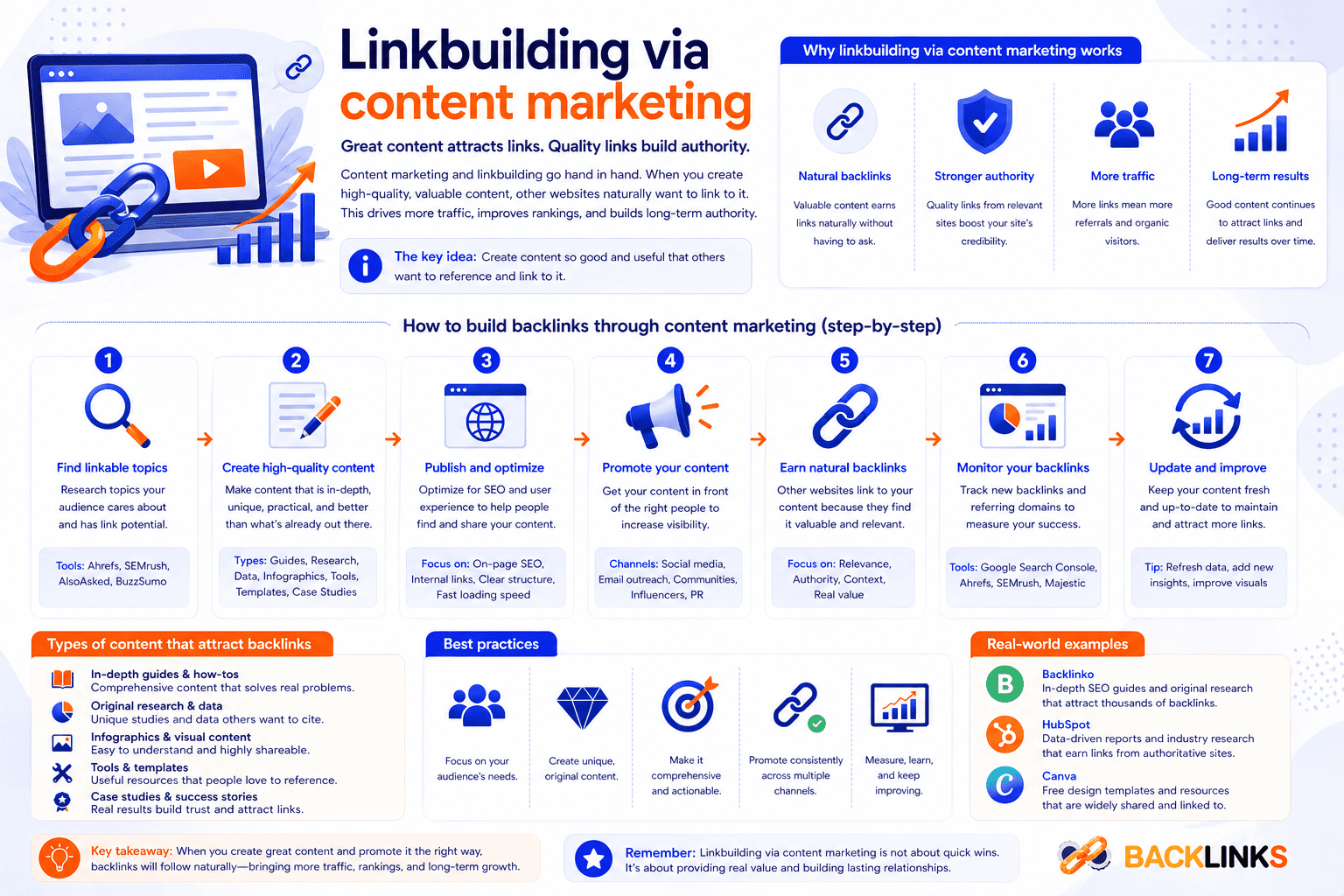
Linkbuilding content marketing takes a different approach. Instead of relying primarily on outreach, it focuses on creating content that naturally attracts backlinks over time. When executed correctly, this approach turns content into a long-term asset that supports both SEO performance and brand authority.
However, not all content contributes to linkbuilding. The difference lies in how content is planned, structured, and positioned within a broader SEO strategy.
This article explains how linkbuilding content marketing works, why it matters, and how to apply it in a practical, sustainable way.
What is Linkbuilding Content Marketing
Linkbuilding content marketing is the process of creating and distributing content specifically designed to earn backlinks.
In practical terms, it involves:
- Identifying topics that are likely to be referenced
- Producing high-value content that addresses those topics
- Structuring content in a way that makes it easy to cite and link to
The goal is not just to attract visitors, but to become a source that other websites rely on when creating their own content.
This distinguishes linkbuilding content marketing from general content marketing, which may prioritize traffic or engagement without considering link acquisition.
Why Linkbuilding Content Marketing Matters
Aligns with Search Engine Expectations
Search engines reward content that earns links naturally. Linkbuilding content marketing supports this by focusing on value and relevance rather than manipulation.
This reduces reliance on higher-risk tactics and improves long-term stability.
Builds Sustainable Authority
When content consistently earns backlinks, it strengthens domain authority over time. Unlike one-time link placements, content-driven links can accumulate and compound.
Supports Topical Clusters
In a pillar-and-cluster structure, linkable content plays a central role. Backlinks to key pages reinforce the authority of the entire topic through internal linking.
For example, a strong resource within your linkbuilding cluster can pass authority to related articles such as those covering niche edits or linkbuilding cost.
Improves Link Quality
Links earned through content are typically editorial. They are placed because the content is useful, which often results in:
- Better contextual placement
- Higher relevance
- Greater long-term value
How Linkbuilding Content Marketing Works
This approach depends on aligning content creation with link opportunities.
Step 1: Identify Linkable Topics
Not all topics attract backlinks. Linkable topics tend to:
- Be frequently referenced by other content creators
- Address complex or important questions
- Fill gaps in existing resources
This requires understanding both user intent and content demand within your niche.
Step 2: Create Link-Worthy Content
The content must provide clear value. This often includes:
- In-depth explanations of specific topics
- Practical frameworks or strategies
- Well-structured guides that simplify complex concepts
Clarity and usefulness are more important than length.
Step 3: Structure Content for Referencing
Content should be easy to cite. This means:
- Using clear headings and logical flow
- Presenting ideas in a structured way
- Making key points easy to extract
Well-structured content is more likely to be referenced by other authors.
Step 4: Integrate with Internal Linking
Linkbuilding content marketing is most effective when integrated into your site architecture.
For example:
- A central guide (pillar page) provides broad coverage
- Supporting cluster pages explore specific subtopics
- Internal links distribute authority across the structure
This ensures that backlinks benefit more than a single page.
Step 5: Enable Visibility
Even high-quality content needs exposure. Initial visibility can come from:
- Internal linking
- Selective outreach
- Inclusion in existing content ecosystems
The goal is to reach the audience most likely to reference your content.
Important Subtopics in Linkbuilding Content Marketing
Linkbait Content as a Core Strategy
Linkbait content is a key component of this approach. It is designed specifically to attract backlinks by offering unique or highly useful information.
Examples include:
- Comprehensive guides
- Insightful analysis
- Clearly structured resources
When aligned with your content cluster, linkbait can act as a central authority-building asset.
Relevance and Topical Authority
Content must align closely with your niche. Backlinks from relevant contexts reinforce topical authority, which is increasingly important in modern SEO.
This is why content should be developed within a clearly defined topic structure rather than scattered across unrelated subjects.
Relationship with Outreach
Content marketing does not replace outreach—it enhances it.
When you have strong content, outreach becomes more effective. Instead of asking for links, you are presenting something that already has value.
This shifts the dynamic from request-based to value-based link acquisition.
Compounding Effect Over Time
Unlike transactional linkbuilding, content-driven links accumulate gradually. A single piece of content can continue earning backlinks long after publication.
This creates a compounding effect that strengthens authority over time.
Common Mistakes
Creating Content Without Link Intent
Not all content is designed to attract backlinks. Publishing articles without considering linkability often results in limited SEO impact.
Prioritizing Volume Over Value
Producing large amounts of content does not guarantee results. Linkbuilding content marketing requires depth, clarity, and usefulness.
Ignoring Content Distribution
Even strong content may not gain traction without initial visibility. Failing to promote content reduces its ability to attract links.
Treating Content and Linkbuilding Separately
Separating content creation from linkbuilding strategy limits effectiveness. The two should be integrated from the planning stage.
Practical Guidance
Focus on High-Impact Content
Identify a small number of pages that can serve as linkable assets. Invest in making these pages as useful and well-structured as possible.
Align Content with Search and Link Intent
Understand both what users are searching for and what content creators are likely to reference. This dual focus improves link acquisition potential.
Build Within a Structured Framework
Develop content within a clear topic structure. This allows authority gained from backlinks to support multiple pages.
Combine with Other Linkbuilding Methods
Linkbuilding content marketing works best alongside:
- Guest blogging
- Niche edits
- Selective outreach
This creates a balanced and resilient backlink profile.
Timing and Expectations
Linkbuilding content marketing is a long-term strategy.
In most cases:
- Initial engagement may occur shortly after publication
- Backlinks accumulate gradually over time
- Significant impact may take several months
The timeline depends on content quality, competition, and visibility.
Consistency is more important than speed.
Conclusion
Linkbuilding content marketing shifts the focus from acquiring links to earning them through value. It aligns SEO efforts with content quality, making backlinks a natural outcome rather than a forced objective.
However, success requires strategic planning. Content must be designed with linkability in mind, integrated into a structured system, and supported by visibility efforts.
When done correctly, this approach creates lasting assets that continue to generate backlinks and authority over time. It transforms content from a short-term traffic driver into a long-term foundation for sustainable SEO growth.