
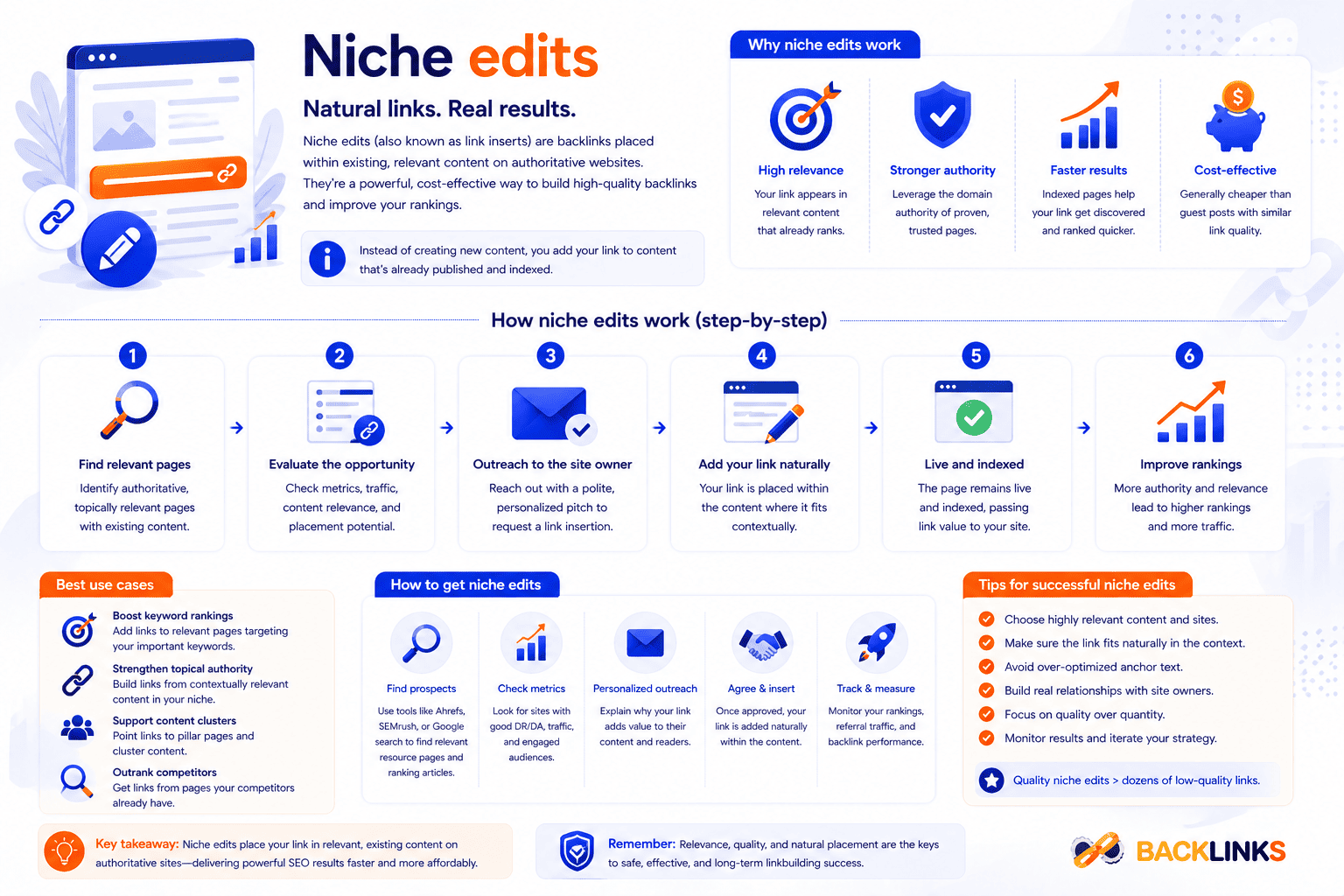
Niche Edits: How Contextual Link Insertions Work in Modern Linkbuilding
Linkbuilding strategies have evolved beyond traditional outreach and guest posting. As competition increases and content saturation grows, many SEO practitioners look for more efficient ways to acquire contextual backlinks.
One method that continues to gain attention is niche edits. It is often presented as a faster alternative to content-driven linkbuilding, but its effectiveness depends heavily on how it is implemented.
When misunderstood, niche edits can introduce risk or deliver limited value. When applied strategically, they can become a useful component within a broader linkbuilding system.
This article explains what niche edits are, how they work, and how to approach them with a focus on quality, relevance, and long-term SEO performance.
What Are Niche Edits
Niche edits refer to the practice of inserting backlinks into existing content on external websites, rather than creating new articles for link placement.
In practical terms, this involves:
- Identifying an already published page
- Adding a contextual link within the existing content
- Ensuring the link fits naturally within the topic
These are sometimes called contextual link insertions because the link is placed directly within relevant text, rather than in a newly created post.
Unlike guest posting, niche edits leverage content that is already indexed, often already ranking, and potentially already receiving traffic.
Why Niche Edits Matter
Faster Indexing and Impact
Because niche edits are placed on existing pages, they can be discovered and evaluated by search engines more quickly than links on newly published content.
If the page already has authority, the link may begin influencing rankings sooner.
Strong Contextual Relevance
When executed properly, niche edits are placed within content that is already topically aligned. This strengthens the relevance signal passed to the linked page.
This is particularly valuable in competitive niches where contextual signals matter as much as domain authority.
Efficiency Compared to Content Creation
Creating new content for every link can be resource-intensive. Niche edits reduce this burden by utilizing existing pages, making them a more efficient option in certain cases.
However, efficiency should not come at the expense of quality.
Complementary Role in Linkbuilding
Niche edits are rarely a complete solution. They are most effective when used alongside other strategies such as content-driven linkbuilding or outreach-based placements.
Within a structured content cluster, they can support key pages without requiring additional content production for each link.
How Niche Edits Work
The effectiveness of niche edits depends on a structured process rather than simple link placement.
Step 1: Identify Relevant Pages
The first step is finding pages that:
- Are topically aligned with your content
- Contain sections where a link could be added naturally
- Have some level of authority or traffic
Relevance is critical. A link inserted into loosely related content provides limited value.
Step 2: Evaluate Content Context
Before inserting a link, it is important to assess the surrounding content:
- Does the topic align closely with your target page?
- Is the content up to date and well maintained?
- Does the link add value to the reader?
The goal is to ensure the link feels like a natural part of the content, not an artificial addition.
Step 3: Insert the Link Naturally
The link should be integrated into existing text in a way that:
- Supports the flow of the content
- Uses appropriate anchor text
- Does not disrupt readability
Poorly placed links are easy to identify and may be ignored by both users and search engines.
Step 4: Maintain Anchor Text Balance
Anchor text should be varied and natural. Over-optimization is a common risk with niche edits, especially when multiple links are placed across similar pages.
A balanced approach includes:
- Brand mentions
- Partial keyword phrases
- Generic anchors
This aligns with natural linking patterns.
Important Subtopics in Niche Edits
Page Authority vs Page Relevance
A common mistake is prioritizing high-authority pages without considering relevance.
In many cases, a link from a moderately authoritative page within the same niche provides more value than a link from a high-authority but unrelated site.
Placement Quality
Not all placements are equal. Links placed within the main body of content are generally more valuable than those added to side sections or loosely related paragraphs.
The closer the link is to relevant context, the stronger its signal.
Relationship with Paid Backlinks
Niche edits are often associated with paid placements. While this can be the case, the distinction lies in execution.
A paid niche edit that is contextually relevant and editorially integrated may perform better than a poorly executed free link. However, patterns of paid placements must be managed carefully to avoid risk.
Integration with Content Strategy
Niche edits should support your broader content structure.
For example, links pointing to key pages within your SEO cluster—such as articles on linkbuilding cost or ROI—can help strengthen those pages without requiring additional content creation.
Common Mistakes
Ignoring Relevance
Placing links on unrelated pages reduces effectiveness and may weaken topical signals. Relevance should always take priority over metrics.
Overusing Exact-Match Anchors
Repeating the same keyword anchor across multiple niche edits creates unnatural patterns. This is one of the most common risks in this approach.
Choosing Low-Quality Pages
Links from poorly maintained or low-quality content provide little value and may contribute to a weaker backlink profile.
Treating Niche Edits as a Shortcut
Niche edits can be efficient, but they are not a substitute for a comprehensive linkbuilding strategy. Over-reliance can limit long-term growth.
Practical Guidance
Focus on Context First
Before evaluating metrics such as domain authority, assess whether the page is genuinely relevant to your topic. Context drives both value and sustainability.
Prioritize Editorial Fit
A good niche edit should feel like it belongs in the content. If the link appears forced, it is unlikely to deliver meaningful results.
Use as Part of a Balanced Strategy
Combine niche edits with other methods such as:
- Content-driven linkbuilding
- Linkbait content
- Outreach-based placements
This creates a more natural backlink profile and reduces dependency on a single method.
Monitor Link Performance
Track the impact of niche edits on:
- Rankings
- Traffic
- Page authority
This helps refine your approach and identify which types of placements deliver the most value.
Timing and Expectations
Niche edits can produce results relatively quickly compared to other linkbuilding methods, but expectations should remain realistic.
In most cases:
- Initial effects may appear within a few weeks
- Stronger impact depends on page authority and competition
- Long-term value depends on consistency and overall link profile quality
Short-term gains should be evaluated within the context of broader SEO performance.
Conclusion
Niche edits offer a practical way to acquire contextual backlinks without creating new content for each placement. Their effectiveness comes from leveraging existing authority and integrating links into relevant content.
However, the strategy requires discipline. Relevance, placement quality, and anchor diversity are critical factors that determine success.
When used thoughtfully, niche edits can complement a broader linkbuilding strategy and support key pages within a content cluster. When used carelessly, they can introduce risk or deliver minimal value.
The key is to treat niche edits as one component of a structured approach to SEO—focused on long-term authority rather than short-term efficiency.